




Tired of seeing “must be authorized to work in Canada” on every job listing? LMIA Approved Jobs in Canada change that. These positions come with official government approval, meaning employers are ready and willing to sponsor foreign workers like you. From skilled trades to healthcare to hospitality, this guide breaks down exactly what LMIA Approved Jobs in Canada are, where to find them, and how to land one. Ready to turn “authorized” into “approved”? Let’s get started.
Table Of Content
1What are LMIA Approved Jobs in Canada?2LMIA Approved Jobs in Canada3How to apply for LMIA Jobs in Canada4LMIA Approved Companies in Canada5Conclusion6Frequently Asked Questions
What are LMIA Approved Jobs in Canada?
LMIA-approved jobs are positions where a Canadian employer has obtained a positive Labour Market Impact Assessment (LMIA) confirming they are allowed to hire a foreign worker because no suitable Canadian or permanent resident is available for that role. In simple terms, it is a job offer backed by government approval that hiring you will not negatively affect Canada’s labour market.
Key Benefits of LMIA Approved Jobs for Foreign Workers
- Stronger work permit applications, because the LMIA shows the job and employer have already been vetted by the Canadian authorities.
- Clear legal status to work in Canada, since most closed work permits are issued based on LMIA-backed job offers.
- Better chances for permanent residence, as an LMIA-supported job offer can add CRS points in Express Entry and support provincial nominations.
- Higher employer commitment, because companies that invest time and fees in an LMIA are usually more serious about retaining and supporting foreign workers.
- Access to verified job postings, since many official portals and job boards allow you to filter specifically for LMIA-approved positions.
LMIA Approved Jobs in Canada
1. Registered Nurse
2. Software Developer
3. Early Childhood Educator
4. Transport Truck Driver
5. Mechanical Engineer
6. Home Support Worker/ Caregiver
7. Welder
8. Construction Electrician
9. Accounting Technicians and Bookkeepers
10. Cook
Here’s a detailed overview of each job role:
1. Registered Nurse
Registered nurses in Canada are commonly hired through LMIA approved jobs in Canada due to ongoing healthcare workforce shortages. Many LMIA jobs for foreigners outside Canada allow qualified international nurses to secure a Canadian work permit through an LMIA-supported job offer, subject to licensing and eligibility requirements.
| Factors | Details |
|---|---|
| LMIA Availability | Available in many provinces, especially in high-demand healthcare settings. |
| Why Employers Hire Through LMIA | To fill critical nursing shortages and support patient care across hospitals and care facilities. |
| NOC Code (correct NOC 2021 title and code) | NOC 31301 – Registered nurses and registered psychiatric nurses. |
| Required Qualifications | Nursing degree or diploma, registration with the provincial nursing regulator, and passing required licensing steps. |
| Eligibility Criteria | LMIA-backed offer, recognized nursing credentials, licensing eligibility, language proficiency, and work permit approval. |
| Industries Hiring | Hospitals, long-term care homes, clinics, community health centres, and home care services. |
| Average Salary (realistic annual CAD range) | CAD 65,000 to CAD 95,000 per year. |
2. Software Developer
Software developers are one of the highest paying jobs in Canada and are sometimes hired through LMIA approved jobs in Canada when employers cannot find enough qualified tech talent locally, especially for specialized programming, product, and systems roles. Companies recruit foreign workers to support digital transformation, product development, and software maintenance across sectors. A qualified candidate can apply for a Canadian work permit after securing a genuine LMIA-supported offer from a Canadian employer. This occupation is strong for skilled applicants because it aligns with Canada’s ongoing need for tech professionals.
| Factors | Details |
|---|---|
| LMIA Availability | Available, though competition is higher and employers usually seek experienced candidates. |
| Why Employers Hire Through LMIA | To fill technical skill gaps in software development, engineering, and product teams. |
| NOC Code (correct NOC 2021 title and code) | NOC 21232 – Software developers and programmers. |
| Required Qualifications | Degree or diploma in computer science or related field, programming experience, and portfolio or project experience. |
| Eligibility Criteria | LMIA-backed offer, technical competence, relevant experience, and work permit eligibility. |
| Industries Hiring | IT services, fintech, startups, telecom, healthcare tech, and enterprise software firms. |
| Average Salary (realistic annual CAD range) | CAD 75,000 to CAD 120,000 per year. |
3. Early Childhood Educator
Early childhood educators are commonly hired through LMIA approved jobs in Canada because childcare demand has grown sharply and many centres struggle to recruit enough qualified staff. Employers recruit foreign workers to support daycare operations, preschool programs, and licensed childcare facilities when local staffing is insufficient. A qualified candidate can apply for a Canadian work permit through an LMIA-supported job offer, especially if they meet provincial certification or recognition requirements. This role is important because childcare shortages affect working families and community services.
| Factors | Details |
|---|---|
| LMIA Availability | Strong in provinces with childcare shortages and growing family populations. |
| Why Employers Hire Through LMIA | To fill staffing gaps in daycare and preschool settings and maintain ratio requirements. |
| NOC Code (correct NOC 2021 title and code) | NOC 42202 – Early childhood educators and assistants. |
| Required Qualifications | Early childhood education diploma or certificate; provincial registration may be required. |
| Eligibility Criteria | LMIA-backed offer, childcare qualifications, background checks, and work permit eligibility. |
| Industries Hiring | Daycares, preschools, child development centres, before/after-school programs, and family support centres. |
| Average Salary (realistic annual CAD range) | CAD 35,000 to CAD 55,000 per year. |
4. Transport Truck Driver
Transport truck drivers are commonly hired through LMIA approved jobs in Canada because freight, logistics, and long-haul transportation companies continue to face driver shortages across provinces. Employers recruit foreign workers when local supply is not enough to meet delivery schedules, especially for regional and cross-country routes. A qualified candidate can apply for a Canadian work permit after receiving a genuine LMIA-supported job offer from a Canadian employer, which confirms the role was approved for foreign hiring. This pathway is especially common in provinces with strong transport and warehousing demand.
| Factors | Details |
|---|---|
| LMIA Availability | High, especially in logistics hubs, freight corridors, and provinces with ongoing driver shortages. |
| Why Employers Hire Through LMIA | To fill urgent vacancies for long-haul, regional, and specialized transport roles when Canadian drivers are unavailable. |
| NOC Code (correct NOC 2021 title and code) | NOC 73300 – Transport truck drivers. |
| Required Qualifications | Class 1/A commercial driving licence, clean driving record, secondary school education, and relevant experience or training. |
| Eligibility Criteria | Valid job offer, LMIA approval, medical admissibility, driving fitness, and ability to meet provincial licensing requirements. |
| Industries Hiring | Freight transport, logistics, warehousing, distribution, food supply, retail delivery, and moving services. |
| Average Salary (realistic annual CAD range) | CAD 50,000 to CAD 75,000 per year. |
5. Mechanical Engineers
Mechanical engineers are commonly hired through LMIA approved jobs in Canada because industries such as manufacturing, energy, construction, and industrial equipment depend on skilled engineering professionals. Employers recruit foreign workers when they need candidates with specialized design, maintenance, production, or project engineering experience that is difficult to source locally. A qualified candidate can apply for a Canadian work permit through an LMIA-supported job offer, provided the employer has approval to hire a foreign worker. This occupation is highly relevant for skilled professionals seeking strong salary prospects and long-term career growth in Canada.
| Factors | Details |
|---|---|
| LMIA Availability | Available, particularly in manufacturing, energy, industrial services, and engineering consulting sectors. |
| Why Employers Hire Through LMIA | To address shortages of experienced engineers for design, maintenance, production, and project work. |
| NOC Code (correct NOC 2021 title and code) | NOC 21301 – Mechanical engineers. |
| Required Qualifications | Bachelor’s degree in mechanical engineering, engineering credentials, and licensure or eligibility for licensure in Canada. |
| Eligibility Criteria | LMIA-backed offer, relevant engineering experience, professional recognition, and work permit eligibility. |
| Industries Hiring | Manufacturing, automotive, oil and gas, HVAC, construction, industrial equipment, and engineering consulting. |
| Average Salary (realistic annual CAD range) | CAD 70,000 to CAD 110,000 per year. |
6. Home Support Worker
Home support workers are often hired through LMIA approved jobs in Canada because the country has a growing need for care workers to assist seniors, persons with disabilities, and individuals recovering at home. Employers recruit foreign workers when local caregivers are insufficient to meet rising demand in private households and care agencies. A qualified candidate can apply for a Canadian work permit once they receive a genuine LMIA-supported job offer from a Canadian employer. This role is important in both urban and rural areas due to Canada’s ageing population.
| Factors | Details |
|---|---|
| LMIA Availability | High in home care and elder care markets across Canada. |
| Why Employers Hire Through LMIA | To address shortages in personal care and in-home assistance services. |
| NOC Code (correct NOC 2021 title and code) | NOC 44101 – Home support workers, caregivers and related occupations. |
| Required Qualifications | Secondary school education, caregiving experience, first aid or CPR training, and sometimes a caregiving certificate. |
| Eligibility Criteria | LMIA-backed job offer, caregiving ability, clear background checks, and work permit eligibility. |
| Industries Hiring | Private homes, home care agencies, retirement residences, and disability support services. |
| Average Salary (realistic annual CAD range) | CAD 30,000 to CAD 45,000 per year. |
7. Welder
Welders are commonly hired through LMIA approved jobs in Canada because manufacturing, construction, shipbuilding, and fabrication companies need skilled trades workers to meet production and infrastructure demands. Employers recruit foreign workers when they cannot find enough trained welders locally, especially for specialized welding positions. A qualified candidate can apply for a Canadian work permit with an LMIA-supported job offer from a hiring employer. This occupation remains important because welding is essential across heavy industry, repair, and construction projects.
| Factors | Details |
|---|---|
| LMIA Availability | Strong in industrial provinces and regions with manufacturing or construction activity. |
| Why Employers Hire Through LMIA | To fill skilled trades shortages and support fabrication, repair, and structural work. |
| NOC Code (correct NOC 2021 title and code) | NOC 72106 – Welders and related machine operators. |
| Required Qualifications | High school completion, welding certificate or apprenticeship, and hands-on experience. |
| Eligibility Criteria | LMIA-backed offer, welding competency, safety compliance, and work permit eligibility. |
| Industries Hiring | Manufacturing, construction, oil and gas, shipbuilding, metal fabrication, and repair shops. |
| Average Salary (realistic annual CAD range) | CAD 50,000 to CAD 80,000 per year. |
8. Construction Electrician
Construction electricians are frequently hired through LMIA approved jobs in Canada because housing projects, commercial builds, and infrastructure work require trained electrical tradespeople. Employers recruit foreign workers when they cannot fully staff projects with local trades labour, especially in fast-growing cities and provinces with large construction pipelines. A qualified candidate can apply for a Canadian work permit through an LMIA-supported job offer, provided they meet trade and licensing requirements. This is one of the most stable skilled trade pathways for foreign workers.
| Factors | Details |
|---|---|
| LMIA Availability | High in construction-heavy provinces and cities with active development projects. |
| Why Employers Hire Through LMIA | To address shortages in licensed and experienced electrical trades workers. |
| NOC Code (correct NOC 2021 title and code) | NOC 72200 – Electricians (except industrial and power system). |
| Required Qualifications | Trade certification, apprenticeship training, and provincial licensing requirements where applicable. |
| Eligibility Criteria | LMIA-backed offer, trade skills, safety training, and work permit eligibility. |
| Industries Hiring | Residential construction, commercial construction, maintenance, contracting, and infrastructure projects. |
| Average Salary (realistic annual CAD range) | CAD 60,000 to CAD 90,000 per year. |
9. Accounting Technicians and Bookkeepers
Accounting technicians and bookkeepers are commonly hired through LMIA approved jobs in Canada because small businesses, accounting firms, and growing companies need reliable financial record-keeping support. Employers recruit foreign workers when they cannot find enough qualified local candidates with bookkeeping, payroll, and basic accounting experience. A qualified applicant can apply for a Canadian work permit through an LMIA-supported job offer from an approved employer. This role is especially relevant for foreign workers with accounting training, practical software skills, and experience in day-to-day financial administration.
| Factors | Details |
|---|---|
| LMIA Availability | Available across Canada, especially in small businesses, accounting firms, retail companies, and service-sector employers. |
| Why Employers Hire Through LMIA | To fill shortages in bookkeeping, payroll support, and financial record management roles. |
| NOC Code (correct NOC 2021 title and code) | NOC 12200 – Accounting technicians and bookkeepers. |
| Required Qualifications | Diploma or certificate in accounting or bookkeeping, knowledge of accounting software, and relevant experience. |
| Eligibility Criteria | LMIA-backed job offer, basic accounting competence, attention to detail, and work permit eligibility. |
| Industries Hiring | Accounting firms, small and medium businesses, construction, retail, logistics, healthcare, and professional services. |
| Average Salary (realistic annual CAD range) | CAD 40,000 to CAD 60,000 per year. |
10. Cook
Cooks are frequently hired through LMIA approved jobs in Canada because food service employers continue to face shortages of skilled kitchen staff. Employers recruit foreign workers to fill positions in restaurants, hotels, cafeterias, and institutional kitchens where dependable staff are needed for daily operations. A qualified candidate can apply for a Canadian work permit through an LMIA-supported offer once the employer has been approved to hire a foreign worker. This occupation is often in demand because the hospitality sector depends on steady, experienced kitchen labour.
| Factors | Details |
|---|---|
| LMIA Availability | High in urban food service markets, tourist areas, and remote communities. |
| Why Employers Hire Through LMIA | To address labour shortages in kitchens and maintain consistent food preparation services. |
| NOC Code (correct NOC 2021 title and code) | NOC 63200 – Cooks. |
| Required Qualifications | Secondary school completion, cooking experience, and sometimes a culinary certificate or apprenticeship. |
| Eligibility Criteria | LMIA-backed job offer, practical cooking ability, workplace readiness, and work permit eligibility. |
| Industries Hiring | Restaurants, hotels, resorts, catering companies, hospitals, schools, and long-term care homes. |
| Average Salary (realistic annual CAD range) | CAD 32,000 to CAD 52,000 per year. |
How to apply for LMIA Jobs in Canada
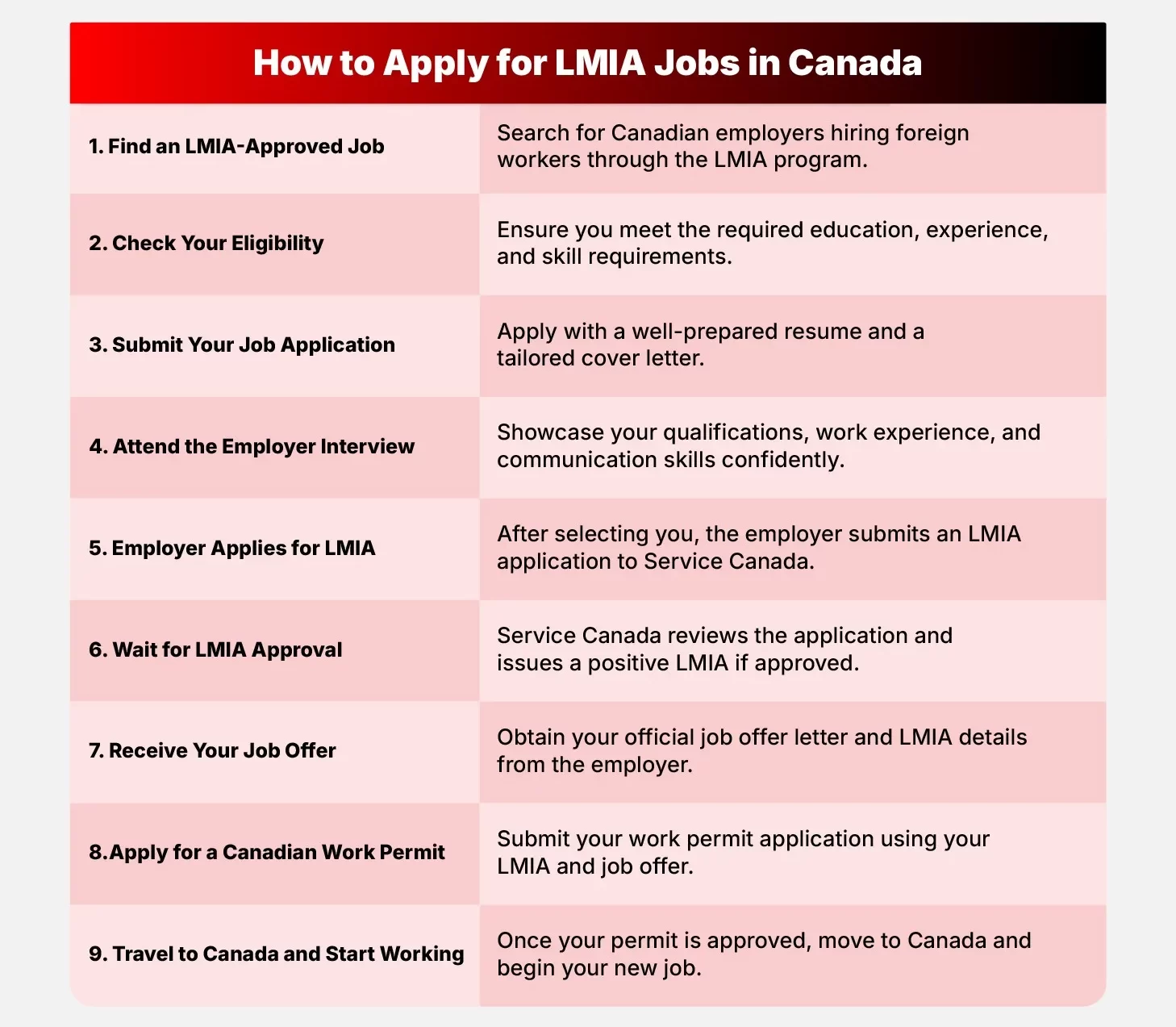
Here is the step-by-step process to apply for LMIA jobs in Canada:
Step 1: Find an LMIA-supported Job Offer
Start by searching for employers who are already approved or willing to apply for LMIA so they can hire a foreign worker for a specific job. Official Canadian job resources and employer job boards are commonly used for this step.
Step 2: Check the Job Requirements Carefully
Make sure your education, experience, licensing, and language ability match the role, because the employer will usually want a candidate who is job-ready and can start quickly. For skilled roles, this may include certificates, trade licensing, or professional recognition.
Step 3: Apply with a Canadian-style Resume and Cover Letter
Tailor your application to the job title, responsibilities, and NOC-level duties. Employers in Canada usually prefer clear, concise applications that show direct experience relevant to the vacancy.
Step 4: Attend Interviews with the Employer
If shortlisted, be prepared to explain your work history, availability, and ability to meet the job’s requirements. Employers often use interviews to confirm that you can perform the duties and adapt to the workplace.
Step 5: Employer applies for LMIA
If the employer wants to hire you, they submit the LMIA application to Service Canada through the LMIA Online Portal and include supporting documents such as recruitment records, business legitimacy documents, and job details.
Step 6: Wait for the LMIA Decision
Service Canada reviews whether hiring a foreign worker is justified and whether the employer met recruitment and program requirements. A positive LMIA means the employer can proceed with hiring you for that position.
Step 7: Receive the Job Offer and LMIA Details
Once the employer gets a positive LMIA, they provide you with the job offer and the LMIA reference or confirmation details needed for your work permit application.
Step 8: Apply for your Canadian Work Permit
Use the LMIA-backed job offer to apply for a work permit through the proper immigration channel. Your application should include your employment documents, passport, qualifications, and any additional forms or biometric requirements.
Step 9: Prepare for Travel and Start Work after Approval
When the work permit is approved, you can travel to Canada and begin working for the employer named in your permit. In most LMIA-based cases, the permit is employer-specific, so you must work only in the approved job.
LMIA Approved Companies in Canada
- Saskatchewan Health Authority
- Cargill
- Groupe ACE
- La Fédération de l’UPA de Lanaudière
- Tim Hortons
- Walmart Canada
- McDonald’s Canada
- Maple Leaf Foods
- JBS Food Canada
- Saputo Inc.
LMIA-approved companies are Canadian employers that have either already obtained or regularly apply for government permission to hire foreign workers. These employers are typically in industries with ongoing labour shortages, such as healthcare, agriculture, food processing, retail, hospitality, logistics, and skilled trades. A positive LMIA does not mean every job at the company is eligible, so candidates still need to check the specific role. For job seekers, these companies are important because they often have a history of sponsoring foreign workers for work permits.
Conclusion
In conclusion, LMIA-approved jobs remain one of the most practical pathways for foreign workers seeking in-demand jobs in Canada because they connect genuine labour shortages with qualified international talent. To improve your chances, target employers with real hiring needs, match your skills to suitable occupations, and submit a strong resume with complete documents. To explore verified job opportunities, use Job Bank Canada, the official job portal for Canadian employers and job seekers.



Thank God for everything
Hi Ifeanyi,
Thank you for taking the time to share your feedback about our blog.
Thank you for your all very useful information for LMIA for foreign worker
Hi Mita,
You’re very welcome! We’re glad you found the information on LMIA for foreign workers helpful. If you’d like to explore more about Canada immigration, work permits, PR pathways and the latest updates, feel free to read more of our blogs on the CanApprove website. Wishing you the very best with your immigration journey!
Thank you so much for this information… I want to ask for procedures of LMIA work for Canada from beginning to the end. After LMIA documents has been issued, what else again will be done?
I will appreciate your response
Thanks
Hi Joseph,
Thank you for your question. Once an employer obtains a positive LMIA, the process generally continues with the worker applying for a Canadian work permit using the LMIA and other required documents. Depending on the job and applicant’s circumstances, additional steps may include submitting biometrics, completing a medical examination if required, and providing supporting documents. If the work permit is approved, the applicant can travel to Canada and begin work according to the conditions of the permit.
The exact process and requirements can vary by job, employer and applicant profile.