


CANADA PR

Canada PR
Canada is known for its immigrant-friendly policies and one of the most sophisticated immigration systems in the world. This makes it a top destination for people looking to build a new life abroad. Every year, hundreds of thousands of people apply for Canada PR. With more than 100 immigration pathways available, there is a route suited to most profiles. Once you become a permanent resident, Canadian citizenship is only a few steps away.
What is PR in Canada?
Canada PR (Permanent Residency) allows foreign nationals to live, work, and study anywhere in Canada permanently. PR holders receive many benefits similar to Canadian citizens, including access to healthcare, education, and social benefits.
With a Canada PR Visa, you can:
- Live and work anywhere in Canada
- Bring your spouse and dependent children
- Access free healthcare and public education
- Apply for Canadian citizenship after eligibility
- Enjoy a high quality of life and career growth
Immigration Programs to Get a Canada PR Visa
Canada offers multiple immigration pathways for skilled workers, students, entrepreneurs, and families who wish to become permanent residents. Depending on your qualifications, work experience, language proficiency, and long-term goals, you may qualify under one or more Canada PR programs.
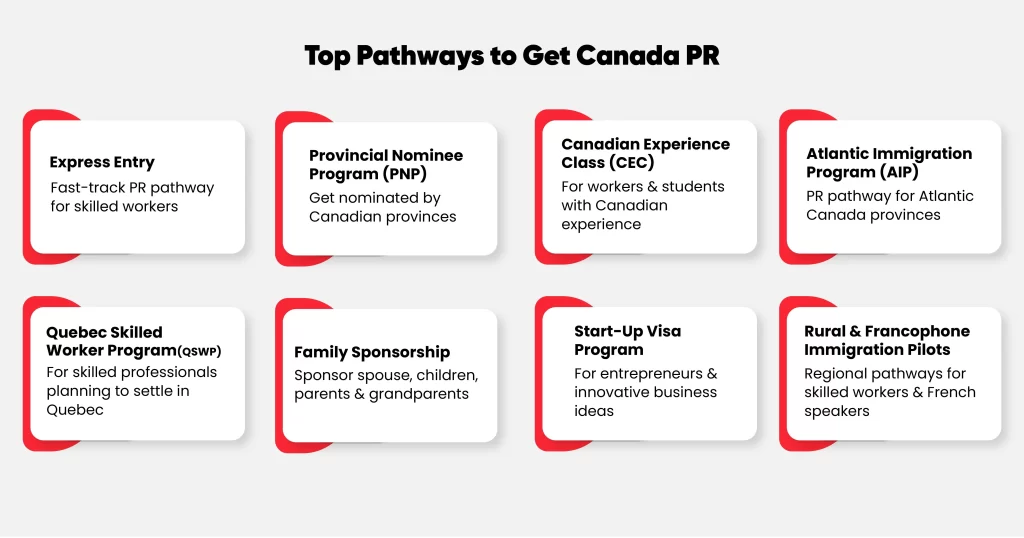
Here are the major immigration programs to get a Canada PR Visa:
1. Express Entry Program
The Express Entry system is the most popular and fastest pathway for skilled workers to obtain Canada PR. It manages applications for three federal economic immigration programs:
- Federal Skilled Worker Program (FSWP)
- Federal Skilled Trades Program (FSTP)
- Canadian Experience Class (CEC)
Candidates are ranked using the Comprehensive Ranking System (CRS), which considers factors such as age, education, work experience, and language proficiency.
Best for:
- Skilled professionals
- IT professionals
- Engineers
- Healthcare workers
International graduates with Canadian experience
2. Provincial Nominee Program (PNP)
The Provincial Nominee Program allows Canadian provinces and territories to nominate candidates based on local labour market needs.
Each province has its own immigration streams targeting specific occupations and skill shortages.
Popular PNPs include:
- Ontario Immigrant Nominee Program (OINP)
- British Columbia PNP (BC PNP)
- Alberta Advantage Immigration Program (AAIP)
- Saskatchewan Immigrant Nominee Program (SINP)
A provincial nomination through Express Entry adds 600 CRS points, significantly improving your chances of receiving an Invitation to Apply (ITA).
3. Canadian Experience Class (CEC)
The Canadian Experience Class is designed for individuals who already have skilled work experience in Canada.
Applicants must usually have:
- At least one year of skilled Canadian work experience
- Valid language test results
- Eligible work experience under TEER categories
Best for:
- International students in Canada
- Temporary foreign workers
- Post-Graduation Work Permit holders
4. Atlantic Immigration Program (AIP)
The Atlantic Immigration Program helps skilled workers and international graduates settle in Canada’s Atlantic provinces:
- Nova Scotia
- New Brunswick
- Newfoundland and Labrador
- Prince Edward Island
Applicants generally require a valid job offer from a designated employer in Atlantic Canada.
Best for:
- Skilled workers with job offers
- International graduates from Atlantic institutions
5. Quebec Skilled Worker Program (QSWP)
Quebec has its own immigration selection system separate from Express Entry.
Applicants are selected based on factors such as:
- Education
- Work experience
- Language skills
- Adaptability
French language proficiency can improve your chances under Quebec immigration programs.
Best for:
- French-speaking applicants
- Skilled professionals planning to settle in Quebec
6. Family Sponsorship Program
Canadian citizens and permanent residents can sponsor eligible family members for permanent residency.
Eligible family members may include:
- Spouse or common-law partner
- Dependent children
- Parents and grandparents
Best for:
- Families seeking reunification in Canada
7. Start-Up Visa Program
The Start-Up Visa Program is designed for entrepreneurs with innovative business ideas that can create jobs in Canada.
Applicants must:
- Secure support from a designated organization
- Meet language requirements
- Have sufficient settlement funds
Best for:
- Entrepreneurs
- Startup founders
- Innovative business owners
8. Rural and Francophone Community Immigration Pilots
Canada also offers community-driven immigration pathways for skilled workers willing to settle in smaller communities and French-speaking regions outside Quebec.
These programs help address labour shortages in participating communities.
Best for:
- Skilled workers seeking regional immigration opportunities
- French-speaking candidates
NOTE : For most skilled professionals in India, Express Entry and Provincial Nominee Programs are the most common and effective routes to Canada PR.
How to Apply for Canada PR from India?
Canada Permanent Residency (PR) is one of the most popular immigration pathways for skilled professionals, students, and families looking to build a future abroad. Canada offers multiple immigration programs, including Express Entry and Provincial Nominee Programs (PNPs), making it possible for eligible applicants to obtain permanent resident status and settle in Canada legally.
Here is the step-by-step process to apply for Canada PR from India:
Step 1: Determine Your Eligibility
Research available immigration programs such as Express Entry, Provincial Nominee Program (PNP), and Family Sponsorship to find the best fit for your profile.
Use the Comprehensive Ranking System (CRS) Calculator to estimate your score and assess your eligibility before proceeding.
Step 2: Gather Your Documents
Ensure your passport is valid for the duration of your application.
Complete an approved language test:
- IELTS General Training or PTE Core for English
- TEF Canada for French
Get your Educational Credential Assessment (ECA) completed through an IRCC-approved organization such as WES, IQAS, or PEBC, depending on your profession and educational background.
Step 3: Create Your Express Entry Profile
Create an online profile through the IRCC portal and provide details regarding:
- Age
- Education
- Work experience
- Language test scores
- Marital status
Based on the information submitted, you will receive a CRS score. A higher CRS score improves your chances of receiving an Invitation to Apply (ITA).
Step 4: Explore Provincial Nominee Programs (Optional)
Check whether any Provincial Nominee Program (PNP) stream matches your occupation, skills, or work experience.
You can either apply directly through a province’s immigration portal or express interest through your Express Entry profile, depending on the specific PNP stream.
A provincial nomination adds 600 CRS points, significantly improving your chances of receiving an ITA.
Step 5: Receive an Invitation to Apply (ITA)
IRCC conducts Express Entry draws regularly and may target specific categories such as:
- Healthcare occupations
- STEM professions
- Trade occupations
- French-speaking candidates
If your CRS score meets or exceeds the draw cut-off score, you will receive an Invitation to Apply (ITA) for Canada PR.
Step 6: Submit Your PR Application
After receiving an ITA, you must submit your complete PR application through the IRCC portal within 60 days.
You must also pay the required government fees and upload supporting documents, including:
- Proof of funds
- Employment records
- Educational certificates
- Passport copies
- Language test results
Step 7: Complete Medical and Security Checks
Complete a medical examination with an IRCC-approved panel physician.
You must also submit police clearance certificates from every country where you have lived for six months or more since turning 18 years old.
Step 8: Wait for a Decision
IRCC generally processes Express Entry applications within approximately six months, although processing times may vary depending on application volume and verification requirements.
If your application is approved, you will receive:
- Confirmation of Permanent Residence (COPR)</li
- PR Visa (if applicable)
Step 9: Land in Canada
Travel to Canada before your COPR expiry date to officially activate your permanent resident status.
At the port of entry, a border services officer will verify your documents and confirm your permanent residency. Your Permanent Resident (PR) card will then be issued.
Canada PR Application Fee 2026
The following fees apply to economic immigration programs in Canada, including:
- Express Entry
- Atlantic Immigration Program
- Canadian Experience Class (CEC)
- Federal Skilled Worker Program (FSWP)
- Federal Skilled Trades Program (FSTP)
- Provincial Nominee Program (PNP)
- Rural and Francophone Community Immigration Pilots
- Quebec-Selected Skilled Workers
Here’s the current Canada PR application fee breakdown:
| Application Type | Canada PR Fees (CAD) |
|---|---|
| Principal Applicant (including Right of Permanent Residence Fee) | CAD 1,590 |
| Principal Applicant (without Right of Permanent Residence Fee) | CAD 990 |
| Spouse or Common-Law Partner (including Right of Permanent Residence Fee) | CAD 1,590 |
| Spouse or Common-Law Partner (without Right of Permanent Residence Fee) | CAD 990 |
| Dependent Child | CAD 270 per child |
Note: These fees were increased on April 30, 2026.
Canada PR Processing Time For Indians
The processing time for a Canada PR Visa depends on the immigration program you apply through, the completeness of your application, background verification, and IRCC application volumes.
| Immigration Program | Estimated Processing Time |
|---|---|
| Express Entry | 6–8 months |
| PNP via Express Entry | Around 7–9 months |
| Non-Express Entry PNP | 12–14 months |
| Quebec Skilled Worker Program | Around 8–11 months |
| Family Sponsorship | Around 12 months |
Several factors can impact your Canada PR processing timeline, including:
- Incomplete documentation
- Delays in medical examinations
- Background and security checks
- Verification of employment or education records
- High application volumes at IRCC
- Additional document requests from immigration officers
Being a Permanent Resident in Canada
Once a person obtains permanent residence, they may apply for a Canada PR card. This card is required to re-enter Canada on a commercial flight or vehicle. The PR card is valid for five years and should be renewed before it expires to avoid any travel disruptions. To retain permanent resident status, a person must have lived in Canada for at least 730 days within any five-year period.
Those who were granted Canada PR but are currently residing outside Canada may apply for a Permanent Resident Travel Document (PRTD). This document allows them to travel to Canada, after which they can apply for their PR card.
Frequently Asked Questions


Canada Visa Rejection: Common Reasons and How to Avoid Them
Canada Visa Rejection can happen for many reasons including incomplete documents, no proof of funds, wrong information, or not meeting…

High Demand for Chefs in Australia
Australia continues to offer opportunities for qualified chefs, supported by demand across restaurants, hotels, catering businesses, resorts and regional hospitality…

Civil Engineering Jobs in Germany with Salaries (2026)
Civil engineering jobs in Germany are in high demand in 2026, driven by ageing infrastructure, housing shortages and large public…

How to Get Nursing Jobs in Australia in 2026: Complete Guide
How to get Nursing Jobs in Australia is a very important question for internationally qualified nurses looking to build a…

Demand for Medical Laboratory Technician Jobs in Canada
Medical Laboratory Technician jobs in Canada are available across the healthcare sector, but employment prospects vary by province and territory.…