




The demand for veterinarians in Canada is strong and growing. Clinics in rural and urban areas struggle to fill positions, and pet ownership, livestock health and public health all rely on qualified vets. For international graduates, especially from India, this creates a real opportunity. It comes with a licensing process you need to understand before you apply.
This guide covers Canadian veterinary job prospects, the NOC code, job types, requirements, salary, visa sponsorship and the steps to become a vet in Canada.
Table Of Content
1Are Veterinarians in Demand in Canada?2NOC Code for Veterinarians in Canada3Types of Veterinary Jobs in Canada4Veterinarian Requirements in Canada5Veterinary Jobs in Canada for Indians/a>6Veterinary Jobs in Canada with Visa Sponsorship7Veterinarian Salary in Canada8How to Get a Veterinary Job in Canada from India9Conclusion10Frequently Asked Questions
Are Veterinarians in Demand in Canada?
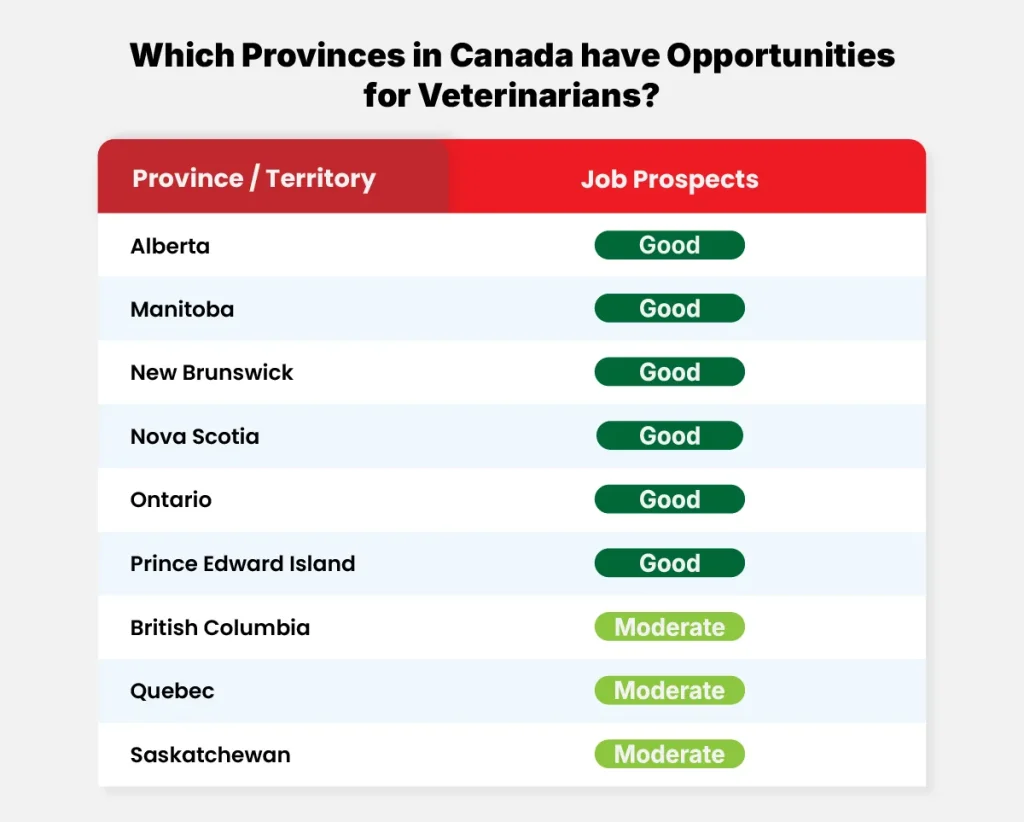
Yes. Canada’s national job-market data shows a labour shortage in several regions. For example, Job Bank classed Saskatoon as having a major labour shortage for veterinarians in recent years. A 2026 Government of Canada release cited in an Alberta licensing guide noted that Alberta’s veterinarian vacancy rate was almost 17 per cent overall and nearly 19 per cent in rural areas.
Outlooks vary by city. Job Bank rates the employment outlook for veterinarians in the Toronto region as Good for 2025–2027, and Windsor–Sarnia carries the same rating. Earlier national forecasts also pointed to a gap: Job Bank projected a further shortfall of about 700 veterinarians over the 2022–2031 period.
Why demand keeps rising:
- More Canadians own pets and spend more on their care.
- Rural and food-animal practices struggle to recruit.
- Many practitioners are retiring or leaving the profession.
- Public health, food safety and research roles keep expanding.
NOTE : Demand is not equal everywhere. Rural and remote communities usually offer the most openings and the strongest incentives, while big-city markets are more competitive.
NOC Code for Veterinarians in Canada
Under Canada’s National Occupational Classification (NOC), veterinarians fall under NOC 31103. Immigration programs, Job Bank searches and employer job postings use this code.
An important development for veterinarians is their inclusion in Canada’s new Express Entry High-Wage Occupations List, effective November 3, 2026.
Under this update, veterinarians are classified under NOC 31103, TEER 1, and appear in the highest high-wage category, where the occupational median wage is at least twice the overall Canadian workforce median.
This makes veterinary professionals an occupation to watch under Canada’s updated Express Entry framework.
Veterinarians prevent, diagnose and treat animal diseases and disorders, advise clients on animal care, and perform surgery. They work in private practice, clinics, farms, laboratories, government and industry.
Use NOC 31103 when you:
- Search for veterinary jobs in Canada on the Job Bank.
- Check eligibility for Express Entry or provincial nominee programs.
- Read job postings and Labour Market Impact Assessment (LMIA) listings.
Types of Veterinary Jobs in Canada
Veterinary jobs in Canada cover far more than small-animal clinics:
Companion animal (small animal) veterinarian: Dogs, cats and exotic pets in urban and suburban clinics.
Large animal and food animal veterinarian: Cattle, swine, poultry and horses, mostly in rural areas.
Mixed practice veterinarian: Both small and large animals, common in smaller communities.
Emergency and specialty veterinarian: Surgery, internal medicine, oncology and other specialties after further training.
Government and public health veterinarian: Food inspection, disease surveillance and regulatory work.
Research and academic veterinarian: Universities, laboratories and pharmaceutical companies.
Locum veterinarian: Short-term cover for clinics, which can be useful while you complete licensing.
Veterinarian Requirements in Canada
To practise as a veterinarian in Canada, candidates must meet the educational, professional competency and licensing requirements established by the relevant provincial regulatory authority.
Having a veterinary degree from India or another country does not automatically authorise someone to practise veterinary medicine in Canada.
Here are the major requirements involved in becoming a licensed veterinarian.
Educational Qualifications
Candidates generally need a recognised Doctor of Veterinary Medicine (DVM) or equivalent veterinary degree from an eligible institution.
Canadian veterinary licensing authorities distinguish between graduates of veterinary schools accredited by the AVMA/CVMA Council on Education and those from non-accredited institutions.
International graduates must have their educational credentials assessed through the appropriate process.
National Examining Board (NEB) Assessment
The National Examining Board (NEB), administered by the Canadian Veterinary Medical Association (CVMA), evaluates the qualifications and professional competency of veterinary graduates.
Graduates from non-accredited veterinary schools generally need to complete the applicable NEB certification pathway to obtain a Certificate of Qualification (CQ).
The regular examination pathway includes assessments such as:
- Basic and Clinical Sciences Examination (BCSE): Evaluates foundational veterinary knowledge.
- North American Veterinary Licensing Examination (NAVLE): Assesses the clinical knowledge and competencies required for veterinary practice.
- Clinical Proficiency Examination (CPE): Evaluates practical clinical skills.
The applicable examination sequence and alternative certification pathways can depend on the candidate’s educational background and current NEB rules. Candidates should verify the latest requirements directly with the NEB before registering.
Provincial Veterinary Licensing
Once the necessary certification requirements are completed, candidates must apply for registration with the veterinary regulatory body in the province where they intend to work.
For example:
- Ontario: College of Veterinarians of Ontario (CVO).
- Alberta: Alberta Veterinary Medical Association (ABVMA).
- British Columbia: College of Veterinarians of British Columbia (CVBC).
- Manitoba: Manitoba Veterinary Medical Association (MVMA).
Provincial authorities may have additional requirements, including professional documentation, registration fees, language proficiency and jurisprudence examinations.
A Certificate of Qualification from the NEB provides eligibility to apply for provincial licensure, but it does not automatically grant a licence to practise.
Language Proficiency
Veterinarians must be able to communicate effectively with animal owners, colleagues and other healthcare professionals.
Depending on the licensing pathway and province, candidates may need to demonstrate English or French language proficiency. The specific accepted tests and minimum scores should be confirmed with the relevant regulatory authority.
Professional Experience
Although experience requirements vary by position and employer, practical experience in clinical practice, animal treatment, surgery and disease diagnosis can strengthen a candidate’s employment profile.
Can Indian veterinarians practise in Canada without a licence?
Generally, no. Individuals must hold the appropriate provincial registration to practise veterinary medicine within the regulated scope of practice. Some limited or supervised registration categories may be available, depending on the province and eligibility criteria.
Veterinary Jobs in Canada for Indians
Indian veterinarians are eligible to work in Canada, but you must clear the licensing process first to practise as a veterinarian. Most Indian BVSc & AH degrees are not from AVMA/CVMA-accredited programs, so you will typically follow the non-accredited (NEB or PAVE) pathway above.
Is an Indian veterinary degree valid in Canada?
It is recognised as a starting qualification, but it does not give you the right to practise on its own. You need credential assessment, exams and provincial registration.
Good news:
You may begin the credential assessment process and take the BCSE and NAVLE before arriving in Canada, at least in some provinces. That means much of the groundwork can be done from India.
Indian veterinarians can explore immigration options such as:
- Federal Skilled Worker Program (FSWP): For eligible skilled professionals with qualifying foreign work experience.
- Provincial Nominee Programs (PNPs): For candidates who meet the requirements of participating provinces.
- Canadian Experience Class (CEC): For eligible candidates with qualifying Canadian work experience.
Important: Inclusion in the High-Wage Occupations List is not the same as inclusion in an occupation-based category draw. Candidates must independently satisfy the eligibility requirements of an Express Entry programme and applicable selection criteria.
Veterinary Jobs in Canada with Visa Sponsorship
Veterinarian jobs in Canada with visa sponsorship do exist, especially in under-served regions. The main routes are:
Employer-sponsored work permit (LMIA): An employer proves it could not find a Canadian or permanent resident for the role. Rural clinics often use this route.
Provincial Nominee Programs (PNPs): Several provinces nominate occupations in demand, and rural provinces actively recruit veterinarians.
Express Entry: Veterinarians (NOC 31103) can qualify through the Federal Skilled Worker or Canadian Experience Class streams based on CRS points. Categories and draws change often, so check IRCC for current occupation-based draws.
Rural and community immigration pilots: Some small communities offer supported pathways.
Important: An employer may sponsor you, but you still need to meet the regulator’s licensing rules. Some employers will hire you as an unlicensed candidate in a supported role while you complete exams, but this varies. Be cautious of agents who promise guaranteed visas or jobs. Always verify employers through official channels.
Veterinarian Salary in Canada
The median veterinarian salary in Canada is about $60 per hour, which works out to roughly $125,000 a year for full-time hours (40 hours a week, my estimate). The typical range is about $34 to $84 per hour, depending on province, practice type and experience.
Job Bank’s wage data for NOC 31103 (updated November 2025) puts the national low at $34.15, the median at $60.00 and the high at $84.13 per hour.
| Province | Low ($/hr) | Median ($/hr) | High ($/hr) |
|---|---|---|---|
| Canada | 34.15 | 60.00 | 84.13 |
| Alberta | 40.75 | 62.50 | 88.94 |
| British Columbia | 35.58 | 60.00 | 86.54 |
| Ontario | 29.81 | 60.00 | 86.54 |
| Quebec | 25.00 | 64.10 | 70.00 |
| Manitoba | 38.46 | 50.48 | 72.12 |
| Saskatchewan | 38.65 | 52.88 | 65.00 |
Source: Job Bank wage data for NOC 31103.
Benefits matter too. About 78% of workers in this occupation receive at least one non-wage benefit. Many rural employers add signing bonuses, relocation help or student-loan support.
Do vets get paid well in Canada? Yes. Pay is strong compared with most occupations, though new graduates, long hours and emotionally demanding work are part of the picture.
How to Get a Veterinary Job in Canada from India
Follow these steps to start your journey:
1. Confirm your pathway. Check whether your degree is accredited, then contact the provincial regulator where you plan to live.
2. Start credential assessment. Register with the CVMA National Examining Board or the AAVSB-PAVE program, as your regulator allows.
3. Prepare for the BCSE and NAVLE. Plan 12 to 18 months of study. The exams can often be taken before you move.
4. Improve your English or French. Take IELTS or CELPIP if required.
5. Choose your immigration route. Compare Express Entry, PNPs and employer-sponsored work permits.
6. Build your Canadian-ready profile. Update your CV to Canadian format and highlight clinical experience, surgery and species exposure.
7. Search for jobs. Use Job Bank, provincial veterinary association job boards, clinic websites and LinkedIn, and consider rural postings first.
8. Complete clinical assessments and register. Finish required clinical components, then apply for provincial registration.
9. Land and practise. After registration, work in a clinic, mixed practice or the public sector.
Tip: Rural and mixed practices often offer the fastest route to employment and the most support.
Conclusion
The demand for veterinarians in Canada is strong, supported by labour shortages in many regions, solid salaries and several immigration pathways. For Indian veterinarians, the main hurdle is licensing, which takes careful planning, time and money, but much of it can start before you move.
Start by choosing your target province, contacting its veterinary regulator and beginning your credential assessment. A clear plan turns a long process into a manageable one.