




Canada’s immigration system rewards skilled workers, but not everyone has a high CRS score or Canadian work experience. That’s exactly where PNP Programs Canada stands out.
If your goal is faster Canada PR, fewer rejections, and better chances even with a low CRS score, the Provincial Nominee Program Canada is one of the most powerful immigration pathways available today.
This blog explains why PNP Canada is faster, which provinces move quickly, and how you can use Canada PNP programs to secure Permanent Residence efficiently.
Table Of Content
1What Is the Provincial Nominee Program (PNP)?2List of PNP Programs in Canada (By Province & Territory)3Why PNP Programs Canada Are Faster Than Other PR Pathways4Types of PNP Programs Canada That Offer Faster PR5In-Demand Occupations Under PNP Programs Canada6Provinces With the Fastest PNP Programs in Canada7Eligibility Requirements for PNP Programs Canada8Step-by-Step Process: How PNP Programs Canada Speed Up PR9Common Mistakes That Delay PNP Applications10Frequently Asked Questions
What Is the Provincial Nominee Program (PNP)?
The Provincial Nominee Program Canada allows Canadian provinces and territories to nominate skilled foreign workers who meet their local labour market needs.
Each province runs its own PNP Canada immigration streams, targeting occupations in demand such as healthcare, IT, engineering, trades, education, and more.
Once nominated, candidates can apply for Canadian Permanent Residence (PR) through:
- Express Entry PNP (enhanced streams)
- Non-Express Entry (base streams)
This makes PNP programs for Canada PR one of the most flexible immigration options.
List of PNP Programs in Canada (By Province & Territory)
Here’s a quick Canada PNP programs list:
Major Provincial Nominee Programs
- Ontario PNP (OINP)
- Alberta PNP (AAIP)
- BC PNP
- Saskatchewan PNP (SINP)
- Manitoba PNP
- Nova Scotia PNP
- New Brunswick PNP
- Prince Edward Island PNP
- Newfoundland and Labrador PNP
Territories
- Yukon Nominee Program
- Northwest Territories Nominee Program
Each province sets its own eligibility rules, CRS preferences, and processing speed, which is why some PNP streams move significantly faster than others.
Why PNP Programs Canada Are Faster Than Other PR Pathways
The biggest advantage of PNP Programs Canada is speed. Unlike federal immigration routes that rely solely on high CRS scores and global competition, Canada PNP programs work on targeted provincial needs, making the entire PR process quicker and more predictable.
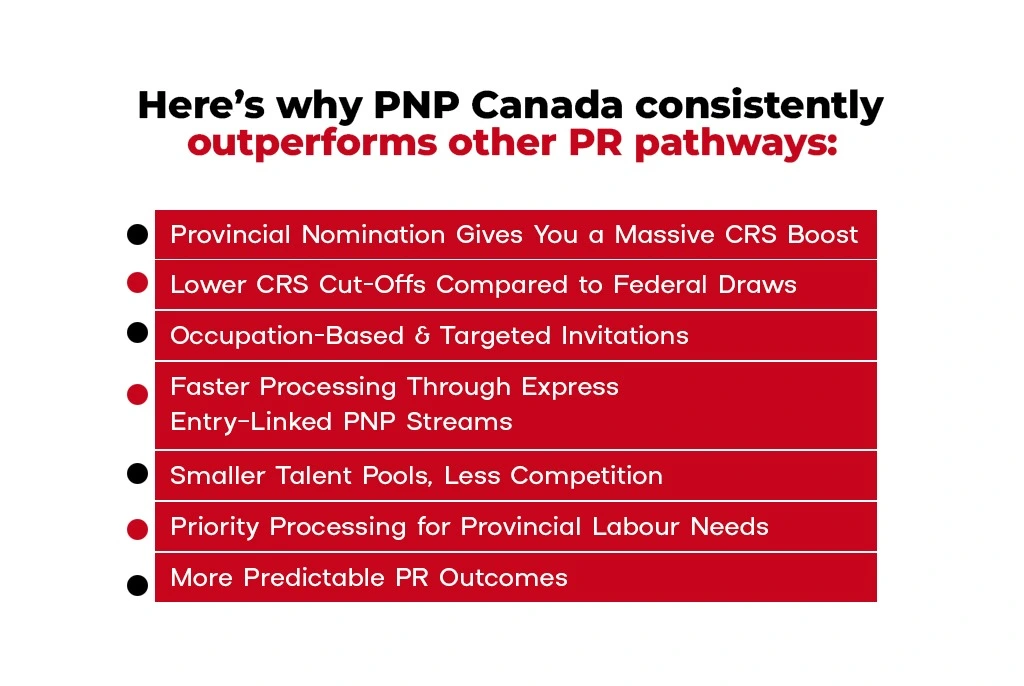
Here’s why PNP Canada consistently outperforms other PR pathways:
1. Provincial Nomination Gives You a Massive CRS Boost
An Express Entry PNP nomination adds 600 CRS points, instantly pushing your profile to the top of the Express Entry pool. This almost guarantees an Invitation to Apply (ITA) in the next draw, regardless of your original CRS score.
2. Lower CRS Cut-Offs Compared to Federal Draws
Many low CRS PNP programs invite candidates with scores far below federal Express Entry cut-offs. Provinces prioritize skills, experience, and occupation relevance over just points—making PR accessible even with moderate scores.
3. Occupation-Based & Targeted Invitations
Unlike general PR pathways, Provincial Nominee Program Canada streams target specific occupations in demand. This reduces competition and shortens waiting time, especially for healthcare, IT, engineering, and skilled trade professionals.
4. Faster Processing Through Express Entry–Linked PNP Streams
Express Entry PNP applications are processed faster than non-Express Entry routes. Once nominated, IRCC typically finalizes PR applications within six months, making it one of the fastest routes to Canadian PR.
5. Smaller Talent Pools, Less Competition
Federal programs assess candidates from across the world. In contrast, PNP Canada immigration evaluates candidates within a single province, drastically reducing competition and speeding up selection.
6. Priority Processing for Provincial Labour Needs
Provinces actively push applications that fill urgent labour shortages. This means candidates aligned with provincial nomination Canada priorities often move faster through both nomination and PR stages.
7. More Predictable PR Outcomes
Because Canada PNP programs follow clear occupation lists and provincial priorities, applicants face fewer surprises compared to federal programs where CRS scores fluctuate sharply.
If speed, certainty, and strategic advantage matter, PNP Programs Canada are often the fastest and smartest route to Canadian PR, especially for candidates struggling with high CRS requirements under federal pathways.
Types of PNP Programs Canada That Offer Faster PR
Not all PNP programs in Canada operate at the same speed. Some streams are specifically designed to fast-track candidates who match immediate provincial labour needs. Choosing the right type of Provincial Nominee Program Canada can significantly reduce your PR processing time.
Below are the PNP Canada pathways known for faster Canadian PR outcomes:
1. Express Entry–Linked PNP Programs (Enhanced Streams)
These are the fastest PNP programs for Canada PR.
- Aligned with the federal Express Entry system
- Provincial nomination adds 600 CRS points
- Almost guaranteed ITA in the next Express Entry draw
- IRCC processing time: ~6 months
Best for: Skilled professionals with eligible Express Entry profiles.
2. Occupation-in-Demand PNP Streams
These streams target applicants whose jobs are urgently needed in specific provinces.
- Often no job offer required
- Lower CRS thresholds
- Faster provincial selection due to labour shortages
- Common in healthcare, IT, engineering, and trades
- Popular examples: Saskatchewan PNP, Nova Scotia PNP
3. Employer-Driven PNP Programs
Designed for candidates with a valid job offer from a provincial employer.
- Higher approval rates
- Priority processing due to verified employment
- Strong settlement intent
Best for: Candidates already working in Canada or with overseas job offers.
4. Tech-Focused PNP Streams
Certain provinces run accelerated tech draws to attract global talent.
- Frequent invitations
- Streamlined nomination process
- Faster timelines compared to general PNP draws
- Popular examples: BC PNP Tech, Ontario Tech Draws
5. International Graduate PNP Streams
Ideal for students who studied in Canada and want a quick PR transition.
- Reduced work experience requirements
- Fast provincial nomination
- Strong approval chances due to Canadian education
Best for: International graduates from Canadian institutions.
6. Regional & Rural PNP Streams
Smaller provinces and rural regions process applications faster to meet workforce shortages.
- Less competition
- Flexible eligibility criteria
- Faster provincial decisions
Popular regions: Atlantic provinces, Northern territories.
Applying under the wrong PNP category can delay your PR by months or even years. A strategic PNP Canada immigration plan, aligned with your occupation, CRS score, and province preference, is key to securing PR faster.
In-Demand Occupations Under PNP Programs Canada
| Occupation Category | In-Demand Job Roles | Provinces Actively Inviting | Why These Occupations Are Prioritized |
|---|---|---|---|
| Healthcare | Registered Nurses, Psychiatric Nurses, Doctors, Medical Laboratory Technologists, Physiotherapists | Alberta PNP, Saskatchewan PNP, Nova Scotia PNP, Manitoba PNP | Ongoing healthcare shortages due to aging population and expansion of healthcare services |
| IT & Technology | Software Developers, Web Developers, Data Analysts, Cybersecurity Specialists, AI Engineers | BC PNP, Ontario PNP, Alberta PNP | Rapid tech growth and digital transformation across provinces |
| Engineering | Civil Engineers, Mechanical Engineers, Electrical Engineers, Industrial Engineers | Ontario PNP, Alberta PNP, Saskatchewan PNP | Infrastructure projects and industrial expansion |
| Skilled Trades | Electricians, Plumbers, Welders, Heavy Equipment Operators, Carpenters | Alberta PNP, Manitoba PNP, Saskatchewan PNP | High demand in construction, energy, and manufacturing sectors |
| Education | Early Childhood Educators, Secondary School Teachers, Special Needs Educators | Ontario PNP, Nova Scotia PNP, BC PNP | Growing population and increased focus on early childhood education |
| Finance & Business | Accountants, Financial Analysts, HR Managers, Business Consultants | Ontario PNP, BC PNP, Alberta PNP | Demand for compliance, financial planning, and corporate management |
| Hospitality & Tourism | Chefs, Cooks, Restaurant Managers, Hotel Supervisors | British Columbia PNP, PEI PNP, Alberta PNP | Tourism recovery and workforce shortages |
| Transport & Logistics | Truck Drivers, Logistics Coordinators, Supply Chain Analysts | Saskatchewan PNP, Manitoba PNP, Alberta PNP | Supply chain expansion and inter-provincial trade |
| Agriculture & Food Processing | Farm Supervisors, Food Processing Workers, Agricultural Technicians | Manitoba PNP, Saskatchewan PNP, Alberta PNP | Critical role in food security and rural economies |
| Social & Community Services | Social Workers, Community Support Workers, Caregivers | Ontario PNP, Nova Scotia PNP, BC PNP | Increased demand for mental health and community care services |
Matching your NOC code with a province’s in-demand list can significantly reduce CRS requirements and speed up PR processing under PNP programs Canada.
Provinces With the Fastest PNP Programs in Canada
Not all PNP programs Canada move at the same pace, some provinces have streamlined systems, lower cut-offs, and priority processing that make their Provincial Nominee Programs particularly fast for obtaining PR. Below is a breakdown of provinces and territories known for quicker PNP nomination and PR pathways:
1. British Columbia (BC PNP)
- BC is known for fast and consistent processing times, often as quick as 2–3 months for key streams like Skilled Worker and International Graduate.
- Tech and in-demand occupations are given priority, with frequent draws and steady timelines.
2. Nova Scotia (NSNP)
- Nova Scotia has some of the shortest processing times in Canada, often 1–3 months for many streams due to smaller volumes and a streamlined digital process.
- Great for in-demand fields such as healthcare, IT, and skilled trades.
3. Ontario (OINP)
- Ontario runs the largest PNP program in Canada with frequent draws and multiple streams, including Express Entry-aligned categories.
- Certain Human Capital and tech-focused streams can move faster due to high quotas and priority processing.
4. Alberta (AAIP / AINP)
- Alberta PNP is renowned for lower CRS requirements (as low as around 300 in some draws) and regular invitations under the Express Entry stream.
- Strong provincial demand and flexible criteria help speed up nominations.
5. Saskatchewan (SINP)
- The Saskatchewan Immigrant Nominee Program is considered one of the faster moving PNPs, especially its International Skilled Worker streams, frequently issuing invitations and processing nominations quickly.
- Some streams don’t require a job offer and have simplified eligibility.
6. Manitoba (MPNP)
- Manitoba’s PNP streams with strong provincial connections (work, study, family) often enjoy quicker selection rounds, especially under Express Entry pathways.
- Processing also speeds up when applicants meet connection criteria.
7. Prince Edward Island (PEI PNP)
- PEI’s smaller size and frequent Express Entry-aligned draws make its PNP relatively fast for candidates with job offers or strong eligibility.
8. Northwest Territories & Yukon
- Due to small application volumes and urgent labour needs, these territories often process nominations quickly, sometimes within a few months.
- Best option for candidates with job offers or high-demand skills.
Eligibility Requirements for PNP Programs Canada
While requirements vary, common PNP Canada requirements include:
- Relevant work experience
- Language proficiency (IELTS / CELPIP)
- Educational credentials (ECA)
- Proof of settlement funds
- Intention to settle in the nominating province
- Age and adaptability factors
Some Provincial nominee Canada streams do not require a job offer, making them ideal for overseas applicants.
Step-by-Step Process: How PNP Programs Canada Speed Up PR
1. Choose the right province based on occupation & CRS
2. Create Express Entry profile (if applicable)
3. Submit EOI or apply to provincial stream
4. Receive Provincial Nomination Canada
5. Gain 600 CRS points (Express Entry PNP)
6. Receive ITA
7. Apply for PR
8. Get Canadian Permanent Residence.
With the right strategy, this process can be significantly faster than federal routes.
Common Mistakes That Delay PNP Applications
1. Applying to the wrong province
2. Ignoring occupation lists
3. Incomplete documentation
4. Incorrect NOC code selection
5. Weak proof of settlement funds
6. Not demonstrating intent to settle in the province.
Avoiding these mistakes can cut months off your PR timeline.