




Business Analyst in Canada is a promising career option for professionals interested in business operations, data analysis, and problem-solving.
Understanding the job market, educational qualifications, skills needed, salary expectations, and career paths can guide aspiring professionals to plan their next move. In this guide, we’ll cover the most important requirements, certifications, jobs and salaries for Business Analysts in Canada.
Table Of Content
1Is Business Analyst in demand in Canada?2What does a Business Analyst do?3What are the Requirements to Work as a Business Analyst in Canada?4Certifications for Business Analysts in Canada5Business Analyst Jobs in Canada6Business Analyst Jobs in Canada with Visa Sponsorship7Business Analyst Salary in Canada8Conclusion9FAQs About Business Analyst Jobs in Canada
Is Business Analyst in demand in Canada?
Yes, Business Analysts are in demand in Canada, with employment opportunities across industries such as information technology, finance, banking, healthcare and consulting. Organisations need business analysis professionals to understand business requirements, analyse data, improve processes and support informed decision-making.
Professionals with skills in data analysis, SQL, Power BI, Microsoft Excel, requirements gathering and project management may find opportunities across different sectors. The specific role and employer needs will dictate where the opportunities are.
Employment prospects for business analysts vary by province and occupation. Candidates researching In Demand Jobs in Canada should check the Government of Canada’s Job Bank for the latest outlook for their specific occupation and location.
According to the Government of Canada’s Job Bank, the 2025–2027 outlook for business management analysts is rated Good in Alberta, Manitoba and Saskatchewan. Candidates should check regional labour market information and current job postings to identify suitable opportunities.
In each province and for each kind of job, there are different possibilities of finding a job. The outlook for business management analysts is rated as Good in Alberta, Manitoba and Saskatchewan for 2025–2027, according to the Government of Canada’s Job Bank. Candidates should consult regional labour market information and current job postings to find suitable opportunities.
What does a Business Analyst do?
A Business Analyst identifies business needs, analyses requirements, and recommends solutions to help organisations improve processes, address challenges, and achieve their goals. They work with stakeholders, business teams, and technical professionals to ensure.
Key responsibilities of a Business Analyst may include:
Analysing Business Requirements: Understanding business needs, gathering information, and documenting project requirements.
Identifying Business Problems: Evaluating existing processes to identify gaps, inefficiencies, and areas for improvement.
Analysing Data: Examining relevant data to identify trends, evaluate performance, and support informed decision-making, depending on the role.
Communicating with Stakeholders: Collaborating with clients, managers, and technical teams to understand needs and align project objectives.
Improving Business Processes: Recommending changes to streamline operations, improve efficiency, and support business goals.
Supporting Solution Implementation: Working with relevant teams to develop, test, or implement solutions and assess whether they meet business requirements.
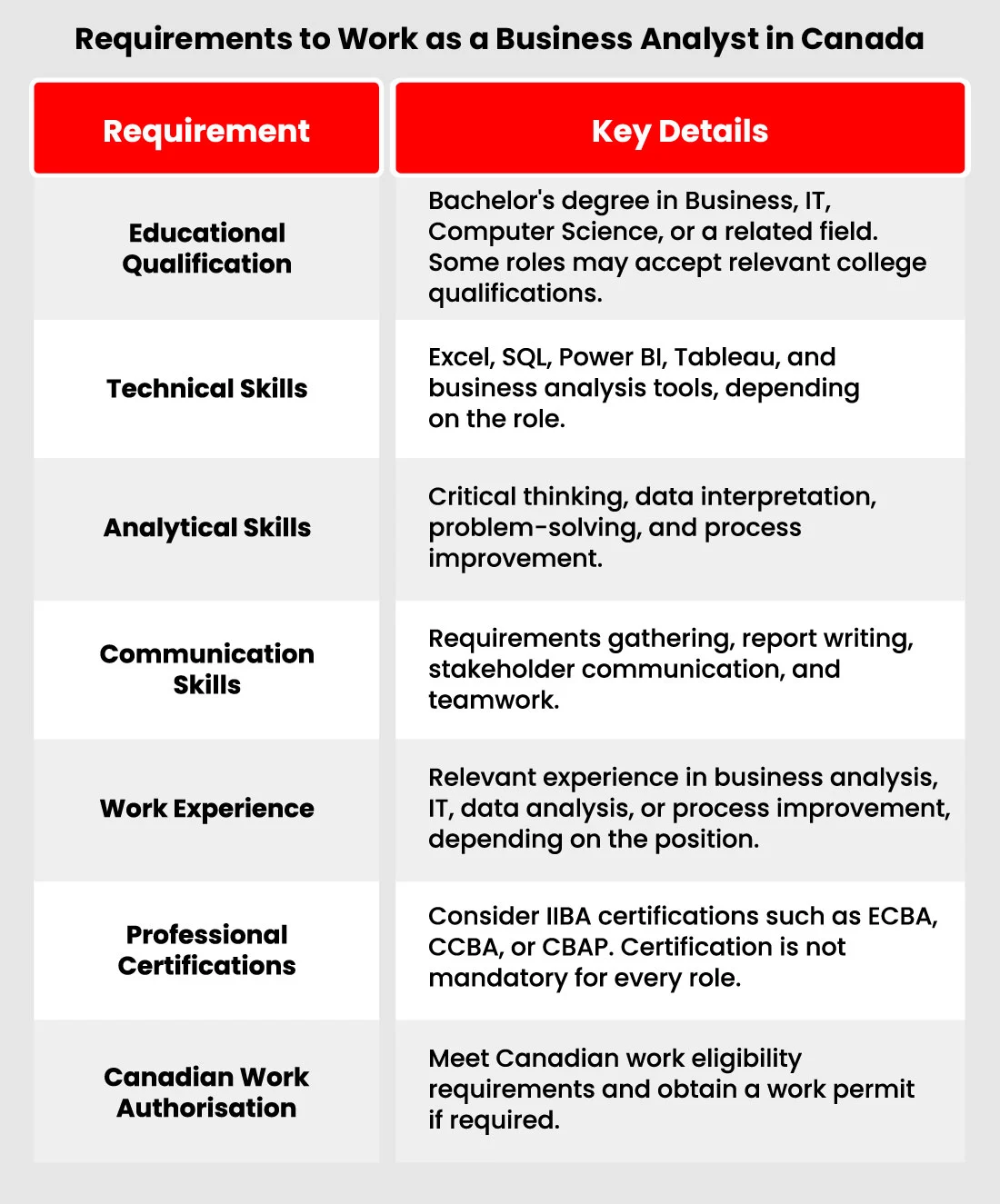
What are the Requirements to Work as a Business Analyst in Canada?
To work as a Business Analyst in Canada, candidates generally need relevant educational qualifications, analytical and communication skills, and knowledge of business processes or information systems. Employers may also require practical experience, technical skills, or professional certifications, depending on the job role.
1. Educational Qualification
A relevant educational background is generally expected for Business Analyst Jobs in Canada. The exact qualification depends on the occupation and employer.
- Complete a bachelor’s degree in business administration, computer science, information systems, commerce, or a related field, depending on the role.
- Some IT business analyst positions may accept a college program in computer science.
- Consider postgraduate studies in business analytics, data analytics, or a related discipline if they align with your career goals. A postgraduate qualification is not a universal requirement.
The Government of Canada’s Job Bank states that a bachelor’s degree in computer science, business administration, information systems, or a related discipline, or a college program in computer science, is usually required for business systems specialists. When checking the NOC Code in Canada for immigration purposes, candidates should identify the occupation that best matches their actual job duties and responsibilities, rather than relying on the job title alone.
2. Technical Skills
Technical skills can help Business Analysts understand business requirements, work with data, and support technology-related projects. The skills required depend on the position.
- Microsoft Excel: Learn to organise data, use formulas, and prepare reports.
- SQL: Develop the ability to retrieve and analyse data from databases, especially for data-focused or IT roles.
- Power BI or Tableau: Understand how to create dashboards and visualise data when required by the job.
- Business Analysis Tools: Learn techniques such as process mapping, requirements documentation, workflow modelling, and business process analysis.
These tools are good examples of the skills that employers may be looking for. The Government of Canada does not list all of these as mandatory requirements for all Business Analyst positions.
3. Analytical and Problem-Solving Skills
Business Analysts need to understand business challenges, evaluate information, and identify practical solutions.
- Develop critical-thinking skills to assess business problems and identify their causes.
- Learn to interpret data and use evidence to support business decisions.
- Practise identifying process gaps and recommending improvements.
- Build the ability to evaluate different solutions and understand their potential impact on business operations.
4. Communication and Interpersonal Skills
Business Analysts in Canada regularly communicate with stakeholders and teams to understand requirements and explain proposed solutions.
- Develop clear written and verbal communication skills.
- Learn to gather requirements by asking relevant questions and listening to stakeholders.
- Practise preparing reports, presentations, and business documentation.
- Build teamwork and negotiation skills to help resolve differences and align project objectives.
5. Relevant Work Experience
Practical experience can strengthen your application, although the amount and type of experience required depend on the employer and position.
- Gain experience in business analysis, data analysis, project coordination, IT, or process improvement where relevant.
- Develop practical knowledge of requirement gathering, documentation, reporting, and stakeholder communication.
- Build a portfolio of relevant projects, such as business reports, process maps, or data dashboards, where appropriate.
- Review Canadian job postings to understand the experience employers expect for entry-level and senior positions.
6. Professional Certifications
Professional certifications can help to demonstrate specialized knowledge and strengthen your profile, but they are not mandatory for every Business Analyst role.
- Consider business analysis certifications relevant to your career goals, such as those offered by the International Institute of Business Analysis (IIBA).
- Explore software vendor training or certifications if you plan to work with specific business systems or technologies.
- Check whether the employer requires any particular certification before investing in a course.
- According to the Government of Canada’s Job Bank, some employers hiring business systems specialists may require software vendor certification or training.
7. Canadian Work Authorisation
Candidates planning to apply for permanent residence should review the Canada PR Requirements for their chosen immigration pathway, as eligibility criteria differ between programs.
- Check whether you need a Canadian work permit or qualify for an exemption.
- If applying for an employer-specific work permit, check whether you need a valid job offer and whether the employer must meet additional requirements.
- Review the eligibility conditions for the relevant work permit before applying.
- Ensure that your work authorisation permits you to undertake the intended employment.
Note: Most foreign nationals need a work permit to work in Canada, although exemptions apply in certain circumstance.
Certifications for Business Analyst in Canada
The most recognised Certifications for Business Analyst in Canada include the Entry Certificate in Business Analysis (ECBA), Certification of Capability in Business Analysis (CCBA), and Certified Business Analysis Professional (CBAP), offered by the International Institute of Business Analysis (IIBA).
These certifications validate business analysis knowledge and professional experience at different career levels.
| Certification | Best Suited For | Business Analysis Work Experience |
|---|---|---|
| ECBA – Entry Certificate in Business Analysis | Beginners, recent graduates, and individuals starting a career in business analysis | No prior work experience required |
| CCBA – Certification of Capability in Business Analysis | Professionals with intermediate business analysis experience | At least 3,750 hours within the last seven years |
| CBAP – Certified Business Analysis Professional | Experienced business analysis professionals | At least 7,500 hours within the last ten years |
Additional eligibility requirements: CCBA applicants must also complete 21 hours of professional development within the last four years and provide two professional references. CBAP applicants must complete 35 hours of professional development within the last four years and provide two professional references. Both certifications have additional requirements concerning the areas in which work experience was gained.
The right Business Analyst certification in Canada depends on your professional experience, career goals, and existing skills. Although certification is not mandatory for every business analyst position, it may strengthen your résumé and demonstrate your commitment to professional development to Canadian employers.
Business Analyst Jobs in Canada
Business Analyst Jobs in Canada include:
1. Business Analyst
2. IT Business Analyst
3. Business Systems Analyst
4. Business Data Analyst
5. Business Process Analyst
6. Business Intelligence Analyst – IT
7. Business Systems Consultant
8. Information Systems Business Analyst
9. Technical Business Analyst
10. Business Solutions Consultant
Business analyst jobs in Canada cover a range of roles in business operations, information technology, data analysis, and process improvement.
International professionals searching for jobs in Canada with visa sponsorship may find business analyst opportunities with employers willing and eligible to support their work authorisation, depending on their qualifications, experience, and the applicable work permit requirements.
However, visa sponsorship is not guaranteed, and some work permit pathways require employers to meet specific eligibility criteria.
Business Analyst Jobs in Canada with Visa Sponsorship
Business Analyst Jobs in Canada with Visa Sponsorship include:
1. Business Analyst
2. IT Business Analyst
3. Business Systems Analyst
4. Business Process Analyst
5. Business Data Analyst
6. Business Intelligence Analyst
7. Financial Business Analyst
8. Technical Business Analyst
9. Healthcare Business Analyst
10. Requirements Analyst
How to Find Business Analyst Jobs in Canada with Visa Sponsorship
To find Business Analyst jobs in Canada with potential employer support, candidates can follow these steps:
Browse Canadian Job Websites: Search the Government of Canada’s Job Bank, established employment platforms, and company career pages for business analyst vacancies. Check each posting for qualifications, experience, location, and international applicant eligibility.
Check Whether International Candidates Can Apply: Look for vacancies that accept candidates from outside Canada and review the employer’s hiring conditions.
Explore Industries Hiring Business Analysts: Search for opportunities in IT consulting, banking, financial services, healthcare, and technology.
Prepare a Professional Resume: Highlight relevant qualifications, work experience, analytical skills, technical knowledge, and business analysis projects.
Check Work Permit Requirements: Check whether the position requires an LMIA or qualifies for an LMIA-exempt work permit pathway.
Job Bank Canada, the Government of Canada’s official job-search platform, provides a dedicated resource for international candidates seeking employment. Candidates can check job postings, regional employment outlooks, and employer requirements for relevant business analyst positions.
However, employer support does not guarantee work permit approval, and candidates must meet the applicable immigration requirements.
Business Analyst Salary in Canada
Here’s a quick overview of Business Analyst salaries in Canada:
Low Salary: CAD 30.67 per hour (approximately CAD 63,800 per year)
Median Salary: CAD 45.13 per hour (approximately CAD 93,900 per year)
High Salary: CAD 62.50 per hour (approximately CAD 130,000 per year)
Actual salaries vary by employer, province, experience, and specialisation. Business analysts working in IT, finance, consulting, and data analytics may have different earning opportunities depending on their skills and responsibilities.
Conclusion
A Business Analyst in Canada can explore career opportunities across different industries by identifying suitable roles and understanding employer expectations. Reviewing current job postings and regional employment trends through the Government of Canada’s Job Bank can help candidates identify relevant opportunities and plan their next career move.



That’s really a great news!
Dear Ila,
Thanks for your kind words. If you need any assistance in getting Canada PR please feel free to connect with us through enquiry@canapprove.com. We are here to help you.