

Job hunting in Germany with the Opportunity Card can be a game-changer for skilled professionals! Especially those applying from India or other non-EU countries, looking to build an international career. Whether you are exploring chancenkarte job search tips for the first time or already searching for jobs in Germany without a job offer, small mistakes in your approach can cost you months of effort in the competitive Germany job market.
In this blog, we’ll explore the most common mistakes to avoid and help you navigate your job search in Germany more effectively and confidently.
Table Of Content
1Understanding the Germany Opportunity Card2Why Job Hunting in Germany Can Be Challenging for Foreigners?3Common Mistakes to Avoid When Job Hunting in Germany4How to Apply for Jobs in Germany from India?5Smart Strategies for Successful Job Hunting in Germany6Best Job Portals to Find Jobs in Germany7Real Success Stories: Proof That the Right Approach Works8Frequently Asked Questions
Understanding the Germany Opportunity Card
The Germany Opportunity Card (Chancenkarte) is a residence permit, designed to help skilled professionals from non-EU countries — including India, the Philippines, and Nigeria— enter Germany and search for employment. It is one of the most flexible pathways for job hunting in Germany, especially for candidates who do not yet have a job offer but meet the eligibility criteria.
Key Benefits:
- No job offer required initially
- Stay up to 12 months
- Work part-time (up to 20 hours/week)
- Access to the growing Germany job market
Why Job Hunting in Germany Can Be Challenging for Foreigners?
While Germany offers excellent career opportunities, job hunting in Germany can be tricky for foreigners due to:
- Language barriers (German is often required)
- Strict hiring standards
- Recognition of foreign qualifications
- Cultural differences in hiring processes
- High competition in certain sectors
Understanding these challenges is the first step toward a successful job search in Germany.
Common Mistakes to Avoid When Job Hunting in Germany
When it comes to job hunting in Germany, many international candidates make simple mistakes that can delay or even block their chances of getting hired. The German hiring process is structured, competitive, and detail-oriented; so avoiding these common errors can make a big difference in your success.
Using the Wrong CV Format
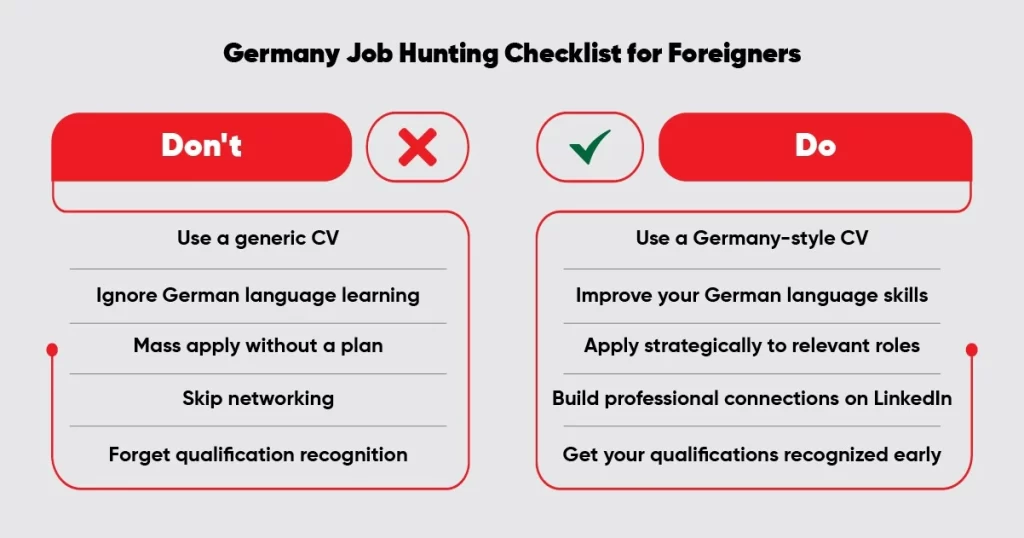
One of the most common mistakes in the job search in Germany is submitting a CV that doesn’t follow the Germany CV format for foreigners. Indian and other international applicants often send a generic resume instead of a structured German-style Lebenslauf and German employers notice immediately.
German employers expect a clear, structured CV, often with a professional photo and detailed, achievement-based content. A generic or poorly formatted resume can lead to immediate rejection.
Ignoring German Language Skills
While there are some jobs in Germany for English speakers — particularly in IT, engineering, and multinational companies — they are extremely competitive and limited in number. Most employers across Germany still prefer candidates with at least B1 or B2 German, especially for client-facing or team-based roles.
If you are job hunting in Germany from India, learning even basic German gives you a significant edge over other international applicants.
Applying Without a Strategy
Mass applying with the same resume is a common mistake during job hunting in Germany.
Instead of sending hundreds of generic applications, focus on:
- Tailoring your CV
- Applying for relevant roles
- Matching your skills with job requirements
A targeted approach always works better.
Not Networking Enough
Many candidates doing a Germany job search for Indian professionals rely only on job portals and completely ignore networking. However, studies show that up to 70% of jobs are never publicly advertised. LinkedIn Germany job search tips consistently point to direct recruiter outreach and referrals as the fastest route to getting hired, far more effective than mass applying on portals alone.
Skipping Qualification Recognition
For many professions, especially regulated ones, qualification recognition is essential.
Failing to verify your degree or certification can result in rejection—even if you are highly qualified. This step is crucial for accessing Germany Opportunity Card jobs.
Writing Long and Unfocused Cover Letters
Another mistake is submitting lengthy cover letters with unnecessary details.
German recruiters prefer short, precise cover letters (2–3 paragraphs) that clearly explain your relevance to the role. Spending too much time on one application can also reduce your overall chances in a competitive market.
Unrealistic Expectations
Many candidates expect high salaries or immediate job offers without understanding the realities of the Germany job market.
Being flexible with:
- Salary expectations
- Job roles
- Location
can help you enter the market faster and grow gradually.
Giving Up Too Early
Job hunting in Germany takes time, effort, and persistence.
It’s common to face multiple rejections before success. Candidates who stay consistent, improve their approach, and keep applying are the ones who succeed in the long run.
How to Apply for Jobs in Germany from India?
For Indian professionals specifically, the process of job hunting in Germany from India requires careful preparation well before arriving on the Opportunity Card. Here is a step-by-step breakdown of exactly what to do:
Step-by-Step Process
1. Prepare Your Profile
- Check qualification eligibility using official portals
- Apply for degree recognition if required
- Learn German (B1 minimum, B2 preferred)
2. Create a German-Style Application
- Keep your CV 1–2 pages, clean and structured
- Include a professional photo
- Highlight measurable achievements (e.g., “Increased efficiency by 20%”)
- Write a short, tailored cover letter only when needed
Avoid overusing AI-generated content, applications should feel authentic and personalized.
3. Use the Right Job Portals
- Apply through platforms like LinkedIn and Indeed Germany
- Use official portals like “Make it in Germany”
- Explore industry-specific job boards for targeted roles
4. Follow a Smart Application Strategy
- Apply consistently (10–20 jobs per day)
- Customize applications for relevant roles
- Stay open to relocation within Germany
5. Focus on Networking
- Build connections through LinkedIn
- Join professional groups and communities
- Attend virtual job fairs and industry events
Networking plays a major role in accessing hidden opportunities in Germany Opportunity Card jobs.
Smart Strategies for Successful Job Hunting in Germany
- Learn German (B1/B2 level) to improve job opportunities
- Customize your CV for each job application
- Apply consistently with a focused strategy
- Target high-demand industries like IT, engineering, and healthcare
- Research jobs in Germany for English speakers if your German is below B1, tech startups and international firms often hire in English while you build language skills
- Build a strong LinkedIn profile and network actively
- Use trusted job portals for your job search in Germany
- Upgrade your skills with relevant certifications and tools
- Prepare for direct and structured German interviews
- Stay flexible with job roles and location
- Track applications and follow up professionally
Best Job Portals to Find Jobs in Germany
To succeed in job hunting in Germany, using the right mix of job portals, networking platforms, and official resources is essential for accessing the full Germany job market. Here are some :
Official Government Portals
- Make it in Germany – Official portal with visa-friendly jobs for international candidates
- Federal Employment Agency (BA) – Offers job listings, career tools, and free guidance
General Job Boards & Networks
- LinkedIn – Best platform for networking and recruiter outreach
- Xing – Germany-focused professional networking platform
- Indeed.de – Popular site for German-specific job listings
- StepStone – Leading platform for full-time and professional roles
- Monster.de – Useful for jobs, training, and career resources
- Joblift.de – Aggregates listings from multiple German job portals
Industry-Specific Job Portals
- Stack Overflow Jobs – Ideal for IT and developer roles
- Remote.com / We Work Remotely – Best for remote tech opportunities
- Hotelcareer.de – Top portal for hospitality jobs
- Yourfirm.de – Focuses on Germany’s mid-sized companies (Mittelstand)
Networking & Alternative Channels
- Meetup – Find industry events and professional meetups
- Facebook & WhatsApp Groups – Discover hidden job opportunities
- EURES Portal – Explore jobs across Germany and the EU
Using a combination of portals and networking channels can significantly improve your chances of finding jobs in Germany for foreigners, especially through hidden opportunities in the market.
Real Success Stories: Proof That the Right Approach Works
At CanApprove, we have guided thousands of aspiring immigrants and job seekers toward achieving their international career goals. Through our years of experience in immigration and overseas career guidance, we have observed that successful candidates are not always the most qualified—they are often the ones who avoid common mistakes and follow a well-planned strategy.
One of our clients, Ms. Manju Michael, a skilled professional who moved to Germany through the Opportunity Card pathway, initially faced challenges securing interviews despite having relevant qualifications and work experience. After receiving guidance on optimizing their CV to German standards, improving their job search approach, and targeting the right opportunities, they successfully secured employment and began building their career in Germany.
Whether you are just beginning your chancenkarte job search or have already been job hunting in Germany from India for several months, the key is to stay consistent, refine your approach, and never underestimate the power of a well-optimized German CV and active networking. The Germany job market in 2026 has real opportunities, the right strategy is what separates successful candidates from those who give up.
Their journey highlights an important lesson: obtaining the Opportunity Card is only the first step. Success depends on understanding the German job market, presenting your skills effectively, and avoiding the common pitfalls that can delay your progress.
With the right preparation and expert guidance, your journey to Germany can become a success story too.