



GIS jobs in Canada are becoming more popular in 2026 as sectors are depending more on mapping, spatial data analysis, remote sensing, and geospatial technologies. GIS professionals are key to turning location-based data into actionable decisions, from urban planning and infrastructure to mining, environment, transportation and public services. Canada offers good career prospects, competitive earnings, and growing GIS job opportunities in Canada for qualified professionals.
Table Of Content
1Are GIS Jobs in Demand in Canada?2GIS Jobs in Canada3GIS Jobs in Canada with Visa Sponsorship4Best Provinces for GIS Jobs in Canada5GIS Salary in Canada6How to Apply for GIS Jobs in Canada7Conclusion8Frequently Asked Questions
Are GIS Jobs in Demand in Canada?
Yes, GIS jobs are in demand in Canada, but opportunities vary by region and industry needs.
The Job Bank Canada points out a nationwide over-supply risk for GIS related occupations, but some places such as Ontario still have moderate prospects and opportunities continue to be listed. GIS careers are increasingly connected to sectors that continue to generate Job Opportunities in Canada, particularly in infrastructure, environment, transportation, and public services.
Why GIS Jobs Are in Demand in Canada
- Infrastructure and Construction Growth: GIS experts plan, coordinate and oversee infrastructure and construction projects across Canada.
- Organisations utilise GIS for resource management, land-use planning and conservation. Environmental and resource management
- Smart City and Urban Planning: Geospatial data is key for cities in terms of transit, utilities, public services and development.
- Location-based decision making Businesses and government agencies use GIS data to increase efficiency and decision making.
- Mapping and Spatial Analysis: GIS expertise are required to produce maps, manage spatial data and analyse geographic data in many sectors.
GIS Jobs in Canada
Canada has a lot of open GIS professional positions. You can develop several areas of expertise including mapping, spatial analysis, remote sensing and geospatial data management. GIS professionals empower organisations of all types, from government agencies and environmental organisations to technology companies and engineering firms, to make data-driven decisions across the board.
Many of these roles are considered In Demand Jobs in Canada, especially where geospatial analysis supports planning, resource management, and infrastructure development.
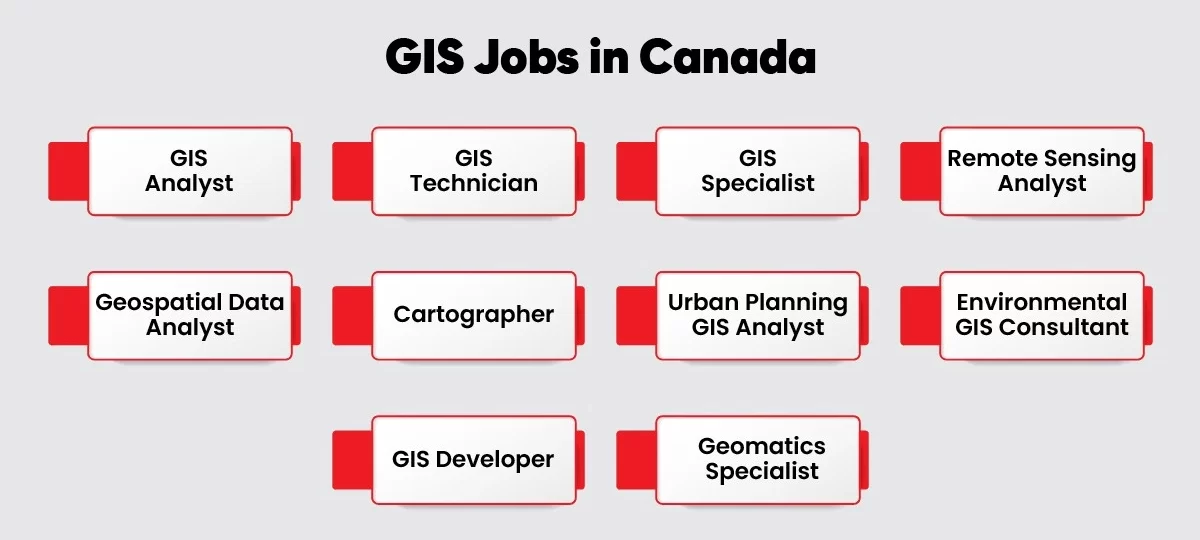
The GIS Jobs in Canada include:
- GIS Analyst
- GIS Technician
- GIS Specialist
- Remote Sensing Analyst
- Geospatial Data Analyst
- Cartographer
- Urban Planning GIS Analyst
- GIS Developer
- Geomatics Specialist
- Environmental GIS Consultant
Now, let’s take a closer look at some of the best GIS jobs in Canada:
1. GIS Analyst in Canada
GIS Analysts use Geographic Information Systems (GIS) to analyse spatial data and provide insights to support business, environmental and infrastructure projects. It’s one of the most in-demand GIS careers in Canada.
GIS Analyst Job Description
- Analyze geospatial data to identify trends, patterns, and geographic relationships.
- Create digital maps, dashboards, and visualizations to present geographic information clearly.
- Perform spatial analysis and modeling to support planning, development, and business decisions.
- Maintain and update GIS databases to ensure the accuracy and reliability of geographic data.
- Prepare reports and provide geospatial insights to stakeholders, clients, and project teams.
- Support infrastructure, environmental, transportation, and land-use planning projects.
- Integrate GIS data with other business systems and technologies to improve operational efficiency.
How to Become a GIS Analyst in Canada
To become a GIS Analyst in Canada:
1. Complete a bachelor’s degree or diploma in GIS, Geomatics, Geography, Environmental Science, or a related field.
2. Develop proficiency in GIS software such as ArcGIS, QGIS, and spatial database tools.
3. Learn programming languages such as Python and SQL to improve GIS analysis capabilities.
4. Gain hands-on experience through internships, co-op programs, or entry-level GIS positions.
5. Build a portfolio showcasing mapping projects, spatial analysis work, and GIS applications.
6. Apply for GIS Analyst positions in government agencies, consulting firms, utilities, and private organizations.
GIS Analyst Salary in Canada
The average GIS Analyst salary in Canada ranges from CAD 65,000 to CAD 85,000 per year, depending on experience, location, industry, and technical expertise.
| Experience Level | Average Annual Salary |
|---|---|
| Entry-Level GIS Analyst | CAD 50,000 – CAD 65,000 |
| Mid-Level GIS Analyst | CAD 65,000 – CAD 85,000 |
| Senior GIS Analyst | CAD 85,000 – CAD 110,000+ |
2. GIS Technician in Canada
A GIS Technician supports GIS teams by collecting, updating, managing, and preparing geographic data for mapping and analysis. This role is suitable for candidates with strong technical skills in GIS software, data entry, mapping, and spatial database maintenance.
GIS Technician Job Description
- Collect, organize, and update geospatial data for GIS projects.
- Prepare maps, charts, and spatial datasets using GIS software.
- Maintain GIS databases and ensure data accuracy.
- Assist GIS Analysts and Specialists in mapping and analysis tasks.
- Convert field data, survey data, and satellite data into usable GIS formats.
- Perform quality checks on spatial data and correct errors.
- Support government, utility, environmental, and infrastructure mapping projects.
How to Become a GIS Technician in Canada
To become a GIS Technician in Canada:
1. Complete a diploma, certificate, or degree in GIS, Geomatics, Geography, Surveying, or a related field.
2. Learn GIS tools such as ArcGIS, QGIS, AutoCAD Map, and spatial database systems.
3. Build practical skills in data collection, map preparation, and database management.
4. Gain experience through internships, entry-level GIS roles, or field mapping projects.
5. Create a portfolio with sample maps, data work, and GIS project outputs.
6. Apply for GIS Technician roles in municipalities, engineering firms, utilities, and environmental organizations.
GIS Technician Salary in Canada
The average GIS Technician salary in Canada ranges from CAD 45,000 to CAD 70,000 per year, depending on experience, location, technical skills, and industry.
| Experience Level | Average Annual Salary |
|---|---|
| Entry-Level GIS Technician | CAD 40,000 – CAD 55,000 |
| Mid-Level GIS Technician | CAD 55,000 – CAD 70,000 |
| Senior GIS Technician | CAD 70,000 – CAD 85,000+ |
3. GIS Specialist in Canada
A GIS Specialist handles advanced geospatial analysis, mapping, database management, and GIS project support. This role usually requires deeper technical knowledge than a GIS Technician and may involve working with complex spatial data, planning systems, and decision-support tools.
GIS Specialist Job Description
- Conduct advanced spatial analysis for planning, business, and infrastructure projects.
- Design and maintain GIS databases, web maps, and geospatial applications.
- Prepare detailed maps, dashboards, reports, and visual presentations.
- Support project teams with location-based insights and technical GIS solutions.
- Integrate GIS data with business, environmental, and engineering systems.
- Ensure spatial data quality, accuracy, and proper documentation.
- Work with government agencies, consulting firms, utilities, and private companies.
How to Become a GIS Specialist in Canada
To become a GIS Specialist in Canada:
1. Complete a degree or diploma in GIS, Geomatics, Geography, Environmental Science, Urban Planning, or a related field.
2. Learn advanced skills in ArcGIS Pro, QGIS, spatial databases, and web GIS tools.
3. Learn data analysis, cartography, remote sensing, and geospatial modelling.
4. Gain hands-on experience through GIS Analyst, GIS Technician, or project-based roles.
5. Create a strong portfolio showing mapping, analysis, database, and dashboard projects.
6. Apply for GIS Specialist roles in planning, infrastructure, environment, energy, and public sector organizations.
GIS Specialist Salary in Canada
The average GIS Specialist salary in Canada ranges from CAD 65,000 to CAD 90,000 per year, depending on experience, location, industry, and technical expertise.
| Experience Level | Average Annual Salary |
|---|---|
| Entry-Level GIS Specialist | CAD 55,000 – CAD 70,000 |
| Mid-Level GIS Specialist | CAD 70,000 – CAD 90,000 |
| Senior GIS Specialist | CAD 90,000 – CAD 115,000+ |
4. Remote Sensing Analyst in Canada
A Remote Sensing Analyst uses satellite imagery, aerial photos, LiDAR data, and other sensor-based data to study land, environment, agriculture, forestry, infrastructure, and climate-related patterns. This is a technical role that combines geospatial analysis with image interpretation.
Remote Sensing Analyst Job Description
- Analyze satellite images, aerial photographs, LiDAR, and drone-based data.
- Process remote sensing data to identify land-use, vegetation, water, and environmental changes.
- Create maps, models, and reports using remote sensing and GIS software.
- Support environmental monitoring, forestry, agriculture, mining, and climate projects.
- Use image classification, change detection, and spatial modelling techniques.
- Maintain and manage remote sensing datasets.
- Work with GIS teams, scientists, engineers, and government agencies.
How to Become a Remote Sensing Analyst in Canada
To become a Remote Sensing Analyst in Canada:
1. Complete a degree in Remote Sensing, GIS, Geomatics, Geography, Environmental Science, Earth Science, or a related field.
2. Learn remote sensing tools such as ArcGIS, QGIS, ENVI, ERDAS Imagine, Google Earth Engine, and LiDAR tools.
3. Develop skills in satellite image processing, image classification, and spatial modelling.
4. Learn programming languages such as Python or R for geospatial analysis.
5. Gain practical experience through research projects, internships, or environmental mapping work.
6. Apply for roles in environmental consulting, forestry, agriculture, mining, research, and government agencies.
Remote Sensing Analyst Salary in Canada
The average Remote Sensing Analyst salary in Canada ranges from CAD 65,000 to CAD 95,000 per year, depending on technical skills, industry, and project experience.
| Experience Level | Average Annual Salary |
|---|---|
| Entry-Level Remote Sensing Analyst | CAD 55,000 – CAD 70,000 |
| Mid-Level Remote Sensing Analyst | CAD 70,000 – CAD 95,000 |
| Senior Remote Sensing Analyst | CAD 95,000 – CAD 120,000+ |
5. Geospatial Data Analyst in Canada
A Geospatial Data Analyst works with location-based data to identify patterns, trends, risks, and opportunities. This role combines GIS, data analytics, statistics, and visualization to support business, government, infrastructure, and environmental decisions.
Geospatial Data Analyst Job Description
- Analyze geospatial datasets to identify trends, patterns, and relationships.
- Create maps, dashboards, and reports to present spatial insights.
- Use GIS, database, and data visualization tools to support decision-making.
- Clean, validate, and manage large spatial datasets.
- Perform spatial modelling, network analysis, and location-based analysis.
- Work with business, planning, transportation, environmental, and infrastructure teams.
- Use tools such as ArcGIS, QGIS, SQL, Python, Power BI, and Tableau.
How to Become a Geospatial Data Analyst in Canada
To become a Geospatial Data Analyst in Canada:
1. Complete a degree or diploma in GIS, Geomatics, Data Analytics, Geography, Statistics, Computer Science, or a related field.
2. Build strong skills in GIS software, spatial databases, and data visualization tools.
3. Learn SQL, Python, R, and basic statistics for geospatial data analysis.
4. Gain experience in spatial modelling, dashboards, and map-based reporting.
5. Build a portfolio with geospatial analytics, visualization, and mapping projects.
6. Apply for Geospatial Data Analyst roles in consulting firms, technology companies, government, logistics, and planning organizations.
Geospatial Data Analyst Salary in Canada
The average Geospatial Data Analyst salary in Canada ranges from CAD 65,000 to CAD 95,000 per year, depending on data skills, GIS expertise, location, and industry.
| Experience Level | Average Annual Salary |
|---|---|
| Entry-Level Geospatial Data Analyst | CAD 55,000 – CAD 70,000 |
| Mid-Level Geospatial Data Analyst | CAD 70,000 – CAD 95,000 |
| Senior Geospatial Data Analyst | CAD 95,000 – CAD 120,000+ |
6. GIS Developer in Canada
A GIS Developer builds geospatial applications, web maps, automation tools, and custom GIS solutions. This role combines programming, GIS knowledge, databases, and web development to create tools that help organizations collect, analyze, and visualize location-based data.
GIS Developer Job Description
- Develop web-based GIS applications, dashboards, and mapping platforms.
- Create custom tools, scripts, and workflows for GIS automation.
- Work with spatial databases, APIs, and cloud-based geospatial systems.
- Integrate GIS data with business applications and enterprise systems.
- Use programming languages such as Python, JavaScript, SQL, and related frameworks.
- Support web mapping using tools such as ArcGIS Online, Leaflet, Mapbox, or OpenLayers.
- Troubleshoot GIS applications and improve system performance.
How to Become a GIS Developer in Canada
To become a GIS Developer in Canada:
1. Complete a degree or diploma in GIS, Geomatics, Computer Science, Software Development, Geography, or a related field.
2. Build strong programming skills in Python, JavaScript, SQL, HTML, CSS, and APIs.
3. Learn GIS platforms such as ArcGIS Enterprise, ArcGIS Online, QGIS, Mapbox, Leaflet, or OpenLayers.
4. Develop knowledge of spatial databases such as PostgreSQL/PostGIS, SQL Server, or Oracle Spatial.
5. Build a portfolio with web maps, GIS apps, automation scripts, and dashboard projects.
6. Apply for GIS Developer roles in technology companies, government, engineering firms, utilities, and consulting organizations.
GIS Developer Salary in Canada
The average GIS Developer salary in Canada ranges from CAD 75,000 to CAD 110,000 per year, depending on programming skills, GIS platform experience, location, and employer.
| Experience Level | Average Annual Salary |
|---|---|
| Entry-Level GIS Developer | CAD 60,000 – CAD 80,000 |
| Mid-Level GIS Developer | CAD 80,000 – CAD 110,000 |
| Senior GIS Developer | CAD 110,000 – CAD 140,000+ |
7. Geomatics Specialist in Canada
A Geomatics Specialist works with geographic data, land surveying, remote sensing, GPS, mapping, and spatial information systems. This role supports land development, construction, infrastructure, environmental management, natural resources, and government mapping projects.
Geomatics Specialist Job Description
- Collect, process, and analyze spatial data from GPS, surveys, drones, LiDAR, and GIS systems.
- Prepare maps, models, survey outputs, and geospatial reports.
- Support land development, construction, transportation, and infrastructure projects.
- Manage geospatial databases and ensure data accuracy.
- Use surveying, mapping, remote sensing, and GIS tools for project delivery.
- Work with surveyors, engineers, planners, environmental teams, and project managers.
- Support field data collection and convert it into usable digital mapping outputs.
How to Become a Geomatics Specialist in Canada
To become a Geomatics Specialist in Canada:
1. Complete a degree or diploma in Geomatics, Surveying, GIS, Geography, Remote Sensing, Civil Engineering Technology, or a related field.
2. Learn tools related to GIS, GPS, CAD, LiDAR, drone mapping, and spatial databases.
3. Develop skills in surveying methods, coordinate systems, mapping standards, and spatial data processing.
4. Gain field and technical experience through internships, survey projects, or GIS roles.
5. Build a portfolio showing mapping, surveying, modelling, and geospatial data projects.
6. Apply for roles in engineering firms, surveying companies, government agencies, construction, mining, energy, and environmental organizations.
Geomatics Specialist Salary in Canada
The average Geomatics Specialist salary in Canada ranges from CAD 65,000 to CAD 95,000 per year, depending on technical skills, field experience, industry, and location.
| Experience Level | Average Annual Salary |
|---|---|
| Entry-Level Geomatics Specialist | CAD 55,000 – CAD 70,000 |
| Mid-Level Geomatics Specialist | CAD 70,000 – CAD 95,000 |
| Senior Geomatics Specialist | CAD 95,000 – CAD 125,000+ |
GIS Jobs in Canada with Visa Sponsorship
GIS Jobs in Canada with Visa Sponsorship Include:
1. GIS Technician
2. GIS Analyst
3. GIS Specialist
4. GIS Developer
5. Geomatics Technologist
6. Remote Sensing Analyst
7. Cartographic Technologist
8. Program Coordinator for Geospatial Programming
GIS jobs in Canada with visa sponsorship are frequently associated with firms who are looking for competent geospatial specialists and are willing to sponsor appropriate foreign workers.
If the candidate’s GIS role fits labour demand and the company cannot fill the role locally, sponsorship opportunities may improve .
People with good GIS software abilities, geographical analytic experience, remote sensing knowledge, programming skills, and the right degree may be better positioned for employer-sponsored opportunities.
Best Provinces for GIS Jobs in Canada
The best provinces for GIS jobs in Canada are Ontario, Alberta, British Columbia, Saskatchewan, Manitoba and Quebec.
Several of these provinces are also regarded among the Best Cities in Canada to Live and Work, offering a combination of employment opportunities and quality of life. Good prospects for GIS specialists in government, engineering, environmental management, transportation, natural resources, and technology are found in these provinces.
Ontario – Ontario offers strong GIS opportunities in government, infrastructure, engineering, and technology.
Alberta – Alberta has good demand for GIS talent in energy, environmental consulting, utilities, and land management.
British Columbia – British Columbia provides growing opportunities in forestry, transportation, environmental management, and urban planning.
Saskatchewan – Saskatchewan offers GIS careers in agriculture, mining, environmental monitoring, and resource management.
Manitoba – Manitoba has opportunities for GIS professionals in government services, transportation planning, utilities, and environmental organizations.
Quebec – Quebec provides a wide range of GIS roles in engineering, infrastructure development, environmental projects, and the public sector.
GIS Salary in Canada
The average GIS salary in Canada ranges from CAD 50,000 to CAD 100,000+ per year. Salary levels vary based on job role, experience, qualifications, and location, with senior and specialized professionals often earning higher salaries.
Entry-level GIS jobs in Canada typically offer lower salaries, while experienced professionals can earn significantly higher pay as they advance in their careers and develop specialized geospatial skills.
Factors that can influence GIS salaries in Canada include:
- Years of experience and technical expertise
- Educational qualifications and GIS certifications
- Job role and level of responsibility
- Province and city of employment
- Demand for GIS, mapping, and geospatial skills
- Specialization in GIS development, spatial analysis, or remote sensing
- Knowledge of GIS software, programming, databases, and geospatial tools
How to Apply for GIS Jobs in Canada
Here are the simple steps to apply for GIS jobs in Canada:
Step 1: Confirm Your Eligibility
- Have a GIS/geomatics/geography diploma or related degree.
- Build core skills: ArcGIS/QGIS, spatial analysis, cartography, basic SQL/Python.
- If abroad, check your work options: PR (Express Entry/PNP) or work permit.
Step 2: Create a GIS Portfolio
- Prepare 4–6 sample projects: maps, web maps, dashboards, small scripts.
- Host them on GitHub, ArcGIS Online, or a simple website.
Step 3: Make a Canadian‑Style Resume and Cover Letter
- 1–2 pages, reverse‑chronological, focused on results (what you mapped, analysed, improved).
- Tailor each cover letter to the specific GIS job ad.
Step 4: Search and Find GIS Vacancies
- Use: LinkedIn, Job Bank, Eluta and government career pages.
- Look for titles like: “GIS Technician”, “GIS Analyst”, “Geomatics Technician”, “Geospatial Analyst”.
Step 5: Align Your Skills with the Job Ad
- See what tools and tasks are mentioned in the job posting (e.g., ArcGIS Pro, Python, spatial joins)
- If you don’t meet 100% of the requirements, apply anyway, especially for junior roles.
Step 6: Apply Online
- Upload resume, cover letter and links to portfolio on the employer’s website or job portal.
- Register yourself and follow the process properly on the official portal for Government jobs.
Step 7: Get Ready for the Interview
- Brush up on GIS Basics (projections, geoprocessing, spatial joins) and your portfolio projects.
- Prepare for technical questions and a short practical exercise or test.
Step 8: Plan Immigration Pathway (if not in Canada)
- Look into PR ( Express Entry / PNP ) , or employer specific work permits. Applicants looking to Get a Job in Canada From India should review both immigration pathways and employer requirements before applying for GIS roles.
Conclusion
GIS Jobs in Canada with Visa Sponsorship in the fields of Mapping, Spatial Data Analysis, Remote Sensing, Geospatial Programming, Urban Development, and more. Some senior GIS and development roles are also among the Highest Paying Jobs in Canada within the broader geospatial sector. Sponsorship is determined by employer needs, demand for occupation and the candidate’s qualifications, experience and technical skills.
Candidates should have a good understanding of the appropriate job role, prepare a strong application and check the official immigration requirements to plan effectively. For the most current information, please visit the official website of Immigration, Refugees and Citizenship Canada.