




Dreaming of building a physiotherapy career Down Under? You’ve picked a good moment. With an ageing population, more people living with chronic conditions and a growing need for rehabilitation, demand for a physiotherapist in Australia has never been stronger. But how do you actually get there? This blog walks you through it step by step, from job demand, registration and IELTS scores to the assessment process, job roles, visa sponsorship and salaries.
Table Of Content
1Are Physiotherapists in demand in Australia?2Requirements to work as a Physiotherapist in Australia3IELTS Requirement for Physiotherapist in Australia4Australia Physiotherapy License Exam5Physiotherapist Jobs in Australia6Physiotherapist Jobs in Australia with Visa Sponsorship7Physiotherapist Salary in Australia8Conclusion9FAQs About Physiotherapists in Australia
Are Physiotherapists in demand in Australia?
Yes, physiotherapists are in demand in Australia, driven by increasing needs in rehabilitation, aged care and injury recovery.
Jobs and Skills Australia projects that employment for physiotherapists will rise by 33.6% over the decade to 2035, pointing to solid long-term career prospects.
Key Factors Behind the Rising Demand for Physiotherapists in Australia
1. Ageing Population: As Australians live longer, more people need physiotherapy to manage reduced mobility, age-related conditions and recovery from falls or injuries.
2. Increase in Chronic Conditions: Widespread problems such as arthritis, back pain and other musculoskeletal disorders call for regular, ongoing physiotherapy treatment.
3. Higher Rehabilitation Needs: People recovering from surgeries, accidents and major injuries depend on physiotherapy to regain movement, strength and physical function.
4. Sports and Workplace Injuries: Injuries from sport and work-related accidents create a steady need for physiotherapists who guide patients back to their everyday routines.
5. Shift Towards Preventive Healthcare: Rising awareness of fitness, injury prevention and mobility care is encouraging more people to book physiotherapy services.
6. Growth in Aged Care Services: Aged care facilities and community health services rely on physiotherapists to help older adults stay mobile, independent and active.
Requirements to work as a Physiotherapist in Australia
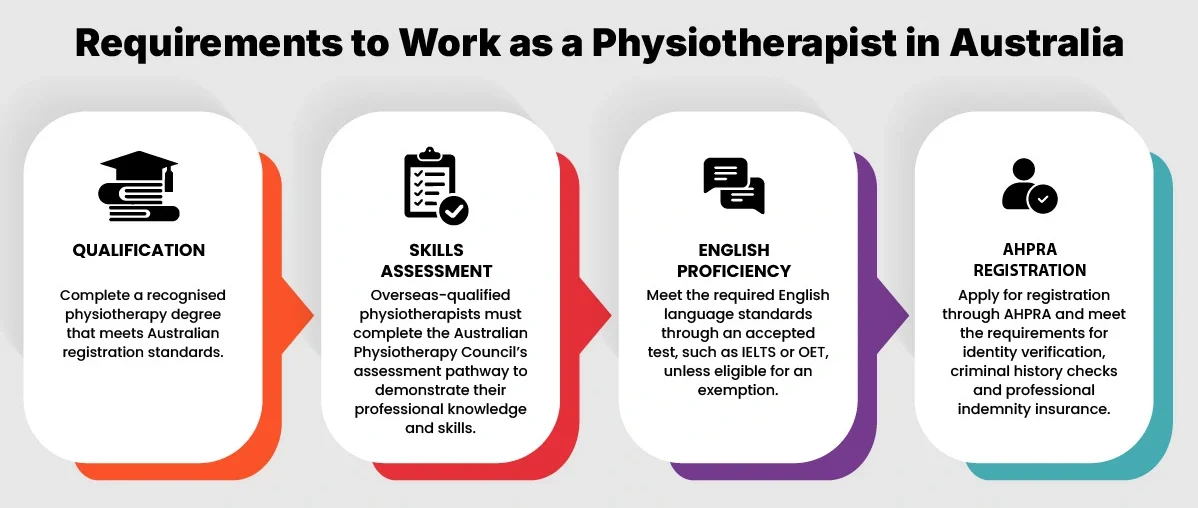
To work as a physiotherapist in Australia, you need an approved physiotherapy qualification, registration with the Australian Health Practitioner Regulation Agency (Ahpra) and proof of English language proficiency. Overseas-trained physiotherapists must also go through the relevant assessment pathway with the Australian Physiotherapy Council before they can apply for general registration.
1. Physiotherapy Qualification
You must hold a recognised physiotherapy qualification to be eligible to work in the country.
- Complete an approved Bachelor of Physiotherapy, Master of Physiotherapy or an equivalent degree.
- Graduate from a university and program that satisfy the criteria of the applicable Australian registration pathway.
- Get your qualification verified wherever this is required.
2. Physiotherapy Qualification Assessment
Physiotherapists trained overseas may first need to be assessed by the Australian Physiotherapy Council before applying for registration.
- Provide the necessary documents as evidence of your physiotherapy qualification.
- Follow the assessment pathway that applies to the country where you qualified.
- Satisfy the assessment standards set by the Australian Physiotherapy Council.
- Receive the required assessment outcome before moving on to registration, where applicable.
3. English Language Proficiency
You must show that you can communicate effectively in English to practise safely with patients and colleagues.
- Meet the English language skills standard set by the Physiotherapy Board of Australia.
- Take an approved English language test for Australia if you do not qualify for an exemption.
- Achieve the required scores in speaking, listening, reading and writing.
- Submit your English language results as part of your registration application.
4. Ahpra Registration
You must be registered with Ahpra through the Physiotherapy Board of Australia before you can legally work.
- Apply for general registration once your qualification and assessment requirements are met.
- Provide proof of identity and your qualification documents.
- Complete the required criminal history and fitness to practise checks.
- Hold appropriate professional indemnity insurance arrangements.
- Receive confirmation of registration before you start practising.
IELTS Requirement for Physiotherapist in Australia
A IELTS Requirement for Physiotherapist in Australia is an overall band score of 7.0 in IELTS Academic, along with the minimum scores set for each section, to satisfy the English language standard for professional registration.
| IELTS Section | Minimum Score |
|---|---|
| Listening | 7.0 |
| Reading | 7.0 |
| Speaking | 7.0 |
| Writing | 6.5 |
Overseas-qualified physiotherapists need to meet the English language standard set by the Australian Health Practitioner Regulation Agency (Ahpra) before they can register and practise. Since the accepted standard can vary with your test date and registration pathway, it is best to confirm the current criteria on the official Ahpra website.
Important: A qualifying IELTS score alone does not secure registration. You must also complete the relevant qualification assessment and fulfil all other professional registration requirements.
Australia Physiotherapy License Exam
The Australia Physiotherapy License Exam forms part of the assessment process for overseas-qualified physiotherapists who plan to practise in the country. The Australian Physiotherapy Council (APC) evaluates international qualifications, clinical knowledge and professional competencies to decide whether applicants meet Australian practice standards. The assessment pathway you follow depends on your qualifications and eligibility.
What Does the Australia Physiotherapy License Exam Involve?
Under the Australian Physiotherapy Entry Pathway (APEP), the assessment is completed in the following stages:
1. Eligibility Assessment: The APC reviews your physiotherapy qualifications and checks whether you are eligible to proceed towards Australian physiotherapy registration.
2. Cultural Safety Training: You complete training that builds your understanding of culturally safe healthcare practice in Australia.
3. Written Assessment: An online multiple-choice exam tests your clinical knowledge, problem-solving and decision-making abilities.
4. Capability Assessment: An online oral assessment examines your clinical reasoning and professional competencies.
5. Clinical Workshop: An in-person workshop in Melbourne tests how well you apply physiotherapy skills in a clinical setting.
Physiotherapist Jobs in Australia
A physiotherapist in Australia can work in hospitals, private clinics, aged care facilities, sports organisations and community health services.
Common physiotherapist jobs in Australia include:
- Musculoskeletal Physiotherapist
- Sports Physiotherapist
- Neurological Physiotherapist
- Paediatric Physiotherapist
- Cardiorespiratory Physiotherapist
- Aged Care Physiotherapist
- Rehabilitation Physiotherapist
- Hospital (Acute Care) Physiotherapist
- Community Health Physiotherapist
- Women’s Health Physiotherapist
- Occupational Health Physiotherapist
- NDIS Physiotherapist
- Private Practice Physiotherapist
- Senior or Clinical Specialist Physiotherapist
- Physiotherapy Team Leader or Manager
- Physiotherapy Lecturer or Researcher
Physiotherapist Jobs in Australia with Visa Sponsorship
Overseas-qualified professionals can find jobs in Australia with visa sponsorship in hospitals, private clinics, rehabilitation centres and aged care facilities. As a physiotherapist in Australia, you may be sponsored by an approved employer, provided you meet both the job requirements and the visa criteria.
Hospital Physiotherapist: Helps patients regain movement and function while recovering from surgery, injuries and serious illnesses.
Musculoskeletal Physiotherapist: Treats muscle, joint and movement-related conditions, including back pain, sprains and arthritis.
Sports Physiotherapist: Supports athletes and active people with injury recovery, rehabilitation and a safe return to sport.
Rehabilitation Physiotherapist: Works on restoring mobility and physical independence after injury, stroke or long-term conditions.
Aged Care Physiotherapist: Helps older adults improve strength, balance and mobility so they can stay independent and avoid falls.
Visa Options for Physiotherapists
Eligible applicants can look at the following employer-sponsored and skilled migration pathways:
Subclass 482: The Skills in Demand visa, for eligible skilled workers sponsored by an approved employer.
Subclass 186: The Employer Nomination Scheme visa, for eligible applicants seeking permanent residence through an employer.
Subclass 494: The Skilled Employer Sponsored Regional visa, for eligible skilled workers taking up jobs in regional Australia.
Subclass 189: The Skilled Independent visa, a points-tested permanent residence visa that needs no employer or state sponsor.
Subclass 190: The Skilled Nominated visa, a points-tested permanent residence visa that requires nomination by a state or territory.
Subclass 491: The Skilled Work Regional visa, a provisional visa for skilled workers nominated by a state or territory (or sponsored by an eligible relative) to live and work in regional Australia.
Requirements for Overseas Applicants
To be considered for sponsored physiotherapy jobs in Canada, applicants generally need to:
1. Hold a recognised physiotherapy qualification.
2. Complete the relevant assessment with the Australian Physiotherapy Council.
3. Satisfy Ahpra registration and English language requirements.
4. Meet the employer’s experience requirements and the criteria of the chosen visa.
Where to find jobs: Check healthcare jobs in Australia through relevant portals, hospital career pages and private clinic vacancies. Always confirm that the employer offers visa sponsorship, as not every physiotherapy job includes it.
Physiotherapist Salary in Australia
The average physiotherapist salary in Australia is approximately AUD 102,000 per year before superannuation, according to the Australian Physiotherapy Association’s 2025 Workforce Census. Actual salaries depend on experience, location, specialisation and employer.
Average Physiotherapist Salary in Australia by Experience
| Experience Level | Average Annual Salary (AUD) |
|---|---|
| Entry-level physiotherapist | $80,000 |
| Intermediate physiotherapist | $96,000 |
| Experienced physiotherapist | $116,000 |
| Expert physiotherapist | $149,000 |
Factors Affecting Physiotherapist Salaries in Australia
Employment Type: Full-time, part-time and contract roles are paid in different ways, which affects total earnings.
Employer: Public hospitals, private clinics, aged care facilities and rehabilitation centres can each offer different pay rates.
Work Location: Pay varies between states, territories and regional areas.
Specialisation: Advanced clinical skills and specialised areas of practice can lead to higher earning potential.
Work Experience: Experienced physiotherapists generally earn more than recent graduates.
Conclusion
Australia offers a strong future for a physiotherapist in Australia, with growing demand across hospitals, clinics and aged care, and competitive pay that rises with experience. Overseas-qualified candidates need to complete the Australian Physiotherapy Council assessment, meet the IELTS requirement and secure Ahpra registration before they can start practising. Those looking for sponsored roles should also check which visa pathway suits them. Visa rules and Australia Visa Processing Time can change, so confirm the latest details on the Australian Department of Home Affairs website before you apply.