



Australia visa processing time varies widely depending on the visa category you apply for. With processing times updated monthly by the Department of Home Affairs, staying on top of the latest figures helps applicants plan their travel, study, or relocation dates with more confidence.
From Student and Skilled visas to Partner, Parent, and Working Holiday visas, each category comes with its own timeline and set of influencing factors. Read on for the latest 2026 processing time updates, what affects them, and how to check the current figure for your specific visa before you apply.
Table Of Content
1Australia Visa Processing Time: How Long Does It Take?2What Factors Affect Australia Visa Processing Time?3How to Check Visa Processing Time for Australia4Conclusion5Australia Visa Processing Time FAQs
Australia Visa Processing Time: How Long Does It Take?
1. Australia Student Visa Processing Time
Student Visa – Subclass 500
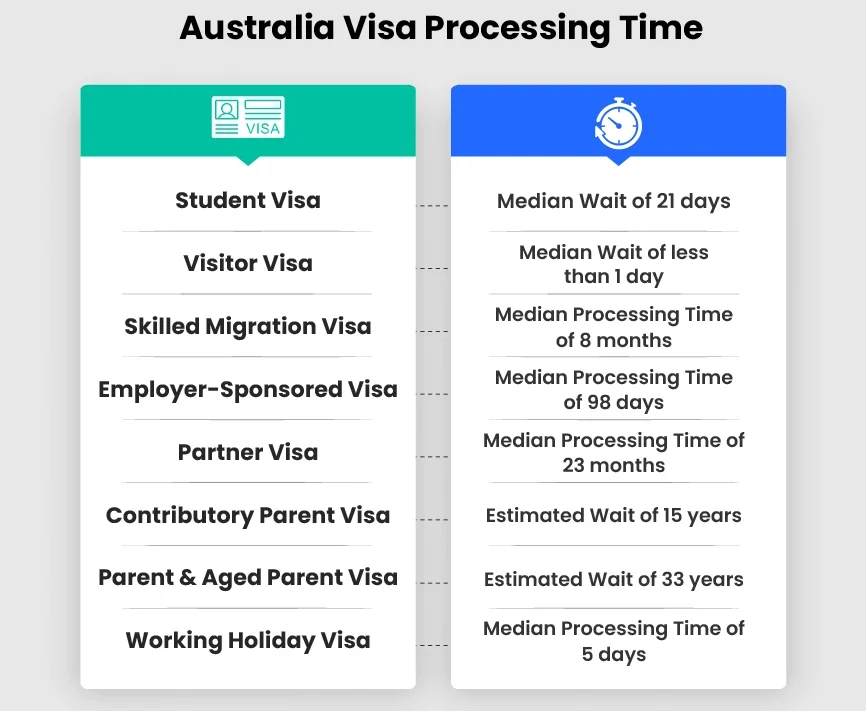
Applicants for the Australia Student Visa (Subclass 500) can currently expect a median wait of 21 days, with 9 in 10 applications resolved within 71 days. Actual wait times depend on the education sector or stream the applicant is lodging under, along with the completeness of the individual application.
Offshore Student Visa applications are assessed in line with the relevant Ministerial Direction, applications lodged before 14 November 2025 fall under Ministerial Direction 111, while those lodged from that date onward are processed under Ministerial Direction 115. Applicants are encouraged to lodge well ahead of their course start date and include every required supporting document upfront, since missing documents are the leading cause of delay.
The processing times for different Student Visa (Subclass 500) streams are:
| Feature | German D Visa | Schengen Visa |
|---|---|---|
| Visa type | National long-stay visa (Type D) | Short-stay visa (Type C) |
| Main purpose | Study, work, family reunification, training, etc. | Tourism, business, family visits, short trips, etc. |
| Stay duration | More than 90 days | Up to 90 days in any 180-day period |
| Main destination | Germany | Schengen Area |
| Long-term residence | May be followed by a German residence permit | Does not normally grant long-term residence |
| Travel within Schengen | Can generally allow short trips to other Schengen countries | Allows travel within the Schengen Area according to the visa conditions |
| Typical applicants | Students, workers, researchers, family members, etc. | Tourists, business travellers, short-term visitors, etc. |
2. Australia Visitor Visa Processing Time
Visitor visas (Subclasses 600, 601, 651) are the fastest-processed of all Australian visas, with a median processing time of less than 1 day. However, individual subclass and stream can shift this significantly.
The Department of Home Affairs publishes a combined figure for subclasses 600, 601 and 651, but the Subclass 600 (Visitor) can take considerably longer than the eVisitor (651) or ETA (601), which are largely automated. If additional information is requested for any stream, the final decision will take longer while that information is assessed.
| Visitor Visa Stream | Typical Processing |
|---|---|
| eVisitor (Subclass 651) | Near-instant to a few days |
| Electronic Travel Authority (Subclass 601) | Near-instant |
| Visitor visa (Subclass 600) – Tourist stream | Days to a few weeks |
| Visitor visa (Subclass 600) – Business stream | Days to a few weeks |
| Visitor visa (Subclass 600) – Sponsored Family stream | Can extend to several weeks |
3. Australia Skilled Migration Visa Processing Time
Skilled (Permanent) visa applications covering Subclasses 189, 190 and 491, currently have a median Australia visa processing time of 8 months, according to the Department of Home Affairs’ July 2026 data, a key benchmark for anyone looking to get Australia PR from India through the skilled migration pathway.
Applicants exploring skilled migration should also check whether their occupation appears on the Australian Skilled Occupation List and meets the requirements for their chosen visa pathway. Occupation eligibility, skills assessment, points, and nomination requirements can all influence the overall migration process, even though they do not determine the visa processing time on their own.
| Skilled Visa Subclass | Typical Range After Lodgement |
|---|---|
| Skilled Independent (Subclass 189) | Around 6–9 months for most applications |
| Skilled Nominated (Subclass 190) | Around 7–12 months, depending on state nomination |
| Skilled Work Regional – Provisional (Subclass 491) | Around 6–12 months, depending on state/territory nomination |
4. Australia Employer-Sponsored Visa Processing Time
Skilled (Temporary) visas, which include the Skills in Demand visa (Subclass 482), have a median processing time of 98 days, per the Department’s July 2026 figures, a key data point for anyone planning their Australia immigration timeline around employer sponsorship.
Processing speed under Subclass 482 depends heavily on the stream. The Specialist Skills stream, aimed at high-income earners in priority sectors, is processed markedly faster than the Core Skills stream, which covers the bulk of employer-sponsored applications.
| Employer-Sponsored Stream | Typical Processing |
|---|---|
| Subclass 482 – Specialist Skills stream | Days to a few weeks |
| Subclass 482 – Core Skills stream | 1–6 months |
| Subclass 186 – Employer Nomination Scheme | Several months, varies by stream |
Applicants looking for suitable employment opportunities can also explore Job Sites in Australia to research vacancies and understand employer requirements. However, securing a job offer does not automatically mean that a visa will be granted, as the relevant sponsorship and visa eligibility conditions must still be satisfied.
5. Australia Partner Visa Processing Time
Partner Visa – Subclasses 820/801 (Onshore) and 309/100 (Offshore)
The Australia Partner Visa (Provisional/Temporary stage) currently has a median Australia visa processing time of 23 months, according to the Department of Home Affairs’ July 2026 figures making it one of the longest-running visa categories outside Parent visas.
Partner visa applications are lodged as a combined temporary and permanent application and assessed in two separate stages. The temporary visa (Subclass 820 for onshore applicants, Subclass 309 for offshore applicants) is decided first. The permanent visa (Subclass 801 or 100) is generally not assessed until around two years after the original lodgement date, once the couple’s relationship can be reviewed over a longer period.
Applications are processed under Ministerial Direction 117, which gives highest priority to onshore applications where the visa can be granted while the applicant remains in Australia. Within each priority group, the Department generally works through applications in date order.
Partner visa priority order under Ministerial Direction 117:
| Priority Level | Application Type |
|---|---|
| Highest priority | Onshore application, visa grantable onshore |
| Lower priority | Onshore application, visa not grantable onshore |
| Lowest priority | Offshore application |
Two-stage structure:
| Stage | Onshore Pathway | Offshore Pathway | Typical Timing |
|---|---|---|---|
| Stage 1 – Temporary | Subclass 820 | Subclass 309 | Assessed first |
| Stage 2 – Permanent | Subclass 801 | Subclass 100 | Typically ~2 years after lodgement |
6. Australia Parent Visa Processing Time
Parent Visa – Subclasses 103, 804, 143, 173, 864, 884
Parent visas don’t run on a standard processing timeline like other categories. Because demand far exceeds the annual number of places available, these visas are subject to capping and queueing, and the Department of Home Affairs estimates a wait of 15 years for Contributory Parent visas and 33 years for Parent and Aged Parent visas for new applications lodged today.
Applications go through two stages: an initial assessment to confirm eligibility and assign a queue date, followed by a wait until a place becomes available for final assessment. The Department does not respond to individual status enquiries and updates queue information once a year, at the end of each migration program year.
Queue release status as at 31 May 2026:
| Parent Visa Subclass | Queue Assessment Stage | Queue Release Date (Final Processing) |
|---|---|---|
| Contributory Parent (143) | Applications lodged November 2023 | Lodged/queued up to November 2018 |
| Contributory Parent Temporary (173) | Applications lodged November 2023 | Lodged/queued up to November 2018 |
| Contributory Aged Parent (864) | Applications lodged April 2023 | Lodged/queued up to November 2018 |
| Contributory Aged Parent Temporary (884) | Applications lodged April 2023 | Lodged/queued up to November 2018 |
| Parent (103) | Applications lodged February 2023 | Queued up to March 2014 |
| Aged Parent (804) | Applications lodged January 2023 | Queued up to April 2014 |
Estimated wait for new applications lodged today:
| Visa Type | Processing Time Frame (Estimate) |
|---|---|
| Contributory Parent visas (143/173/864/884) | 15 years |
| Parent & Aged Parent visas (103/804) | 33 years |
7. Australia Working Holiday Visa Processing Time
Working Holiday Maker visas have a median Australia visa processing time of 5 days, based on recently finalised applications.
Onshore applications are currently being prioritised, which means offshore applications may take considerably longer in some cases several months to be finalised. Applicants are advised not to book flights or make firm travel, work, or study commitments until the visa is granted.
| Visa Type | Processing Time Frame (Estimate) |
|---|---|
| Contributory Parent visas (143/173/864/884) | 15 years |
| Parent & Aged Parent visas (103/804) | 33 years |
What Factors Affect Australia Visa Processing Time?
Several key factors affecting Australia Visa Processing Time determine how quickly an application moves from lodgement to decision, and understanding them can help applicants set realistic expectations. The key factors are:
Application completeness — Missing documents are the leading cause of delay. An incomplete application often results in a Request for Further Information, which pauses processing until the applicant responds.
Method of lodgement — Applications lodged online generally move faster than paper applications, since digital lodgement helps streamline the Department’s internal processing.
Response time to requests — How quickly an applicant replies to a case officer’s request for additional information directly affects the overall timeline. Slow responses push the application further back in the queue.
External agency checks — Health, character, and national security checks often depend on information from external agencies. These checks run on their own timeline, separate from the Department’s internal processing.
Migration program places (permanent visas) — For permanent visa categories, the number of places available in that year’s migration program can slow processing once demand outpaces supply.
Application complexity — More complex cases, such as those involving prior immigration history, multiple countries of residence, or additional dependents, generally take longer to assess.
Application volume — When the number of applications received increases, processing times across the board tend to extend, simply due to caseload.
Ministerial Directions — Certain visa categories (Student, Skilled, Partner, Parent) are processed according to Ministerial Directions that set priority order. A change to these directions can shift how quickly a particular application type moves through the system.
Deciding older applications — When the Department prioritises clearing a backlog of older applications, this can temporarily increase processing times for newer applications, since resources are directed toward the queue rather than new arrivals.
How to Check Visa Processing Time for Australia
Checking your Australia visa processing time only takes a few minutes using the Department of Home Affairs’ official tool.
Here’s how to do it:
Step 1: Visit the Official Visa Processing Times Guide
Go to the Department of Home Affairs’ visa processing times guide on the official immi.homeaffairs.gov.au website. This is the only source that gives accurate, regularly updated figures.
Step 2: Select Your Visa Type
Choose the visa category relevant to your application for example, Student, Skilled, Partner, Visitor, or Working Holiday.
Step 3: Select the Specific Visa Stream
Within each visa type, select the exact stream you applied under (for example, Higher Education under Student visa, or Points-Tested under Skilled Independent visa). Processing times can differ significantly between streams within the same subclass.
Step 4: Choose Your Application Location
Some visas show different processing times depending on whether the application was lodged onshore or offshore. Select the option that matches your situation.
Step 5: Review the Processing Time Estimate
The tool will display the estimated time it took to process 75% and 90% of recently decided applications for that visa and stream. This gives a realistic range rather than a single fixed number.
Step 6: Check the Last Updated Date
Processing times are updated monthly, so always check the date shown on the page to confirm you’re viewing the most current figures before making any plans around it.
Step 7: Track Your Own Application (If Already Lodged)
If you’ve already submitted your application, log in to ImmiAccount to check its individual status. Note that the Department does not respond to processing time enquiries outside this portal.
Conclusion
Australia visa processing times vary significantly across categories, from same-day Visitor visa decisions to multi-year waits for Parent visas. While the Department of Home Affairs publishes indicative timeframes for most visa types, these figures are based on recently decided applications and are not a guarantee for any individual case.
The most effective way to avoid unnecessary delays is to lodge a complete, decision-ready application with all supporting documents, health checks, and character clearances submitted upfront and to respond promptly to any requests for further information.
Since processing times are updated monthly and can shift with changes in application volume or Ministerial Directions, applicants are encouraged to check the official Department of Home Affairs Visa Processing Times Guide before making any travel, work, or study plans around a specific date.