


D Visa for Germany is something you’ll probably come across if you’re planning to move to Germany for studies, work, training, or to join your family. Figuring out which visa you need, what documents to prepare, how much it costs, and what happens after you arrive can feel a little confusing.
In this guide explains the Germany D Visa types, requirements, application process, fees, processing time, and the difference between a D Visa and a Schengen Visa in simple terms.
Table Of Content
1What is D Visa in Germany? 2What are the Different Types of D Visas for Germany? 3Germany D Visa Requirements 4How to Apply for a D Visa for Germany 5How much does a D Visa for Germany Cost? 6What is the Difference Between a German D Visa and a Schengen Visa? 7Conclusion 8D Visa for Germany FAQs
What is D Visa in Germany?
The Germany D Visa is a long-stay visa that allows eligible foreign nationals to stay in Germany for more than 90 days. It is also known as the German National Visa.
You may need a Germany D Visa if you plan to travel to Germany for:
- Studying at a university or educational institution
- Working in Germany
- Looking for a job, where applicable
- Joining family through family reunification
- Vocational training
- Other approved long-term stays
A D Visa is intended for long-term stays in Germany, while a Schengen Visa is generally used for short-term stays of up to 90 days. Depending on the purpose and duration of your stay, you may also need to apply for a residence permit after arriving in Germany.
What are the Different Types of D Visas for Germany?
The main types of Germany D Visas include Student Visa, Work Visa, Job Seeker Visa, Vocational Training Visa, Research Visa, and Family Reunification Visa. These visa categories are based on the purpose of the applicant’s long-term stay in Germany.
Here’s a simple overview of the different types of D Visas available in Germany:
1. Germany Student Visa
The Germany Student Visa is one of the long-term visa options under the German D Visa (National Visa) category. It is for international students who plan to study at a recognised university or other recognised higher education institution in Germany.
With this visa, students can enter Germany for their studies and, where applicable, complete the necessary residence formalities after arrival.
2. Germany Work Visa
The Germany Work Visa is a long-term visa for foreign nationals who want to work in Germany. It is generally used by qualified professionals who meet the requirements to work in Germany and have an appropriate employment opportunity or other qualifying basis.
Different work-related pathways may be available depending on the applicant’s qualifications and employment situation, including options for skilled workers and EU Blue Card holders.
3. Germany Job Seeker Visa
The Germany Job seeker visa is designed for qualified applicants who wish to enter for Job hunting in Germany and seek suitable employment.
This route may allow eligible applicants to search for employment in Germany without securing a job before travelling. Once suitable employment is secured, the applicant may be able to proceed with the appropriate residence and work route, subject to the applicable requirements.
4. Germany Vocational Training Visa
The Germany Vocational Training Visa is intended for foreign nationals seeking vocational training in Germany.
This may include practical and theoretical training under the German vocational training system. Applicants generally need an appropriate training place and must fulfil the applicable visa requirements before entering Germany.
5. Germany Research Visa
The Germany Research Visa is designed for international researchers and academics planning to conduct eligible research activities in Germany.
It is intended for applicants with a research opportunity or arrangement with a German research institution or another eligible organisation. The visa allows them to enter Germany for their approved research stay and complete the necessary residence formalities.
6. Germany Family Reunification Visa
The Germany Family Reunification Visa is for eligible family members who want to join a family member legally living in Germany.
Depending on the circumstances, this may include a spouse or registered partner, parent, or child. The exact requirements depend on the family relationship and the residence status of the family member already living in Germany.
Germany D Visa Requirements
The common Germany D Visa requirements may include:
1. Valid passport
2. Completed and signed national visa application form
3. Recent biometric photographs
4. Proof of the purpose of stay
5. Proof of sufficient financial means
6. Valid health insurance
7. Proof of accommodation
8. Purpose-specific documents
9. Additional documents, if requested
Tip: Always check the requirements for your specific Germany D Visa category before submitting your application. The required documents can differ for study, employment, family reunification, and other long-term purposes.
How to Apply for a D Visa for Germany
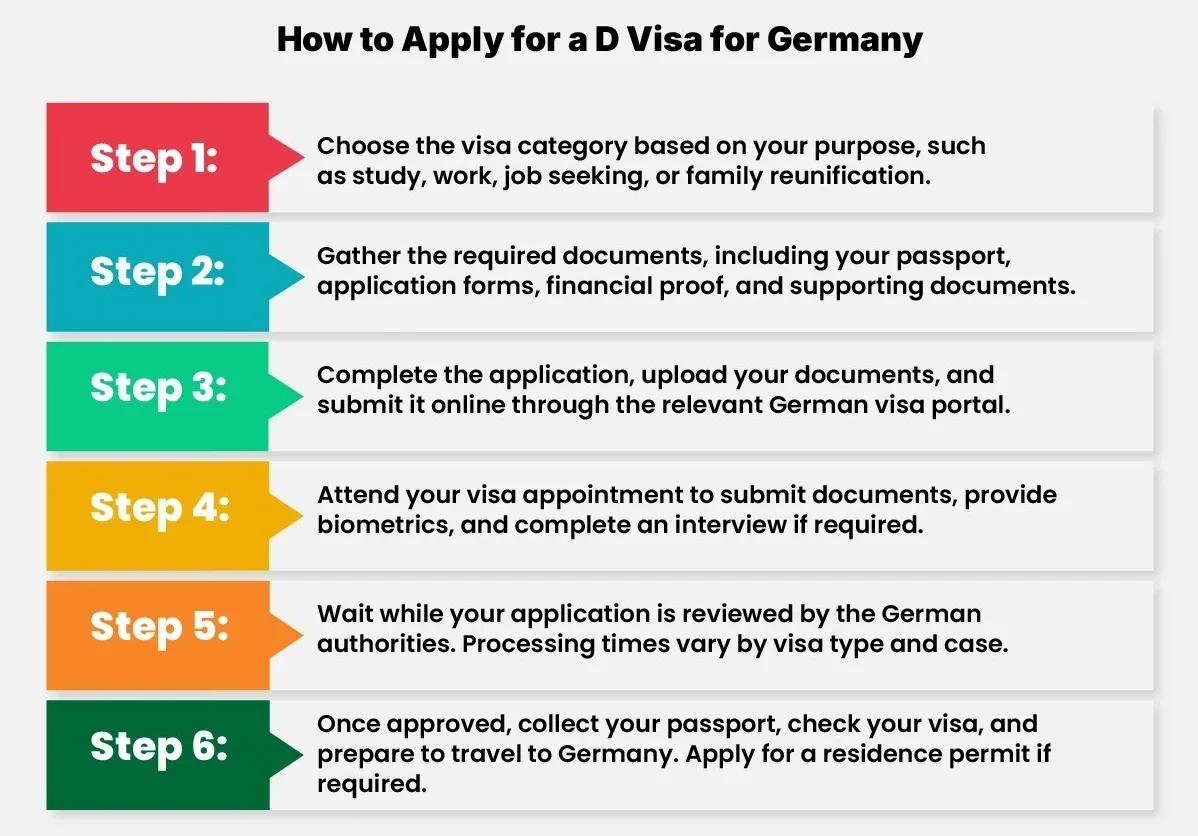
Here is the Step-by-Step Process to Apply for a D Visa for Germany:
Step 1: Check Which D Visa You Need
First, determine why you are going to Germany. Depending on the purpose of your stay, you may need to apply for a German National Visa and submit the required documents.
For example, the requirements for a student visa will differ from those for a work visa or a family reunification visa. Check the requirements for your specific visa category before applying.
Step 2: Prepare Your Documents
Once you have identified the right visa category, prepare the required documents.
- Valid passport
- Completed national visa application form
- Recent biometric photographs
- Proof of your purpose of stay
- Proof of financial means
- Health insurance
- Educational or employment documents
- Any additional documents required for your specific visa
Check the document requirements carefully before submitting your application, as they can vary depending on your visa type and the German mission handling your application.
Step 3: Submit Your Application Online
For many long-term visa categories, Germany allows applicants to start the application online through the Consular Services Portal.
You can create an account, enter your details, select your visa category, and upload the required documents. Your application may then be checked before you attend your in-person appointment.
If your visa category cannot be applied for online, you may need to follow the applicable offline application process through the relevant German mission or visa service provider.
Step 4: Attend Your Visa Appointment
Even if you start your application online, you will generally need to attend an in-person appointment.
- Submit or show your original documents
- Provide your fingerprints
- Have your photograph taken
- Pay the visa application fee
During the appointment, the visa authorities review your documents and verify the information provided in your application.
Step 5: Wait for Your Visa Decision
Once you have submitted the required information and documents, your application enters the processing stage.
The processing time can vary depending on your reason for staying in Germany, the visa category, your individual circumstances, and the checks required for your application.
If you applied through the Consular Services Portal, you may be able to use your account to check the status of your application and receive updates about the next steps.
Step 6: Get Your D Visa and Travel to Germany
If your application is approved, you will receive your Germany D Visa and can travel from India to Germany for the approved long-term purpose.
However, getting a D Visa does not necessarily complete all immigration formalities. Depending on your circumstances, you may need to apply for a residence permit after arriving in Germany.
How much does a D Visa for Germany Cost?
The Germany D Visa fee is €75 for applicants aged 18 and above and €37.50 for applicants under 18. For applicants in India, the visa fee is payable in Indian rupees (INR) at the applicable exchange rate on the day of the visa appointment.
The Germany D Visa fee is generally non-refundable, even if the visa application is rejected or withdrawn. When applying through an external visa service provider, applicants may also need to pay an additional service fee.
Remember that the visa fee and service fee are two different charges. Paying a service fee to a visa application centre does not guarantee that the Germany D Visa will be approved.
What is the Difference Between a German D Visa and a Schengen Visa?
The main difference between a German D Visa and a Schengen Visa is the purpose and duration of stay. A German D Visa is a long-stay visa for staying in Germany for more than 90 days, while a Schengen Visa is generally a short-stay visa for up to 90 days within a 180-day period.
| Feature | German D Visa | Schengen Visa |
|---|---|---|
| Visa type | National long-stay visa (Type D) | Short-stay visa (Type C) |
| Main purpose | Study, work, family reunification, training, etc. | Tourism, business, family visits, short trips, etc. |
| Stay duration | More than 90 days | Up to 90 days in any 180-day period |
| Main destination | Germany | Schengen Area |
| Long-term residence | May be followed by a German residence permit | Does not normally grant long-term residence |
| Travel within Schengen | Can generally allow short trips to other Schengen countries | Allows travel within the Schengen Area according to the visa conditions |
| Typical applicants | Students, workers, researchers, family members, etc. | Tourists, business travellers, short-term visitors, etc. |
Conclusion
Getting a D Visa for Germany is an important step, but it is not always the final step. Depending on your purpose and circumstances, you may need to complete further residence formalities after arriving in Germany.
Depending on your purpose and circumstances, you may need to complete further residence formalities after arriving in Germany. A D Visa can also generally allow short trips within the Schengen Area, subject to the applicable rules.
Before you apply for the most accurate and up-to-date information, always verify your requirements through the German Federal Foreign Office https://www.auswaertiges-amt.de/ Its official Visa Navigator can help you identify which visa you may need based on your travel purpose, including study, work, tourism, or family reunification.