



Dreaming of a nursing career in Australia often starts with one question: can you settle there permanently? Australia PR for Nurses is possible through several skilled and employer-sponsored visas. However, you must first meet the requirements for skills assessment, registration, English and points. In this guide, we break down the pathways, requirements and steps to help you plan your journey.
Table Of Content
1Do Nurses Get PR in Australia?2PR Pathways for Nurses in Australia3Australia PR for Nurses Requirements4PTE Score for Australia PR for Nurses5Age Limit for PR in Australia for Nurses6PR Points for Nurses in Australia7How to Get PR in Australia as a Nurse8Visa Sponsorship for Overseas Nurses in Australia9Conclusion10FAQs About Australia PR for Nurses
Do Nurses Get PR in Australia?
Yes, nurses can get PR in Australia through skilled migration, as long as they meet the visa, nursing registration and skills assessment requirements.
However, you will need to clear a few checkpoints first.
Key Factors for Nurses seeking Australia PR:
PR Pathways: The Skilled Independent (189) and Skilled Nominated (190) visas lead directly to PR. Meanwhile, the Skilled Work Regional visa (491) is provisional and can lead to PR later.
Nursing Qualifications: Your degree or diploma must be comparable to an Australian nursing qualification.
Nursing Registration: In addition, overseas nurses must register with the Nursing and Midwifery Board of Australia (NMBA).
English Proficiency: You also need an approved English test score for registration and your visa. Therefore, it helps to prepare early.
Age and Points: Because these visas are points-tested, your age, experience and qualifications affect your chances.
Skills Assessment: Finally, a positive skills assessment for your nursing occupation is required before you apply.
PR Pathways for Nurses in Australia
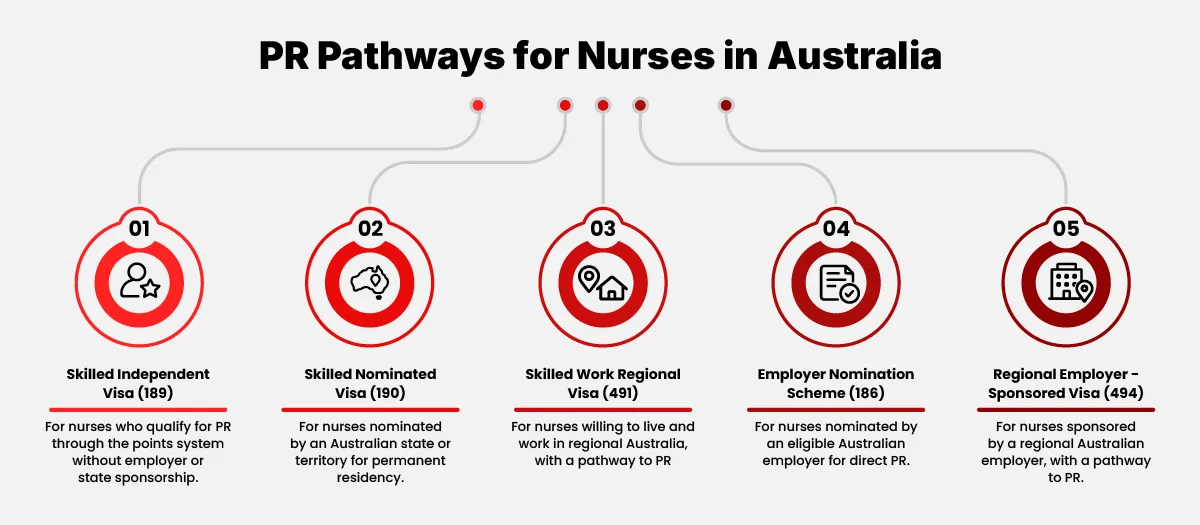
The main PR pathways for nurses in Australia include the Skilled Independent visa (189), Skilled Nominated visa (190), Skilled Work Regional visa (491), Employer Nomination Scheme (186) and regional employer-sponsored visas. However, the right option depends on your occupation, skills assessment, English score and work experience.
1. Skilled Independent Visa (Subclass 189)
- The Skilled Independent Visa suits nurses who want PR without a sponsor or state nomination.
- First, you need an eligible nursing occupation and a positive skills assessment. Then you must submit an Expression of Interest and meet the points test.
- Besides this, you must satisfy the English, age and health criteria.
- Although a job offer is not required, you can only apply after receiving an invitation.
- Note that meeting the minimum points does not guarantee an invitation.
2. Skilled Nominated Visa (Subclass 190)
- The Skilled Nominated Visa suits nurses who receive nomination from an Australian state or territory.
- Like the 189, it requires an eligible occupation, a skills assessment and the minimum points.
- In addition, each state sets its own conditions, such as work experience or a commitment to live in the region.
- Once approved, you receive PR straight away.
- However, nomination availability varies, so check each state’s current list.
3. Skilled Work Regional Visa (Subclass 491)
- The Skilled Work Regional Visa suits nurses who are willing to live and work in a designated regional area of Australia.
- You need a state nomination or an eligible family sponsor, along with a skills assessment and points.
- Meanwhile, you must stay in a regional area and meet the work and income conditions.
- Afterwards, you can apply for PR through the Permanent Residence (Skilled Regional) visa (subclass 191).
- Even so, you must meet the conditions before PR is granted.
4. Employer Nomination Scheme (Subclass 186)
- The Employer Nomination Scheme suits nurses who receive sponsorship from an Australian employer for a nursing position.
- Typically, you need a skills assessment, relevant work experience and a genuine job offer.
- Furthermore, the employer must meet the sponsorship and nomination requirements.
- As a result, you can move to PR without taking the points test.
- Nevertheless, approval depends on the occupation, employer and current rules.
5. Regional Employer-Sponsored Pathways (Subclass 494)
- The Regional Employer-Sponsored Visa suits nurses who receive sponsorship from an employer in a designated regional area of Australia.
- Therefore, it suits applicants with a job offer from an approved regional employer.
- You still need a skills assessment, English proficiency and suitable experience.
- Later, you can transition to PR through subclass 191 once you meet the conditions.
- Still, eligibility depends on the employer, the location and the latest visa rules.
Australia PR for Nurses Requirements
To get Australia PR for nurses, applicants generally need an eligible nursing occupation, NMBA registration, a positive skills assessment from ANMAC and the required English language proficiency. Additionally, they must qualify for a suitable skilled or employer-sponsored visa, although the exact requirements vary by nursing occupation and PR pathway.
1. Eligible Nursing Occupation
- Your role must match a nursing occupation with an Australia ANZSCO Code, such as Registered Nurse (Aged Care) or Registered Nurse (Medical).
- Therefore, the occupation you nominate should reflect your actual experience.
- Additionally, the occupation must appear on the relevant skilled occupation list for your visa.
- Since lists change, check the latest version before applying.
2. Skills Assessment
- Nurses are assessed by the Australian Nursing and Midwifery Accreditation Council (ANMAC).
- In this step, your qualifications and work experience are compared with Australian standards.
- Moreover, you must submit documents such as transcripts, registration proof and employment letters.
- A positive outcome is required before you can lodge an Expression of Interest.
3. NMBA Registration
- Overseas-qualified nurses generally need registration with the Nursing and Midwifery Board of Australia.
- Registration is processed through the Australian Health Practitioner Regulation Agency (AHPRA).
- Besides qualifications, you must meet the board’s standards on English, identity and criminal history.
- As a result, you can legally practise as a nurse once registration is granted.
4. English Language Proficiency
- You must prove your English Language Proficiency through English language tests for Australia such as IELTS, OET or PTE.
- Notably, registration usually needs higher scores than the basic visa requirement.
- For example, PTE needs an overall 63, for nursing registration.
- Furthermore, stronger scores can earn extra points in the points test.
5. Health and Character
- Every applicant must meet the Australian health requirement through a medical examination.
- Similarly, you must provide police clearance certificates from countries where you have lived.
- Also, any false or misleading information can lead to refusal.
- Hence, gather accurate documents early to avoid delays.
PTE Score for Australia PR for Nurses
Nurses need an overall PTE Academic score of 63 for NMBA registration, with at least 58 in Listening, 59 in Reading, 60 in Writing and 76 in Speaking. However, the PR points test uses separate English proficiency score requirements set by the Department of Home Affairs, so nurses should plan for both.
Key PTE Score Requirements for Australia PR for Nurses
Registration Score: First, note that these scores apply to tests taken on or after 23 April 2026. Earlier tests are judged on the older table, which required 66 overall.
Speaking Matters Most: Notably, Speaking at 76 is now the highest bar, so focus your preparation there.
Visa Minimum: Meanwhile, Competent English for the visa needs 47 in Listening, 48 in Reading, 51 in Writing and 54 in Speaking. Therefore, the registration score is the higher requirement.
Proficient English (10 points): Moreover, you need 58 in Listening, 59 in Reading, 69 in Writing and 76 in Speaking.
Superior English (20 points): Even better, scoring 69 in Listening, 70 in Reading, 85 in Writing and 88 in Speaking earns the maximum points.
Other Tests: Alternatively, IELTS needs 7 in Listening, Reading and Speaking and 6.5 in Writing for registration. Still, always check the latest Ahpra and Home Affairs rules before you book.
Age Limit for PR in Australia for Nurses
The age limit for PR in Australia for nurses is generally under 45 years when they receive an invitation for most points-tested skilled visas, such as the Skilled Independent (189) and Skilled Nominated (190) visas. Nurses below this age can apply once they meet the English, skills assessment, points and other visa requirements.
Moreover, age strongly affects the points score in the Australia PR process for nurses, so applying early can work in their favour. However, employer-sponsored and other pathways may have different age requirements.
Age Bands and PR Eligibility
| Age of nurse | What it means for PR |
|---|---|
| 18–24 years | Eligible to apply, and you earn good age points. |
| 25–32 years | Highest age points under the points test. |
| 33–39 years | Still eligible, although points start to drop. |
| 40–44 years | Eligible, but with much lower age points. |
| 45 years and above | Generally not eligible for the 189 and 190 visas. |
Age Points under the Points Test
| Age at invitation | Points |
|---|---|
| 18–24 years | 25 |
| 25–32 years | 30 |
| 33–39 years | 25 |
| 40–44 years | 15 |
| 45 years and above | Generally not eligible for the 189 and 190 visas |
Notably, your age is counted on the day you are invited, not the day you lodge your Expression of Interest. Therefore, a delay in assessment or registration can cost you points.
PR Points for Nurses in Australia
Nurses need at least 65 points to be eligible for Australia PR through the points-tested visas. However, most invitations go to applicants who score higher, so every extra point counts. Therefore, an Australia PR points calculator can help you check your score before you apply.
| Category | Criteria | Points |
|---|---|---|
| Age | 18–24 years | 25 |
| 25–32 years | 30 | |
| 33–39 years | 25 | |
| 40–44 years | 15 | |
| English language | Competent | 0 |
| Proficient | 10 | |
| Superior | 20 | |
| Skilled work experience outside Australia | 3–4 years | 5 |
| 5–7 years | 10 | |
| 8+ years | 15 | |
| Skilled work experience in Australia | 1–2 years | 5 |
| 3–4 years | 10 | |
| 5–7 years | 15 | |
| 8+ years | 20 | |
| Education | Bachelor’s or Master’s degree | 15 |
| Doctorate | 20 | |
| Diploma or trade qualification | 10 | |
| Study in Australia | At least two years of study | 5 |
| Regional study | Study in a regional area | 5 |
| Partner skills | Skilled partner | 10 |
| Partner with competent English only | 5 | |
| Single applicant | 10 | |
| Professional Year | Completed in Australia | 5 |
| State or territory nomination | Subclass 190 | 5 |
| Subclass 491 | 15 |
How to Get PR in Australia as a Nurse
Here is a simple step-by-step process to get PR in Australia as a nurse:
1. Confirm Your Nursing Occupation: First, match your role to an eligible ANZSCO code, such as Registered Nurse (Aged Care) or Registered Nurse (Medical).
2. Take an English Test: Take an approved test like PTE for Australia Immigration, IELTS or OET. Aim for scores that meet registration standards, since they also boost your points.
3. Complete Your Skills Assessment: Then, apply to ANMAC for your Australian Skill Assessment. Make sure your transcripts and employment letters are ready beforehand.
4. Apply for NMBA Registration: Meanwhile, begin your registration through AHPRA, because it is usually needed to work as a nurse in Australia.
5. Calculate Your Points: After that, add up your score using the points table above. You need at least 65 points, although a higher score improves your chances.
6. Submit an Expression of Interest: Once your assessment is positive, lodge an EOI through SkillSelect and choose your visa subclass, such as the 189, 190 or 491.
7. Receive an Invitation: Subsequently, wait for the Department of Home Affairs to invite you. Note that a valid EOI does not guarantee an invitation.
8. Lodge Your Visa Application: Once invited, submit your application within the given deadline, along with identity, qualification and work documents.
9. Complete Health and Police Checks: In addition, undergo a medical examination and provide police clearance certificates.
10. Receive Your Decision: Finally, if approved, you receive your PR grant and can live and work in Australia.
Australia PR for nurses follows a structured application process, with each stage playing an important role in meeting skilled migration requirements. Completing the steps in the correct order can help avoid delays and application-related complications.
Visa Sponsorship for Overseas Nurses in Australia
Yes, overseas nurses can get visa sponsorship in Australia, because many hospitals, aged care providers and regional health services recruit internationally. However, you must usually hold NMBA registration, or be eligible for it, before an employer can sponsor you.
Sponsored Visa Options: First, employers can sponsor nurses through the Skills in Demand visa (subclass 482). Alternatively, they can use the Employer Nomination Scheme (186) for permanent residency or the Skilled Employer Sponsored Regional visa (494) for regional roles.
Who Sponsors: Public hospitals, private healthcare groups and aged care providers are the most common sponsors. In particular, regional and rural facilities often face staff shortages, so they actively hire overseas nurses.
Employer Obligations: Moreover, the employer must be an approved sponsor and offer a genuine role with market-rate pay.
Your Requirements: Meanwhile, you still need a positive skills assessment, suitable English scores and relevant work experience.
Where to Look: Therefore, search Job Sites in Australia such as SEEK, state health department careers pages and aged care recruiters for roles that mention visa sponsorship.
PR through Sponsorship: Finally, a temporary sponsored visa can lead to PR, although the pathway depends on your visa type and the employer’s nomination.
Conclusion
Australia PR for nurses is achievable if you plan each step carefully. First, confirm your nursing occupation, complete your skills assessment and secure NMBA registration. Next, build a strong points score through your age, English results and work experience. Additionally, explore employer sponsorship, since it can offer an alternative route to permanent residency.
However, visa rules and points requirements change often, so always verify the latest details before you apply. For current visa information, visit the Australian Department of Home Affairs.