



The healthcare system of Canada is significantly reliant on medical laboratory professionals, and this dependence is only increasing. Skilled medical laboratory technicians (MLTs) are in high demand in the country due to the persistent shortage of trained laboratory staff, the increasing prevalence of chronic diseases, and the aging population. This medical laboratory technician course in Canada is one of the most strategically sound choices available in the country’s healthcare sector for international students, as it offers a clear pathway to permanent residency, globally revered credentials, and high demand.
This guide encompasses all the essential information you require, including the course’s content, the most suitable institutions that offer it, the admission requirements, fees, and the opportunities that await you upon graduation.
Table Of Content
1What is a Medical Laboratory Technician Course?2Medical Laboratory Technician Course in Canada3Best Universities for Medical Laboratory Technician Course in Canada4Medical Lab Technician Course in Canada Requirements5Medical Laboratory Technician Course in Canada for International Students Fees6Conclusion7Frequently Asked Questions
What is a Medical Laboratory Technician Course?
Medical laboratory technician programs teach clinical laboratory tests for disease diagnosis, treatment, and prevention. Doctors and technologists supervise MLTs using diagnostic equipment and samples in labs. Interactive class. In-depth patient training. A student manipulating blood, urine, tissue, and other bodily specimens gives clinicians accurate medical data.
Most MLT Programs Encompass the Following Core Laboratory Disciplines:
Clinical Chemistry: The examination of bodily fluids to identify metabolic disorders, organ dysfunction, and hormonal imbalances.
Hematology: The study of blood cells to diagnose conditions such as leukemia, anemia, and clotting disorders.
Microbiology: The study of the bacteria, viruses, fungi, and parasites that are responsible for the transmission of infectious diseases.
Blood Banking (Transfusion Medicine): The process of ensuring the safety of transfusions by cross-matching and typing blood products.
Histology: The process of preparing and processing tissue samples for microscopic examination to identify cancer and other pathological changes.
Phlebotomy: The safe and precise collection of blood specimens from patients.
Body Fluid Analysis and Urinalysis: Chemical and microscopic examination of body fluids and urine.
Medical laboratory technician accredited programs in Canada are regulated programs that guarantee that graduates meet the national competency standards established by the Canadian Society for Medical Laboratory Science (CSMLS). This qualification enables them to take national certification exams and practice throughout the country.
Medical Laboratory Technician Course in Canada
The Medical Laboratory Technician Course in Canada offers certificate, diploma, and advanced diploma levels, allowing students to customize their training. These are Canada’s most popular healthcare programs for international students seeking stable, in-demand careers.
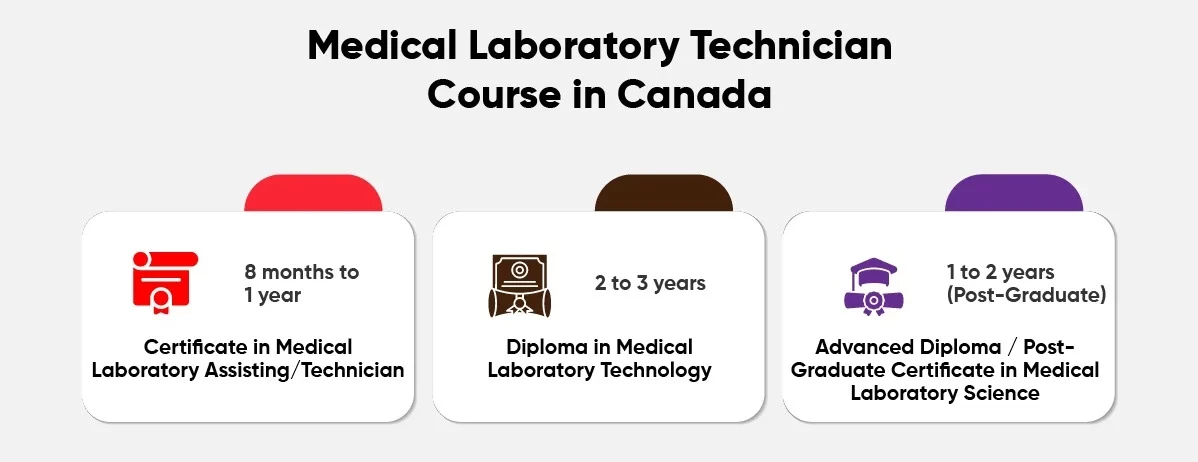
The following is a detailed analysis of each program level:
1. Certificate in Medical Laboratory Assisting/Technician
Course Duration: 8 months to 1 year
Who Should Choose This Program
Individuals who have recently completed secondary school or are transitioning into a new career and are seeking the most efficient path to a clinical laboratory environment. This is an entry-level credential that is intended to facilitate your employment in a support position.
Skills You Will Learn in a Medical Laboratory Assistant/Technician Certificate Program
- Specimen handling and blood collection (phlebotomy)
- Routine laboratory testing and basic urinalysis
- Protocols for laboratory safety and infection control
- Medical terminology and documentation
- Utilizing conventional laboratory apparatus
- Record management and patient interaction
Career Opportunities After a Medical Laboratory Assistant/Technician Certificate
- A medical laboratory assistant
- Phlebotomist
- Technician of Specimen Processing
- Laboratory Support Technician
- Specialist in Clinical Data Entry
Summary
A credential that is skills-focused and expedited, designed for individuals who wish to enter the healthcare workforce quickly and accumulate experience prior to pursuing advanced qualifications.
2. Diploma in Medical Laboratory Technology
Course Duration: 2 to 3 years
Who Should Choose This Program
Students seeking accredited training in all core lab disciplines. A diploma is the main path to national CSMLS certification and full medical laboratory technician registration in Canada. This is the most common credential for international students and one of Canada’s most competitive courses.
Skills You Will Learn in a Medical Laboratory Technology Diploma Program
- Biochemical analysis and clinical chemistry
- Hematology and coagulation studies
- Transfusion medicine and blood banks
- Parasitology and medical microbiology
- Cytology and histotechnology
- Specimen collection and phlebotomy
- Laboratory quality assurance and management
- Clinical experience in hospital laboratories that are accredited
Career Opportunities After a Diploma in Medical Laboratory Technology
- Medical Laboratory Technician
- Blood Bank Technician
- Clinical Chemistry Technician
- Microbiology Technician
- Histology Technician
- Advanced phlebotomist
Summary
Most popular medical laboratory technician course in Canada. In most provinces, graduates of accredited diploma programs must register with provincial regulatory bodies and take the CSMLS certification exam to work.
3. Advanced Diploma/Post-Graduate Certificate in Medical Laboratory Science
Course Duration: 1 to 2 years (post-graduate)
Who Should Choose This Program
International healthcare professionals, biology graduates, and diploma holders seeking Canadian specialization or upgrading. Canadian postgraduate certificates in medical laboratory science are PGWP-eligible, making them appealing to international students seeking permanent residency.
Skills You Will Learn in an Advanced Diploma/Post-Graduate Certificate in Medical Laboratory Science Program
- Diagnostics and instrumentation for sophisticated laboratories
- Point-of-Care testing and molecular biology techniques
- Laboratory information systems (LIS) management
- Quality management and research methodology
- Specialized laboratory settings for advanced clinical practicums
Career Opportunities After an Advanced Diploma/Post-Graduate Certificate in Medical Laboratory Science
- Senior Laboratory Technician
- Specialized MLT (molecular, genetic, and immunology)
- Laboratory Coordinator
- Research Technician
- Quality Assurance Specialist
Summary
Ideal for professionals seeking specialization or international credential recognition. Among the most popular medical laboratory technician courses in Canada, these programs also offer pathways to bachelor’s degrees in laboratory science.
Best Universities for Medical Laboratory Technician Course in Canada
The best colleges and institutions for medical laboratory technician courses in Canada include:
1. Michener Institute of Education at UHN — Toronto, Ontario (highly respected, hospital-affiliated program with 20-week clinical placement)
2. BCIT (British Columbia Institute of Technology) — Burnaby, British Columbia (CSMLS-accredited; all faculty members are CSMLS-certified)
3. Centennial College — Toronto, Ontario (clinical placements arranged by the college, practical focus)
4. Conestoga College — Kitchener, Ontario (recognized diploma with advanced standing options)
5. Nova Scotia Community College (NSCC) — Nova Scotia (provincial licensing pathway program that is nationally certified)
6. Algonquin College — Ottawa, Ontario (diploma and MLA/T programs, CSMLS-competency aligned)
7. Saskatchewan Polytechnic — Saskatchewan (accredited program with strong rural healthcare placement options)
8. Northern Alberta Institute of Technology (NAIT) — Edmonton, Alberta (well-equipped labs and hospital network ties)
9. Red River College Polytechnic — Winnipeg, Manitoba (diploma program with clinical practicum)
10. George Brown College — Toronto, Ontario (healthcare-focused campus with modern laboratory facilities)
Medical Lab Technician Course in Canada Requirements
The admission requirements for a medical laboratory technician course in Canada are contingent upon the institution and program level.
The following are the standard requirements for studying in-demand courses in Canada:
1. Certificate Programs
Academic Qualification
- Ontario Secondary School Diploma (OSSD) or equivalent Grade 12 qualification
- Minimum grade of 60–65% in Grade 12 Biology, Chemistry, and English (or equivalent)
English Language Proficiency
- IELTS: 6.0 overall (no band below 5.5)
- TOEFL iBT: 79–80
- Duolingo English Test: 100+ (accepted at select institutions)
Additional Requirements
- Medical/immunization documentation (hepatitis B, MMR, TB screening, and others as specified by each program’s clinical placement requirements)
- Standard First Aid and CPR-HCP certification (often required before clinical placement)
- Vulnerable Sector Background Check
2. Diploma Programs (2–3 years)
Academic Qualification
- Completion of Grade 12 or equivalent with strong science prerequisites
- Biology (Grade 12) and Chemistry (Grade 11 or 12) are typically mandatory
- Minimum average: 65–70% (varies by institution and competition for spaces)
English Language Proficiency
- IELTS: 6.0–6.5 overall (with no band below 5.5 or 6.0 depending on the institution)
- TOEFL iBT: 80–90
- PTE Academic: 58–65
Application Documents
- Certified copies of academic transcripts (translated to English or French if needed)
- Proof of English language proficiency
- Completed institutional application form
- Reference letters (some programs require one or two)
- Personal statement (some programs include this requirement)
Clinical Requirements (Pre-Placement)
- Immunization records (hepatitis B, varicella, MMR, influenza, and others as listed)
- Criminal background check (Vulnerable Sector Check)
- Standard First Aid/CPR certification
3. Post-Graduate Certificate (for International Students with Prior Degrees)
Academic Qualification
- A bachelor’s degree or a 3-year diploma in a relevant field (biology, health sciences, medical science)
- Minimum GPA of 2.7–3.0 on a 4.0 scale
English Language Proficiency
- IELTS: 6.5 overall (no band below 6.0)
- TOEFL iBT: 88 or higher
Application Documents
- Official transcripts from all prior post-secondary institutions
- Curriculum Vitae or Resume
- Statement of Purpose
- One to two letters of reference
- Proof of any relevant clinical or laboratory experience (if applicable)
Requirements for International Students (Visa and Immigration)
Study Permit
- Obtain a Letter of Acceptance (LOA) from a Designated Learning Institution (DLI)
- Apply for a Canadian Study Permit through IRCC after receiving the LOA
Proof of Funds
- Sufficient funds to cover tuition and living expenses (approximately CAD 10,000–15,000 per year in addition to tuition, depending on the province)
Medical Examination
- Required for applicants from certain countries or for programs exceeding six months
Biometrics and Additional IRCC Requirements
- Biometric data (fingerprints and photograph) are typically required
- Police clearance certificates may also be requested by IRCC
Health Insurance
- Most provinces require proof of health coverage; many institutions facilitate enrollment in student health plans upon arrival
Medical Laboratory Technician Course in Canada for International Students Fees
The average tuition fees for a Medical Laboratory Technician course in Canada range from CAD 9,500 to CAD 30,000 per year for international students, depending on the institution and program level.
| Program Level | International Tuition (CAD) | Typical Duration |
|---|---|---|
| Certificate (MLA/T) | CAD 9,500 – 15,000 total | 8–12 months |
| Diploma (2-year) | CAD 14,000 – 22,000 per year | 2 years |
| Diploma (3-year) | CAD 13,000 – 20,000 per year | 3 years |
| Post-Graduate Certificate | CAD 12,000 – 18,000 total | 1 year |
Additional Program Costs
| Cost Item | Estimated Amount (CAD) |
|---|---|
| Textbooks and Lab Manuals | CAD 800 – 1,500 |
| Lab Coats, Scrubs, and PPE | CAD 150 – 300 |
| First Aid / CPR Certification | CAD 100 – 175 |
| Immunization and Health Screening | CAD 200 – 500 |
| CSMLS Certification Exam (upon graduation) | CAD 350 – 500 |
| Criminal Background Check | CAD 50 – 100 |
Estimated Annual Living Expenses
| Expense Category | Annual Cost (CAD) |
|---|---|
| Accommodation | CAD 8,000 – 15,000 |
| Food and Groceries | CAD 4,000 – 7,000 |
| Transportation | CAD 1,500 – 3,000 |
| Books and Supplies | CAD 800 – 1,500 |
| Health Insurance | CAD 600 – 900 |
| Total (approximate) | CAD 14,900 – 27,400 |
Part-time jobs in Canada is an option for international students to mitigate these expenses. The majority of student visa holders are permitted to work up to 24 hours per week during academic sessions.
Scholarships to Study in Canada for MLT Students
International students enrolled in healthcare programs are eligible for a variety of scholarships to study in Canada
Entrance Scholarships offered by individual colleges (typically CAD 1,000–3,000)
CSMLS Foundation Awards — specific bursaries for students in accredited MLT programs
Government of Canada Scholarships — federal programs for students from specific countries
Provincial Health Workforce Incentives — several provinces offer financial incentives for students who commit to working in healthcare upon graduation
Conclusion
Canada offers a practical and rewarding path for international students interested in medical laboratory science. Accredited programs with nationally recognized credentials offer good employment prospects. Experience and specialization determine salaries between CAD 45,000 and CAD 80,000.
Canadian institutions offer programs to help you achieve your goals, whether you want a one-year certificate to speed up your workforce entry or a two-to-three-year accredited diploma for national CSMLS certification. Canadian public university or designated college graduates with PGWP-eligible MLT programs have post-graduation work rights and a direct experience pathway to Express Entry or provincial nominee programs for permanent residency.
For the most current immigration and study permit information, visit the official IRCC website at www.canada.ca/en/immigration-refugees-citizenship.html.



I intend to study Medical Laboratory Science in Canada, I have OND and HND in Science Laboratory Technology in Nigeria. How do I go about it.
Hi Rebecca,
That’s a great choice. We’re glad to help you. To assist you better send your details/resume to enquiry@canapprove.com or Book an Appointment Our overseas education experts will get back to you. Thank you!
I intend to study Medical Laboratory Science in Canada, I have OND and HND in Science Laboratory Technology in Nigeria. How do I go about it.
Hi Rebecca,
That’s a great choice. We’re glad to help you. To assist you better send your details/resume to enquiry@canapprove.com or Book an Appointment Our overseas education experts will get back to you. Thank you!
I intend to study Medical laboratory science in Canada, I have a certificate in Medical laboratory Techniques in Uganda. How do I go about it?
Hi Don,
Yes, you can explore studying Medical Laboratory Science/Technology in Canada with your Ugandan Certificate in Medical Laboratory Techniques. However, the exact admission route depends on the level and duration of your certificate, subjects studied, grades, and clinical training.
As a first step, choose a Canadian college offering a suitable Medical Laboratory Technology/Science program and check whether your Ugandan qualification meets its admission requirements. If your goal is eventually to work as a Medical Laboratory Technologist, Canada also has a professional registration process; internationally educated applicants may need a Prior Learning Assessment (PLA) and competency examinations through CAMLPR.