



Dreaming of building your tech career in Germany? You’re in good company, as software developer jobs in Germany are open to skilled professionals from around the world. Moreover, the country offers strong salaries, high demand for IT talent, and visa options like the EU Blue Card.
In this guide, you’ll find the job roles available, visa sponsorship options, salary expectations, and top hiring companies. Finally, we’ll walk you through a simple step-by-step process to land a job in Germany from India.
Table Of Content
1Are Software Developers in demand in Germany?2Software Developer Jobs in Germany3Software Developer Jobs in Germany with Visa Sponsorship4Software Developer Salary in Germany5Top 10 Software Companies in Germany6How to get a Software Developer Jobs in Germany from India7Conclusion8FAQs About Software Developer Jobs in Germany
Are Software Developers in demand in Germany?
Yes, Software developers are still in demand in Germany, although the shortage has eased compared to a few years ago. Even so, tens of thousands of IT roles remain unfilled, so software developer jobs in Germany continue to open up across many industries. Moreover, most companies still report trouble finding enough qualified IT specialists. As a result, employers are widening their search to international candidates. Therefore, a skilled software developer in Germany, especially one with cloud, backend, or embedded experience, still has strong prospects.
Why are Software Developers in Demand in Germany?
Ongoing Digitalisation: Companies in every sector, from banking to manufacturing, are moving their operations to digital systems and need developers to build them.
Ageing Workforce: Far fewer young people are entering the labour market than older workers are retiring, which leaves gaps in IT teams.
Strong Automotive and Engineering Sector: Carmakers and industrial firms rely heavily on embedded and automation software, which keeps IT jobs in Germany plentiful.
Growing Startup Ecosystem: Startups in Berlin, Munich, and Hamburg compete hard for backend, frontend, and mobile developers.
Rise of Cloud, AI, and Cybersecurity: New technologies create specialised roles that the local talent pool cannot fill fast enough.
Shortage of Local Graduates: Not enough IT students graduate each year, and Bitkom has pointed to high dropout rates as part of the problem.
Skilled Immigration Policies: Programs like the EU Blue Card and the German Opportunity Card make it easier for companies to hire developers from abroad.
Software Developer Jobs in Germany
Software developer jobs in Germany offer several specialisations, including:
- Front-End Developer
- Back-End Developer
- Full-Stack Developer
- Embedded Software Developer
- Mobile App Developer
- DevOps Engineer
- QA / Test Automation Engineer
Each specialisation offers different career opportunities depending on your technical skills, experience and interests. Let’s explore each role in detail to understand its responsibilities and career prospects.
1. Front-End Developer
A Front-End Developer builds the visual, user-facing part of websites and web applications. Moreover, they turn design mockups into responsive pages that work smoothly on every device. As a result, front-end roles are a steady part of the in demand jobs in Germany, especially in startups and e-commerce companies. Additionally, they work closely with designers and back-end teams.
Front-End Developer Job Description
- Build responsive user interfaces using HTML, CSS, and JavaScript
- Develop web applications with frameworks such as React, Angular, or Vue
- Convert UI/UX designs into working pages
- Optimise websites for speed, accessibility, and browser compatibility
- Integrate front-end code with APIs and back-end services
- Test, debug, and maintain code using Git
How to Become a Front-End Developer in Germany
1. Earn a Bachelor’s degree in Computer Science, IT, or a related field (or complete a coding bootcamp).
2. Learn HTML, CSS, JavaScript, and frameworks such as React or Angular.
3. Gain practical experience by building websites and web applications.
4. Build a portfolio showcasing your front-end projects.
5. Learn Git and responsive web design.
6. Improve your German, preferably to B1/B2 level, although English-speaking roles are also available.
7. Apply for front-end positions and secure the required work authorisation.
Front-End Developer Salary in Germany
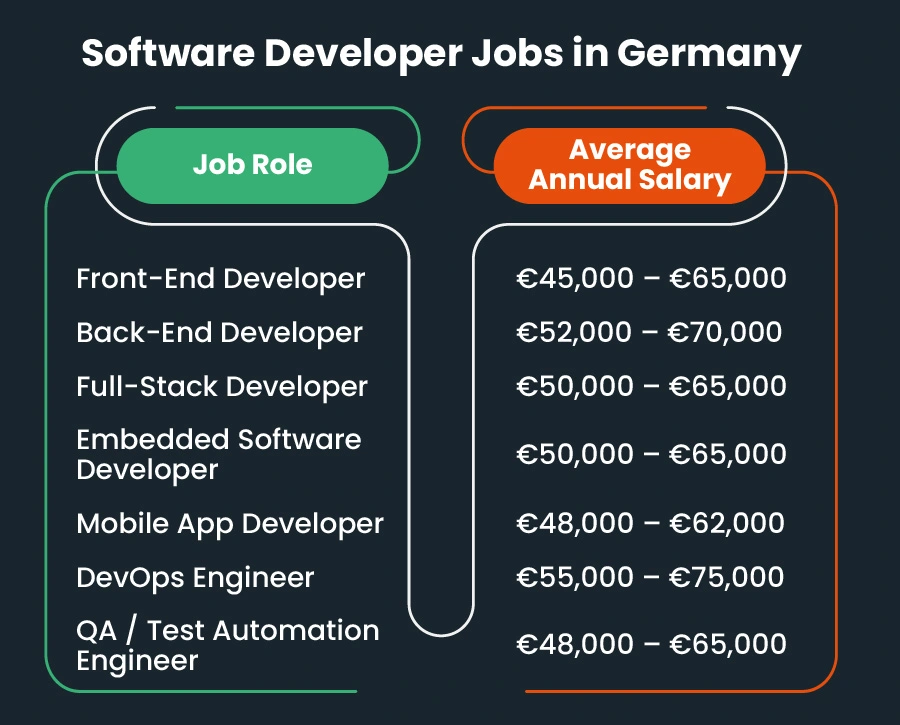
The average annual salary for a Front-End Developer in Germany generally ranges from €45,000 to €65,000, depending on skills, experience, company, and location.
Salary by Experience Level:
- Entry Level (0–2 years): €38,000–€48,000 per year
- Mid Level (3–7 years): €48,000–€62,000 per year
- Senior Level (8+ years): €66,000–€85,000+ per year
2. Back-End Developer
A Back-End Developer builds the server-side logic, databases, and APIs that power an application behind the scenes. Furthermore, they make sure data moves securely and quickly between the server and the user’s screen. Consequently, banks, insurers, and large corporations hire them heavily, which keeps software developer jobs in Germany plentiful in this area. In addition, they often work with cloud platforms.
Back-End Developer Job Description
- Design and build server-side applications and APIs
- Manage and optimise databases such as PostgreSQL, MySQL, or MongoDB
- Write clean code in languages such as Java, Python, Node.js, or C#
- Implement authentication, security, and data protection measures
- Work with front-end developers to connect user-facing features
- Monitor performance and fix bugs in live systems
How to Become a Back-End Developer in Germany
1. Earn a Bachelor’s degree in Computer Science, Software Engineering, or a related field.
2. Learn a back-end language such as Java, Python, Node.js, or C#.
3. Understand databases, SQL, and REST API design.
4. Build projects such as APIs and database-driven applications.
5. Learn Git, Docker, and basic cloud services.
6. Improve your German skills, preferably to B1/B2 level, although English-speaking roles exist.
7. Apply for back-end positions and obtain the required work authorisation.
Back-End Developer Salary in Germany
The average annual salary for a Back-End Developer in Germany generally ranges from €52,000 to €70,000, depending on skills, experience, company, and location.
Salary by Experience Level:
- Entry Level (0–2 years): €38,000–€50,000 per year
- Mid Level (3–7 years): €52,000–€65,000 per year
- Senior Level (8+ years): €67,000–€80,000+ per year
3. Full-Stack Developer
A Full-Stack Developer works on both the front end and the back end of an application. Therefore, they can take a feature from the database all the way to the user’s screen. Moreover, startups and small teams value this flexibility because one person can cover several tasks. Consequently, full-stack roles are a popular entry point into software development in Germany.
Full-Stack Developer Job Description
- Build both user interfaces and server-side logic
- Work with technology stacks such as MERN, MEAN, or Java with Angular
- Design databases and develop REST or GraphQL APIs
- Deploy and maintain applications on cloud platforms
- Write tests and review code with the team
- Translate business requirements into complete features
How to Become a Full-Stack Developer in Germany
1. Earn a Bachelor’s degree in Computer Science, IT, or a related field.
2. Learn front-end technologies (HTML, CSS, JavaScript, React or Angular).
3. Learn a back-end language and database skills (Node.js, Java, or Python with SQL).
4. Build complete end-to-end projects and publish them on GitHub.
5. Learn Docker, CI/CD basics, and cloud deployment.
6. Improve your German, preferably to B1/B2 level, although English-speaking opportunities are available.
7. Apply for full-stack positions and obtain the required work authorisation.
Full-Stack Developer Salary in Germany
The average annual salary for a Full-Stack Developer in Germany generally ranges from €50,000 to €65,000, depending on skills, experience, company, and location.
Salary by Experience Level:
- Entry Level (0–2 years): €35,000–€48,000 per year
- Mid Level (3–7 years): €48,000–€62,000 per year
- Senior Level (8+ years): €65,000–€80,000+ per year
4. Embedded Software Developer
An Embedded Software Developer writes the code that runs inside hardware such as cars, medical devices, and industrial machines. In addition, they work closely with electronics engineers to make software and hardware function as one system. Because of Germany’s strong automotive and manufacturing industries, embedded software developer jobs in Germany are always in demand. As a result, this role is among the better-paid specialisations.
Embedded Software Developer Job Description
- Develop firmware and software for microcontrollers and embedded systems
- Write low-level code in C and C++
- Work with real-time operating systems (RTOS) and hardware interfaces
- Test and debug software on real devices
- Follow safety standards in automotive and industrial projects
- Collaborate with hardware and electronics engineers
How to Become an Embedded Software Developer in Germany
1. Earn a Bachelor’s or Master’s degree in Computer Science, Electronics, or Electrical Engineering.
2. Learn C and C++ along with microcontroller programming.
3. Understand RTOS, communication protocols such as CAN, and hardware basics.
4. Build hands-on projects using Arduino, Raspberry Pi, or STM32 boards.
5. Learn Git and debugging tools used in embedded work.
6. Improve your German skills, since many automotive employers prefer B1/B2 level.
7. Apply to automotive and industrial companies and obtain the required work authorisation.
Embedded Software Developer Salary in Germany
The average annual salary for an Embedded Software Developer in Germany generally ranges from €50,000 to €65,000, depending on skills, experience, company, and location.
Salary by Experience Level:
- Entry Level (0–2 years): €42,000–€52,000 per year
- Mid Level (3–7 years): €55,000–€66,000 per year
- Senior Level (8+ years): €65,000–€80,000 per year
5. Mobile App Developer
A Mobile App Developer designs and builds apps for Android and iOS devices. Moreover, they make sure those apps run smoothly, look good, and stay secure. Meanwhile, banks, mobility startups, and retail companies in Germany keep investing in their apps, so demand remains steady. Additionally, cross-platform skills make candidates more attractive.
Mobile App Developer Job Description
- Build and maintain apps for Android (Kotlin/Java) or iOS (Swift)
- Develop cross-platform apps using Flutter or React Native
- Connect apps to back-end services through APIs
- Optimise app performance, battery usage, and security
- Test apps on multiple devices and fix bugs
- Publish and update apps on the Google Play Store and Apple App Store
How to Become a Mobile App Developer in Germany
1. Earn a Bachelor’s degree in Computer Science, IT, or a related field.
2. Learn Kotlin for Android, Swift for iOS, or a cross-platform framework such as Flutter.
3. Understand mobile UI design guidelines and app architecture.
4. Build and publish sample apps to create a portfolio.
5. Learn Git, API integration, and app testing.
6. Improve your German, preferably to B1/B2 level, although English-speaking roles are available.
7. Apply for mobile developer positions and obtain the required work authorisation.
Mobile App Developer Salary in Germany
The average annual salary for a Mobile App Developer in Germany generally ranges from €48,000 to €62,000, depending on skills, experience, company, and location.
Salary by Experience Level:
- Entry Level (0–2 years): €38,000–€48,000 per year
- Mid Level (3–7 years): €48,000–€62,000 per year
- Senior Level (8+ years): €62,000–€75,000 per year
6. DevOps Engineer
A DevOps Engineer connects development and operations teams so software can be built, tested, and released quickly and reliably. Furthermore, they automate infrastructure and deployments, which reduces errors and downtime. Therefore, companies moving to the cloud rely on them heavily. As a result, DevOps is one of the higher-paying software developer jobs in Germany.
DevOps Engineer Job Description
- Build and manage CI/CD pipelines for automated testing and deployment
- Manage cloud infrastructure on AWS, Azure, or Google Cloud
- Use tools such as Docker, Kubernetes, and Terraform
- Monitor systems and respond to performance or uptime issues
- Automate repetitive tasks using scripts
- Improve security and reliability across environments
How to Become a DevOps Engineer in Germany
1. Earn a Bachelor’s degree in Computer Science, IT, or a related field.
2. Learn Linux, networking basics, and a scripting language such as Python or Bash.
3. Learn Docker, Kubernetes, and CI/CD tools such as Jenkins or GitLab CI.
4. Gain hands-on experience with a cloud platform and earn a certification (AWS, Azure, or GCP).
5. Practice infrastructure as code with tools such as Terraform.
6. Improve your German skills, preferably to B1/B2 level, although English-speaking roles are available.
7. Apply for DevOps positions and obtain the required work authorisation.
DevOps Engineer Salary in Germany
The average annual salary for a DevOps Engineer in Germany generally ranges from €55,000 to €75,000, depending on skills, experience, company, and location.
Salary by Experience Level:
- Entry Level (0–2 years): €36,000–€48,000 per year
- Mid Level (3–7 years): €58,000–€72,000 per year
- Senior Level (8+ years): €70,000–€90,000 per year
7. QA / Test Automation Engineer
A QA / Test Automation Engineer makes sure software works properly before it reaches users. In addition, they write automated tests that catch bugs early, which saves time and money. Consequently, this role suits people who enjoy both coding and problem-solving. Moreover, it is a practical entry route into software developer jobs in Germany.
QA / Test Automation Engineer Job Description
- Create test plans and test cases based on requirements
- Write automated test scripts using tools such as Selenium, Cypress, or Playwright
- Run regression tests and report bugs clearly
- Integrate automated tests into CI/CD pipelines
- Work with developers to reproduce and fix issues
- Check performance, security, and usability of applications
How to Become a QA / Test Automation Engineer in Germany
1. Earn a Bachelor’s degree in Computer Science, IT, or a related field.
2. Learn software testing fundamentals and the software development lifecycle.
3. Learn a programming language such as Java, Python, or JavaScript.
4. Practise with test automation tools like Selenium, Cypress, or Playwright.
5. Consider an ISTQB certification to stand out.
6. Improve your German, preferably to B1/B2 level, although English-speaking roles are available.
7. Apply for QA positions and obtain the required work authorisation.
QA / Test Automation Engineer Salary in Germany
The average annual salary for a QA / Test Automation Engineer in Germany generally ranges from €48,000 to €65,000, depending on skills, experience, company, and location.
Salary by Experience Level:
- Entry Level (0–2 years): €38,000–€50,000 per year
- Mid Level (3–7 years): €52,000–€62,000 per year
- Senior Level (8+ years): €62,000–€78,000 per year
Software Developer Jobs in Germany with Visa Sponsorship
Popular software developer jobs in Germany with visa sponsorship include:
1. Front-End Developer
2. Back-End Developer
3. Full-Stack Developer
4. Java Developer
5. Python Developer
6. Mobile App Developer
7. DevOps Engineer
8. Software Engineer
Companies in IT, automotive, finance, telecommunications, e-commerce, and software services all hire developers from abroad.
Local talent alone cannot meet Germany’s demand for technical skills, so employers look overseas to keep their digital projects moving. Consequently, suitable candidates may be offered a contract that backs their visa application, a strong salary, help with relocation, and room to grow. Keep in mind that Germany has no separate sponsorship fee. Instead, the employer simply supplies a job contract that satisfies the visa rules.
Applicants from outside the EU are judged on their academic background, programming ability, specialist knowledge, and past experience. Therefore, a solid portfolio can strengthen your case considerably.
A degree in Computer Science, Software Engineering, or IT usually forms the basis of an application, although equivalent training and experience can also count. Notably, IT professionals without a degree can still obtain an EU Blue Card if they have worked in IT for three of the past seven years.
German is not needed for every developer position. Multinational firms, startups, and tech companies often hire English-speaking developers, particularly for international teams. Furthermore, the IT specialist visa route no longer demands German, although each employer sets its own language expectations.
Software Developer Salary in Germany
The average salary of software developer in Germany is about €5,000 to €5,500 per month before tax.
Moreover, developers with advanced skills and experience can earn far more, since senior software engineers typically make between about €71,000 and €96,000 a year. As a result, software developer jobs in Germany reward those who keep upgrading their expertise. Therefore, building in-demand skills is one of the surest ways to raise your pay.
Factors That Influence a Software Developer’s Salary in Germany
Experience Level: Pay climbs steadily as you move from junior to mid-level to senior roles.
Location: Cities such as Berlin, Munich, and Frankfurt generally pay more because they host many large tech companies and startups.
Company and Skills: Large corporations such as SAP tend to pay noticeably more than smaller employers like online retailers. Moreover, skills like cloud, security, and reliability engineering can command a premium. Therefore, pairing a strong employer with in-demand skills gives you the best chance of a top salary.
Industry: IT specialists in automotive manufacturing and supply earn the highest salaries.
Job Role and Specialisation: Specialised roles such as software architect average well above QA and mobile developer positions.
Education and Qualifications: Salaries can differ by around €10,000 a year between developers with an apprenticeship and those with a Master’s degree.
German Language Skills: Local language ability can add a premium for junior developers, in some cases close to 9%.
Top 10 Software Companies in Germany
These ten companies are among the top employers for software developers in Germany:
1. SAP
2. Siemens
3. Bosch
4. Deutsche Telekom
5. Celonis
6. TeamViewer
7. Nemetschek
8. Zalando
9. Delivery Hero
10. Cariad
How to get a Software Developer Jobs in Germany from India
Follow these 7 simple steps to get a Software Developer Jobs in Germany from India:
Step 1: Choose Your Visa Route
Decide between the EU Blue Card, which needs a job offer, and the German Opportunity Card, which lets you job hunt in Germany for up to 12 months without one. Moreover, the Opportunity Card requires at least six points under its points system.
Step 2: Prepare Your Profile
Update your CV, build a portfolio or GitHub page, and strengthen in-demand skills such as cloud, DevOps, or backend development. As a result, recruiters can see your value quickly.
Step 3: Search on Job Sites in Germany
Start with the official Make it in Germany portal and the Federal Employment Agency’s job board. Then add LinkedIn, StepStone, Indeed, and XING, and filter for English-speaking jobs in Germany.
Step 4: Secure a Job Offer
Attend interviews and ask for a signed contract that states your job title, salary, and start date. Importantly, the fixed base salary must meet the 2026 Blue Card threshold, which is €45,934.20 for IT specialists.
Step 5: Check Your Degree Recognition
Verify your degree in the Anabin database. If it doesn’t match, request a ZAB statement, which usually takes only about two weeks for Blue Card applications.
Step 6: Apply for Your Visa in India
Submit your documents at the German Embassy in New Delhi or a German consulate in India, then wait for a decision. Since work visas typically take a few weeks, apply as early as possible.
Step 7: Move and Register in Germany
After arriving, register your address and book an appointment with the local Foreigners’ Authority to receive your Blue Card.
Conclusion
Software developer jobs in Germany remain a strong career option, since demand for skilled developers is still high and salaries are competitive. Moreover, visa routes such as the EU Blue Card and the German Opportunity Card make it easier for Indian professionals to move. Therefore, building in-demand skills, preparing a strong profile, and applying early can improve your chances considerably. Finally, for official guidance on visas, job listings, and qualification recognition, visit the Make it in Germany website.