




Canada is home to some of the world’s most respected universities, and many of them belong to the U15 Universities in Canada group. These institutions are known for academic excellence, strong research programs, and global recognition.
For international students, U15 Universities in Canada offer quality education, modern facilities, and courses that prepare students for real career opportunities. In this blog, we’ll cover what U15 universities are, the list of institutions, rankings, popular courses, application process, fees, and key details to help you choose the right university in Canada.
Table Of Content
1What is a U15 University in Canada?2List of U15 Universities in Canada3U15 Universities Ranking4Best Courses in U15 Universities in Canada5How to Apply to U15 Universities in Canada6U15 Universities in Canada Fees7Conclusion8Frequently Asked Questions
What is a U15 University in Canada?
A U15 university in Canada is one of the country’s 15 leading public research universities. Formed in 1991 and based in Ottawa, the U15 Group represents universities known for academic excellence and strong research output. Together, they conduct nearly 80% of Canada’s university research, worth over $5 billion annually.
Key Role of U15 Universities:
- Lead research and innovation in Canada
- Produce over 70% of the country’s PhD graduates
- Contribute about C$36 billion to the Canadian economy
List of U15 Universities in Canada
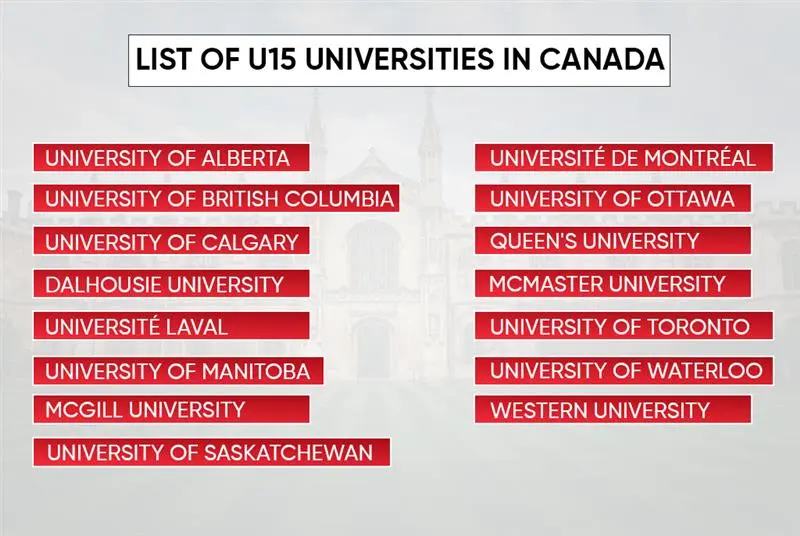
Below is the Complete list of U15 universities in Canada:
1. University of Alberta (Alberta)
2. University of British Columbia (British Columbia)
3. University of Calgary (Alberta)
4. Dalhousie University (Nova Scotia)
5. Université Laval (Quebec)
6. University of Manitoba (Manitoba)
7. McGill University (Quebec)
8. McMaster University (Ontario)
9. Université de Montréal (Quebec)
10. University of Ottawa (Ontario)
11. Queen’s University (Ontario)
12. University of Saskatchewan (Saskatchewan)
13. University of Toronto (Ontario)
14. University of Waterloo (Ontario)
15. Western University (Ontario)
U15 Universities Ranking
U15 universities in Canada consistently rank among the top public universities in Canada and across the world. These rankings reflect their strong academic standards, research excellence, and global reputation in 2026.
| University | QS Rank |
|---|---|
| McGill University | 27 |
| University of Toronto | 29 |
| University of British Columbia | 40 |
| University of Alberta | 94 |
| University of Waterloo | 119 |
| Western University | 151 |
| Université de Montréal | 168 |
| McMaster University | 173 |
| Queen’s University | 191 |
| University of Calgary | 211 |
| University of Ottawa | 219 |
| Dalhousie University | 283 |
| University of Saskatchewan | 378 |
| Université Laval | 469 |
| University of Manitoba | 643 |
Best Courses in U15 Universities in Canada
The best courses in U15 universities in Canada are offered in major fields such as Engineering & Technology, Business & Management, Health & Life Sciences, Computer Science & IT, Arts & Social Sciences, and Natural & Applied Sciences.
1. Engineering & Technology
Best Courses: Mechanical Engineering, Civil Engineering, Electrical Engineering, Software Engineering, Artificial Intelligence (AI), and Data Science.
These courses combine practical learning with advanced research, giving students hands-on experience and exposure to the latest technologies. Graduates can build careers in engineering, technology development, and research-driven industries.
2. Computer Science & IT
Best Courses: Computer Science, Artificial Intelligence, Data Science, Cybersecurity, Software Engineering, Machine Learning, and Information Systems.
Programs focus on coding skills, AI innovation, and real-world projects, helping students prepare for fast-growing tech careers.
3. Business & Management
Best Courses: Business Administration, MBA, Finance, Marketing, Accounting, International Business, and Entrepreneurship.
These programs often include co-op opportunities and case-based learning, preparing students for leadership roles and global business careers.
4. Health & Life Sciences
Best Courses: Medicine, Nursing, Health Sciences, Biotechnology, Pharmacy, Public Health, and Kinesiology.
Students gain strong clinical exposure and research training, opening doors to careers in healthcare, research, and life sciences.
5. Natural & Applied Sciences
Best Courses: Physics, Chemistry, Biology, Environmental Science, Forestry, Agriculture, and Earth Sciences.
These research-focused programs help students build careers in scientific research, environmental studies, and applied sciences.
6. Arts & Social Sciences
Best Courses: Law, Psychology, Economics, Political Science, Sociology, and International Relations.
These courses develop critical thinking and communication skills, preparing students for careers in law, public policy, research, and social services.
How to Apply to U15 Universities in Canada
Here’s a step-by-step process to apply to U15 universities in Canada:
1. Research and Shortlist
Start by choosing your program, study level (UG or PG), and intake. Shortlist 3–6 U15 universities and check their entry requirements, including GPA, subject background, and English-language scores like IELTS or TOEFL.
2. Check Eligibility and Deadlines
Undergraduate students should confirm required subjects and minimum marks. Postgraduate applicants need to check degree requirements, GPA, and extras like work experience or research proposals. Deadlines usually vary by program.
3. Prepare Your Documents
Common documents include academic transcripts, passport, English test scores, SOP, CV, and recommendation letters. Master’s and PhD applicants may also need a research statement and supervisor details.
4. Apply Online
Create an account on the university’s application portal, fill in details, upload documents, and pay the application fee. Make sure all information is accurate before submitting.
5. Track and Accept Offer
Check your email and portal for updates. If selected, you’ll receive a conditional or final offer, which you must accept within the given deadline.
6. Arrange Finances and Apply for Visa
After receiving the Letter of Acceptance, arrange funds and apply for a Canadian study permit using your offer letter and financial proof.
7. Plan Your Arrival
Book accommodation, register for courses, and plan travel to arrive in time for orientation and campus welcome sessions.
U15 Universities in Canada Fees
The U15 universities in Canada fees range between CAD 35,000–45,000 per year for international students, depending on the program, level of study, and university.
Understanding the fee structure in advance, along with exploring scholarships to study in Canada, like merit-based awards and research assistantships worth CAD 5,000 – 50,000, helps students plan their budget with more confidence and clarity.
1. Overall Fee Range
- U15 universities usually cost about CAD 30,000–40,000 per year in tuition for international students, depending on program and study level.
2. Undergraduate Programs
- Tuition generally ranges from CAD 25,000 to CAD 45,000 per year.
- Programs such as Engineering, Computer Science, and Business tend to be at the higher end of this range.
3. Graduate Programs (Master’s & PhD)
- Fees are commonly CAD 18,000 to CAD 50,000 per year.
- Research‑intensive programs, MBAs, and specialized technology courses may be more expensive due to lab or project costs.
4. Other Living Costs
- Students should also budget CAD 15,000 to CAD 20,000 per year for accommodation, food, transport, books, and health insurance.
5. Scholarships and Financial Aid
- Many U15 universities offer merit scholarships, research assistantships, and financial aid to international students, which can reduce the total cost of study.
Conclusion
U15 universities in Canada are a great choice for students seeking quality Canada Education and strong career opportunities, especially in In Demand Courses in Canada. With proper planning and the right information, studying at one of these universities can be a meaningful step toward building a successful future in Canada.
Visit the official U15 website for detailed information.
Frequently Aasked Questions


I NEED MENTORSHIP ON HOW TO APPLY
Hi Godwin,
Thank you for reaching out.
Please share your qualifications and experience, and we’ll assist you further. BOOK A FREE CONSULTATION NOW!
I will love to apply for medicine
Hi Owhe,
Thank you for reaching out.
We can guide you through the most suitable study visa options and help you explore opportunities that align with your educational background and career goals.
Please share your qualifications and experience, and we’ll assist you further. BOOK A FREE CONSULTATION NOW!