




Each year, the United Kingdom is the most frequently chosen destination for international students to pursue their studies abroad. British public universities have a long history of academic prestige and conduct cutting-edge research. They enroll hundreds of thousands of international students in undergraduate and postgraduate programs. The United Kingdom government provides funding for public universities and public universities in the UK with low tuition fees are highly popular among the international students.
This is a comprehensive guide to public universities in the UK that offer affordable tuition rates. It also encompasses the top 10 acceptance rates, fees, and admission requirements. This list consists of the Best Universities in The UK and will assist you in identifying the appropriate university for your academic aspirations and financial constraints, regardless of whether you are drawn to the Gothic spires of Oxford, the research hub of Imperial College London, or the vibrant student community of Manchester.
Table Of Content
1List of Public Universities in UK2Top 10 Public Universities in the UK3Conclusion4Frequently Asked Questions
List of Public Universities in UK
The list of public universities in the UK includes:
- University of Oxford
- University of Cambridge
- Imperial College London
- University College London (UCL)
- King’s College London
- London School of Economics and Political Science (LSE)
- The University of Edinburgh
- The University of Manchester
- University of Bristol
- University of Glasgow
- University of Birmingham
- University of Leeds
- University of Southampton
- University of Nottingham
- University of Sheffield
- Newcastle University
- Cardiff University
- Queen Mary University of London
- University of York
- University of Liverpool
- Queen’s University Belfast
- University of Exeter
- University of Reading
- University of Leicester
- University of Sussex
- Lancaster University
- University of East Anglia
- Durham University
- University of Bath
- Loughborough University
- University of Surrey
- Swansea University
- Aston University
- Coventry University
- University of Portsmouth
- Nottingham Trent University
- Oxford Brookes University
- Manchester Metropolitan University
- University of Greenwich
- University of West London
So, public universities in UK for a master’s are a natural choice for many international students.
Top 10 Public Universities in the UK
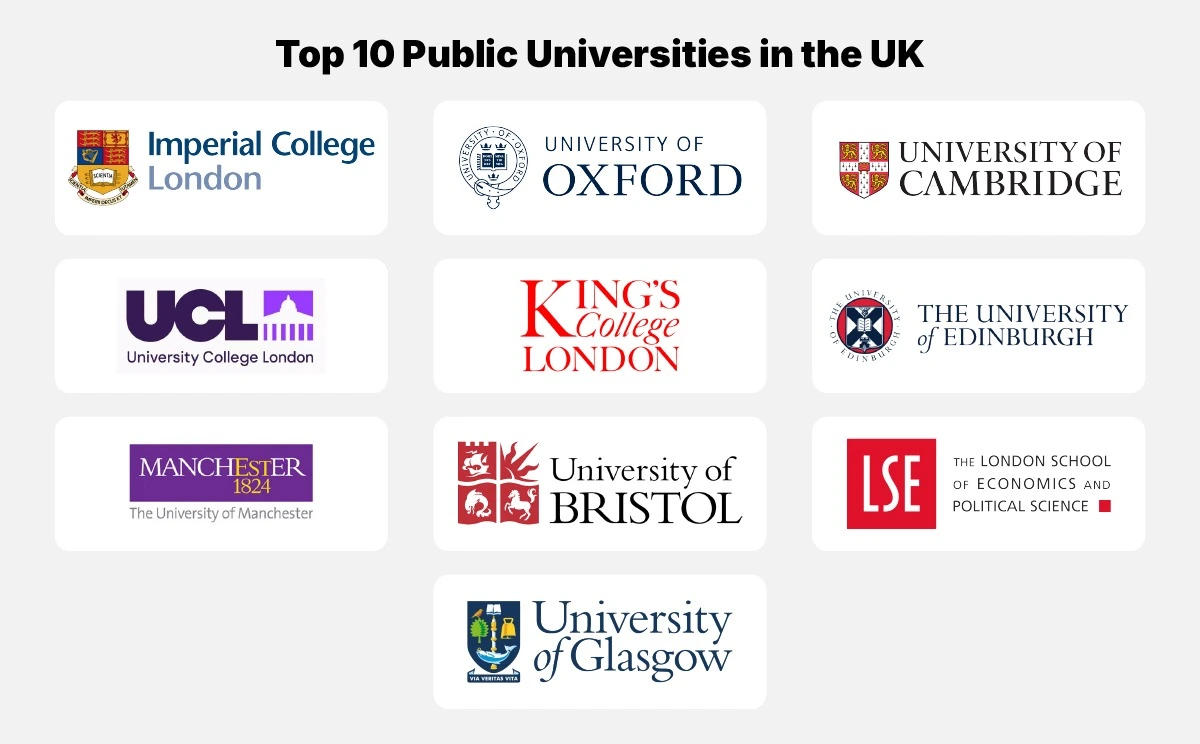
According to the QS World University Rankings 2026, one of the most widely recognized global university ranking systems for prospective international students, here are the top 10 public universities in the UK:
1. Imperial College London
Location: South Kensington, London, England, United Kingdom
QS Ranking: #2 (QS World University Rankings 2026)
Imperial College London is a university that specializes in science, engineering, medicine, and business. It is currently ranked higher than both Oxford and Cambridge on a global scale. It is the optimal choice for students who desire a STEM-focused, research-intensive environment in the heart of London.
Best Courses at Imperial College London
- Medicine
- Mechanical Engineering
- Computer Science
- Electrical and Electronic Engineering
- Chemical Engineering
- Physics
- Biomedical Engineering
- Business (Imperial College Business School)
- Mathematics
Imperial College London Admission Requirements for International Students
Academic Score: Typically a score of 90% or higher, in addition to strong grades in pertinent science and mathematics subjects.
Degree: A relevant secondary qualification (Bachelor’s) or bachelor’s degree (Master’s)
English Proficiency: IELTS 6.5–7.5 or TOEFL iBT 92–100+ depending on course
Program Requirements: Many courses require the Imperial Admissions Test, portfolio, or interview
Documents: Academic transcripts, personal statement, references, passport, English proficiency certificate
Imperial College London Fees for International Students
The average tuition fee at Imperial College London for international students ranges from £38,000 to £45,000 per year, depending on the program. Some medicine and clinical programs cost more than £60,000 per year. In addition to tuition fees, students should budget for accommodation and other living expenses.
Medicine & Clinical Courses: Up to £60,000+ per year
Living Expenses: Approximately £15,000–£18,000 per year
Imperial College London Acceptance Rate
Imperial College London has an acceptance rate of around 10–14%, making it one of the UK’s most competitive universities, particularly for medicine and engineering.
2. University of Oxford
Location: Oxford, England, United Kingdom
QS Ranking: #4 (QS World University Rankings 2026)
The University of Oxford is one of the most prestigious public universities in the world and the oldest English-speaking university. The University of Oxford, established in 1096, is renowned for its exceptional academic standing, world-class research, and wonderful teaching. Each year, Oxford’s undergraduate and postgraduate programs in a wide range of disciplines draw thousands of international students.
Best Courses at the University of Oxford
- Medicine
- Law
- Computer Science
- Business and Management
- Economics
- Engineering
- Mathematics
- Psychology
- Philosophy, Politics, and Economics (PPE)
- English Language and Literature
Oxford University Admission Requirements for International Students
Academic Score: generally 90-95% or equivalent in previous qualifications
Education level: Secondary education for Bachelor’s, Bachelor’s degree for Master’s
English Proficiency: IELTS 7.0–7.5 or TOEFL iBT 100–110+ (depending on the course)
Program Requirements: Have to meet certain academic requirements for the course and may have to take entrance tests and interviews
Documents: Academic transcripts, SOP, LORs, passport, CV (if required) and English language proficiency certificate
Oxford University Fees for International Students
The average tuition fee at the University of Oxford for international students ranges from £35,000 to £60,000 per year, depending on the program. Medicine and clinical courses generally have higher tuition fees. Students should also budget for accommodation and living expenses.
Medicine & Clinical Courses: Up to £85,000 per year
Living Expenses: Approximately £15,000–£20,000 per year
University of Oxford Acceptance Rate
The University of Oxford has an acceptance rate of around 15–17%, contingent upon the course. Admission is exceedingly competitive. The University of Oxford evaluates applicants based on academic excellence, interviews, entrance examinations (if applicable), and the overall strength of the application.
3. University of Cambridge
Location: Cambridge, England, United Kingdom
QS Ranking: #6 (QS World University Rankings 2026)
Cambridge is Oxford’s historic rival and one of the most research-intensive universities in the world, structured around 31 individual colleges. It’s especially renowned for natural sciences, mathematics, engineering, and economics and is consistently among the best public universities in the UK.
Best Courses at the University of Cambridge
- Natural Sciences
- Engineering
- Economics
- Law
- Computer Science
- Medicine
- Mathematics
- Land Economy
- Architecture
University of Cambridge Admission Requirements for International Students
Academic Score: Generally 90%+ or top percentile in national qualifications
Degree: Relevant secondary qualification (Bachelor’s) or bachelor’s degree (Master’s)
English Proficiency: IELTS 7.0–7.5 or TOEFL iBT 100–110+
Program Requirements: Subject-specific admissions tests and a college interview are standard
Documents: Transcripts, SOP, references, passport, English proficiency certificate
University of Cambridge Fees for International Students
The average tuition fee at the University of Cambridge for international students ranges from £36,000 to £63,000 per year, depending on the program.
Medicine & Clinical Courses: Up to £80,000+ per year
Living Expenses: Approximately £13,000–£16,000 per year
University of Cambridge Acceptance Rate
The University of Cambridge has an acceptance rate of around 17–21%, although the level of competition varies significantly by course and college.
4. University College London (UCL)
Location: Bloomsbury, London, England, United Kingdom
QS Ranking: #9 (QS World University Rankings 2026)
UCL is the largest and most diverse public university in London, with an international student population that accounts for nearly half of its student body. It is recognized for its comprehensive, multidisciplinary academic program.
Best Courses at University College London
- Architecture (Bartlett School)
- Law
- Medicine
- Economics
- Psychology
- Engineering
- Education
- Life Sciences
- Arts and Humanities
University College London Admission Requirements for International Students
Academic Score: Generally 85–90%+ or equivalent
Degree: Relevant secondary qualification (Bachelor’s) or bachelor’s degree (Master’s)
English Proficiency: IELTS 6.5–7.5 or TOEFL iBT 92–109 depending on course
Program Requirements: Some courses require portfolios, additional tests, or interviews
Documents: Transcripts, SOP, references, passport, English proficiency certificate
University College London Fees for International Students
The average tuition fee at University College London (UCL) for international students ranges from £28,000 to £40,000 per year, depending on the program. Tuition fees for medical and clinical courses typically exceed £55,000 per year.
Medicine & Clinical Courses: Up to £55,000+ per year
Living Expenses: Approximately £15,000–£18,000 per year (London-based), and part-time jobs in the UK offer help in this regard.
University College London Acceptance Rate
University College London (UCL) has an acceptance rate of around 35–40%, making it more accessible than Imperial College London and Oxbridge while remaining one of the world’s leading universities.
5. King’s College London (KCL)
Location: Central London, England, United Kingdom
QS Ranking: #31 (QS World University Rankings 2026)
King’s College London, with its central London location near government and industry hubs, is one of the founding colleges of the University of London. The college is particularly strong in health sciences, law, and international relations.
Best Courses at King’s College London
- Medicine and Dentistry
- Law
- International Relations
- Nursing and Healthcare Courses
- Psychology
- Business (King’s Business School)
- Biomedical Sciences
King’s College London Admission Requirements for International Students
Academic Score: Generally 80–88%+ or equivalent
Degree: Relevant secondary qualification (Bachelor’s) or bachelor’s degree (Master’s)
English Proficiency: IELTS 6.5–7.5 or TOEFL iBT 92–100+
Program Requirements: Health-related courses often require additional admissions tests and interviews
Documents: Transcripts, SOP, references, passport, English proficiency certificate
King’s College London Fees for International Students
The average tuition fee at King’s College London for international students ranges from £27,000 to £38,000 per year, depending on the program. Tuition fees for medical and clinical courses typically exceed £58,000 per year.
Medicine & Clinical Courses: Up to £58,000+ per year
Living Expenses: Approximately £14,000–£17,000 per year
King’s College London Acceptance Rate
King’s College London has an acceptance rate of around 25–30%, with health science courses being the most competitive.
6. The University of Edinburgh
Location: Edinburgh, Scotland, United Kingdom
QS Ranking: #34 (QS World University Rankings 2026)
The University of Edinburgh, Scotland’s premier public university, was founded in 1583 and is one of the oldest universities in the English-speaking world. It is renowned for its sustainability initiatives and research output, and it draws a substantial international community.
Best Courses at the University of Edinburgh
- Veterinary Medicine
- Law
- Informatics and Computer Science
- Medicine
- Business
- Psychology
- Artificial Intelligence
University of Edinburgh Admission Requirements for International Students
Academic Score: Generally 80–90%+ or equivalent
Degree: Relevant secondary qualification (Bachelor’s) or bachelor’s degree (Master’s)
English Proficiency: IELTS 6.5–7.0 or TOEFL iBT 92–100+
Program Requirements: Some courses require portfolios or additional assessments
Documents: Transcripts, SOP, references, passport, English proficiency certificate
University of Edinburgh Fees for International Students
The average tuition fee at the University of Edinburgh for international students ranges from £24,000 to £35,000 per year, depending on the program. Tuition fees for medical and veterinary programs typically exceed £50,000 per year.
Medicine & Veterinary Courses: Up to £50,000+ per year
Living Expenses: Approximately £12,000–£15,000 per year
University of Edinburgh Acceptance Rate
The University of Edinburgh has an acceptance rate of around 40–45%, which makes it more accessible than the majority of the universities mentioned above while maintaining a strong global reputation. It is a viable alternative when comparing public universities in the United Kingdom with low tuition fees relative to their rankings.
7. The University of Manchester
Location: Manchester, England, United Kingdom
QS Ranking: #35 (QS World University Rankings 2026)
Manchester is a public university in the United Kingdom that has a long history of scientific breakthroughs, including the study of graphene. It is one of the largest in terms of student population. It is a favored option for students who desire a diverse, expansive campus in a major UK city outside of London.
Best Courses at the University of Manchester
- Chemical Engineering
- Materials Science
- Business (Alliance Manchester Business School)
- Computer Science
- Medicine
- Law
- Pharmacy
University of Manchester Admission Requirements for International Students
Academic Score: Generally 75–85%+ or equivalent
Degree: Relevant secondary qualification (Bachelor’s) or bachelor’s degree (Master’s)
English Proficiency: IELTS 6.0–7.0 or TOEFL iBT 87–100+
Program Requirements: Course-specific requirements; some need portfolios or interviews
Documents: Transcripts, SOP, references, passport, English proficiency certificate
University of Manchester Fees for International Students
The average tuition fee at the University of Manchester for international students ranges from £24,000 to £33,000 per year, depending on the program. Tuition fees for medical courses are typically elevated, with certain programs exceeding £50,000 annually.
Medicine Courses: Up to £50,000+ per year
Living Expenses: Approximately £11,000–£14,000 per year
University of Manchester Acceptance Rate
The University of Manchester has an acceptance rate of around 50–56%, making it one of the more accessible large research universities in the UK.
8. University of Bristol
Location: Bristol, England, United Kingdom
QS Ranking: #51 (QS World University Rankings 2026)
A Russell Group university, the University of Bristol is renowned for its robust engineering, sciences, and social sciences departments, as well as its vibrant student city, which consistently achieves high levels of student satisfaction.
Best Courses at the University of Bristol
- Aerospace Engineering
- Law
- Economics
- Computer Science
- Biological Sciences
- Psychology
- Chemistry
University of Bristol Admission Requirements for International Students
Academic Score: Generally 75–85%+ or equivalent
Degree: Relevant secondary qualification (Bachelor’s) or bachelor’s degree (Master’s)
English Proficiency: IELTS 6.5–7.0 or TOEFL iBT 90–100+
Program Requirements: Course-specific requirements; interviews for select programs
Documents: Transcripts, SOP, references, passport, English proficiency certificate
University of Bristol Fees for International Students
The average tuition fee at the University of Bristol for international students ranges from £24,000 to £32,000 per year, depending on the program. In general, the tuition fees for medicine and veterinary courses are higher, with some programs costing over £48,000 annually.
Medicine & Veterinary Courses: Up to £48,000+ per year
Living Expenses: Approximately £11,000–£14,000 per year
University of Bristol Acceptance Rate: Bristol’s acceptance rate is estimated to be between 55% and 60%.
9. London School of Economics and Political Science (LSE)
Location: Central London, England, United Kingdom
QS Ranking: #56 (QS World University Rankings 2026)
LSE is a specialized social sciences institution that is consistently recognized as a global top-10 name in economics, politics, and law, despite its relatively modest overall QS position, which is partly due to its non-STEM focus.
Best Courses at London School of Economics and Political Science
- Economics
- Law
- International Relations
- Finance
- Politics
- Sociology
- Management
LSE Admission Requirements for International Students
Academic Score: Generally 88–95%+ or equivalent
Degree: Relevant secondary qualification (Bachelor’s) or bachelor’s degree (Master’s)
English Proficiency: IELTS 7.0 or TOEFL iBT 100+
Program Requirements: Personal statement and academic strength are heavily weighted; no interviews for most courses
Documents: Transcripts, SOP, references, passport, English proficiency certificate
London School of Economics and Political Science Fees for International Students
The average tuition fee at the London School of Economics and Political Science (LSE) for international students ranges from £26,000 to £31,000 per year, depending on the program.
Living Expenses (London): Approximately £15,000–£18,000 per year
London School of Economics and Political Science Acceptance Rate
The London School of Economics and Political Science (LSE) has an acceptance rate of around 8–12%, making it one of the most competitive public universities in the UK for admission.
10. University of Glasgow
Location: Glasgow, Scotland, United Kingdom
QS Ranking: #79 (QS World University Rankings 2026)
The University of Glasgow, founded in 1451, is one of the oldest universities in the English-speaking world. It is a prominent institution in the fields of veterinary science, medicine, and life sciences, and it is experiencing a significant increase in the number of international students.
Best Courses at the University of Glasgow
- Veterinary Science
- Medicine
- Life Sciences
- Law
- Business (Adam Smith Business School)
- Engineering
University of Glasgow Admission Requirements for International Students
Academic Score: Generally 75–85%+ or equivalent
Degree: Relevant secondary qualification (Bachelor’s) or bachelor’s degree (Master’s)
English Proficiency: IELTS 6.0–7.0 or TOEFL iBT 87–100+
Program Requirements: Course-specific requirements; portfolios for creative subjects
Documents: Transcripts, SOP, references, passport, English proficiency certificate
University of Glasgow Fees for International Students
The average tuition fee at the University of Glasgow for international students ranges from £21,000 to £30,000 per year, depending on the program. In general, the tuition fees for medicine and veterinary courses are higher, with some programs costing over £45,000 annually.
Medicine & Veterinary Courses: Up to £45,000+ per year
Living Expenses: Approximately £10,000–£13,000 per year
University of Glasgow Acceptance Rate
The University of Glasgow has an acceptance rate of around 60–65%, making it one of the more accessible public universities in the UK and a great choice for international students seeking affordable tuition fees.
Conclusion
The public universities of the United Kingdom offer international students an unparalleled combination of academic prestige, research output, and post-study career opportunities. There is a public university in the UK that can accommodate nearly any academic objective and financial constraints, whether you are striving for the highest echelons of academia, such as Oxford and Imperial, or seeking stronger, more affordable alternatives, such as Glasgow and Manchester.
For the latest official rankings, always cross-check with the primary source: QS World University Rankings.