



Each year, thousands of students aspire to study in Germany on a fully funded ride, and the KAAD Scholarship in Germany is one of the more overlooked opportunities to achieve this goal. It is administered by the Catholic Church, it is generous, and it is distinguished by a genuine caveat that is frequently disregarded by guides: it is not a neutral, merit-based program; faith is a factor. This guide offers a thorough description of the scholarship, covering the qualifications, necessary documents, application procedures, and submission deadlines. This information will help you avoid any surprises during the application process.
Table Of Content
1What is KAAD Scholarship in Germany?2Who is Eligible for the KAAD Scholarship?3KAAD Scholarship in Germany Requirements4How to Apply for KAAD Scholarship in Germany5KAAD Scholarship Germany Deadline8Conclusion9Frequently Asked Questions
What is KAAD Scholarship in Germany?
The Catholic Academic Exchange Service (KAAD) in Germany provides the KAAD Scholarship, a funding program, to international students who are enrolled in a master’s degree, PhD, or research program at accredited universities in Germany. The KAAD Scholarship helps students manage their higher education expenses and supports them throughout their academic careers.
In addition to financial support, the scholarship provides students with the opportunity to participate in German language training, academic mentoring, career guidance, and networking events, all of which are designed to improve their educational and professional experiences.
The KAAD Scholarship may also provide the following benefits:
- Living allowance per month
- Medical insurance
- Allowance for travel
- A course in German language prior to enrollment in the program
- Academic and personal guidance
- Research or study-related assistance (if applicable)
The program’s objective is to assist exceptional students in concentrating on their studies, enhancing their professional development, and optimizing their educational experience in Germany.
Who is Eligible for the KAAD Scholarship?
International students from developing and emerging countries who aspire to enroll in the best courses in Germany for a master’s degree, PhD, or research program at a reputable German university are eligible for the KAAD Scholarship in Germany. KAAD has established academic, professional, and personal requirements that applicants must meet.
To be eligible for the KAAD Scholarship in Germany, applicants must generally satisfy the following eligibility criteria:
- Be a citizen of a developing or emerging country.
- Possess a bachelor’s degree for a master’s program or a relevant postgraduate qualification for a PhD.
- Possess an exceptional academic record.
- Must have relevant professional work experience (required for the majority of applicants).
- Obtain admission to or pursue a degree at a recognized university in Germany.
- Demonstrate their active involvement in social or community service and their potential for leadership.
- Plan to return to their country of origin after graduation and make a meaningful contribution to its economic or social progress.
- Have a willingness to acquire basic German language skills or be willing to learn German, contingent upon the depending
- You must comply with any supplementary eligibility criteria that the host university or KAAD establishes.
Christian applicants are typically prioritized due to the fact that KAAD is a Catholic scholarship organization. Nevertheless, applicants from other religions may also be eligible if they meet the scholarship requirements and align with KAAD’s values and mission.
KAAD Scholarship in Germany Requirements
To apply for the KAAD Scholarship in Germany, applicants must submit the required documents and fulfill the application requirements specified by KAAD. While the exact requirements may vary depending on the study program and country, the following are the most commonly required documents.
1. Completed Application Form
Fill out the official KAAD scholarship application form with accurate personal, academic, and professional information. Ensure all sections are completed before submission.
2. Academic Transcripts and Degree Certificates
Submit official transcripts and degree certificates from your previous studies to confirm your academic qualifications and educational background.
3. Curriculum Vitae (CV)
Submit an updated CV that delineates your educational background, work experience, research activities, skills, achievements, and extracurricular involvement.
4. Motivation Letter
Compose a concise motivation letter that elucidates your motivation for studying in Germany, your reasons for applying for the KAAD Scholarship, your career aspirations, and how you intend to contribute to your home country upon graduation.
5. Research Proposal
(For PhD Applicants) To be considered for a PhD or research program, applicants must submit a well-organized research proposal that delineates the research topic, objectives, methodology, and anticipated results.
6. Proof of University Admission
If necessary during the application process, provide evidence of admission to a recognized German university or that you have applied for admission.
7. Letters of Recommendation
Submit recommendation letters from professors, academic supervisors, or employers who can evaluate your academic capabilities, professional experience, and leadership potential.
8. Proof of Professional Work Experience
Relevant work experience is required for certain KAAD programs. By requesting employment certificates or experience letters, you can confirm your professional background.
9. Language Proficiency Documents
Submit evidence of English or German language proficiency if required by KAAD or your selected university. In certain circumstances, KAAD also provides German language training prior to the commencement of the study program.
10. Valid Passport and Supplementary Documents
Submit a valid passport and any additional documentation that KAAD may require, such as identity documents or country-specific forms.
Before submitting your application, ensure that you submit all required documents by the deadline and review the most recent KAAD Scholarship guidelines. This mitigates evaluation delays.
How to Apply for KAAD Scholarship in Germany
The process of applying for the KAAD Scholarship in Germany consists of several stages, including the verification of eligibility and the completion of university enrollment.
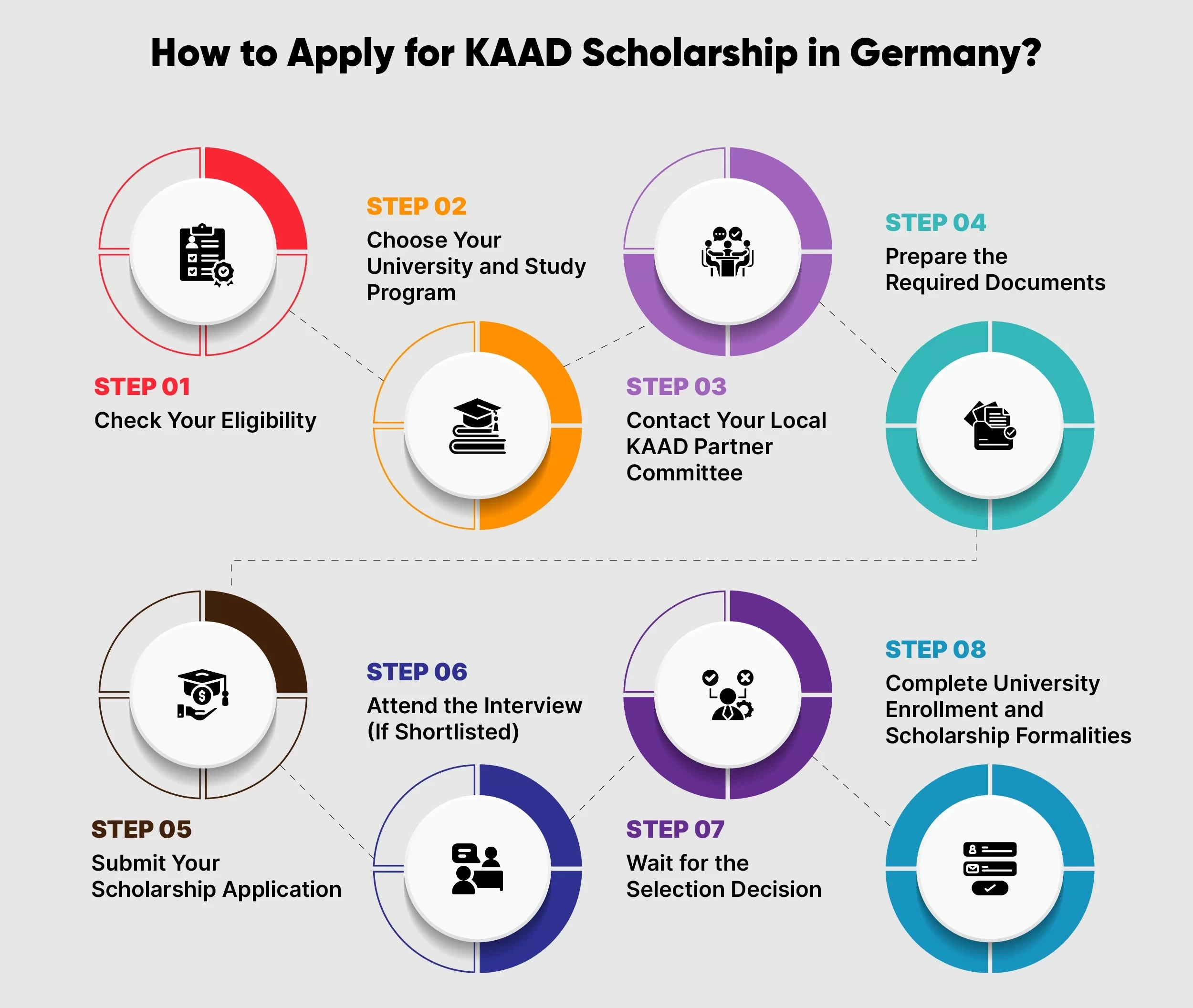
Here is the step-by-step process to apply for the KAAD Scholarship in Germany:
Step 1: The Initial Step is to Verify Your Eligibility
Prior to submitting an application, verify that you satisfy the eligibility criteria of KAAD, which encompass academic qualifications, professional experience, citizenship, language proficiency, and other program-specific requirements.
Step 2: Select Your University and Study Program
Choose a master’s, PhD, or research program at a reputable German university that is consistent with your academic and professional objectives. In some instances, it may be necessary to obtain university admission prior to applying for the KAAD scholarship. In some programs, you may be able to apply before receiving an admission offer, depending on the scholarship program and application stage.
Step 3: Reach Out to Your Local KAAD Partner Committee
KAAD works through regional partner committees and Church-affiliated organizations in many countries. Contact the relevant committee in your home country to learn about local application procedures, eligibility requirements, and deadlines.
Step 4: Gather Your Documents
Gather all required documents, which typically include:
- Completed application form
- Completed application formegree certificates
- Curriculum Vitae (CV)
- Motivation letter
- Letters of recommendation
- Proof of work experience (if applicable)
- Research proposal (for research applicants)
- Language proficiency certificates
- Letter of admission to the university (if necessary)
Step 5: Submit Your Application
Depending on the application procedure in your country, you may submit your completed application and supporting documents directly to KAAD or through your local KAAD partner committee. Guarantee that all documents are submitted prior to the designated deadline.
Step 6: Participate in an Interview (if chosen)
Typically, shortlisted applicants are invited to an interview, which may be in person or online. The interview evaluates your motivation, professional objectives, academic background, and suitability for the scholarship.
Step 7: Await the Selection Decision
KAAD will notify successful candidates after it has reviewed their application and interview. The selection process may necessitate several weeks or more, depending on the application cycle.
Step 8: Enrollment Formalities Must be Finalized
Before commencing your studies, ensure that you have completed your university enrollment and have satisfied any supplementary KAAD requirements, such as participating in German language preparation or orientation programs, if you have been selected.
KAAD Scholarship Germany Deadline
The deadline for the KAAD Scholarship Germany typically falls between January and June, and it is contingent upon the study program you are applying for, your country of residence, and the local KAAD partner committee. It is crucial to verify your region’s deadline, as there is no single application deadline for all applicants.
To ensure that the KAAD Scholarship Germany deadline is not missed:
- Verify the application deadline for the KAAD partner committee in your country or local area.
- Ensure that all necessary documents are prepared in advance of the deadline.
- Please submit your application prior to the deadline.
- For the most recent information regarding application deadlines and updates, it is recommended that you frequently consult the official KAAD website.
Conclusion
The KAAD Scholarship is a comprehensive, fully funded, and genuinely robust pathway to study at the best universities in Germany. It includes tuition, living expenses, insurance, travel, and language training. However, it is imperative to be transparent about the scholarship’s nature: a Catholic Church scholarship that is predicated on a genuine faith requirement, a genuine return-home obligation, and an application process that is conducted through local partner committees rather than a single online portal. It is one of the best-kept secrets in German scholarship funding if your profile and objectives align. If it does not, you would be better off spending your time on a secular equivalent, such as DAAD.
For the most current eligibility rules, deadlines, and country-specific committees, always check the official source: https://www.kaad.de/en/stipendien