



Are you thinking of pursuing dental career in Germany? You are not alone. Dentists in Germany have promising career opportunities, including international graduates but moving from a BDS degree to actually practising as a dentist involves a few important steps.
Whether you are looking for information about the demand for dentists and salary expectations, the German language requirements, qualification recognition, Approbation or finding the right job, this guide covers the key things you need to know.
If you are an Indian BDS graduate who wishes to work in Germany then this blog will help you understand the process in simple terms and give you a clear idea of what to expect at each stage.
Table Of Content
1Are Dentists in demand in Germany?2What are the Requirements to Become a Dentist in Germany?3How to become Dentist in Germany4Dentist Jobs in Germany5Dentist Salary in Germany6Conclusion7Frequently Asked Questions
Are Dentists in demand in Germany?
Yes, Dentists are in demand in Germany.
The demand for dentists in Germany is underlined by:
1. Great job opportunities and very low unemployment rates for dental professionals.
2. Retiring dentists creating new opportunities as experienced professionals leave the workforce.
3. Higher demand in rural and underserved areas where access to dental care can be limited.
4. Growing need for dental care among Germany’s aging population.
5. Increasing opportunities in dental practices and healthcare settings.
6. Germany needs qualified international dentists to help fill its dental workforce needs.
What are the Requirements to Become a Dentist in Germany?
To practise dentistry in Germany, applicants must meet the required education, qualification recognition, language, and professional licensing requirements.
1. Dental Education
A recognized dental qualification is required.
- Complete a dental degree such as BDS, DMD or equivalent qualification.
- Graduate from a recognized dental institution.
- An equivalency assessment is required for international dental qualifications.
2. Recognition of Dental Qualification
Foreign dental qualifications must be recognized by the relevant German authority.
- Submit your professional and academic documents for assessment.
- Fulfill the German dental education equivalency requirements.
- Complete additional training or an assessment examination if substantial differences are identified.
3. German Language Proficiency
German language skills are essential for professional dental practice.
- Demonstrate German language proficiency at B2 level.
- Pass the necessary professional language test, usually at C1 level.
- Use good communication skills in the workplace.
4. Approbation
The approbation is the German licence required to practise dentistry without restrictions.
- Apply to the competent authority in the relevant German state.
- Meet the qualification recognition and language requirements.
- Meet the professional and legal requirements for licensing.
5. Personal and Professional Requirements
Applicants must demonstrate their professional and personal suitability.
- Provide proof of good professional standing.
- Meet the health standards required.
- Demonstrate personal reliability and professional suitability.
6. Required Documents
Documents you might need to apply:
- Valid passport or identity document
- Dental degree and academic transcripts
- CV
- Proof of professional experience
- German language certificate
- Certificate of good standing
- Medical fitness certificate
- Other documents requested by the relevant authority
How to Become Dentist in Germany
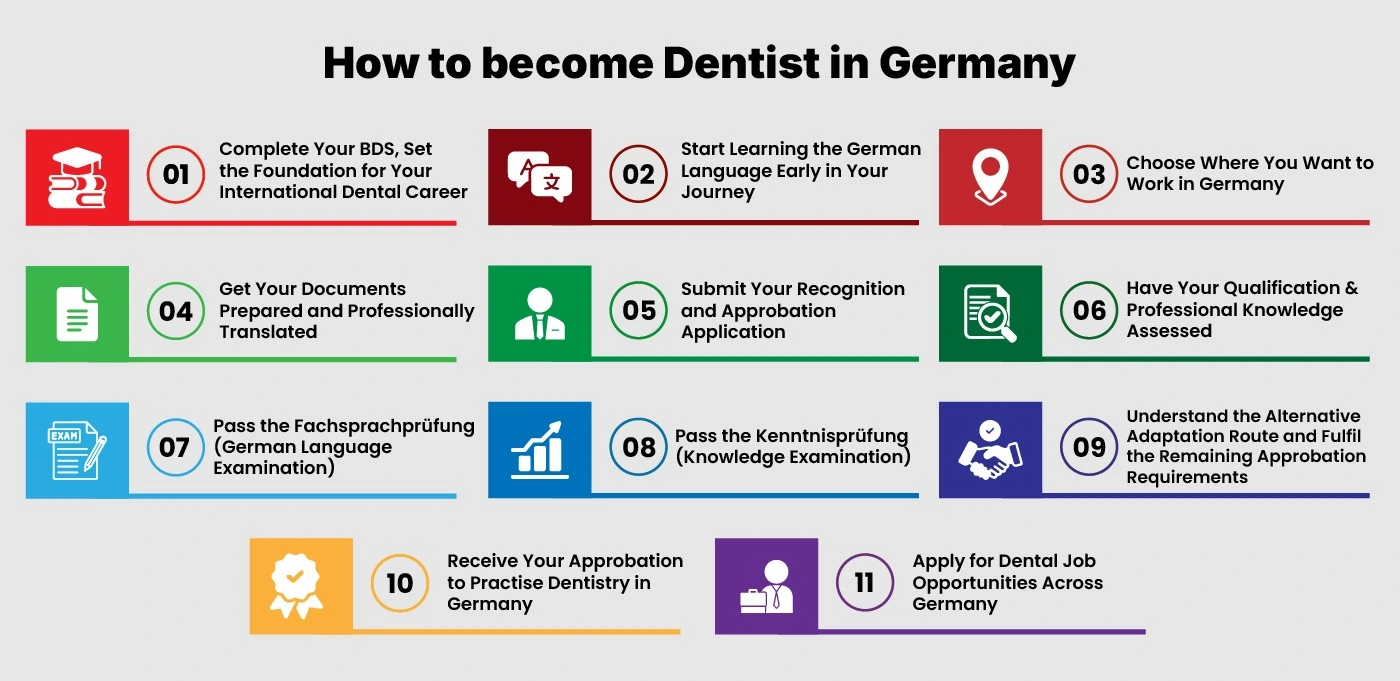
Here are the step-by-step processes to become a dentist in Germany:
Step 1: Complete Your BDS
If you are studying BDS in India, complete your degree and the required internship/clinical training.
Start getting your documents ready before you move to Germany.
Typical documents may include:
- BDS degree certificate
- Academic transcripts/mark sheets
- Internship certificate
- Detailed syllabus
- Evidence of clinical training
- Professional registration
- Certificate of good standing
- Work-experience certificates, if applicable
- Passport/identity documents
- Police/good-conduct documents
- Medical documentation
Tip: Please be aware that the exact list of documents depends on the competent authority of the German state in which you apply.
Step 2: Start Learning German Early
Ideally this should begin while you are doing your BDS and not after you graduate.
For the professional recognition process, the Recognition Finder specifies B2 German and usually a C1-level specialist-language examination (Fachsprachprüfung) for dentists.
A practical target is:
B1 → B2 → C1 professional German.
Do not underestimate this step. A dentist must be able to:
- Take a patient’s medical history
- Ask about symptoms
- Discuss treatment options
- Explain risks
- Give post-treatment instructions
- Write professional documentation
- Communicate with colleagues
While English Speaking Jobs in Germany may be available in some fields, dentists need strong German communication skills because they work directly with patients and healthcare professionals.
Step 3: Choose Where You Want to Work in Germany
Germany has 16 federal states and the competent authority for recognition may vary depending on where you want to work. So don’t just send your papers to some random German authority.
First find the competent Approbation/recognition authority of your intended state.
The official Anerkennung in Deutschland Recognition Finder can help you find the correct procedure and authority. https://www.anerkennung-in-deutschland.de/
Step 4: Prepare and Translate Your Documents
Your foreign qualification needs to be compared to the German dental qualification.
Depending on the authority, documents may need to be:
- Certified
- Translated into German
- Apostilled or otherwise authenticated where applicable
The important thing is to check the requirements of your authority, with its current documentation, before you pay for translations or certifications.
Step 5: Submit Your Recognition and Approbation Application
Once your documents are prepared and translated as required, you can apply for recognition of your foreign dental qualification and for Approbation.
A dentist’s application is generally referred to as Erteilung der Approbation.
The application is submitted to the competent authority in the German federal state where you intend to work. The authority is responsible for processing your application and determining which requirements and procedures apply to you.
For international Dentists in Germany, recognition of the foreign dental qualification is an essential part of the licensing process.
Step 6: Have Your Qualification and Professional Knowledge Assessed
After you submit your application, the competent authority processes your case and determines how your foreign dental qualification will be assessed under the applicable rules.
For applicants who qualified outside the EU/EEA, the new rules coming into effect on 1 November 2026 introduce a more standardised approach to assessing professional knowledge.
Step 7: Pass the Fachsprachprüfung (German Language Examination)
Fachsprachprüfung is a professional language examination and not simply a general German test.
You have to show that you can communicate effectively in a professional healthcare environment.
The Recognition Finder states that dentists need B2 German and usually have to take a specialist-language exam at the C1 level.
Step 8: Pass the Kenntnisprüfung (Knowledge Examination)
For dentists who qualified outside the EU/EEA, the Kenntnisprüfung (knowledge examination) is an important component of the new recognition system.
The recognition procedure for healthcare professionals from third countries, including dentists, is being made more standardized under the new rules that are to apply from 1 November 2026. Applicants with third-country qualifications will have their professional knowledge assessed through a knowledge examination, instead of the previous document-heavy equivalence route in the same way.
The Kenntnisprüfung is to determine whether your professional knowledge is at the level required to practise dentistry in Germany. Hence it is not the same as the Fachsprachprüfung:
Fachsprachprüfung: tests professional German communication.
Kenntnisprüfung: tests professional dental knowledge.
Step 9: Understand the Alternative/Adaptation Route and Fulfil the Remaining Approbation Requirements
The new system also provides for alternative routes in certain circumstances, including adaptation or compensatory measures where applicable. You should therefore not assume that every applicant will follow exactly the same route.
The competent authority will determine which procedure applies to your individual application and will inform you of any additional requirements.
You must also fulfil the other Approbation requirements, which can include:
- Proof of completed dental education
- Personal and professional suitability
- Medical fitness
- Proof of German-language proficiency
- Certificate of good standing or equivalent professional-conduct documentation
- Identity and other required official documents
Only after all applicable requirements have been fulfilled can the competent authority grant Approbation, allowing you to practise dentistry in Germany without the restrictions associated with temporary or limited permission
Step 10: Receive Your Approbation
Once all required conditions have been fulfilled, you can receive your Approbation as a Dentist.
Once Approbation is granted, international graduates can officially practise as Dentists in Germany without the restrictions associated with temporary or limited permission.
Step 11: Apply for Dental Jobs
With the necessary professional licence you can look for a job in dentistry.
Possible places of employment:
- Private dental practices
- Dental clinics
- Dental centres
- Hospitals
- Academic/teaching environments, depending on qualifications and position
Once your licensing requirements are completed, Job Hunting in Germany becomes the next important step in starting your dental career.
Dentist Jobs in Germany
Dentistry is an important part of Healthcare Jobs in Germany, with career opportunities across different areas of dental practice.
Dentist jobs in Germany include:
- General Dentist
- Orthodontist
- Oral Surgeon
- Periodontist
- Prosthodontist
- Pediatric Dentist
- Endodontist
- Implantologist
- Dental Public Health Specialist
- University or Academic Dentist
- Research Dentist
- Dental Clinic Dentist
- Hospital Dentist
- Cosmetic Dentist
Dentist Salary in Germany
A Dentist in Germany can typically earn around €60,000 to €90,000 per year, depending on experience, location, specialization, and type of employment.
Dentistry can also be a competitive career option for professionals researching Highest Paying Jobs in Germany, although actual earnings vary by experience and specialisation.
Germany’s Federal Employment Agency reports a median gross salary of €6,152 per month, which is about €73,824 per year, for the relevant dentist and orthodontist occupational group.
Here’s a quick overview of dentist salaries in Germany based on experience:
Entry-Level Dentist: Around €45,000–€60,000 per year
Mid-Level Dentist: Around €60,000–€75,000 per year
Experienced Dentist: Around €75,000–€95,000 per year
Senior / Specialized Dentist: €95,000+ per year
Conclusion
Germany is not only a chance to get a dental job for international dentists but also a long-term career opportunity in a country where healthcare professionals are in demand.
For Indian dental graduates planning to Migrate to Germany from India, understanding the recognition and licensing process early can make the journey more manageable.
For the latest requirements and your specific recognition pathway, always check the official Anerkennung in Deutschland – Recognition Finder https://www.anerkennung-in-deutschland.de/