




Considering Canada PR for Nurses in 2026? You are not alone. There are a few PR pathways for nurses in Canada, including Express Entry, healthcare category-based draws, PNPs and CEC.
But getting PR is only half the battle. If you are an internationally educated nurse, you will also need to meet Canada’s requirements for nursing registration and licensing.
In this guide, we’ll cover the requirements, PR pathways, IELTS scores and the steps you need to follow.
Table Of Content
1Can Nurses get PR in Canada?2PR Pathways for Nurses in Canada3Canada PR Requirements for Nurses4IELTS Score for Canada for Nurses5How to get PR for Nurses in Canada8Conclusion9Frequently Asked Questions
Can Nurses get PR in Canada?
Yes, nurses can get Canadian Permanent Residence (PR) if they meet the eligibility requirements of a Canadian immigration program. Nursing falls under the Healthcare and Social Services occupations category in Canada’s Express Entry system, so eligible nurses may be considered for category-based invitations.
NOC 31301 includes registered nurses and registered psychiatric nurses. NOC 31302 includes nurse practitioners. They are in the Healthcare and Social Services category. Licensed practical nurses fall under NOC 32101.
Licensed Practical Nurse in Canada is a regulated nursing profession, so applicants must meet the registration requirements of the province or territory where they want to work.
PR Pathways for Nurses in Canada
The major PR pathways for nurses in Canada are Express Entry, Provincial Nominee Programs (PNP), Canadian Experience Class (CEC) and employer-supported work permit pathways.
1. Express Entry – Federal Skilled Worker Program (FSWP)
- Designed for experienced nurses who have studied and worked internationally and meet the Express Entry eligibility criteria.
- Nurses applying under FSWP usually need to have at least 1 year of continuous full-time or equivalent part-time skilled work experience within the last 10 years.
- Applicants must have an approved English or French language test such as IELTS, CELPIP or TEF/TCF depending on the language.
- A foreign-educated nurse typically requires an Educational Credential Assessment (ECA) for immigration purposes.
- The Comprehensive Ranking System (CRS) ranks the eligible nurses. If you score high enough on the points test, you may receive an Invitation to Apply (ITA) for permanent residence.
- You do not need a job offer for FSWP. Express Entry CRS points for job offers were also cut in March 2025.
2. Express Entry – Healthcare and Social Services Stream
- Nurses could also benefit from targeted category Express Entry draws for healthcare and social services jobs. Express Entry for nurses in Canada can be a useful pathway for eligible nurses who meet the program and category requirements.
- Registered nurses and registered psychiatric nurses (NOC 31301) and nurse practitioners (NOC 31302) are eligible occupations.
- To be eligible for a healthcare category-specific draw, candidates must meet the specific category requirements, including the required amount of eligible work experience.
- Candidates must also be eligible for and meet the requirements of at least one of the participating Express Entry programs.
- Not being eligible for the healthcare category does not guaranty an ITA. Express Entry draw still has to select candidates.
3. Provincial Nominee Programs (PNP)
- Nurses who meet the requirements of a province or territory may apply through a Provincial Nominee Program.
- A lot of provinces have immigration streams for healthcare professionals, including eligible nurses.
- Requirements vary by province and can include work experience, education, language ability, registration/licensing, and a job offer.
- Some PNP streams are aligned with Express Entry; some are not.
- If your provincial nomination is via an Express Entry-linked PNP, it can provide a significant boost to an Express Entry candidate’s CRS score.
4. Canadian Experience Class (CEC)
- Nurses with qualifying skilled work experience in Canada may be able to apply for PR under the Canadian Experience Class.
- In most cases, you will need to have a minimum of 1 year of eligible Canadian skilled work experience in the 3 years before you apply.
- Your work experience must satisfy the CEC requirements, including the level of skill required for the occupation and authorized work in Canada.
- A job offer is not required to apply under CEC.
- This pathway can be a good fit for nurses who first obtain authorization to work in Canada and then build the required Canadian work experience.
5. Job Offer & Work Permit Pathway
- Nurses with a valid job offer from a Canadian employer may be able to get a work permit depending on the job, province and work permit requirements.
- Depending on the circumstances, the employer may require an LMIA or the nurse may qualify under an LMIA-exempt work permit category.
- Nurses who have gained qualifying Canadian work experience may be eligible to transition to PR via the CEC, Express Entry or relevant PNP pathway.
- Nursing is a regulated profession in Canada and a work permit does not give a nurse the automatic right to practice.
- Internationally educated nurses also have to meet the nursing registration and licensing requirements of the province or territory where they intend to work
Canada PR Requirements for Nurses
To apply for Canada PR as a nurse, you generally need a recognized nursing qualification, relevant work experience, approved language test results, and eligibility for a Canadian immigration program such as Express Entry or a Provincial Nominee Program (PNP).
For internationally educated nurses, additional requirements may include a credential assessment and meeting the nursing registration requirements of the province or territory where they plan to practise.
Here are the key Canada PR requirements for nurses:
1. Nursing Qualification
A recognized nursing qualification is an important requirement for the immigration and nursing licensing process both.
Canada PR for Nurses requires applicants to meet the relevant education and immigration requirements.
If the nursing education was completed outside Canada, an Educational Credential Assessment (ECA) may be required to compare the qualification to Canadian education standards.
2. Relevant Work Experience
For the Express Entry Healthcare and Social Services category, candidates generally need at least 12 months of full-time work experience, or an equivalent amount of part-time experience, within the past 3 years in an eligible occupation.
The qualifying nursing work experience can be gained in Canada or abroad.
3. Language Proficiency
Applicants must demonstrate their proficiency in English or French by taking a recognized language test.
For example, Federal Skilled Worker Program (FSWP) applicants typically require at least a CLB 7 in English or French.
Higher language scores can also help improve an applicant’s Express Entry ranking.
4. Educational Credential Assessment (ECA)
Nurses who have completed their education outside of Canada may require an ECA to determine how their foreign qualification compares to Canadian education standards.
Whether an ECA is required depends on the immigration program you are using.
5. Express Entry Eligibility
Before being considered for category-based selection, applicants must first meet the eligibility requirements of an Express Entry program.
Express Entry includes:
- Federal Skilled Worker Program (FSWP)
- Canadian Experience Class (CEC)
- Federal Skilled Trades Program (FSTP)
6. Nursing Registration
Internationally educated nurses usually need to have their nursing qualifications assessed and meet the registration requirements of the province or territory’s nursing regulatory body where they would like to work.
Getting Canadian PR doesn’t mean a nurse automatically gets a licence to practise nursing, in simple terms.
7. CRS Score
There is no fixed CRS score specifically for nurses to obtain Canadian PR.
You can use a Canada CRS Calculator to estimate your Express Entry CRS score based on your:
- Age
- Education
- Language proficiency
- Work experience
A competitive CRS score can improve the chances of receiving an Invitation to Apply (ITA).
8. Provincial Nominee Program (PNP)
Nurses may also qualify for a Provincial Nominee Program (PNP) based on the eligibility requirements and labour-market needs of a particular province.
Some provincial immigration streams specifically target healthcare professionals, including nurses, providing an additional pathway to Canadian permanent residence.
IELTS Score for Canada for Nurses
IELTS score for nurses in Canada depends on what you are applying for: Canada PR, nursing registration, or both. Nurses applying for immigration can use IELTS General Training to prove their English ability, for example, when applying for Express Entry.
For Canada PR through Express Entry, nurses generally need at least CLB 7 in English under programs like the Federal Skilled Worker Program. For IELTS General Training, CLB 7 means a minimum score of 6.0 in Listening, Reading, Writing, and Speaking. A higher IELTS score can also give you more language points and improve your overall Express Entry ranking. A strong language score can improve your chances for Canada PR for Nurses through Express Entry.
The IELTS requirement for nursing registration in Canada can be higher and is based on the province and nursing regulator. A common requirement is an IELTS overall score of 7.0 with 7.0 in Listening and Speaking and 6.5 in Reading and Writing.
Important: IELTS requirements for nursing registration are not the same across Canada. If you’re an internationally educated nurse, always check the exact English-language requirement and accepted tests for the nursing regulator in the province where you want to practise.
How to get PR for Nurses in Canada
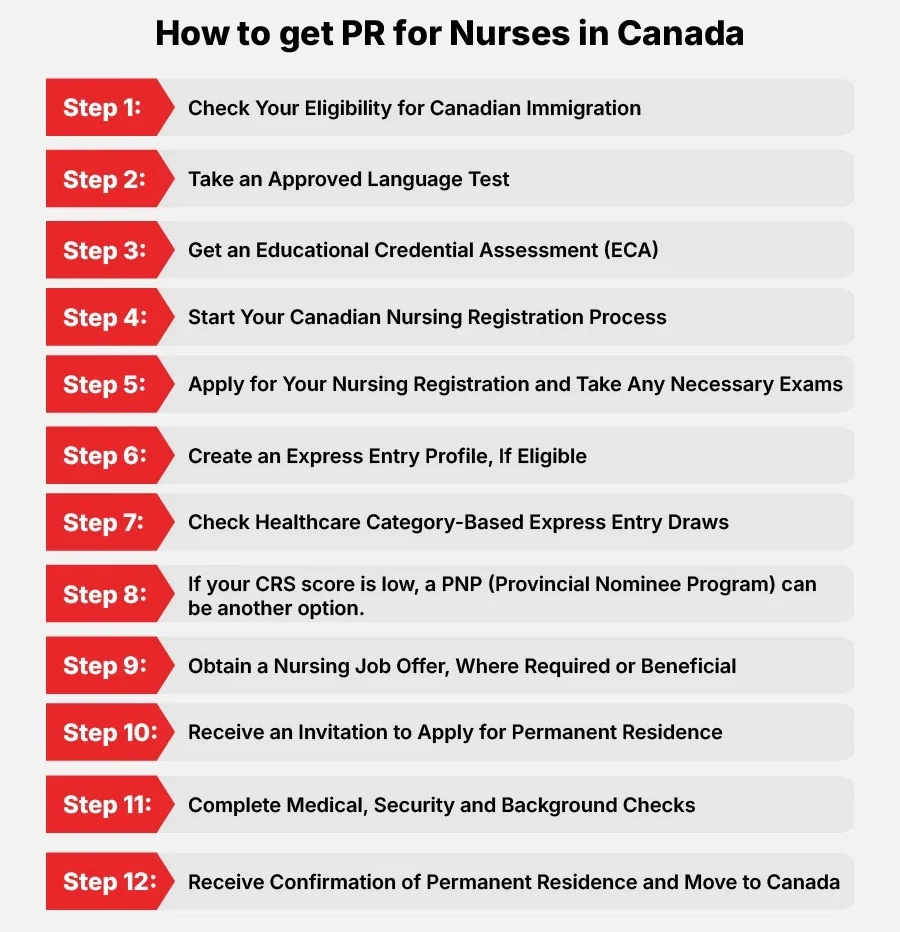
Here is the Step-by-Step Process to get PR for Nurses in Canada:
Step 1: Check Your Eligibility for Canadian Immigration
Start by determining which PR pathway you may qualify for.
For nurses, common options can include:
- Express Entry
- Provincial Nominee Programs (PNPs)
- Certain provincial or regional immigration pathways
Your eligibility may depend on factors such as:
- Age
- Education
- Nursing work experience
- English or French language ability
- Canadian work experience
- Provincial connections
- Job offer, where applicable
Nursing occupations are currently included in Canada’s Healthcare and Social Services category-based selection under Express Entry, subject to the specific requirements for each draw. For eligible applicants, Canada PR for Nurses can be pursued through this category-based selection.
Step 2: Take an Approved Language Test
You need an approved English or French language test for most economic immigration pathways.
For English, commonly accepted tests include:
- IELTS General Training
- CELPIP-General
- PTE Core
For French, approved options include tests such as:
- TEF Canada
- TCF Canada
Your test results affect your eligibility and, for Express Entry, can have a major impact on your CRS score.
Make sure your language test remains valid when you submit your immigration application.
Step 3: Get an Educational Credential Assessment (ECA)
If your nursing qualification was obtained outside Canada, you may need an Educational Credential Assessment (ECA) for immigration purposes.
An ECA confirms how your foreign education compares with Canadian educational standards.
However, there is an important distinction:
ECA for immigration ≠ nursing credential assessment for licensing.
You may need additional assessment of your nursing education and professional credentials for provincial nursing registration.
Step 4: Start Your Canadian Nursing Registration Process
This is one of the most important steps for internationally educated nurses.
Nursing is a regulated profession in Canada, meaning you need to be registered with the appropriate provincial or territorial nursing regulatory body before practising as a nurse.
For many internationally educated nurses, the process begins through the National Nursing Assessment Service (NNAS), although requirements and pathways vary by province and nursing category.
NNAS can assess internationally educated nurses’ credentials and provide an advisory report to the relevant nursing regulatory body.
You may need to submit:
- Nursing education documents
- Identity documents
- Registration/licensing information
- Employment records
- Language evidence
- Other documents requested by the relevant regulator
Step 5: Apply for Your Nursing Registration and Take any Necessary Exams
After your assessment as an internationally educated nurse (IEN), the provincial or territorial nursing regulator will determine what you need to do to become registered.
Depending on your education, experience and the province you’re in, you may need to:
- Complete additional nursing education or bridging programs
- Pass a nursing registration examination
- Complete a competency assessment
- Provide additional proof of education or clinical experience
- Meet language proficiency requirements
- Complete a criminal record check
- Obtain professional liability coverage, where required
Most Canadian nursing regulators use the NCLEX-RN as the registration examination for Registered Nurses (RNs). Practical nurses and registered psychiatric nurses have different registration requirements and different examinations.
The process varies depending on the province or territory where you want to practice, so check the requirements of the appropriate nursing regulator before making immigration or employment decisions
Step 6: Create an Express Entry Profile, If Eligible
If you meet the requirements of an Express Entry program, you can create an Express Entry profile with the Government of Canada.
You will provide information such as:
- Personal details
- Education
- Language test results
- Work experience
- Age
- Marital status
- Canadian work experience, if applicable
- Provincial nomination, if applicable
- Other information relevant to your eligibility
Your profile is then entered into the Express Entry pool and may receive a Comprehensive Ranking System (CRS) score.
A high CRS score can improve your chances of receiving an Invitation to Apply (ITA) for permanent residence.
Step 7: Check Healthcare Category-Based Express Entry Draws
Nurses may benefit from Canada’s category-based selection for healthcare and social services occupations.
However, being a nurse does not automatically guarantee an invitation
You must still:
- Qualify for an Express Entry program
- Meet the requirements of the applicable category
- Have the required amount of qualifying work experience
- Maintain a valid Express Entry profile
- Meet the CRS and other requirements applicable to the particular draw
Because Express Entry categories and draw requirements can change, always verify the current requirements before relying on a particular pathway.
Step 8: Provincial Nominee Program (PNPs)
If your CRS score is not high enough to get a direct invitation through Express Entry, then a PNP (Provincial Nominee Program) might be another option.
Canada’s provinces and territories administer their own immigration streams, and some have pathways dedicated to healthcare professionals or internationally educated nurses.
A provincial nomination through an Express Entry-linked stream can provide a significant CRS advantage.
Requirements can include:
- Nursing education and experience
- Language proficiency
- A job offer
- Provincial nursing registration or eligibility for registration
- Work experience
- Intention to live in the province
- Other province-specific requirements
Each province has different rules, so compare the nursing-related streams available rather than applying to a province just because it has a lower CRS cutoff.
Step 9: Obtain a Nursing Job Offer, Where Required or Beneficial
A Canadian nursing job offer is not required for every PR pathway, but it can be important for certain provincial immigration streams and can also help with your career and licensing process.
You can begin looking for employers such as:
- Hospitals
- Long-term care facilities
- Community healthcare organizations
- Private healthcare providers
- Clinics
- Other eligible healthcare employers
Before accepting a nursing position, make sure you understand whether the employer requires you to already hold Canadian nursing registration or whether they hire internationally educated nurses who are completing the registration process.
Step 10: Receive an Invitation to Apply for Permanent Residence
If you are selected through Express Entry, you may receive an Invitation to Apply (ITA) for permanent residence.
After receiving an ITA, you normally need to submit your complete application within the specified deadline.
You may need documents such as:
- Passport and identity documents
- Language test results
- ECA report
- Educational documents
- Employment reference letters
- Police certificates
- Medical examination results
- Proof of funds, where applicable
- Civil-status documents
- Provincial nomination documents, if applicable
Canada Immigration Medical Exam is required as part of the permanent residence process.
Make sure the information in your PR application is accurate and consistent with the information in your Express Entry profile.
Step 11: Complete Medical, Security and Background Checks
After submitting your PR application, the Canadian government will process your application and conduct the required checks.
This can include:
- Medical examination
- Police/security checks
- Verification of work experience
- Verification of education
- Verification of other information provided in your application
You should respond promptly if immigration authorities request additional documents or information.
Step 12: Receive Confirmation of Permanent Residence and Move to Canada
If your application is approved, you will receive confirmation of your permanent resident status and the documents required to complete your landing process.
Once you become a permanent resident, you can settle in Canada and continue completing any outstanding provincial nursing registration requirements.
Important: Canadian PR and Canadian nursing registration are two separate processes. Getting PR does not automatically give you a license to practice nursing, and obtaining nursing registration does not automatically give you PR.
Conclusion
Canada PR for nurses in 2026 is definitely possible. Nurses can explore options like Express Entry, healthcare category-based draws, PNPs, and CEC, depending on their qualifications and experience. You can check the latest official Express Entry requirements from the Government of Canada Website. The important thing to remember is that getting PR and getting a nursing license are two different things. If you studied nursing outside Canada, you’ll also need to meet the nursing registration requirements of the province where you want to work
So, before applying, check your work experience, language score, education, Express Entry eligibility, and nursing registration requirements. Immigration rules can change, so always check the latest official information before making a decision.