


Planning a holiday in the UK from India? If you are visiting the UK for tourism, sightseeing, or to meet family and friends, you may need a UK Standard Visitor visa.
The term UK tourist visa is commonly used to describe this visa, but the official visa route is called the Standard Visitor visa.
This guide explains the UK tourist visa application process, eligibility requirements, documents, fees, processing time, bank balance, validity, refusal reasons and frequently asked questions for applicants from India.
Table Of Content
1What Is a UK Standard Visitor Visa?2What Can You Do on a UK Standard Visitor Visa?3What You Cannot Do on a UK Visitor Visa4Who Needs a UK Tourist Visa From India?5UK Tourist Visa Application Eligibility Requirements6UK Tourist Visa Application Documents Checklist7How to Apply for a UK Tourist Visa From India8How Long Does a UK Tourist Visa Take?9How Much Bank Balance Is Required for a UK Tourist Visa?10UK Tourist Visa Validity and Length of Stay11What If Your UK Tourist Visa Application Is Refused?12UK Tourist Visa vs UK Standard Visitor Visa13UK Tourist Visa Application: How to Strengthen Your Application14UK Tourist Visa Application Process: Quick Checklist15Frequently Asked Questions
What Is a UK Standard Visitor Visa?
The UK Standard Visitor visa allows eligible visitors to enter the UK for certain permitted purposes, including tourism and visiting family or friends.
It is commonly called a UK tourist visa when the main purpose of travel is a holiday or sightseeing.
A Standard Visitor can usually stay in the UK for up to 6 months. Depending on the purpose of travel, different rules can apply to activities such as study, medical treatment, business activities or permitted paid engagements.
If you need a visa, you must apply online before travelling and attend an appointment at a visa application centre. You can apply as early as 3 months before your planned travel date.
Who Uses a UK Standard Visitor Visa?
You may use this route to visit the UK for purposes such as:
- Tourism and holidays
- Visiting family or friends
- Certain business activities
- Certain permitted paid engagements
- Short recreational courses
- Certain study activities
- Medical treatment
- Passing through the UK in certain circumstances
The exact permitted activities depend on the circumstances of your visit.
What Can You Do on a UK Standard Visitor Visa?
A Standard Visitor visa can be used for several permitted activities.
1. Tourism
You can visit the UK for a holiday, sightseeing and other tourism-related activities.
For example, you could plan to visit:
- London
- Edinburgh
- Manchester
- Birmingham
- Oxford
- Cambridge
- Bath
- Liverpool
- The Scottish Highlands
2. Visit Family or Friends
You can visit relatives or friends who live in the UK, provided you meet the visitor requirements. If someone in the UK is financially supporting your trip, you should provide appropriate evidence of the relationship and the support they will provide.
3. Certain Business Activities
A Standard Visitor may undertake certain business activities, such as attending meetings, conferences, seminars or negotiating contracts, subject to the visitor rules.
4. Certain Short-Term Study
Some study activities are permitted under the Standard Visitor route, subject to the applicable rules.
5. Medical Treatment
Visitors can use the Standard Visitor route for certain private medical treatment, provided they satisfy the relevant requirements.
What You Cannot Do on a UK Visitor Visa
A UK tourist visa is not a work or settlement visa.
Generally, a Standard Visitor cannot:
- Take employment in the UK
- Work for a UK company
- Work as a self-employed person
- Undertake an ordinary work placement or internship
- Claim public funds
- Use frequent or successive visits to effectively live in the UK
- Get married or enter a civil partnership under the Standard Visitor route
There are limited exceptions for specific permitted activities, so applicants should check the rules applicable to their circumstances. A UK Standard Visitor visa does not allow you to study in the UK, with one narrow exception.
If your main purpose is to marry or form a civil partnership in the UK, you generally need to consider the Marriage Visitor visa instead.
Who Needs a UK Tourist Visa From India?
Indian citizens generally need permission to visit the UK, and whether this is a visa or another form of permission depends on nationality and circumstances.
For an Indian citizen planning a normal tourist visit, the relevant route is generally the Standard Visitor visa.
Before applying, check the official UK government visa checker because entry requirements can change depending on nationality, purpose and individual circumstances.
UK Tourist Visa Application Eligibility Requirements
There is no single checklist or bank balance that guarantees approval.
UKVI assesses whether you satisfy the visitor requirements based on your individual circumstances.
A successful applicant generally needs to demonstrate that they:
1. Are a genuine visitor
You should have a genuine and permitted reason for visiting the UK.
For a tourist application, this could be a holiday or sightseeing trip.
2. Intend to leave the UK
You must demonstrate that you intend to leave the UK at the end of your visit.
Your personal, professional, financial and family circumstances can help explain your reasons for returning home.
3. Have enough money for the trip
You need sufficient funds to cover the reasonable costs of your visit, including accommodation, travel and living expenses.
The money should be accessible to you and its source should be explainable.
4. Can pay for your return or onward journey
You should be able to show that you can afford your return or onward travel.
5. Will not use the visitor route to live in the UK
Frequent or successive visits should not be used to make the UK your main home.
UK Tourist Visa Application Documents Checklist
There is no universal document list that applies identically to every applicant. The documents you provide should support the information in your application and explain your personal circumstances.
The following documents can be relevant depending on your situation.
Basic Documents
- Valid passport or travel document
- Previous passports, where relevant
- Completed online visa application
- Visa application fee payment
- Biometric appointment confirmation
- Travel details
- Accommodation information
Your passport or travel document should be valid for your stay in the UK.
Financial Documents
You may provide:
- Recent bank statements
- Salary slips
- Proof of earnings
- Employment documents
- Tax-related documents, where relevant
- Evidence explaining the source of funds
- Financial documents from a sponsor, if someone else is funding the trip
UKVI guidance specifically highlights bank statements and proof of earnings as examples of evidence that can demonstrate access to funds.
Employment Documents
If you are employed, useful evidence may include:
- Employer letter
- Job title
- Salary details
- Employment start date
- Approved leave
- Employer contact details
An employer letter can help establish your professional circumstances and explain why you are expected to return to India after the trip.
Self-Employed Applicants
If you run a business, documents may include:
- Business registration documents
- Recent invoices
- Business bank statements
- Tax records
- Evidence of ongoing business activity
UKVI guidance specifically mentions business registration documents and recent invoices as possible evidence for self-employed applicants.
Student Applicants
Students may provide:
- Student ID
- University or college letter
- Enrolment confirmation
- Approved leave documentation
- Evidence of funding
Visiting Family or Friends
If you are visiting relatives or friends, you can provide relevant evidence such as:
- Invitation letter
- Details of your relationship
- Host’s UK address
- Evidence of accommodation
- Evidence of financial support, if applicable
Remember that an invitation letter alone does not automatically establish eligibility. Your own circumstances and the overall evidence are also important.
Previous Travel History
Previous passports can help demonstrate your travel history where relevant.
However, having extensive travel history is not itself a mandatory requirement for every applicant. The application is assessed on the overall circumstances and evidence.
Documents Not in English or Welsh
Documents that are not in English or Welsh generally need a full translation that can be independently verified by the Home Office.
The translation should include the translator’s confirmation, date, name, signature and contact details.
How to Apply for a UK Tourist Visa From India
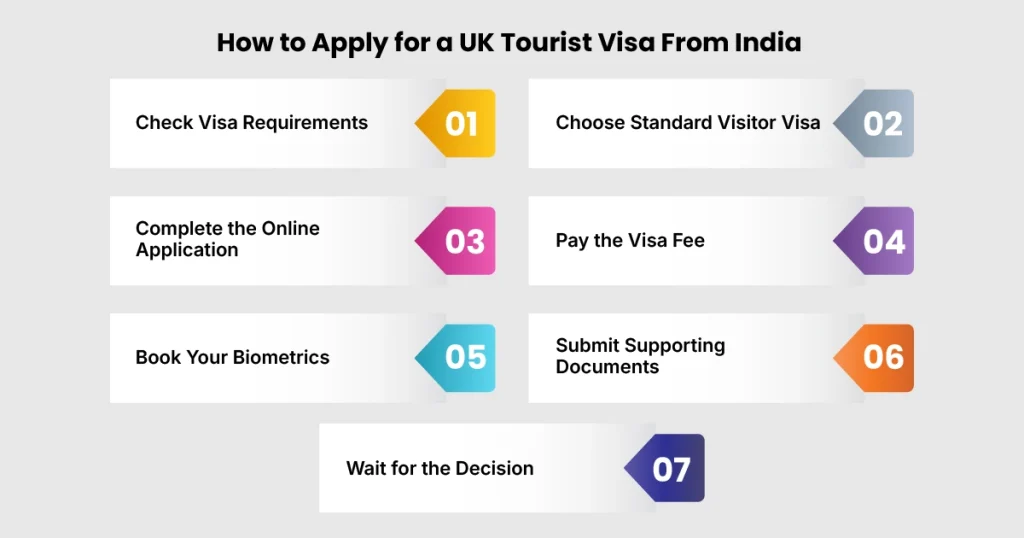
The UK tourist visa application process from India can be completed in several steps.
Step 1: Check Whether You Need a Visa
Use the official UK government visa checker to confirm the permission you need based on your nationality and travel purpose.
Step 2: Choose the Standard Visitor Visa
For a normal tourism visit requiring a visa, select the Standard Visitor route.
Step 3: Complete the Online Application
Complete the online application form carefully.
You will typically need information about:
- Personal details
- Passport
- Travel dates
- Purpose of visit
- Accommodation
- Employment
- Income
- Travel history
- Family circumstances
- Who will pay for the trip
Make sure the information is consistent with your supporting documents.
Step 4: Pay the Visa Fee
Pay the applicable visa application fee.
Step 5: Book a Biometrics Appointment
After completing the online application, you need to attend an appointment at a visa application centre.
At the appointment, you will provide biometric information, including fingerprints and a photograph, and submit the required documents according to the application process.
Step 6: Submit Supporting Evidence
Upload or submit the documents required for your application.
The documents should support the information provided in your application rather than simply adding a large number of unrelated documents.
Step 7: Wait for the Decision
After you have applied online, proved your identity and submitted the required documents, UKVI says you will usually receive a decision within 3 weeks.
UK Tourist Visa Application Fees From India
As of September 2026, the UK Home Office lists the following Standard Visitor visa fees for applications from India:
| Visa type | Visa application fee (INR) |
|---|---|
| Short-term Standard Visitor visa – up to 6 months | ₹18,054 |
| Longer-term Standard Visitor visa – up to 2 years | ₹67,671 |
| Longer-term Standard Visitor visa – up to 5 years | ₹1,20,764 |
| Longer-term Standard Visitor visa – up to 10 years | ₹1,50,855 |
| Visiting academic – more than 6 months and up to 12 months | ₹31,294 |
| Marriage Visitor visa | ₹18,054 |
| Private medical treatment – more than 6 months and up to 11 months | ₹31,294 |
| Visit the UK in a Chinese tour group – UK only | ₹18,054 |
The Home Office’s current fee information lists the short-term Standard Visitor fee at £135, with the India fee page showing ₹18,054. Fees can change, so applicants should verify the amount at the time of application.
What Is a Long-Term UK Visitor Visa?
If you visit the UK regularly, you may be able to apply for a long-term Standard Visitor visa valid for:
- 2 years
- 5 years
- 10 years
However, a long-term visitor visa does not mean that you can stay in the UK continuously for the entire validity period.
You can normally stay for a maximum of 6 months per visit. UKVI can also grant a shorter visa than requested if the eligibility requirements are not met for the requested period.
How Long Does a UK Tourist Visa Take?
The standard UK visitor visa processing time is usually 3 weeks after you have completed the application, proved your identity and provided the required documents.
However, processing times can vary.
You should therefore avoid making non-refundable travel arrangements solely based on the standard processing timeframe.
Depending on availability and eligibility, faster visa decision services may also be available for some applications.
How Much Bank Balance Is Required for a UK Tourist Visa?
One of the most common questions is:
“How much bank balance is required for a UK tourist visa?”
The UK does not specify a universal minimum bank balance for a Standard Visitor visa.
Instead, you need to show that you have enough money to cover the reasonable costs of your proposed visit.
Your financial evidence should make sense in relation to:
- Trip duration
- Accommodation
- Flights
- Daily expenses
- Planned activities
- Number of travellers
- Your income
- Existing financial commitments
- Source of funds
UK immigration rules require visitors to have sufficient funds for the reasonable costs of their visit without working or accessing public funds.
Is a Sudden Large Deposit a Problem?
A large unexplained deposit can raise questions because UKVI guidance says financial evidence should clearly show access to funds and their origin.
If your account recently received a significant amount of money, you should be able to explain and document its source where relevant.
Can Someone Else Pay for My UK Trip?
Yes, third-party support can be considered where the relevant requirements are met.
For example, a family member may pay for your accommodation, travel or other expenses.
The relationship and the sponsor’s ability and intention to provide support should be supported by appropriate evidence.
UK Tourist Visa Validity and Length of Stay
A standard UK visitor visa generally allows a stay of up to 6 months.
A long-term Standard Visitor visa can be valid for 2, 5 or 10 years, but the maximum stay is generally 6 months per visit.
A UK visitor visa’s validity period is different from the length of stay permitted in the UK.
For example:
A 10-year Standard Visitor visa does not allow you to remain in the UK for 10 years.
It allows you to use the visa during its validity period, subject to the visitor rules and the maximum permitted stay for each visit.
What If Your UK Tourist Visa Application Is Refused?
If your UK tourist visa application is refused, read the refusal notice carefully.
The decision letter should explain why UKVI was not satisfied that the requirements had been met.
Common areas that can cause concerns may include:
- Insufficient evidence of funds
- Unclear source of funds
- Inconsistencies between the application and documents
- Unclear purpose of travel
- Insufficient evidence of circumstances outside the UK
- Concerns about whether the applicant intends to leave
- Unsupported information
- Previous immigration issues
There is no single refusal reason that applies to all applicants.
What Should You Do After a Refusal?
Do not simply submit the same application again without addressing the concerns.
First:
1. Read the refusal letter.
2. Identify each concern raised by UKVI.
3. Review the evidence submitted previously.
4. Determine what additional or clearer evidence is available.
5. Make sure the new application accurately explains the applicant’s circumstances.
6. Check whether the appropriate legal route or review mechanism applies to the particular decision.
A new application should address the actual issues identified in the refusal rather than merely adding more documents.
UK Tourist Visa vs UK Standard Visitor Visa
These terms are often used interchangeably, but there is an important distinction.
| Term | Meaning |
|---|---|
| UK Tourist Visa | Common term used for a UK visit visa for tourism |
| UK Standard Visitor Visa | Official name of the main visitor visa route |
| UK Visitor Visa | General term commonly used for visitor permission |
| UK Long-Term Standard Visitor Visa | Visitor visa valid for 2, 5 or 10 years, subject to the rules |
If you are searching for “UK tourist visa application”, “UK visitor visa”, or “UK Standard Visitor visa”, you may be referring to the same visitor route when your purpose is tourism.
UK Tourist Visa Application: How to Strengthen Your Application
There is no document that guarantees a UK visa.
Instead, aim to make your application clear, consistent and evidence-based.
1. Explain the real purpose of your trip
Your planned activities should match the reason stated in your application.
2. Show realistic finances
Your proposed trip should be financially reasonable compared with your income and available funds.
3. Explain your source of funds
Your bank statements should make your financial position understandable.
4. Demonstrate your circumstances in India
Employment, business, education, family and other relevant circumstances can help explain your situation outside the UK.
5. Keep your documents consistent
Dates, income, employment details, travel plans and other important information should not contradict each other.
6. Avoid unnecessary documents
More documents do not automatically make an application stronger.
Submit relevant evidence that supports the specific information in your application.
7. Be honest
Do not create documents, hide important information or provide misleading information.
False or misleading information can have serious immigration consequences.
UK Tourist Visa Application Process: Quick Checklist
Before submitting your application, check:
- Valid passport
- Correct visa category
- Clear purpose of visit
- Planned travel dates
- Accommodation details
- Financial evidence
- Evidence of source of funds
- Employment/business/student evidence
- Evidence relevant to your circumstances in India
- Previous travel documents, where relevant
- Sponsor documents, if someone else is paying
- Translations for documents where required
- Online application completed accurately
- Visa fee paid
- Biometrics appointment booked
- Supporting documents submitted