


Canada PR for Indians remains an attractive option for those looking to build a successful career, settle with their families and explore new opportunities. With various immigration pathways available, knowing the right option and preparing well will make the PR journey clearer and more manageable.
If you are planning to apply for Canadian PR from India, then knowing the current eligibility criteria, costs, application process and recent updates can help you to take the next step with confidence.
If Canada is part of your future plans, keep reading to discover what the PR journey could look like for you in 2026.
Table Of Content
1Canada giving PR to Indians now?2What are the ways to get PR in Canada from India?3Canada PR Eligibility for Indian4Canada PR Requirements for Indian5How to get Canada PR from India6Total Cost for Canada PR from India7New Rules for PR in Canada8Conclusion9Canada PR for Indians FAQs
Canada giving PR to Indians now?
Yes, Canada is still giving permanent residence (PR) to Indian applicants.
The current 2026-2028 Immigration Levels Plan from Canada seeks to welcome 380,000 permanent residents in each of 2026, 2027 and 2028. Economic immigration remains a key focus, especially candidates who can help meet Canada’s labour-market requirements.
Canada does not have a separate PR program or quota specifically for Indian citizens. Indians can apply through eligible immigration pathways based on factors such as skills, work experience, education, language ability and other program-specific requirements.
Therefore, Indians are still apply for Canada PR, but the approval is based on the eligibility criteria and selection factors of the immigration program.
What are the ways to get PR in Canada from India?
The main ways to get PR in Canada from India include Express Entry, Provincial Nominee Programs (PNPs), family sponsorship, and regional immigration program. The suitable pathway depends on factors such as education, work experience, language ability, age, occupation, and family connections in Canada.
Here’s How Each Pathway Works :
1. Express Entry
Express Entry is an online immigration system used by the Government of Canada to manage applications from skilled workers under three federal economic immigration programs:
- Federal Skilled Worker Program (FSWP)
- Canadian Experience Class (CEC)
- Federal Skilled Trades Program (FSTP)
Applicants with eligible skilled work experience may qualify for one of these programs if they meet the applicable eligibility requirements. For example, the Federal Skilled Worker Program can be an option for applicants with eligible skilled work experience gained in Canada or abroad.
Eligible candidates who enter the Express Entry pool receive a Comprehensive Ranking System (CRS) score. The CRS considers factors such as age, education, language proficiency, Canadian work experience and other eligible factors. Candidates are ranked in the pool according to their CRS scores.
A job offer is not required to qualify for the Federal Skilled Worker Program. However, applicants who are required to show proof of settlement funds must meet IRCC’s applicable funds requirement unless an exemption applies.
2. Provincial Nominee Programs (PNPs)
Provincial Nominee Programs (PNPs) allow Canadian provinces and territories to nominate individuals who meet the criteria of their immigration streams. Each province or territory has its own eligibility criteria, which is based on the immigration needs and requirements of that province or territory.
PNPs can be available through Express Entry and non-Express Entry streams. For an Express Entry-linked PNP, applicants must be eligible for both the province or territory’s PNP stream and one of the three Express Entry programs: the Federal Skilled Worker Program, Federal Skilled Trades Program, or Canadian Experience Class.
For non-Express Entry PNP streams, applicants first apply to a province or territory for a nomination. The province or territory assesses the application based on its requirements, immigration needs, and whether the applicant intends to live there. Once nominated, the applicant can apply for permanent residence to the federal government.
Eligibility requirements can differ depending on the province and the stream, and they may include factors such as work experience, education, language ability, occupation and other criteria specified by the individual program.
3. Family Sponsorship
Family sponsorship allows eligible Canadian citizens and permanent residents to sponsor family members to come to Canada as permanent residents. Depending on the program, eligible family members may be a spouse, common-law partner, conjugal partner, dependent child, parents, grandparents or certain other relatives.
The sponsor must meet applicable eligibility requirements. For example, sponsors must generally be at least 18 years old and be a Canadian citizen, permanent resident or a person registered in Canada as an Indian under the Indian Act, depending on the sponsorship category.
The sponsored family member must also meet the eligibility requirements to become a permanent resident, including meeting Canada’s admissibility requirements. The application process and requirements vary depending on the family relationship and the sponsorship category
In many sponsorship classes, the sponsor also signs an undertaking to provide financial support to the sponsored family member for a specified period. The length of the undertaking depends on the relationship and other applicable rules.
4. Regional Immigration Programs
Canada has regional immigration programs to help participating communities attract skilled workers and support local labour needs. The existing Rural Community Immigration Pilot (RCIP) provides a pathway to permanent residence for qualified skilled workers who wish to work and live in participating rural and remote communities
To apply through the RCIP, applicants generally need to meet the federal eligibility requirements, receive a qualifying job offer from a designated employer in a participating community, and receive a recommendation from the community before applying for permanent residence.
For example, the RCIP requires applicants to have at least one year (1,560 hours) of related work experience within the previous three years, subject to the program’s specific requirements and exemptions.
Canada PR Eligibility for Indian
Canada PR for Indians is available through eligible immigration programs, with each pathway having its own requirements and selection criteria. Express Entry manages three federal skilled-worker programs: the Canadian Experience Class, Federal Skilled Worker Program and Federal Skilled Trades Program. Each program has different eligibility requirements.
The Canada PR Eligibility for Indian Applicants includes:
1. Age
Age is one of the factors considered under the Comprehensive Ranking System (CRS) for Express Entry.
For the CRS, the maximum points are awarded for age to applicants who are between 20 and 29 years old. Age points decrease gradually from age 30 onward and applicants aged 45 or older get 0 CRS points for age.
2. Education
Education can contribute to your CRS score and, depending on the immigration program, can also be part of the eligibility requirements.
If your education was completed outside Canada, you may need an Educational Credential Assessment (ECA) for immigration purposes, particularly when claiming CRS points for foreign education or when applying under the Federal Skilled Worker Program.
3. Work Experience
Skilled work experience is an important factor under Express Entry.
Each program has its own specific work experience requirements. For example:
- Canadian Experience Class: Usually requires 1 year of eligible Canadian work experience in the last 3 years.
- Federal Skilled Worker Program: Requires at least 1 year of continuous skilled work experience in the last 10 years.
- Federal Skilled Trades Program: 2 years of skilled-trade work experience within the previous 5 years.
Foreign work experience can also contribute to the CRS score through the skill-transferability factors.
4. Language Proficiency
Applicants must demonstrate their English and/or French language ability by passing an approved language test when required for their Express Entry program.
The minimum language requirement varies by program. For example, the Federal Skilled Worker Program requires CLB 7 in English or the equivalent French proficiency. The Canadian Experience Class has different requirements depending on the TEER category of the occupation.
5. Proof of Funds
Some Canada PR applicants must provide proof of sufficient settlement funds to demonstrate that they can support themselves and their family after arriving in Canada.
The required amount depends on family size and is updated by IRCC. Exceptions can be made, such as for certain applicants under the Canadian Experience Class and for applicants who have the right to work in Canada and have a valid job offer.
6. CRS Score
The Comprehensive Ranking System (CRS) is the points-based system IRCC uses to rank eligible Express Entry candidates in the pool. Applicants can use the Canada CRS Calculator to estimate their score based on factors such as age, education, language ability and work experience.
CRS considers information such as age, education, language ability, skilled work experience and other factors. Candidates are ranked by their CRS scores and invitations to apply are issued during Express Entry invitation rounds in accordance with the applicable rules.
Canada PR Requirements for Indian
The Canada PR requirements for Indian applicants depend on the immigration program and the applicant’s individual circumstances. Applicants may need to provide documents that establish their identity, education, work experience, language ability, admissibility and eligibility for their chosen immigration pathway.
Canada PR Requirements for Indians include:
1. Valid Passport or Travel Document – A passport or travel document to establish the applicant’s identity and travel details.
2. Language Test Results – Results from an IRCC-approved language test may be required to demonstrate English or French language proficiency, depending on the immigration program.
3. Educational Documents and ECA – Applicants may need educational certificates, diplomas, degrees and transcripts. An Educational Credential Assessment (ECA) may be required to assess foreign education for immigration purposes, depending on the program.
4. Work Experience Proof – Where work experience is part of the eligibility criteria, applicants may need employment contracts, employer reference letters, pay slips, tax documents or other evidence showing their work history.
5. Proof of Funds – Some immigration programs require applicants to demonstrate that they have sufficient funds to support themselves and their family in Canada. The requirement and exemptions depend on the program.
6. Police Certificates – Applicants may need police certificates to help establish that they meet Canada’s admissibility requirements. The countries and periods for which certificates are required depend on the applicant’s circumstances and immigration program.
7. Medical Examination – Applicants may need an immigration medical examination conducted by an IRCC-approved panel physician as part of the permanent residence process.
8. Family and Civil Documents – Depending on the applicant’s circumstances, documents such as birth certificates, marriage certificates, divorce or separation documents, death certificates and adoption records may be required.
9. Provincial Nomination – Applicants applying through a Provincial Nominee Program (PNP) may need to provide proof of their provincial or territorial nomination.
10. Photographs and Document Translations – Applicants may need photographs that meet IRCC’s specifications. Documents that are not in English or French generally need to be accompanied by an appropriate translation and the required supporting documentation.
How to get Canada PR from India
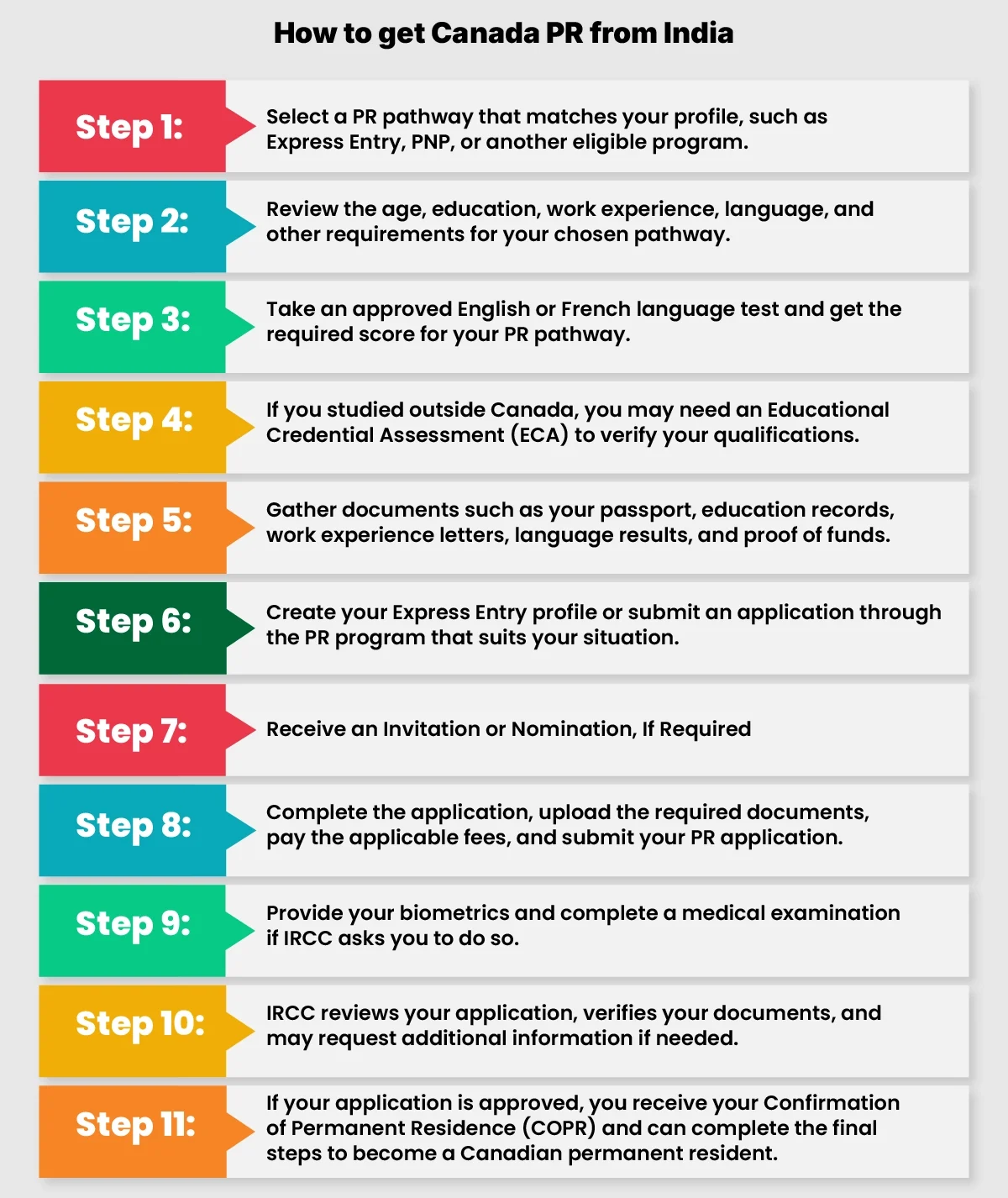
Here is the step-by-step process to get Canada PR from India:
Step 1: Choose the Right Canada PR Pathway
If you are planning to migrate to Canada from India, the first step is to identify the immigration pathway that best matches your profile. Skilled workers may qualify for Express Entry or a PNP, and applicants with eligible family members in Canada may be eligible for family sponsorship. Regional pathways such as the Rural Community Immigration Pilot (RCIP) and Francophone Community Immigration Pilot (FCIP) are available to eligible skilled workers who wish to work and settle in participating communities.
Step 2: Check Your Eligibility
Before beginning your application, review the requirements of the program you select. Depending on the pathway, eligibility can include factors such as age, education, work experience, language ability, occupation, settlement funds, family relationships, a job offer or provincial nomination.
For Express Entry, applicants must qualify for at least one of the three programs managed through the system: Federal Skilled Worker Program, Federal Skilled Trades Program or Canadian Experience Class.
Step 3: Take an Approved Language Test
If your chosen immigration program has a language requirement, get your English or French language test results from an approved test before you create your application or profile.
Language test results are among the information used to assess eligibility and the applicant’s CRS score for Express Entry.
Step 4: Get Your Education Assessed, If Required
If you completed your education outside Canada, you may need an Educational Credential Assessment (ECA) to demonstrate how your international education compares to Canadian standards of education.
The ECA requirement depends on the immigration program and your circumstances, so applicants should check the specific requirements of their pathway before obtaining one.
Step 5: Prepare Your Supporting Documents
Gather the documents required for your selected immigration pathway. Depending on the program, these may include:
- Valid passport or travel document
- Language test results
- Educational documents and ECA, where required
- Work experience documents
- Proof of funds, where required
- Police certificates
- Civil and family documents
- Provincial nomination, if applicable
- Medical examination documents
- Other documents listed in your personalized IRCC checklist
IRCC provides a personalized document checklist for applications such as Express Entry, so applicants should follow the checklist generated for their specific application.
Step 6: Create an Express Entry Profile or Apply Through Your Chosen Pathway
If you are applying via Express Entry, create an online profile and submit it to the Express Entry pool. IRCC reviews your information and if you’re eligible, if you are eligible, places your profile in the pool and assigns a CRS score. Being in the pool does not guarantee an invitation to apply for permanent residence.
For a non-Express Entry PNP, you first apply to the province or territory for a nomination. If nominated, you can then apply for permanent residence to the federal government.
Step 7: Receive an Invitation or Nomination, If Required
IRCC conducts rounds of invitations for Express Entry and invites eligible candidates based on the applicable selection criteria and CRS ranking. Once you get an Invitation to Apply (ITA), you usually have 60 days to apply for your permanent residence.
For a PNP, you must first receive a provincial or territorial nomination before proceeding with the relevant permanent residence application.
Step 8: Submit Your PR Application
Once you are eligible to apply, complete the online permanent residence application, upload the required documents and pay the applicable fees.
After you complete the online application form for Express Entry, IRCC gives you a personalized document checklist. Once you receive your invitation, you must apply within the specified deadline.
For non-Express Entry PNP applications, nominated applicants apply online through the Permanent Residence Portal and submit the required forms, supporting documents and fees.
Step 9: Complete Biometrics and Medical Requirements
After submitting your application, you may need to provide biometrics (fingerprints and photograph). Once you receive your biometric instruction letter, you can book biometric appointment for Canada at an appropriate collection location. IRCC gives applicants 30 days from the date on the letter to provide their biometrics.
Permanent residence applicants may also need an immigration medical examination conducted by an IRCC-approved panel physician.
Step 10: Wait for IRCC to Process Your Application
IRCC reviews your application, your documents and the admissibility requirements. The officer may request additional information or documentation, if needed. Processing times will vary depending on the immigration program and individual application.
Step 11: Receive Your PR Confirmation
If your PR application is approved, IRCC will send you the documents confirming your permanent resident status. Depending on your situation, you may receive a Confirmation of Permanent Residence (COPR) and, if required, a permanent resident visa.
Total Cost for Canada PR from India
The total cost of applying for Canada PR from India ranges from approximately ₹2 lakh to ₹3 lakh for a single applicant. This covers the main application expenses but excludes settlement funds, airfare, and immigration consultant or lawyer fees.
The exact amount varies because some expenses, such as medical examinations and ECA, depend on the service provider. The total cost of applying for Canada PR from India depends on the immigration pathway and the applicant’s circumstances.
The major expenses involved in a Canada PR application for Indians may include:
1. Language Test Fee – The cost of taking an approved English or French language test. The fee depends on the test provider and location.
2. ECA Fee – The cost of assessing foreign educational qualifications for Canadian immigration purposes. An ECA is required only for certain immigration programs or situations.
3. PR Application Fees – Applicants may need to pay government processing fees and the Right of Permanent Residence Fee (RPRF), depending on the immigration program.
4. Biometrics Fee – A fee may apply when applicants are required to provide their fingerprints and photograph. The current individual biometrics fee is CAD $85.
5. Medical Examination Fee – Applicants who need an immigration medical examination must pay the panel physician or clinic. The cost can vary depending on the location and medical services required.
6. Police Clearance Certificate (PCC) – Applicants may need to obtain police certificates to meet Canada’s admissibility requirements. The cost of obtaining a PCC can vary depending on the issuing authority and applicant’s circumstances.
7. Other Expenses – Additional costs may include document translation, courier services, notarisation and professional assistance, if required. These are separate from IRCC government fees.
New Rules for PR in Canada
Canada has made several recent changes to its permanent residence system in 2025 and 2026. These include changes to Express Entry CRS points, new 2026 selection categories, updated immigration targets, higher PR fees and changes to some immigration programs. The impact of each change depends on the applicant’s chosen PR pathway.
1. Express Entry No Longer Gives CRS Points for Job Offers
Since March 25, 2025, Express Entry candidates no longer receive 50 or 200 CRS points for having a valid job offer.
However, a job offer can still be required for eligibility under some immigration programs, including certain streams of the Federal Skilled Worker Program, Federal Skilled Trades Program and Provincial Nominee Programs.
2. New Express Entry Categories for 2026
For 2026, IRCC has introduced or continued several category-based selection categories under Express Entry.
The 2026 categories include:
- French-language proficiency
- Healthcare and social services occupations
- Trades occupations
- Transport occupations
- Physicians with Canadian work experience
- Researchers with Canadian work experience
- Senior managers with Canadian work experience
- Education occupations
- Certain candidates recruited by the Canadian Armed Forces
IRCC will use these categories to invite eligible candidates who meet the requirements of the relevant category.
3. Canada Has Set New PR Admission Targets for 2026–2028
Under the 2026–2028 Immigration Levels Plan, Canada has set a target of 380,000 new permanent residents for each year from 2026 to 2028.
The plan also focuses on economic immigration and aims to give greater attention to skilled workers who can help address labour shortages.
4. More Focus on Candidates Already Working in Canada
Canada’s current immigration strategy places greater emphasis on people who are already living and working in the country.
The government has announced a plan to accelerate the transition of up to 33,000 temporary workers to permanent residence in 2026 and 2027. The plan focuses on those workers who have developed strong ties to their communities and contribute to the Canadian economy.
5. PNP Admission Targets Have Changed
The Provincial Nominee Program (PNP) has a planned admission target of 91,500 permanent residents in 2026, compared with the previous levels plan.
The PNP continues to allow provinces and territories, except Quebec and Nunavut, to nominate eligible immigrants based on their regional labour market and economic needs.
6. New Rural and Francophone Immigration Pathways
Canada currently offers the Rural Community Immigration Pilot (RCIP) and Francophone Community Immigration Pilot (FCIP).
Under these pathways, eligible applicants generally need a qualifying job offer from a designated employer, relevant work experience, language ability, education and settlement funds. Applicants also need a recommendation from the participating community before applying for permanent residence.
These programs can be relevant to applicants who are willing to settle and work in participating communities outside Canada’s largest urban centres.
7. Permanent Residence Application Fees Increased in 2026
IRCC increased several permanent residence fees on April 30, 2026.
For example, the Right of Permanent Residence Fee increased from CAD $575 to CAD $600, while the principal applicant fee for the Provincial Nominee Program increased from CAD $950 to CAD $990. Family-class principal applicant fees also increased from CAD $545 to CAD $570.
Because IRCC fees can change, applicants should check the latest fee schedule before submitting an application.
8. Parents and Grandparents Program Intake Is Paused
A significant family-immigration change in 2026 is that IRCC paused the intake of new applications under the Parents and Grandparents Program (PGP).
As of July 2026, IRCC stated that it would continue processing existing applications and planned to approve up to 15,000 people for permanent residence through the PGP in 2026. The government also stated that it would not accept new interest-to-sponsor forms or invite new potential sponsors to apply until further notice.
Conclusion
Canada PR for Indians can be a big step toward building a new life in Canada but every applicant’s journey is different. The secret is to know your options well and plan your application carefully, not to adopt a one-size-fits-all approach.
Immigration rules can change, so always check the latest information before making any decision.
For official updates, visit the Government of Canada’s immigration website: Immigration and citizenship – Canada.ca
A well-planned application can make your Canada PR journey clearer, smoother and easier to manage.