



Germany attracts Indians looking to study, work, or travel, with options such as the German Opportunity Card opening new possibilities. However, visa applications can be refused for several reasons, including incomplete documents, insufficient financial proof, unclear travel purposes, or eligibility issues. Understanding these common refusal reasons can help applicants prepare more carefully and avoid mistakes. This guide explains the key reasons for German Visa Rejection, rejection rates for Indian applicants, ways to reduce the risk of refusal, and the steps to take if an application is rejected.
Table Of Content
1German Visa Rejection Reasons2Germany Visa Rejection Rate for Indians3How to Avoid German Visa Rejection?4How to Reapply for a German Visa After Rejection?5Conclusion6German Visa Rejection FAQs
German Visa Rejection Reasons
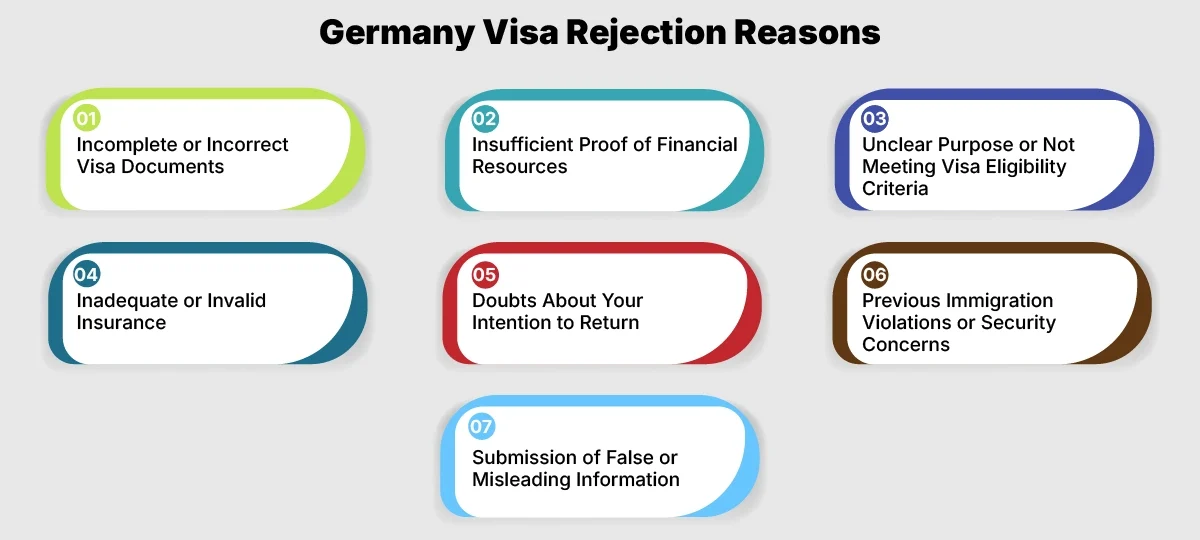
The most common germany visa rejection reasons include incomplete documents, insufficient financial proof, an unclear purpose of stay or ineligibility for the chosen visa category, inadequate insurance, and doubts about the applicant’s return. In addition, past immigration violations and false information can lead to refusals.
1. Incomplete or Incorrect Visa Documents
A single missing, outdated, or wrongly prepared document can lead to a German visa rejection. Each visa category has its own checklist, and consular officers expect every item to be complete and consistent.
Common document issues include:
- Mandatory documents left out of the file
- Old or incorrectly filled application forms
- Documents without the required attestation or certification
- Missing or improper translations
- Details that do not match across documents
- No supporting evidence for claims made in the application
As a result, applicants should carefully check the document checklist for their specific visa category before submitting their application.
2. Insufficient Proof of Financial Resources
Applicants must prove they can support themselves for the full duration of their stay in Germany. Weak or unclear financial evidence is one of the most frequent grounds for refusal.
For example, acceptable financial proof may include:
- Recent bank statements
- Salary slips or other income proof
- Sponsorship documents or a formal obligation letter (Verpflichtungserklärung)
- Scholarship award letters
- Blocked account (Sperrkonto) confirmation, where applicable
- Other recognised financial guarantees
Therefore, financial documents should clearly demonstrate that the applicant can cover the expected costs of their stay.
3. Unclear Purpose or Not Meeting Visa Eligibility Criteria
Consular officers must clearly understand why you are travelling and confirm that you qualify for the visa category you chose. A vague purpose, or applying under a category whose requirements you do not meet, such as the Job Seeker Visa or the Opportunity Card, can result in refusal.
Common gaps include:
- Vague or inconsistent reason for travel, study, or work
- Missing admission letter, job offer, or invitation letter
- Qualifications not recognised in Germany
- Insufficient points for the Opportunity Card
- Language proficiency below the required level
- Choosing the wrong visa type for your purpose
For this reason, your documents should clearly support both your purpose of travel and your eligibility for the selected visa category.
4. Inadequate or Invalid Insurance
Valid insurance is a mandatory part of the application. Coverage that falls short of the requirements, or a policy that does not match your stay, can result in refusal.
Common insurance issues include:
- No insurance policy submitted
- Coverage below the required minimum (for Schengen short stays, €30,000)
- Policy not valid for the entire duration of the stay
- Policy not valid in Germany or the Schengen area
- Insurance from a provider not accepted for the visa type
- Missing medical or repatriation cover
As a result, applicants should verify that their insurance meets the requirements of their specific visa before submitting the application.
5. Doubts About Your Intention to Return
For short-stay and other temporary visas, officers must be satisfied that you will leave Germany before your visa expires. Weak ties to your home country can raise doubts about this.
Evidence that helps show strong ties includes:
- Employment proof or approved leave letter
- Ownership of property or business
- Family responsibilities in your home country
- Confirmed return flight booking
- Ongoing studies or enrolment in India
- Previous travel history with timely returns
In contrast, unclear plans or limited evidence of ties can make it harder to establish your intention to return.
6. Previous Immigration Violations or Security Concerns
Your travel and immigration history is checked closely. Past violations or security-related flags can lead to refusal, even if your current documents are in order.
Common red flags include:
- Overstaying a previous visa
- Earlier visa cancellations or revocations
- Deportation or an existing entry ban
- Criminal record
- An alert in the Schengen Information System (SIS)
Therefore, applicants should disclose relevant immigration history accurately rather than leaving out information that may later be identified during the assessment.
7. Submission of False or Misleading Information
Providing forged documents or deliberately false information is treated as a serious offence. It can lead to immediate refusal and may affect your chances of getting a visa in the future.
Examples include:
- Fake or altered bank statements
- Forged experience letters or certificates
- Fabricated job offers or invitation letters
- Concealing previous visa refusals
- False statements in the application form or interview
If an application is refused, the germany visa rejection letter will state the specific grounds, which can help the applicant identify and address the issue before applying again.
Germany Visa Rejection Rate for Indians
In 2025, German missions refused about 10.5% of the roughly 153,000 Schengen short-stay applications filed by Indians, compared with a 15.8% overall refusal rate for Indian applicants across all Schengen countries. For German student visas, the rejection rate is commonly estimated at around 10% or below, although these are industry estimates rather than official statistics.
Importantly, rejection rates are not fixed and can vary based on several factors:
Visa Category: Short-stay Schengen, student, job seeker and work visas follow different rules and are recorded separately.
Year of Application: Rates can shift with application volumes, consular workload and policy changes.
Applicant Profile: Complete documents, strong financial proof, clear eligibility and a well-defined purpose of stay can support a stronger application.
In addition, official Schengen statistics from the European Commission are published by destination country and by the location where the application was filed. German national visas for study and work are handled and reported separately. Therefore, no single percentage applies to every visa type.
These figures should be treated as a guide. Instead, applicants should focus on submitting a complete, well-documented application to reduce avoidable issues.
How to Avoid German Visa Rejection?
To avoid German visa rejection, applicants should submit a complete and genuine application, meet the requirements of their visa category, prove they can fund their stay, and explain the purpose of their trip clearly.
To reduce the risk of refusal, consider the following steps:
Submit Complete Documents: Include every mandatory document listed for your visa category, in the correct format and valid on the date of application.
Keep Your Information Accurate and Genuine: Details in the application form must match your supporting documents. Use only authentic certificates and records, and declare any previous refusals honestly, as false statements can lead to refusal and affect future applications.
Show Sufficient Financial Resources: Provide accepted proof, such as bank statements, a blocked account, a sponsorship letter or a scholarship, that covers your living costs in Germany.
Arrange Valid Insurance: Buy a policy that meets the minimum coverage requirement and is valid in Germany for your entire stay.
Meet the Eligibility Criteria and Choose the Right Visa: Check the requirements for your category, whether it is a student visa, a work visa, the German Opportunity Card or a short-stay visa. Then, apply under the category that matches your purpose and length of stay.
Explain Your Purpose Clearly: Support your reason for going with documents such as an admission letter, job offer or invitation letter, along with a clear itinerary or plan.
Show Strong Ties to Your Home Country: For temporary visas, proof such as employment, property or family responsibilities and a return ticket can help show that you will leave on time.
Prepare for the Visa Interview: If you are called for an interview, answer questions about your plans, finances and stay clearly and consistently.
Review Your Application Before Submitting: Finally, recheck forms, translations, photographs and document order to catch avoidable errors or omissions.
How to Reapply for a German Visa After Rejection?
You can reapply after a German visa rejection. The Federal Foreign Office confirms that rejected applicants can submit a new visa application at any time, so there is no fixed waiting period.
However, repeating the same application without addressing the original concerns may result in another refusal. Your second application should therefore explain what has changed and how the issues identified in the previous decision have been addressed.
Here is the Step-by-Step Process to Reapply for a German Visa After Rejection:
Step 1: Read the Rejection Letter Carefully
The germany visa rejection letter lists the grounds for refusal. First, note each reason carefully, as your new application should address every relevant concern.
Step 2: Fix the Identified Issues
Collect any missing documents, strengthen your financial proof, correct inconsistencies, and update anything outdated, such as insurance, translations or forms.
In addition, check whether any documents need to be newly issued rather than simply resubmitted.
Step 3: Understand Your Options
Germany abolished the remonstration procedure for visa rejections worldwide from 1 July 2025. Therefore, under the current germany visa rejection appeal policy, applicants can either file a new application or challenge the decision in court.
Legal challenges go to an administrative court in Berlin. However, applicants should understand the requirements, costs and time involved before choosing this route.
Step 4: Re-check the Visa Category and Requirements
Confirm that you are applying under the right category, whether student, work, Opportunity Card or short-stay, and that you meet its current eligibility criteria.
This is particularly important when your circumstances have changed since the previous application.
Step 5: Prepare a Stronger Application
Use fresh, valid documents and add a short cover letter explaining what has changed since the last refusal and how you have resolved each concern.
As a result, the visa officer can more clearly see how the new application addresses the issues identified previously.
Step 6: Submit the New Application and Pay the Fee Again
A fresh application means paying all fees again. National visas for skilled workers, apprentices, students and family reunification can be applied for online through the Consular Services Portal, which guides you through the required documents.
After submitting the application, attend your appointment or interview as required and track the status of your application.
Conclusion
A German visa rejection does not have to end your plan to Migrate to Germany from India. Most refusals come from issues such as incomplete documents, weak financial proof or an unclear purpose of stay.
However, understanding the reason for refusal is an important first step. By addressing each concern, providing genuine supporting documents and choosing the correct visa category, applicants can submit a more complete application.
Since Germany immigration rules and requirements can change, check the latest visa and residence information on Make it in Germany before applying again.