


If you are applying for a Canada Super Visa, having valid private health insurance is one of the key requirements. The insurance must meet specific conditions set by Immigration, Refugees and Citizenship Canada (IRCC), including a minimum coverage of CAD $100,000 and a validity period of at least one year from the date of entry into Canada.
As of 2026, eligible applicants can obtain Super Visa insurance from a Canadian insurance company or, subject to IRCC’s requirements, from certain qualifying insurance companies outside Canada. The policy must cover healthcare, hospitalization and repatriation and must be valid for each entry to Canada.
This guide explains Super Visa insurance requirements, coverage, cost, pre-existing conditions, eligible insurers, purchasing options, proof of insurance, cancellation and renewal.
Table Of Content
1What Is Super Visa Insurance?2Who Needs Super Visa Insurance?3Super Visa Insurance Requirements4How Much Super Visa Insurance Coverage Is Required?5How Much Does Super Visa Insurance Cost?6What Affects Super Visa Insurance Premiums?7What Does Super Visa Insurance Cover?8Does Super Visa Insurance Cover Pre-Existing Conditions?9Super Visa Insurance Providers10Canadian vs Qualifying Foreign Insurance Companies11How to Purchase Super Visa Insurance12What Proof of Super Visa Insurance Is Required?13Can You Cancel Super Visa Insurance and Get a Refund?14Is Monthly Super Visa Insurance Available?15Can You Buy Super Visa Insurance Before Travelling to Canada?16Do You Need to Renew Super Visa Insurance?17Super Visa Insurance Checklist18Frequently Asked Questions
What Is Super Visa Insurance?
Super Visa insurance is private medical insurance required for parents and grandparents applying for or travelling to Canada under the Super Visa program.
The Super Visa is a multiple-entry visa that allows eligible parents and grandparents of Canadian citizens, permanent residents or registered Indians to visit their family in Canada for extended periods. A Super Visa can allow a stay of up to 5 years at a time, subject to the applicable entry and stay rules.
Because Super Visa holders are not generally covered by Canada’s provincial or territorial health insurance plans, they must have private health insurance that meets IRCC’s requirements.
Super Visa Insurance Requirements
- Be valid for at least 1 year from the date of entry into Canada
- Provide at least CAD $100,000 in emergency coverage
- Cover healthcare
- Cover hospitalization
- Cover repatriation
- Be valid for each entry to Canada
- Be issued by an eligible insurance company
- Be paid in accordance with the insurer’s requirements; an insurance quote alone is not sufficient proof
- Be available for review by a border services officer when requested
Who Needs Super Visa Insurance?
Super Visa insurance is required for applicants travelling to Canada under the Parent and Grandparent Super Visa program.
This includes eligible:
- Parents of Canadian citizens
- Parents of Canadian permanent residents
- Grandparents of Canadian citizens
- Grandparents of Canadian permanent residents
The applicant must provide proof of private health insurance that meets the Super Visa requirements. IRCC also requires the applicant to undergo an immigration medical examination and meet the other eligibility and admissibility requirements.
If you are planning to stay in Canada for 6 months or less, you may instead need to consider a regular visitor visa or another applicable travel authorization rather than a Super Visa.
Super Visa Insurance Requirements
The following requirements are particularly important when purchasing Super Visa medical insurance.
| Requirements | Details |
|---|---|
| Minimum insurance coverage | CAD $100,000 |
| Minimum policy validity | 1 year from date of entry |
| Healthcare coverage | Required |
| Hospitalization | Required |
| Repatriation | Required |
| Valid for each entry | Yes |
| Insurance quote | Not accepted as proof |
| Payment | Policy must be paid in full or according to an accepted instalment/deposit arrangement |
| Insurer | Eligible Canadian or qualifying foreign insurance company |
IRCC states that the insurance policy must provide a minimum emergency coverage of $100,000 and cover healthcare, hospitalization and repatriation.
Important 2026 update: Foreign insurance companies
Since January 28, 2025, IRCC has allowed Super Visa applicants to purchase qualifying private health insurance from certain companies outside Canada.
However, not every foreign insurance company automatically qualifies.
IRCC states that a foreign insurer must meet specific requirements, including authorization by the Office of the Superintendent of Financial Institutions (OSFI) to provide accident and sickness insurance, appearing on OSFI’s publicly available list of federally regulated financial institutions, and issuing or making the policy while conducting insurance business in Canada.
Therefore, applicants should verify that the insurer and policy meet the current IRCC requirements before purchasing coverage.
How Much Super Visa Insurance Coverage Is Required?
The minimum required Super Visa insurance coverage is: CAD $100,000
This is the minimum emergency coverage required by IRCC.
However, applicants may find insurance plans offering coverage above the minimum, depending on the insurer and policy.
For example, an applicant may compare policies offering:
- $100,000 coverage
- $150,000 coverage
- $200,000 coverage
- Higher coverage amounts
The coverage amount is only one factor to consider. Applicants should also check the policy’s exclusions, deductibles, pre-existing condition provisions, medical stability requirements and claim conditions.
Important: A higher coverage amount does not automatically mean that every medical expense will be covered. Coverage depends on the terms and conditions of the specific policy.
How Much Does Super Visa Insurance Cost?
The Super Visa insurance cost is not fixed. Insurance companies calculate premiums based on factors related to the applicant and the selected policy.
The price can vary significantly between applicants.
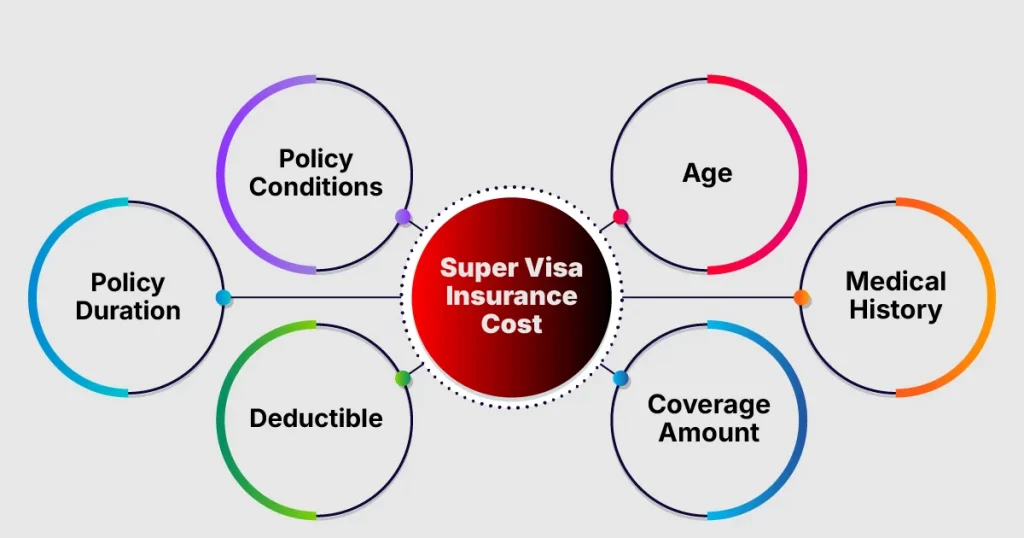
Some of the major factors affecting Super Visa insurance cost include:
- Age of the insured person
- Coverage amount
- Length of the policy
- Medical history
- Pre-existing medical conditions
- Deductible selected
- Coverage options
- Insurance provider
- Policy terms and exclusions
Older applicants or applicants with certain medical conditions may pay higher premiums because the insurer may consider them to have a higher potential risk of making a medical claim.
Therefore, there is no single Super Visa insurance price that applies to every parent or grandparent.
Why should you compare Super Visa insurance quotes?
Comparing quotes can help you understand differences in:
- Premiums
- Coverage limits
- Deductibles
- Pre-existing condition coverage
- Exclusions
- Medical stability periods
- Refund conditions
- Cancellation terms
- Payment options
The cheapest policy is not necessarily the policy that provides the most suitable coverage. Always read the policy wording before purchasing.
What Affects Super Visa Insurance Premiums?
Several factors can affect the premium quoted by an insurer.
1. Age
Age is one of the factors insurers may consider when calculating premiums. In general, insurance costs can increase as the insured person’s age increases.
2. Medical history
Existing or previous medical conditions may affect eligibility, coverage and premium calculations.
3. Coverage amount
Choosing coverage above the minimum required amount can affect the premium.
4. Deductible
Some policies allow applicants to select a deductible. A deductible is the amount the insured may have to pay toward an eligible claim before the insurer pays according to the policy.
5. Policy duration
The length of coverage can influence the total premium.
6. Coverage conditions
Different insurers may have different rules for pre-existing conditions, stability periods, exclusions and medical assessments.
What Does Super Visa Insurance Cover?
A qualifying Super Visa insurance policy must cover:
Healthcare
The policy must provide coverage for eligible healthcare expenses according to the policy terms.
Hospitalization
Hospital-related eligible expenses must be covered under the policy.
Repatriation
The policy must also provide coverage for repatriation, subject to the policy’s conditions.
Emergency medical expenses
The policy must provide at least CAD $100,000 in emergency coverage.
However, applicants should not assume that every medical service or treatment is automatically covered.
Policies can contain:
- Exclusions
- Deductibles
- Waiting or stability periods
- Maximum limits for particular services
- Conditions for making a claim
- Restrictions relating to pre-existing conditions
Always review the certificate of insurance and policy wording before travelling.
Does Super Visa Insurance Cover Pre-Existing Conditions?
It depends on the insurance policy.
A pre-existing condition is a medical condition that existed before the insurance policy started. Examples may include:
- Diabetes
- High blood pressure
- Heart disease
- Asthma
- Previous cancer
- High cholesterol
Some Super Visa insurance plans may provide coverage for certain pre-existing conditions if the applicant satisfies the insurer’s medical stability requirements.
Other policies may exclude particular conditions or impose specific limitations.
What is a stability period?
An insurer may require a medical condition to have remained stable for a specified period before the policy provides coverage related to that condition.
The definition of “stable” and the required period can vary between insurance providers.
Therefore, applicants with pre-existing conditions should disclose their medical history accurately and carefully review the policy’s pre-existing condition provisions.
Do not assume that buying a policy automatically means your existing medical conditions are covered.
Super Visa Insurance Providers
When choosing Super Visa insurance, applicants should check both the insurance company and the specific policy to make sure the coverage meets current IRCC requirements.
Super Visa applicants can generally obtain qualifying insurance from an eligible Canadian insurance company. Since January 28, 2025, IRCC has also allowed insurance from certain qualifying foreign insurance companies that meet additional Canadian regulatory requirements.
Canadian Insurance Providers
Canadian insurance companies are the more established route for Super Visa applicants. Depending on the insurer and policy, applicants may find plans that offer:
- Emergency medical coverage
- Hospitalization coverage
- Repatriation
- Coverage for certain pre-existing medical conditions
- Different deductible options
- Different coverage limits
- Different cancellation and refund conditions
Examples of companies that offer travel or visitor insurance products in Canada include:
- Manulife
- Sun Life
- Canada Life
- Blue Cross
- GMS (Group Medical Services)
- Travelance
- Allianz Global Assistance
- TuGo
- 21st Century Insurance
- Destination Canada
- Secure Travel (RIMI)
Important: The availability of a Super Visa insurance product can vary by provider, applicant profile and policy. Applicants should verify the current policy details directly with the insurer before purchasing.
Being a Canadian insurance company does not by itself mean that every insurance product automatically qualifies for a Super Visa. The policy should still satisfy the current IRCC requirements, including the minimum coverage amount, policy duration and required healthcare, hospitalization and repatriation coverage.
Qualifying Foreign Insurance Companies
Since January 28, 2025, IRCC has allowed Super Visa applicants to purchase private health insurance from certain insurance companies outside Canada.
However, additional requirements apply.
According to IRCC, a foreign insurance company must:
- Be authorized by the Office of the Superintendent of Financial Institutions (OSFI) to provide accident and sickness insurance.
- Appear on OSFI’s publicly available list of federally regulated financial institutions.
- Have issued or made the policy while conducting insurance business in Canada.
This means that simply purchasing a policy from an international or overseas insurance company does not automatically make the policy acceptable for a Super Visa.
Canadian vs Qualifying Foreign Insurance Companies
One of the important changes to Super Visa insurance rules is that eligible applicants may now obtain coverage from certain insurance companies outside Canada.
Canadian insurance company
A policy from an eligible Canadian insurance company can satisfy the insurance requirement if it meets the Super Visa policy conditions.
Foreign insurance company
A policy from outside Canada must satisfy additional requirements.
IRCC’s current guidance states that the foreign insurance company must be authorized by OSFI to provide accident and sickness insurance, appear on OSFI’s list of federally regulated financial institutions, and have issued or made the policy while conducting insurance business in Canada.
Why does this matter?
Simply purchasing a policy from an overseas travel insurer does not automatically mean the policy qualifies for a Super Visa.
Applicants should verify the insurer’s eligibility and ensure the policy itself satisfies IRCC’s requirements.
How to Purchase Super Visa Insurance
The process is generally straightforward, but applicants should compare the policy conditions carefully.
Step 1: Determine your required coverage
Start with the IRCC minimum: CAD $100,000 emergency coverage for at least 1 year.
Step 2: Compare insurance providers
Obtain Super Visa insurance quotes from eligible providers.
Compare the premium, coverage, deductible, exclusions and pre-existing condition provisions.
Step 3: Review medical requirements
If you have a pre-existing medical condition, check whether the policy covers it and whether a stability period applies.
Step 4: Check the policy duration
The policy must be valid for at least one year from the date of entry into Canada.
Step 5: Confirm payment requirements
IRCC states that quotes aren’t accepted as proof. The policy must be paid in full or meet the applicable payment/deposit requirements.
Step 6: Obtain the insurance documents
Keep the insurance certificate or policy documents showing:
- Name of insured person
- Date of birth
- Insurance company
- Coverage amount
- Policy start date
- Policy expiry date
- Covered benefits
Step 7: Submit proof with your Super Visa application
Include the required proof of insurance with your application and keep a copy for travel.
What Proof of Super Visa Insurance Is Required?
The insurance document should clearly identify the insurer and demonstrate that the policy satisfies the Super Visa requirements.
IRCC states that the policy should include the insurance company’s name, be valid for at least one year from the date of entry, provide at least $100,000 in emergency coverage, cover healthcare, hospitalization and repatriation, and be valid for each entry to Canada.
A quote alone is not sufficient.
Applicants should retain their insurance documents and be prepared to show proof to a border services officer if requested.
Can You Cancel Super Visa Insurance and Get a Refund?
Yes, you may be able to cancel your Super Visa insurance and receive a refund, but the refund rules are set by the insurance provider, not IRCC.
If your Super Visa is refused before the policy becomes effective, many insurers may offer a refund after you provide the official IRCC refusal letter. Other cancellations may involve administrative fees or different refund conditions.
Before purchasing a policy, check the insurer’s:
- Visa-refusal refund policy
- Cancellation fees
- Policy start-date rules
- Refund eligibility after arrival in Canada
- Conditions relating to claims
Important: Refund terms vary between insurers, so confirm the specific conditions with your insurance provider before purchasing.
Is Monthly Super Visa Insurance Available?
Some insurance providers may offer payment options that allow premiums to be paid in installments rather than entirely upfront.
However, applicants should distinguish between: monthly payment options and monthly insurance coverage.
IRCC requires the insurance policy to be valid for at least one year from the date of entry into Canada. The current IRCC guidance also states that the policy can be paid in full or in installments with a deposit, provided the policy meets the applicable requirements.
Therefore, applicants should check the insurer’s payment structure carefully rather than assuming that a month-to-month policy automatically meets the Super Visa requirement.
Can You Buy Super Visa Insurance Before Travelling to Canada?
Yes. Applicants need proof of qualifying private health insurance for the Super Visa, and the policy must be valid for at least one year from the date of entry into Canada.
The insurance should therefore be arranged before travelling and should satisfy IRCC’s requirements.
Applicants should also ensure that the dates on the insurance policy correspond appropriately with their intended travel and entry plans.
Do You Need to Renew Super Visa Insurance?
Yes. Super Visa holders must maintain valid health insurance while they are in Canada.
IRCC states that proof of valid health insurance is required on re-entry and that applicants should renew their insurance if the existing policy expires before they leave Canada.
For example, if a parent remains in Canada beyond the original insurance period, they need to ensure that their coverage remains valid.
Visa validity and insurance validity are not the same thing.
A Super Visa can be valid for multiple entries for up to 10 years, while the health insurance policy is required to be valid for at least one year from the date of entry and must be maintained as required during the stay.
Super Visa Insurance Checklist
Before purchasing your policy, check the following:
- Minimum CAD $100,000 emergency coverage
- At least 1 year of validity from the date of entry
- Healthcare coverage
- Hospitalization coverage
- Repatriation coverage
- Valid for each entry to Canada
- Eligible insurance company
- Pre-existing condition terms reviewed
- Deductible checked
- Exclusions reviewed
- Cancellation and refund conditions understood
- Payment requirements satisfied
- Insurance certificate obtained
This checklist can help parents and grandparents avoid choosing a policy based solely on price.