



Medical Laboratory Technician jobs in Canada are available across the healthcare sector, but employment prospects vary by province and territory. Canada’s Job Bank currently classifies Medical Laboratory Technicians under NOC 33101, officially “Medical laboratory assistants and related technical occupations.”
The occupation includes work such as collecting and processing samples, conducting routine laboratory tests, preparing reagents, and maintaining laboratory equipment. For internationally educated applicants, an important distinction is that being qualified for a laboratory occupation and being eligible to immigrate to Canada are separate questions.
NOC 33101 is currently included in Canada’s Express Entry healthcare and social services category, but candidates must still meet the applicable Express Entry program and category requirements. Professional requirements also differ between Medical Laboratory Technicians/Assistants and Medical Laboratory Technologists.
Table Of Content
1Is There a Demand for Medical Laboratory Technicians in Canada?2Is a Medical Laboratory Technician a Good Career in Canada?3NOC Code 33101 – Medical Laboratory Technicians in Canada4Medical Laboratory Technician vs Medical Laboratory Technologist in Canada5Which Provinces Have Demand for Medical Laboratory Technicians Jobs In Canada?6Requirements to Work as a Medical Laboratory Technician in Canada7Do Medical Laboratory Technicians Jobs in Canada Need a Licence?8Can International Medical Laboratory Technicians Work in Canada?9How to Become a Medical Laboratory Technician in Canada10Medical Laboratory Technician Salary in Canada11Immigration Pathways for Medical Laboratory Technicians12NOC 33101 vs NOC 32120: Which One Applies to You?13Visa Sponsorship for Medical Laboratory Jobs14Frequently Asked Questions
Is There a Demand for Medical Laboratory Technicians in Canada?
Yes, Medical Laboratory Technician jobs exist across Canada, but the employment outlook for NOC 33101 varies by province and region. Job Bank’s current outlook covers the 2025–2027 period and shows different prospects across Canadian jurisdictions.
Job Bank lists hospitals, clinics, research facilities, post-secondary institutions and government research laboratories among the workplaces for this occupational group.
The national outlook should not be interpreted as a single demand level for every part of Canada. For example, Job Bank currently reports a Good 2025–2027 outlook for NOC 33101 in Saskatchewan, New Brunswick and Nova Scotia, while Ontario, British Columbia, Alberta, Manitoba, Quebec and Newfoundland and Labrador have Moderate provincial outlooks.
What factors affect demand?
Demand can be influenced by:
- Population growth and demographic changes
- Healthcare service requirements
- Employment growth within healthcare facilities
- Retirements and worker replacement
- Regional differences in healthcare staffing
- The number of workers available in a particular labour market
- Differences between urban, rural and northern communities
Job Bank’s outlook methodology considers factors such as employment growth, retirements and the number of unemployed workers with recent experience in the occupation.
Therefore, someone researching lab tech jobs in Canada should check the outlook for the specific province or region where they intend to work rather than relying only on a national statement.
Is a Medical Laboratory Technician a Good Career in Canada?
Yes, being a medical laboratory technician is indeed a good career in Canada. Canada offers employment opportunities in hospitals, clinics, laboratories, research facilities and other healthcare-related settings, but career requirements, wages and professional regulation depend on the occupation and province.
Instead of treating the occupation as universally suitable or unsuitable, prospective applicants should consider the following factors:
| Factor | What to Know |
|---|---|
| Demand | Job Bank reports that prospects vary by province and territory. |
| Salary | The national median wage for NOC 33101 is currently $27/hour. |
| Education | A college certificate in medical laboratory science is typically required for the occupation. |
| Licensing | Job Bank currently describes NOC 33101 as not regulated in Canada. |
| Workplaces | Hospitals, clinics, laboratories, research facilities and educational institutions are among the workplaces. |
| Career Progression | Workers may pursue additional education and qualifications for related laboratory occupations. |
| International Applicants | Foreign education and experience do not automatically establish eligibility for every Canadian laboratory role. |
| Immigration | NOC 33101 is included in the current Express Entry healthcare and social services category, subject to program and category requirements. |
Job Bank‘s current information places the median Canadian wage for NOC 33101 at $27.00 per hour, based on 2023–2024 Labour Force Survey data.
NOC Code 33101 – Medical Laboratory Technicians in Canada
Many people search for “MLT NOC code Canada” and find NOC 33101. Note that the official title of NOC 33101 is Medical Laboratory Assistants and Related Technical Occupations, not “technologists”.
- People in this group collect blood and other samples, process specimens, prepare reagents for testing, run routine lab tests, and set up, clean and maintain lab equipment.
- The occupation usually requires a college diploma, an apprenticeship of less than two years, or more than six months of on-the-job training.
- It sits in TEER 3.
Fully qualified technologists are classified separately under NOC 32120 (Medical Laboratory Technologists, TEER 2). If you match your duties to the wrong code, your immigration file can be refused, so match by duties, not by job title.
Medical Laboratory Technician vs Medical Laboratory Technologist in Canada
A Medical Laboratory Technician/Assistant under NOC 33101 is not the same occupation as a Medical Laboratory Technologist under NOC 32120. The two occupations differ in their NOC classification, duties, qualification requirements and regulatory framework.
| Medical Laboratory Assistant / Technician (33101) | Medical Laboratory Technologist (32120) | |
|---|---|---|
| Typical education | Short college certificate or diploma, or on-the-job training | Accredited 2–3 year college diploma or a degree in medical laboratory science |
| Main work | Specimen collection and processing, routine testing, equipment upkeep | Complex analysis, quality control, interpreting results, working with pathologists |
| Regulation | Usually not a regulated title | Regulated in most provinces; national certification through CSMLS |
| TEER level | 3 | 2 |
| Pay | Lower | Generally higher |
Job Bank states that medical laboratory technologists conduct laboratory tests, experiments and analyses used to assist in the diagnosis, treatment, monitoring and prevention of disease. It also lists registration requirements in Newfoundland and Labrador, Nova Scotia, New Brunswick, Quebec, Ontario, Manitoba, Saskatchewan and Alberta.
This distinction is especially important for internationally educated applicants. Someone holding an Indian qualification may need to determine whether their education and work experience align with the Canadian technician/assistant occupation or technologist occupation before selecting a NOC for employment or immigration purposes.
Which Provinces Have Demand for Medical Laboratory Technicians Jobs In Canada?
Demand is not uniform across Canada. Job Bank’s current 2025–2027 outlook shows Good or Moderate prospects in several provinces, while individual regions within a province can have different outlooks.
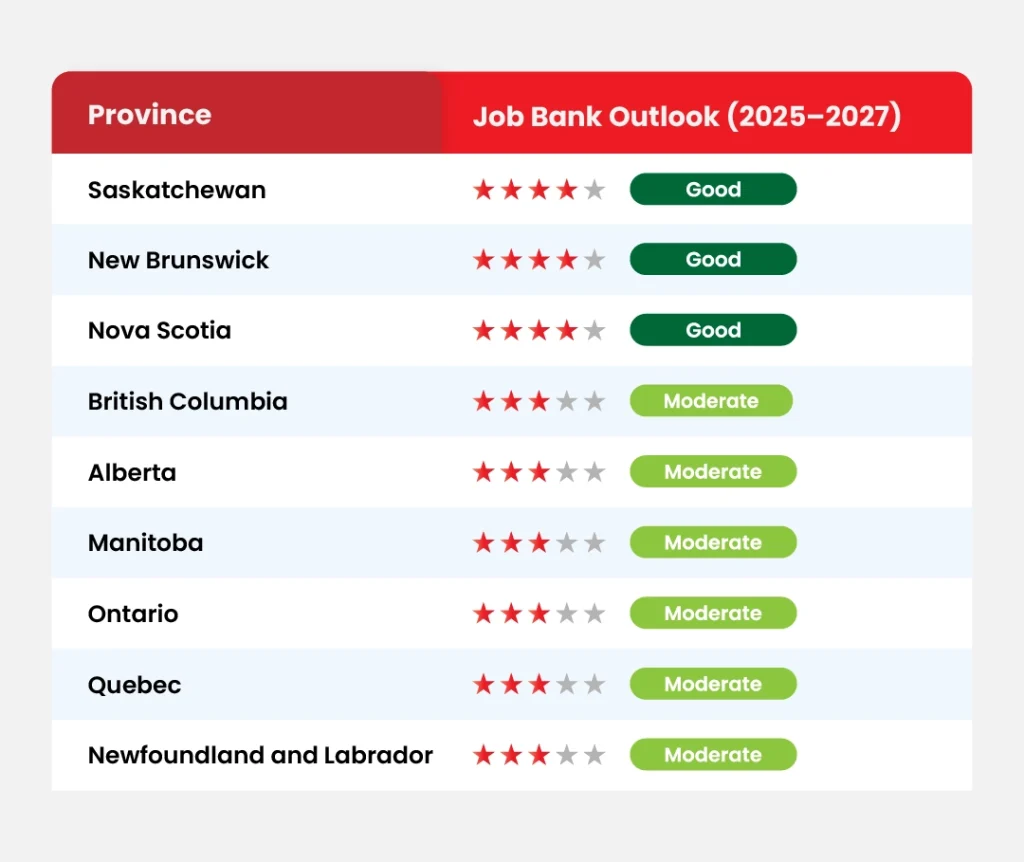
The provincial ratings above refer specifically to NOC 33101 and the 2025–2027 Job Bank outlook period.
Regional variation can be significant. For example, Job Bank reports a Moderate outlook for Alberta overall, but several Alberta regions are rated Limited, while Calgary and Edmonton are Moderate. Manitoba is Moderate overall, with the Southwest region rated Good.
This means applicants should check provincial and regional Job Bank data before deciding where to search for a Canada laboratory technician vacancy.
Requirements to Work as a Medical Laboratory Technician in Canada
For NOC 33101, Job Bank states that medical laboratory assistants and related technical workers typically require a college certificate program in medical laboratory science. Employers may also require certification from the Canadian Society for Medical Laboratory Science (CSMLS).
Education
For NOC 33101, the typical educational requirement is a college certificate program in medical laboratory science. Job Bank’s broader profile also describes post-secondary education or other training routes for the occupational group.
The exact assessment of an international qualification depends on the credential, occupation and employer.
Work experience
Work experience requirements can vary by employer and position. Experience in sample collection, laboratory procedures, specimen processing, quality control and related laboratory activities may be relevant to particular jobs.
Applicants should compare their actual duties with the Canadian occupational description rather than relying only on the job title.
Credential assessment
An Indian MLT degree or diploma is not automatically equivalent to every Canadian laboratory qualification.
Applicants should first identify whether they are pursuing:
1. A Medical Laboratory Technician/Assistant role under NOC 33101; or
2. A Medical Laboratory Technologist role under NOC 32120.
The credential-recognition process can be substantially different between the two.
Language requirements
Language requirements can come from several sources, including:
- The employer
- A provincial regulatory body, where applicable
- A certification process
- An immigration program
Immigration applicants must separately meet the language requirements of the specific immigration program they apply under.
Registration or licensing
NOC 33101 is currently listed by Job Bank as not regulated in Canada. This is different from NOC 32120, where professional registration is required in several provinces.
Employer requirements
Individual employers can impose additional requirements relating to:
- Certification
- Laboratory experience
- Clinical experience
- Specific technical skills
- Language ability
- Shift availability
- Workplace safety training
Therefore, applicants should always read the requirements in the individual job posting.
Do Medical Laboratory Technicians Jobs in Canada Need a Licence?
Generally, medical laboratory assistants and related occupations under NOC 33101 do not require a provincial professional licence to work in Canada. Unlike medical laboratory technologists, medical laboratory assistants are generally not regulated as a profession.
However, employer requirements can vary. Depending on the laboratory, hospital or healthcare facility, you may need:
- A medical laboratory assistant certificate or diploma
- Training or experience in specimen collection and phlebotomy
- Immunization and health records
- A police background check
- CPR or first-aid certification
- Relevant laboratory experience
Can International Medical Laboratory Technicians Work in Canada?
Yes. Internationally trained lab technicians do work in Canadian laboratories, but your foreign diploma doesn’t automatically let you do every lab job. What you can do depends on which Canadian occupation your training and experience match.
These roles cover specimen collection and processing, preparing reagents, routine tests, and equipment upkeep. They are generally not regulated, so you don’t need a professional licence.
Check the employer’s requirements – These often include a college certificate or diploma, phlebotomy or specimen-handling training, immunization records, a police check, and sometimes CPR or first aid.
Get your education assessed if you need immigration points – An Educational Credential Assessment (ECA) is separate from any licensing assessment.
Meet the language requirement – IELTS General or CELPIP, at the level the employer or immigration stream requires.
Apply for jobs – through Job Bank, provincial health authorities, hospital career pages and private labs.
Sort out work authorisation – A job offer and diploma alone don’t give you the right to work. Immigration status is a separate question (see the immigration section).
How to Become a Medical Laboratory Technician in Canada
The medical laboratory technician jobs in Canada pathway depends on whether you are studying in Canada or already hold foreign laboratory education and experience.
For students in Canada
A typical route can involve:
1. Choose an appropriate Canadian medical laboratory education program.
2. Complete the required academic and practical training.
3. Determine the certification or examination requirements applicable to the intended occupation.
4. Complete any required examinations.
5. Apply for registration where the occupation and province require it.
6. Search for employment in hospitals, clinics, laboratories or other relevant workplaces.
CAMLPR currently provides a registration pathway for Canadian-educated Medical Laboratory Technologists in participating jurisdictions. Its process includes examinations, professional practice orientation and application to the provincial regulator.
For internationally educated Medical Lab Technicians
A foreign-trained applicant should:
1. Confirm your duties match NOC 33101, or another suitable code.
2. Pick a province and look at employer requirements, such as a college certificate, phlebotomy or specimen-handling training, immunizations and a police check.
3. Get an Educational Credential Assessment (ECA) if you need it for immigration points.
4. Meet the language requirements for immigration and for the job.
5. Apply for jobs.
6. Work out the work-permit or PR route separately.
Medical Laboratory Technician Salary in Canada
Job Bank’s current national median wage for NOC 33101 is $27.00 per hour. The published wage data is based on the 2023–2024 Labour Force Survey and was updated by the Job Bank in November 2025.
Medical Laboratory Technician salary in Canada
The wage figures above are for NOC 33101, not NOC 32120 Medical Laboratory Technologists.
An annual figure can be estimated from the hourly wage, but it should not be presented as an official annual salary. For example, using a simple 40-hour work week over 52 weeks:
$27 × 40 × 52 = approximately $56,160 per year before taxes.
Actual earnings can differ because of working hours, overtime, shift premiums, employment arrangements and other factors.
Medical Laboratory Technician salary in Indian rupees
For an illustrative conversion only, using approximately C$1 = ₹67.7 on September 28, 2026:
- C$27/hour ≈ ₹1,828/hour
- C$56,160 annual equivalent ≈ ₹38.0 lakh/year
The INR figures are currency conversions, not Canadian salary figures. Exchange rates change daily, and actual amounts received in India would also depend on transfer rates, fees and other factors.
Immigration Pathways for Medical Laboratory Technicians
Medical laboratory assistants and related occupations (NOC 33101) may qualify for Canadian economic immigration programs if they meet the requirements of the specific program. NOC 33101 is included in Canada’s healthcare and social services category for Express Entry, but working as a medical laboratory assistant does not automatically lead to permanent residence.
Express Entry Healthcare and Social Services Category
Medical laboratory assistants and related technical occupations (NOC 33101) are included in the current Express Entry healthcare and social services category. Medical laboratory technologists (NOC 32120) are also listed separately under the same category.
For the healthcare and social services category, candidates generally need at least 12 months of full-time work experience, or an equivalent amount of part-time experience, in one eligible occupation within the previous three years. The experience does not need to be continuous and may be gained in Canada or abroad. Candidates must also meet the requirements specified for the particular category-based round.
Being included in the healthcare category does not replace the basic Express Entry requirements. You must first be eligible for one of the Express Entry programs and then meet the requirements of the applicable category-based selection round.
IRCC determines the type of Express Entry round, the number of candidates invited and the eligibility requirements for each round. Therefore, being listed in a category does not mean that invitations will be issued regularly or that every eligible candidate will receive an ITA.
Canadian Experience Class (CEC)
The Canadian Experience Class (CEC) is an Express Entry program for skilled workers who have qualifying Canadian work experience.
Since NOC 33101 is a TEER 3 occupation, eligible work experience may count toward CEC requirements. Candidates generally need at least 1 year or 1,560 hours of qualifying Canadian work experience within the three years before applying. The work must have been authorised, paid and performed while the candidate was legally authorised to work in Canada.
For NOC TEER 2 and 3 occupations, the minimum language requirement for CEC is CLB 5 in English or NCLC 5 in French in all four language abilities: reading, writing, listening and speaking.
CEC is therefore primarily relevant to medical laboratory assistants who have already gained qualifying work experience in Canada. It is not a pathway based solely on overseas work experience.
Federal Skilled Worker Program (FSWP)
Medical laboratory assistant experience under NOC 33101 (TEER 3) may also be relevant to the Federal Skilled Worker Program, provided the applicant meets all FSWP requirements.
For FSWP, applicants generally need:
- At least 1 year of continuous skilled work experience in the same primary occupation within the last 10 years
- Work experience in TEER 0, 1, 2 or 3
- A minimum language level of CLB 7 in English or NCLC 7 in French in all four abilities
- At least a Canadian secondary-school credential or an equivalent foreign credential with an Educational Credential Assessment (ECA)
- At least 67 points out of 100 under the FSWP selection factors
The FSWP selection grid considers factors such as language ability, education, work experience, age, arranged employment and adaptability. The 67-point FSWP threshold is separate from the Comprehensive Ranking System (CRS) score used to rank candidates in the Express Entry pool.
Provincial Nominee Programs (PNPs)
Provincial Nominee Programs (PNPs) can provide another pathway to Canadian permanent residence for medical laboratory assistants. Each province and territory establishes its own eligibility requirements, and these requirements can change.
Depending on the specific PNP stream, applicants may need:
- A job offer from a Canadian employer
- Canadian or provincial work experience
- Relevant education or training
- Language proficiency
- Work experience in an eligible occupation
- A connection to the province or territory
NOC 33101 does not automatically qualify you for every PNP stream. You must meet the requirements of the specific province and immigration stream.
If you receive a nomination through an Express Entry-linked PNP, IRCC awards 600 additional CRS points. A nomination can therefore significantly increase a candidate’s CRS score, but the candidate must still meet the applicable requirements and receive an invitation to apply.
NOC 33101 vs NOC 32120: Which One Applies to You?
For Medical Laboratory Technician jobs in Canada the NOC code you use for immigration should match your actual job duties and work experience, not simply the name of your qualification.
NOC 33101: Medical laboratory assistants and related technical occupations — TEER 3
NOC 32120: Medical laboratory technologists — TEER 2
Both occupations are currently included in the Express Entry healthcare and social services category, but they are separate occupations with different NOC descriptions and TEER classifications.
Therefore, an internationally trained professional should determine the NOC that best matches their actual employment duties and responsibilities before claiming work experience for immigration purposes.
Canadian immigration rules, Express Entry categories and program requirements can change. Always confirm the latest eligibility requirements on the official IRCC website before applying.
Visa Sponsorship for Medical Laboratory Jobs
International job seekers often use “visa sponsorship” informally, but Canadian immigration applications generally require specific work-permit or immigration mechanisms rather than a generic sponsorship process.
Depending on the circumstances, an international applicant may need:
- An employer-specific work permit
- An LMIA-supported employment route, where applicable
- An LMIA-exempt work permit under an applicable category
- Another work-authorisation pathway
- Permanent residence through an economic immigration program
A Canadian job offer does not automatically lead to a work permit or permanent residence. Also, not every laboratory employer in Canada hires from abroad.
Important: Immigration rules, eligibility criteria, and processing requirements change frequently. This information is for general guidance only and is not legal or immigration advice. Always confirm current requirements on the official Immigration, Refugees and Citizenship Canada (IRCC) website.



Hi
I’m licensed medical laboratory scientist from Nigeria, have done my credit evaluation and have Ielts result of 7.5. I’m currently in the express entry pool with crs 405. Is it possible for me to get a job without csmls license?
Hi Abimbola Aisat Ogunlowo,
You can apply for a temporary work permit by securing a job offer from a Canadian employer with LIMA permit and some provinces may have equivalency assessment processes for international credentials.
Hello, I’m a fresh graduate (medical laboratory technician), but with no license for now.
Can I apply for Medical Lab Technician in Canada?
Hi ANORUO JOY,
Yes, you can apply for a Medical Lab Technician (MLT) position in Canada as a fresh graduate without a license, but you will need to meet specific requirements and go through a process to become eligible to work as an MLT in Canada. It will be appreciated if you could get in touch with our Canada immigration experts at Canapprove to receive a personalized assistance. BOOK A FREE CONSULTATION NOW!
I am an international Medical Technologist, I recently pass the exam for Medical Laboratory Assistant in Canada. Can your company assist me in applying for an open work permit. I have applied for several jobs but once they ask my status and I say I only have a visitor visa the conversation ends.
Hi Jacquline Holness,
Thank you for reaching out and sharing your situation. At CanApprove, we understand the challenges international professionals face when transitioning from a visitor visa to obtaining an open work permit. Our experienced team can provide comprehensive assistance for you. BOOK A FREE CONSULTATION NOW!
My name is Dhara Lad, and I am from India. I have over eight years of experience as a medical laboratory technician in the healthcare field. I have completed my WES evaluation for Canada immigration, and I achieved a General IELTS score of 6 bands in each category. I am currently seeking a work permit and would appreciate any suggestions on how to find a job without my CSMLS certification.
Dear Ms. Lad,
Thank you for reaching out to us and sharing your impressive background as a medical laboratory technician with over eight years of experience. We appreciate your initiative in completing the WES evaluation and securing your IELTS score.
To work in Canada as a medical laboratory technician, obtaining certification from the Canadian Society for Medical Laboratory Science (CSMLS) is typically required. However, there are alternative pathways you can explore while working towards your certification.
We recommend booking a consultation with us so we can provide detailed guidance tailored to your profile. Feel free to contact us at https://canapprove.com/book-an-appointment/#immigration to discuss the best way forward.
Looking forward to assisting you in achieving your goals!
Hi,
I am Chialuka Modesta. Medical laboratory technician with my licence.
I’m currently working in hospital.
I would love to work with any laboratory in Canada.
Hi Chialuka,
Thank you for reaching out. It’s great to hear about your experience as a licensed medical laboratory technician currently working in a hospital. Canada has a growing demand for skilled medical professionals like you.
At CanApprove, we can guide you through the process of finding suitable opportunities in Canada and help you with the immigration procedures. Let us know if you would like to discuss the available options and eligibility criteria in detail. BOOK A FREE CONSULATATION NOW!
Looking forward to hearing from you!
Lab technician
Hi Salman,
Thank you for reaching out.
If you are interested in working as a Lab Technician in Canada, there are possible pathways, but the requirements depend on your exact qualification and role.
For example, Medical Laboratory Technologists are classified under NOC 32120, while Medical Laboratory Assistants are classified under NOC 33101. Medical Laboratory Technologists are also included in Canada’s current healthcare and social services category for Express Entry.
For regulated positions, you may need to complete the applicable credential assessment, professional certification and provincial registration before you can practise. Requirements vary by province.
CanApprove can guide you regarding the Canadian immigration pathway based on your occupation and background. Please note that immigration eligibility does not automatically mean employment or professional licensing in Canada, and job or visa approval cannot be guaranteed.