




If you are planning to migrate to Canada from India or any other country, understanding the Educational Credential Assessment for Canada immigration process is an important first step. An ECA verifies that your foreign education meets Canadian standards and confirms its equivalency to a Canadian qualification. This assessment is a mandatory requirement for most permanent residence pathways, including Express Entry, and plays a key role in determining your eligibility and immigration points.
Table Of Content
1What is Educational Credential Assessment Canada?2Designated ECA Organizations for Canada Immigration3ECA in Canada Requirements4How to get ECA for Canada5Educational Credential Assessment Fees6Educational Credential Assessment for Canada Immigration Processing Time8Conclusion9Frequently Asked Questions
What is Educational Credential Assessment Canada?
An Educational Credential Assessment (ECA) is a process that verifies whether your foreign degree, diploma, or certificate is equal to a Canadian educational standard.
ECA in Canada is required for immigration programs such as:
- Skilled Immigration Programs such as Express Entry
- Educational Credential Assessment for Canada PR applications
- Certain Provincial Nominee Programs (PNPs)
Without a valid ECA, your education will not be counted for immigration points, which can affect your chances of qualifying for Canada PR.
Designated ECA Organizations for Canada Immigration
When applying for Canadian immigration, your Educational Credential Assessment (ECA) certificate must be issued by an officially approved organization. Only ECAs issued by bodies recognized by Immigration, Refugees and Citizenship Canada (IRCC) are accepted for Express Entry and other economic immigration programs.
Choosing the right ECA organization is important, as it can affect processing time, cost, and how your qualification is assessed.
List of Designated ECA Organizations in Canada
The list of Designated ECA Organizations in Canada are:
- World Education Services (WES)
- Comparative Education Service (CES)
- International Credential Assessment Service of Canada (ICAS)
- International Qualifications Assessment Service (IQAS)
- International Credential Evaluation Service (ICES)
Let’s see each in detail:
1. World Education Services (WES)
World Education Services (WES) Educational Credential Assessment is one of the best Educational Credential Assessment for Canada immigration or most widely used ECA organizations for Canada immigration, particularly among Express Entry applicants.
- WES Educational Credential Assessment processing time is usually 30–45 days after all required documents are received
- It is a preferred ECA organization for Canada immigration due to its faster processing
- Simple and user-friendly online ECA application process
- WES is fully recognized by Immigration, Refugees and Citizenship Canada (IRCC) for immigration purposes
- Sends ECA report directly to IRCC
- WES Educational Credential Assessment report is valid for 5 years
2. Comparative Education Service (CES)
Comparative Education Service (CES) is operated by the University of Toronto School of Continuing Studies and is accepted for Express Entry and other Canada PR pathways.
- CES Educational Credential Assessment processing time is generally 12–14 weeks after documents are received
- Suitable for applicants with complex or research-based academic credentials
- Academic-oriented evaluation approach
- CES is fully recognized by Immigration, Refugees and Citizenship Canada (IRCC) for immigration purposes
- The CES ECA report can be used for Express Entry and Provincial Nominee Program (PNP) applications
- CES Educational Credential Assessment report is valid for 5 years
3. International Credential Assessment Service of Canada (ICAS)
International Credential Assessment Service of Canada (ICAS) is commonly used by applicants with older qualifications or mixed secondary and post-secondary education.
- ICAS Educational Credential Assessment processing time typically ranges from 20 to 25 weeks
- Often chosen for older or less common international credentials
- Detailed assessment methodology
- ICAS is fully accepted by IRCC for Canada immigration
- ECA report issued directly to the applicant
- ICAS Educational Credential Assessment report is valid for 5 years
4. International Qualifications Assessment Service (IQAS)
International Qualifications Assessment Service (IQAS) is operated by the Government of Alberta and is used for both federal and provincial immigration programs.
- IQAS Educational Credential Assessment processing time usually ranges from 20 to 30 weeks
- Accepted for Express Entry and most PNP streams
- IQAS is recognized by IRCC for immigration use
- Government-run assessment authority
- Suitable for a wide range of international qualifications
- IQAS Educational Credential Assessment report is valid for 5 years
5. International Credential Evaluation Service (ICES)
International Credential Evaluation Service (ICES) is based in British Columbia and is accepted for Canada immigration applications.
- ICES Educational Credential Assessment processing time generally ranges from 20 to 25 weeks
- Provides comprehensive credential evaluation reports
- ICES is often selected by applicants planning to settle in Western Canada
- Recognized by IRCC for Express Entry and PR applications
- ECA report issued to the applicant
- ICES Educational Credential Assessment report is valid for 5 years
For Regulated Professions
If your occupation is regulated, you may need an ECA from a specific authority:
- Medical Council of Canada (MCC) – For Doctors
- Pharmacy Examining Board of Canada (PEBC) – For Pharmacists
ECA in Canada Requirements
To apply for an Educational Credential Assessment for Canada immigration in 2026, you must meet these essential requirements:
1. Designated ECA Organization
Apply through an agency approved by Immigration, Refugees and Citizenship Canada (such as WES, IQAS, ICES, ICAS, CES, MCC, PEBC, or CACAB).
2. Completed Foreign Education
A degree, diploma, or certificate from a recognized institution outside Canada that is equal to a completed Canadian secondary or post-secondary credential.
3. Academic Documents
Final certificates and official transcripts issued on or after the date the organization was designated by IRCC.
4. Profession-specific Bodies
Physicians must use the MCC, pharmacists use the PEBC, and architects must use the CACB for their assessments.
5. Document Language
All reports must be in English or French to be used for eligibility and CRS points.
Key Facts for Applicants:
- ECA is mandatory for Express Entry (FSW) and often required for PNP; it is optional but recommended for CEC and FSTP to claim points.
- The report is valid for 5 years from the date IRCC receives your profile and permanent residence application.
- An ECA is not a license to practice a profession; it is only used to verify your education level for immigration scoring.
- If your degree was awarded in Canada, an ECA for that specific credential is not required
These requirements help you successfully complete your ECA and claim education points for Canada immigration.
How to get ECA for Canada
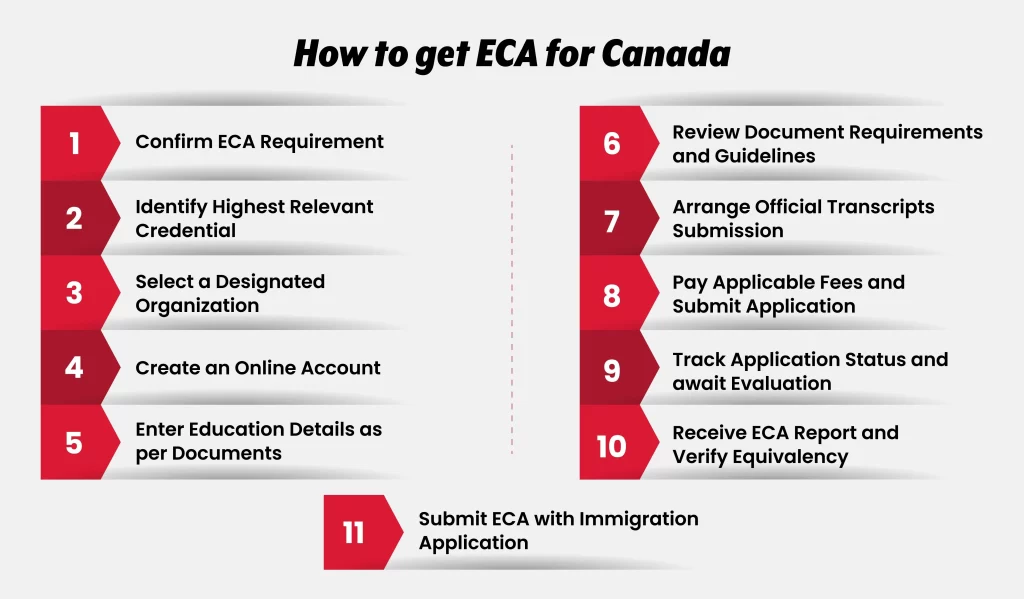
A valid ECA supports your profile and improves job opportunities in Canada.
Follow these simple steps to get your Educational Credential Assessment for Canada immigration:
Step 1: Confirm you actually need an ECA
Before starting, check whether your immigration program requires an ECA and for which credentials.
- It is mandatory for Federal Skilled Worker applicants using foreign education and for anyone who wants CRS points for non‑Canadian degrees.
- If all your education is Canadian, you usually do not need an ECA.
Step 2: Identify your Highest and most Relevant Credential
Decide which degree/diploma you will assess (often the highest completed credential, like bachelor’s, master’s, or professional degree).
- Assessing only the top credential is enough for immigration in most cases, unless a program or strategy requires multiple credentials.
Step 3: Choose the Correct Designated Organization
Select a designated ECA organization for your Educational Credential Assessment for Canada Immigration based on your profile.
- General applicants usually choose WES, IQAS, ICES, ICAS, or CES; doctors must use MCC, pharmacists use PEBC, and architects use CACB.
- Compare processing times, fees, accepted institutions, and document rules on each organization’s website before deciding.
Step 4: Create an Online Account with the Chosen Body
Go to the website of your selected organization and register.
- You typically provide personal details, contact information, and select “Immigration” or “ECA for IRCC/Canada” as the evaluation type (for example, WES has a specific “ECA for IRCC” package).
Step 5: Enter your Education History exactly as on your Documents
Fill in your academic details in the portal.
- List each credential you want evaluated, using the same names, dates, and institutions shown on your degree and transcripts.
Step 6: Review Required Documents and Instructions
After you complete the application details, the system generates a personalized required‑documents list and a reference number.
- This list explains which documents must be sent directly by your university/board and which you can upload or courier yourself, plus any translation rules.
Step 7: Arrange Transcripts and Documents to be Sent
Contact your college/university or school board to send official documents as per the organization’s rules.
- Usually, transcripts must be sent directly by the institution or in a sealed, stamped envelope, often quoting your ECA reference number.
Step 8: Pay the ECA Fees and Submit your Application
Complete the payment within your account to activate the evaluation.
- Once payment is confirmed, your application moves into the processing queue, and you can track status updates online.
Step 9: Wait for Evaluation and Monitor Status
Processing can take several weeks to a few months depending on the organization and volume.
- Most bodies show milestones like “documents received”, “in queue”, and “evaluation in progress”, so applicants can monitor progress.
Step 10: Receive your ECA Report and Check the Equivalency
When your report is ready, you get an electronic copy and often a mailed hard copy.
- Verify that your credential is recognized as a completed Canadian level (for example, “Bachelor’s degree” or “Master’s degree”) and note the report number.
Step 11: Use the ECA in your Immigration Application
Enter the ECA number, date, and organization name in your Express Entry profile or other application forms.
- Ensure the ECA is less than 5 years old on the date IRCC receives both your profile and your PR application.
Educational Credential Assessment Fees
The Educational Credential Assessment (ECA) fee for Canada is typically around CAD 200 to CAD 260 (base fee), though total costs can vary depending on the organization and additional services required.
Here’s a clear fee breakdown:
ECA Application Fee: The base fee charged by organizations like WES, ICES, or IQAS, usually CAD 200 – CAD 260 per application or credential.
Courier Charges: Fees for secure or express delivery of your report, typically ranging from CAD 20 – CAD 60+ depending on speed and destination.
Additional Report Copies: If you need extra copies for multiple institutions or regulators, it costs around CAD 10 – CAD 25 per copy.
Document Translation: If your documents are not in English or French, certified translation charges will apply (costs vary based on document length).
Institutional Document Fees: Additional costs charged by your home university or board to issue and courier official transcripts directly to the ECA body.
Educational Credential Assessment for Canada Immigration Processing Time
The Educational Credential Assessment for Canada immigration usually takes 4 to 8 weeks after all required documents are received by the designated authority (such as WES or IQAS).
Let’s break down the processing time for Educational Credential Assessment for Canada Immigration:
1. Document Submission & Verification (1–4 weeks)
Your academic documents are received and verified for authenticity.
2. Evaluation (2–4 weeks)
Your education is assessed against Canadian standards for equivalency.
3. Final Report (1–5 business days)
The ECA report is issued once evaluation is complete.
Conclusion
Educational Credential Assessment plays a critical role if you plan to migrate to Canada from India, as it directly affects eligibility, CRS points, and long-term settlement plans. Whether you are applying through Express Entry or another pathway, a valid ECA ensures your education is recognised for Canada immigration and career progression.
For the most accurate and up-to-date information, always refer to the official Immigration, Refugees and Citizenship Canada website.