




Accountants in Canada remain vital to the country’s financial and business landscape, supporting public practice, corporate finance, taxation, and compliance roles. Economic activity, evolving regulations, and an ageing workforce continue to drive steady demand nationwide.
For overseas professionals, understanding demand for Accountants in Canada and current job trends is an important first step when considering career or migration options. This blog outlines demand conditions, job prospects, and key factors shaping the profession.
Table Of Content
1Are Accountants in demand in Canada?2Accountants in Canada Requirements3How to Become an Accountant in Canada4Accounting Jobs in Canada5Accounting Jobs in Canada with Visa Sponsorship6Accounting Firms in Canada7Accountants Salary in Canada8Conclusion9Frequently Asked Questions
Are Accountants in demand in Canada?
Yes, accountants are in demand in Canada.
The demand for accountants in Canada is driven by:
Ongoing Business Growth across Industries – Companies rely on accountants to manage financial reporting, budgeting, compliance, and decision-making as operations expand.
Shortage of Qualified Accounting Professionals – Employers often prefer candidates with recognised professional credentials such as CPA Canada, and Shortages are more noticeable at Experienced and Specialised Levels.
Complex Tax and Financial Regulations – Canadian businesses depend on accounting professionals to handle taxation, audits, and regulatory compliance accurately
Increasing need for Financial Analysis and Planning – Organisations require reliable financial insights to support strategy, risk management, and long-term planning.
Retirement of Senior Accountants – An ageing workforce is creating replacement demand, opening opportunities for new and mid-career professionals.
Accountants in Canada Requirements
The requirements to become an accountant in Canada are:
1. Educational Qualification
Most accounting roles in Canada require at least a bachelor’s degree in accounting, commerce, finance, or a related field. Many employers prefer candidates who are on a professional pathway such as the CPA designation.
For regulated accounting careers, academic qualifications must align with CPA education requirements, including completion of core accounting and business subjects.
2. Skills Assessment
For immigration and employment purposes, an Educational Credential Assessment (ECA) is usually required to confirm that foreign qualifications are equivalent to Canadian standards.
For CPA candidates, education and training are assessed against CPA requirements, and practical experience must also meet professional standards.
3. Work Experience
CPA pathways require relevant paid accounting experience that is progressively responsible and professionally supervised.
A common benchmark is around 30 months of qualifying experience, although exact requirements vary by province and pathway.
4. Skills Required
Accountants in Canada are expected to have strong analytical ability, attention to detail, problem-solving skills, and numerical accuracy.
Good communication, organisation, ethical judgement, time management, and familiarity with accounting software and financial reporting standards are also essential.
5. English Language Proficiency
English proficiency is important for both employment and immigration. Applicants may need to prove language ability through recognised tests such as IELTS or other approved exams.
For immigration programs, higher language scores can improve eligibility and ranking.
6. Licensing and Registration
To work as a licensed professional accountant, most candidates pursue the CPA designation, which requires approved education, practical experience, and completion of CPA program requirements.
Licensing is managed at the provincial level, so registration criteria may differ by location.
7. Immigration Requirements
Accountants commonly apply through skilled migration programs such as Express Entry. Typical requirements include an ECA, language test results, relevant work experience, and other program-specific criteria.
Strong profiles in education, language ability, and experience improve immigration prospects.
How to Become an Accountant in Canada
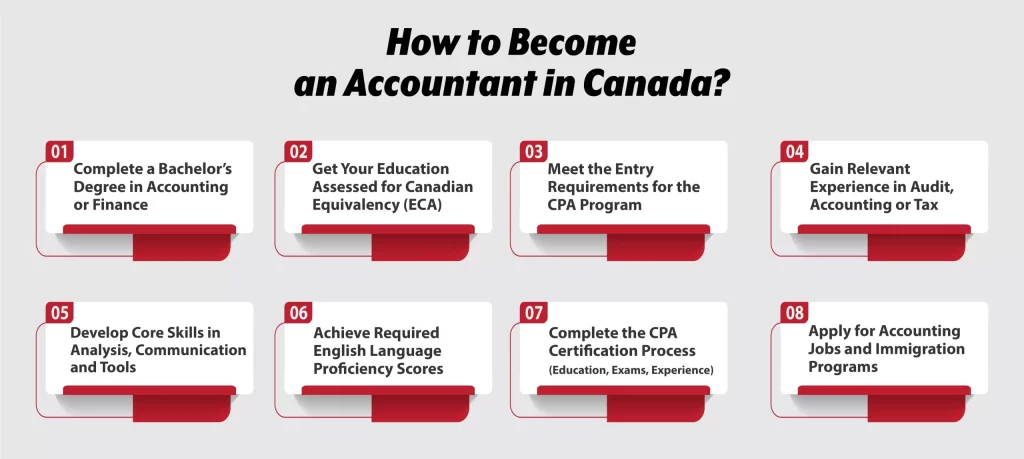
If you want to build an accounting career in Canada, the process usually involves completing the right education, meeting CPA requirements, proving language ability, gaining practical experience, and handling immigration or registration steps. When broken into stages, the pathway is straightforward.
Step 1: Complete a Recognised Education
The first step is to earn a bachelor’s degree in accounting, commerce, finance, or a related field.
If your qualification was completed outside Canada:
- It must be assessed to confirm equivalency to Canadian standards
- This assessment is important for both employment and immigration purposes
Step 2: Meet CPA Entry Requirements
In Canada, the main professional accounting designation is CPA (Chartered Professional Accountant). And the regulatory body for accountants in Canada is CPA Canada.
To enter the CPA pathway:
- Your academic background must meet required prerequisite subjects
- If gaps exist, additional courses may be required before progression
Step 3: Gain Relevant Work Experience
Practical experience is a core requirement for professional accounting roles in Canada.
Relevant experience typically includes:
- Accounting or bookkeeping roles
- Audit or taxation work
- Finance or reporting-related positions
This experience helps develop technical skills and professional judgement.
Step 4: Build the Required Skills
Accountants in Canada are expected to demonstrate:
- Strong attention to detail and analytical thinking
- Clear communication and ethical judgement
- Good organisation and time management
Comfort with spreadsheets, accounting software, and financial reporting tools is also important.
Step 5: Prove English Proficiency
English proficiency is essential for both work and immigration.
Applicants may need:
- An approved English language test if applying from outside Canada
- Strong language ability for client communication, reporting, and interviews
- Higher scores can also improve immigration eligibility
Step 6: Complete Licensing and Registration
For professional accounting roles, the CPA designation is the primary credential.
This usually involves:
- Approved education
- Relevant practical experience
- Completion of CPA assessment requirements
Licensing rules are province-based, so requirements can vary by location.
Step 7: Handle Immigration Requirements
International applicants typically need:
- An Educational Credential Assessment (ECA)
- Language test results
- Relevant skilled work experience
Many accountants apply through Express Entry or other skilled immigration programs. A stronger profile improves selection chances.
Step 8: Apply for Accounting Jobs
Once education, experience, and immigration status are in place, you can apply for roles such as:
- Junior or staff accountant
- Bookkeeper
- Tax assistant
- Audit assistant
Employers often prefer candidates who are progressing toward CPA or hold Canadian-recognised qualifications.
Accounting Jobs in Canada
Here are the common accounting jobs in Canada:
- Staff Accountant
- Senior Accountant
- Junior Accountant
- Accounting Clerk
- Bookkeeper
- Accounting Assistant
- Controller
- Assistant Controller
- Financial Accountant
- Payroll Specialist
Best Province in Canada for Accounting Jobs
Best Province in Canada for Accounting Jobs
Ontario: The biggest job market overall, especially in Toronto and surrounding business hubs. It has the largest share of accounting-related activity and many openings in corporate finance, audit, and public practice.
Alberta: Strong demand in energy, construction, and corporate accounting, with generally good wages for accountants.
British Columbia: Good opportunities in Vancouver and the Mainland/Southwest region, with a large concentration of accounting employment and steady job openings.
Quebec: A major market for finance and accounting, especially in Montreal, though French language ability can be important for many roles.
Accounting Jobs in Canada with Visa Sponsorship
Yes, accounting jobs in Canada with visa sponsorship are available for skilled international candidates. Employers may consider foreign accountants when there are shortages of qualified local professionals, particularly in regions or sectors facing talent gaps.
Here are common accounting jobs in Canada with visa sponsorship:
- Financial Accountant
- Management Accountant
- Tax Accountant
- Auditor
- Accounts Payable / Receivable Specialist
- Payroll Accountant
- Financial Analyst
- Bookkeeper
How to get Accounting Jobs in Canada with Visa Sponsorship?
Here is the simple step-by-step process to get accounting jobs in Canada with visa sponsorship:
Step 1: Get a bachelor’s degree in accounting, finance, commerce, or a related field.
Step 2: Complete or begin a professional certification such as CPA Canada, which is widely preferred by employers.
Step 3: Gain several years of relevant work experience in accounting, audit, taxation, or financial reporting.
Step 4: Build strong knowledge of accounting standards and basic Canadian tax regulations.
Step 5: Prove English language proficiency where required (IELTS/CELPIP).
Step 6: Apply through recognised job portals and target employers offering visa sponsorship or LMIA support.
Accounting Firms in Canada
Here are the top 10 accounting firms in Canada commonly listed among the country’s leading accounting and advisory firms:
1. Deloitte
2. PwC
3. KPMG
4. EY
5. Grant Thornton
6. BDO
7. MNP
8. Smythe LLP
9. Capstone LLP Chartered Professional Accountants
10. BBS Accounting CPA
Accountants Salary in Canada
The average salary for accountants in Canada is around CA$86,500 per year, or approximately CA$44.36 per hour, depending on experience, qualifications, the province, and the industry.
Accountant salaries in Canada increase steadily with experience and professional certifications such as CPA, and senior or specialised accounting positions can feature among the higher-paid and, in some cases, highest paying jobs in Canada, particularly in large organisations and major cities.
Average Accountant Salary in Canada by Experience Level
Entry-Level Accountant Salary in Canada: Around CA$66,250 per year
Mid-Level Accountant Salary in Canada: Approximately CA$70,000 – CA$92,500 per year
Senior Accountant Salary in Canada: Can reach up to CA$107,000 per year, with higher potential for CPA-qualified professionals
Accountant Salary in Canada by Job Role
Staff Accountant: CA$55,000 – CA$70,000 per year
Senior Accountant: CA$70,000 – CA$92,500 per year
Tax Accountant / Senior Tax Accountant: CA$80,000 – CA$120,000 per year
Financial Analyst: CA$90,000 – CA$150,000 per year
Manager / Accounting Manager: CA$90,000 – CA$180,000 per year
Director of Finance / Accounting: CA$140,000 – CA$250,000 per year
Conclusion
Accounting remains to be one of the in demand jobs in Canada, offering long-term career prospects for qualified professionals, including international applicants. With the right education, experience, and licensing pathway, accountants can access opportunities across multiple industries and provinces. For the most accurate and up-to-date information on eligibility, visa options, and requirements, readers should refer to the official website of Immigration, Refugees and Citizenship Canada.