




International students keep flocking to Germany, making nursing courses in Germany a global launchpad. This surge stems from unmatched opportunities ahead. They gain hands-on training in elite hospitals while studying at affordable universities. Here, we will focus on the main ones, Nursing Ausbildung, and BSc Nursing, in detail. Now let’s dive into how everything works in Germany.
Table Of Content
1Is Nursing Free in Germany?2Nursing Courses in Germany3Public Universities in Germany for Nursing4What Are the Requirements to Study Nursing in Germany?5Nursing Fees in Germany for International Students6Conclusion7Frequently Asked Questions
Is Nursing Free in Germany?
Yes, public universities in Germany offer nursing courses tuition-free or at very low cost (just semester fees ~€200-400), making it an unbeatable deal for international students.
The reality depends on the pathway you choose.
1. BSc Nursing (University Route – Limited Availability)
- Some public universities offer low-cost or tuition-free programs.
- Students typically pay a semester fee (~€200–€400).
- These programs are limited and usually taught in German.
- Often structured as dual programs (study + practical training).
2. Nursing Ausbuilding (Vocational Training – Most Common Route)
- No tuition fees
- Students receive a monthly stipend (~€1,100–€1,300)
- Training is conducted in hospitals and nursing schools (dual system)
- This is the primary pathway to become a registered nurse in Germany
Nursing Courses in Germany
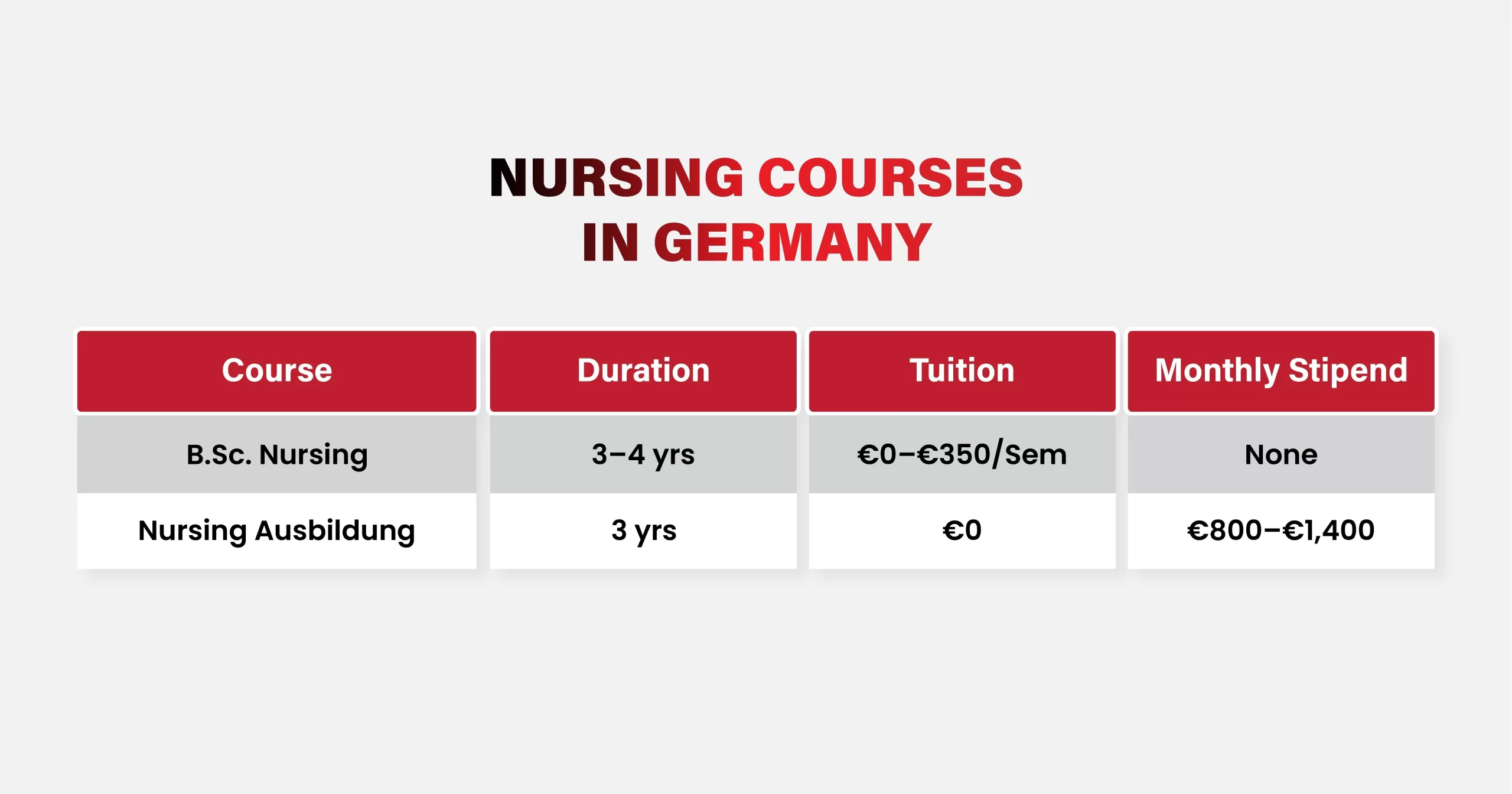
Nursing courses in Germany are offered through two pathways including Nursing Ausbildung and BSc Nursing.
First being the vocational Nursing Ausbildung, and second is the BSc Nursing degree. Moreover both routes are nationally recognised and lead to strong career prospects in Germany.
1. BSc Nursing in Germany
BSc Nursing in Germany is a bachelor’s degree program that combines theoretical learning with practical hospital training, helping students gain real-world healthcare experience.
- Duration for BSc Nursing in Germany is typically 3 to 4 years.
- Language proficiency is required since it is taught in German.
- Prepares students for registered nurse roles and advanced healthcare careers.
BSc Nursing in Germany Requirements
Here are the requirements to study BSc Nursing in Germany:
- Complete 12th grade (Biology preferred) + 1 year of a Bachelor’s degree in India (relevant field preferred) or complete a Studienkolleg (foundation year in Germany) and pass the Feststellungsprüfung (FSP).
- German language proficiency (B2 level required)
- Minimum 50–70% marks (varies by university)
- Language tests like TestDaF or DSH (if required)
- Some universities may conduct interviews or entrance tests
- Medical fitness certificate
- Police clearance certificate
- Valid passport
- German student visa (for international students)
BSc Nursing in Germany Fees
BSc Nursing in Germany is mostly free in public universities, with only a small semester contribution required, following the principle of free education in Germany.
Private universities for BSc Nursing in Germany charge around €5,000–€15,000 per year and students should budget €850–€1,200 per month for living expenses.
How to Apply for BSc Nursing in Germany
To apply for BSc Nursing in Germany, follow this step-by-step process:
Step 1: Choose a university that offers BSc Nursing and shortlist programs based on your preferences.
Step 2: Check the eligibility criteria, including academic qualifications and German language requirements.
Step 3: Learn German and achieve at least B2 level, as most nursing programs are taught in German.
Step 4: Prepare all required documents such as academic transcripts, valid passport, SOP, CV, and language certificates.
Step 5: Apply through the university’s official portal or via uni-assist.
Step 6: Wait for the admission letter after your application is reviewed.
Step 7: Apply for a German student visa by submitting financial proof and required documents.
Step 8: Travel to Germany, complete enrollment, and start your program.
2. Nursing Ausbildung in Germany
Nursing Ausbildung in Germany is a vocational training route. Here, students learn through a combination of classwork and paid practical training in hospitals and care facilities. This is the primary pathway to become a registered nurse in Germany. Duration is typically 3 years.
- Students receive a monthly training allowance throughout the course.
- German language ability is usually required at B2 level.
- Students receive a monthly stipend (~€1,100–€1,300).
- No tuition fee, employers often cover training costs.
- Leads directly to a recognised nursing qualification in Germany.
Nursing Ausbildung in Germany Requirements
Here are the requirements to study Nursing Ausbildung in Germany:
- Complete 12th grade or equivalent.
- Biology, science, or related subjects are preferred.
- German language proficiency, usually B2 level.
- Some employers or schools may ask for TestDaF, TELC, or Goethe certificates.
- Good physical and mental fitness.
- Medical fitness certificate.
- Police clearance certificate.
- Valid passport.
- German visa or residence permit for international students.
Nursing Ausbildung in Germany Fees
Nursing Ausbildung in Germany is generally tuition-free or very low cost because it is part of Germany’s vocational training system. Instead of paying tuition, students usually receive a monthly stipend during training.
The Nursing Ausbildung stipend in Germany typically ranges from €1,100 to €1,300 per month, depending on the employer and year of training. However, students should plan for their cost of living in Germany, which is approximately €850 to €1,200 per month.
How to Apply for Nursing Ausbildung in Germany
To apply for Nursing Ausbildung in Germany, follow this step-by-step process:
Step 1: Choose a Nursing Ausbildung program or training provider in Germany.
Step 2: Check the eligibility criteria, especially education and German language requirements.
Step 3: Learn German and reach at least B1/B2 level.
Step 4: Prepare documents such as school certificates, passport, CV, SOP, language certificate, and medical records.
Step 5: Apply directly to hospitals, nursing homes, or vocational schools.
Step 6: Attend interviews or assessments if required.
Step 7: Receive your training contract or admission confirmation.
Step 8: Apply for a German visa with the required documents and financial proof.
Step 9: Travel to Germany, complete enrollment, and begin your training.
Public Universities in Germany for Nursing
Below are some of the best public universities in Germany for nursing:
- Charité – Universitätsmedizin Berlin
- Heidelberg University
- University of Freiburg
- Hamburg University of Applied Sciences
- Munich University of Applied Sciences
- Berlin University of Applied Sciences
- Frankfurt University of Applied Sciences
- Cologne University of Applied Sciences
- Dortmund University of Applied Sciences and Arts
- Osnabrück University of Applied Sciences
What Are the Requirements to Study Nursing in Germany?
To study nursing in Germany, you need to meet the following requirements:
Language: Most programs are in German, so B2 German is required.
Age: Usually at least 17–18 years old.
Medical Fitness: Must be physically and mentally fit for healthcare work.
Training Contract (for vocational programs): Needed if you choose Ausbildung.
Financial Proof: Show you can support yourself (around €11,904 EUR per year).
Visa & Health Insurance: Student visa and health insurance are mandatory.
Nursing Fees in Germany for International Students
Most public universities don’t charge tuition fees for nursing courses in Germany. Students only pay a small semester fee of €150–€350.
Private nursing schools, however, can charge €5,000–€20,000 per year.
On top of that, living costs in Germany range from €800–€1,200 per month. But, part time jobs in Germany help students cover them without much strain.
Conclusion
If you want a practical and affordable healthcare career, nursing courses in Germany offer strong value. Through public education, paid vocational training, and excellent job prospects, you can have a flourishing career. Germany’s healthcare sector welcomes international nursing professionals, making this one of the most promising study-and-work destinations in Europe.
For reliable planning, always check official programme pages before applying for Germany Education.
Official Resource: Make it in Germany — Nursing Professional



If a nursing student withdraws from course, should she pay any penaly for the return of her certificates
Hi Crknairlaw,
In Germany, if a nursing student withdraws from a course, a penalty may apply depending on the school’s contract and timing of withdrawal. Fees already due may still need to be paid.
However, original certificates are generally not permanently withheld, but they may be released only after clearing any pending dues or completing the formal withdrawal process.
I want go there for bsc nursing study .
I am from Bihar.
Hi Bablu,
Thank you for reaching out.
We can guide you through the most suitable study visa options and help you explore opportunities that align with your educational background and career goals.
Please share your qualifications and experience, and we’ll assist you further. BOOK A FREE CONSULTATION NOW!