



Mining Engineers in Australia remain a critical part of the country’s resource sector in 2026, ranking among the most In Demand Jobs in Australia due to ongoing mining projects and critical mineral expansion. Australia’s reliance on mining as a core industry means experienced engineers are required across planning, operations, and compliance roles. Overseas professionals considering Australia need a clear understanding of demand trends and job prospects before making career decisions.
Table Of Content
1Are Mining Engineers in demand in Australia?2Requirements to Become a Mining Engineer in Australia3How to Become a Mining Engineer in Australia?4Mining Engineer Jobs in Australia5Mining Engineer Jobs in Australia with Visa Sponsorship6Mining Engineer Salary in Australia7Conclusion8Frequently Asked Questions
Are Mining Engineers in demand in Australia?
The demand for Mining Engineers in Australia remains high, reflecting the ongoing strength of the mining industry and the need for skilled professionals across various mining operations.
The demand for mining engineers in Australia is driven by:
- Australia’s strong mining sector, which continues to generate consistent job opportunities
- Shortages of experienced and qualified mining professionals across key regions
- High global demand for resources such as iron ore, coal, lithium, and critical minerals
- Ongoing expansion of existing mines and development of new mining projects
- An ageing workforce, creating replacement demand for skilled mining engineers
Requirements to Become a Mining Engineer in Australia
Becoming a mining engineer in Australia requires a recognised engineering qualification, a positive skills assessment, relevant practical experience, English language proficiency, and appropriate work rights or migration pathways for international professionals. For Mining Engineers in Australia, meeting these requirements is essential for both employment and migration pathways.
All mining engineers must meet professional standards set by Engineers Australia, which is the designated assessing authority for this occupation.
Educational Qualifications
A Bachelor’s degree or higher in mining engineering is the minimum requirement. Degrees in geotechnical engineering, civil engineering, or closely related engineering fields may also be accepted if they are comparable to Australian standards.
Key points include:
- Programs are typically 4 years full-time.
- Qualifications must be obtained from a recognised institution.
- Postgraduate qualifications can improve eligibility for senior or specialist roles.
- Entry into these programs usually requires strong background knowledge in advanced mathematics, physics, and chemistry.
Skills Assessment
A positive skills assessment is required for visas such as Subclass 189, 190, 491, and 482, and is a key eligibility step for Mining Engineers in Australia applying through skilled or employer-sponsored pathways. Applicants must demonstrate that their qualifications and competencies align with Australian engineering standards. This is done through one of several assessment pathways, including accredited qualifications or the Competency Demonstration Report (CDR) route.
Practical Experience
While not always mandatory for skills assessment, 2–3 years of relevant post-graduate experience is strongly preferred by employers and improves migration competitiveness.
Relevant experience may include:
- Graduate engineer programs
- On-site mining roles
- Internships or structured training placements
Experience typically covers:
- Mine design and planning
- Equipment operation and handling
- Drilling and blasting activities
- Environmental management
- Compliance with safety and mining regulations
Graduate engineers often progress to full professional roles after this initial experience period.
English Language Proficiency
Mining engineers must demonstrate competent English proficiency for skills assessment, visa eligibility, and employment.
Accepted tests include:
- IELTS
- PTE Academic
- TOEFL
- OET
The minimum requirement is generally IELTS 6.0 overall with no band below 6.0, though higher scores (such as IELTS 7.0 or above) can earn additional migration points. Exemptions are limited and usually apply only to applicants from specific English-speaking countries.
Professional Registration and Licensing
Professional registration is not always mandatory, but it significantly improves employability and may be required for certain roles or states, particularly for engineering jobs in Australia.
Mining engineers may need:
- Registration with Engineers Australia or relevant state engineering boards.
- Site-specific certifications such as first aid, hazardous materials handling, or supervisory credentials.
- Some employers and mining sites require these registrations before allowing engineers to work independently or hold senior responsibilities.
Work Rights and Migration
To work as a mining engineer in Australia, Mining Engineers in Australia must hold valid work rights through citizenship, permanent residency, or an eligible visa. Common pathways include employer-sponsored visas such as Subclass 482, as well as points-tested skilled migration visas like Subclass 189, 190, and 491.
Most points-tested visas require applicants to be under 45 years of age and achieve at least 65 points, based on factors such as age, qualifications, work experience, and English proficiency. Employer sponsorship is common in the mining sector, particularly for experienced engineers, and CSOL eligibility supports both temporary and permanent employer-sponsored options.
Additional Requirements
Applicants must also meet standard Australian requirements, including:
- Health examinations
- Character and police clearance checks
To remain competitive, mining engineers are expected to:
- Maintain strong technical skills, including industry software such as AutoCAD and Surpac
- Follow Australian workplace health, safety, and environmental standards
- Participate in ongoing professional development and industry networking
Continuous learning and compliance help support long-term career growth and professional recognition in Australia.
How to Become a Mining Engineer in Australia?
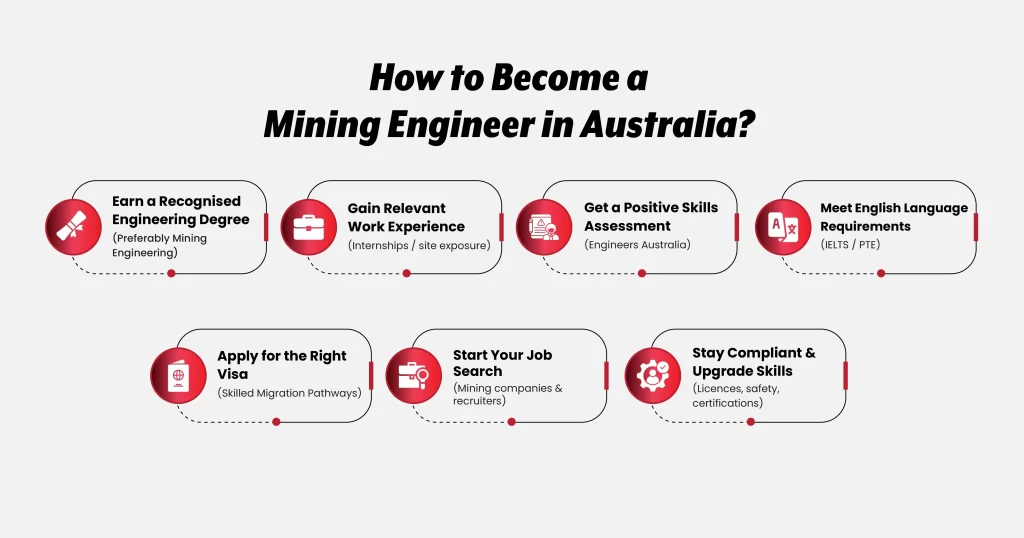
Here is the Step-by-Step Process to Work as a Mining Engineer in Australia
Step 1: Complete a Recognised Engineering Degree
You must complete a Bachelor’s degree in Mining Engineering or a closely related field. The qualification must be recognised in Australia, as this is essential for skills assessment, employment, and migration eligibility.
Step 2: Gain Relevant Work Experience
Practical mining experience is strongly preferred by employers and helps with migration points. This can include:
- Graduate engineer roles
- Site-based mining experience
- Internships or structured training programs
While not always mandatory for skills assessment, experience improves job prospects significantly.
Step 3: Obtain a Skills Assessment
Australian skills assessment is required through Engineers Australia under ANZSCO 233611 (Mining Engineer – excluding petroleum). You must submit your qualifications and, where applicable, employment evidence. A positive outcome is mandatory for skilled migration visas.
Step 4: Gain Relevant Work Experience
You must demonstrate English proficiency through an approved test. Requirements vary by purpose:
- Minimum English scores apply for skills assessment
- Higher scores are needed to gain additional migration points
- Strong English improves visa competitiveness
Step 5: Apply for a Suitable Visa
Select a visa pathway based on your profile and employment options. Common visas include:
- Skilled Independent and State Nominated visas
- Regional provisional visas
- Employer-sponsored visas
Most options require applicants to be under 45 and meet points thresholds.
Step 6: Search and Apply for Mining Engineer Jobs
Mining engineer roles are commonly advertised through Australian job portals and mining company websites, especially in Western Australia and Queensland. Employers usually assess your skills assessment, work experience, and visa status before shortlisting.
Step 7: Maintain Skills and Industry Compliance
To build a long-term career, mining engineers must:
- Keep technical and safety skills up to date
- Follow Australian mining and workplace safety regulations
- Engage in ongoing professional development
Mining Engineer Jobs in Australia
Mining engineer jobs in Australia are in high demand, especially in resource-rich states like WA and QLD, with roles spanning entry-level graduates to senior positions at top firms like Rio Tinto and BHP. Here’s a list of common active job post names:
- Graduate Mining Engineer
- Mining Engineer (FIFO)
- Senior Mining Engineer
- Open Pit Mining Engineer
- Junior Underground Mining Engineer
- Mining Engineer – Ventilation
- Operations Engineer (Mining)
- Mining Backfill Engineer
- Mine Engineering Superintendent
- Graduate Mine Engineer
Mining Engineer Jobs in Australia with Visa Sponsorship
Mining Engineer jobs in Australia may be offered with visa sponsorship when skill shortages exist, particularly for experienced Mining Engineers in Australia with operational or project-critical expertise. Sponsorship is typically employer-led and depends on project requirements, experience level, and eligibility under Australian visa rules.
Common Sponsored Roles
Visa sponsorship is most commonly available for experienced mining engineers whose skills align with operational or project-critical needs. These roles generally require a recognised mining engineering qualification, relevant industry experience, and suitability for visas such as the Subclass 482 (Skills in Demand).
- Mining Engineer (Open Cut / Surface Mining): Manages surface mining operations, production planning, and site safety in open-pit environments.
- Underground Mining Engineer: Oversees underground mine design, tunnelling operations, ventilation, and ground stability.
- Mine Planning Engineer: Develops short- and long-term mine plans, production schedules, and resource models using industry software.
- Drill and Blast Engineer: Designs drilling patterns and blasting plans to ensure safe and efficient rock fragmentation.
- Production Engineer (Mining Operations): Focuses on optimising daily production, equipment utilisation, and operational efficiency.
- Geotechnical Mining Engineer: Assesses rock mechanics, slope stability, and ground support systems across mining sites.
- Mine Project Engineer: Supports project delivery from feasibility and design through construction and commissioning phases.
- Mineral Resource Engineer: Evaluates ore reserves, grades, and economic feasibility for reporting and planning purposes.
- Senior Mining Engineer: Provides technical leadership, supervises teams, and ensures regulatory and safety compliance.
- Mine Site Engineer: Handles day-to-day engineering coordination, maintenance planning, and site operations.
Sponsoring Companies
Several major mining companies in Australia have a history of sponsoring overseas mining engineers where genuine skill shortages exist, particularly in Western Australia and Queensland. Sponsorship availability varies by project, location, and labour market conditions.
- BHP: Sponsors experienced engineers for operational and planning roles across large-scale iron ore and coal projects.
- Rio Tinto: Engages sponsored engineers for production, geotechnical, and mine planning roles, particularly in WA.
- Fortescue Metals Group: Recruits internationally for mining and project engineering roles linked to expansion and sustainability initiatives.
- Anglo American: Sponsors specialised engineers for coal and metallurgical mining operations in Queensland.
Disclaimer: Visa sponsorship is subject to employer approval and current Australian immigration regulations. Eligibility depends on individual qualifications, experience, and visa criteria at the time of application.
Mining Engineer Salary in Australia
The average salary of a mining engineers in Australia works out to approximately AU$170,000–175,000 per year, reflecting the strong demand, specialised skill requirements, and higher-paying roles in senior and resource-intensive positions. Earnings vary by experience, role, and location, with higher pay common in resource-intensive states like Western Australia and Queensland.
Below is a simple salary overview for mining engineers in Australia based on experience:
- Entry-Level / Graduate Mining Engineer: Typically earns around AU$120,000–$151,000 per year, excluding allowances.
- Mid-Career Mining Engineer: Generally earns around AU$112,000 – AU$151,000 per year, depending on responsibilities and industry sector.
- Senior Mining Engineer: Salaries often range from AU$188,000 – AU$250,000+ per year, with higher earnings possible in leadership, specialist, or high-impact roles.
- Top-Tier / Principal Mining Engineer: Experienced professionals in strategic or project-lead roles can exceed AU$250,000 per year, particularly with bonuses and FIFO allowances.
Pay is also influenced by roster arrangements and location, with FIFO jobs in Australia and regional allowances frequently increasing total compensation.
Conclusion
Mining engineering remains a high-demand and the Highest Paying Jobs in Australia, offering strong job prospects, visa sponsorship options, and competitive salaries across key regions such as Western Australia and Queensland. Skilled professionals with recognised qualifications and relevant experience continue to be actively sought by employers.
International applicants must meet requirements such as a recognised engineering degree, Engineers Australia skills assessment, English proficiency, and appropriate work experience. Many roles are supported through employer-sponsored or skilled migration pathways, with salaries commonly ranging from AU$120,000 to AU$180,000+. For official and up-to-date visa information, eligibility criteria, and application guidelines, refer to the Department of Home Affairs website.



Dear please send me for australia mining engineer jobs details.how to getting the jobs