




Have you ever thought about what it would be like to be a dentist in Canada?
If you’re already a practicing dentist or a student thinking about dentistry, Canada is definitely the perfect place for you. Canada offers a range of opportunities and benefits that make it an attractive destination for dental professionals.
So, grab a cup of coffee, sit back, and let’s explore why Canada might be the ideal place for your dental career.
Table Of Content
1Is There a Shortage of Dentists in Canada?2Job Opportunities for Dentists in Canada3Salary of Dentists in Canada4Top Provinces with High Demand for Dentists5Requirements to Work as a Dentist in Canada6How to Become a Licensed Dentist in Canada7Immigration Pathways for Dentists to Canada8Important Note on Licensing9Frequently Asked Questions
Is There a Shortage of Dentists in Canada?
Yes, Canada is currently facing a shortage of dentists, particularly in rural and underserved regions. While major cities have a relatively stable number of dental professionals, many smaller communities struggle to access timely oral healthcare services. This gap is driven by factors such as an aging population, increasing demand for dental care, and the retirement of experienced dentists. As a result, qualified dentists, especially internationally trained professionals have strong job prospects and opportunities to build successful careers across Canada.
Job Opportunities for Dentists in Canada
The dental industry in Canada is known for its growing nature and the wide range of job opportunities it provides. Whether you’re a recent graduate or an experienced dentist, you’ll find plenty of options to suit your career goals.
Here are some potential roles:
General Dentistry: Providing comprehensive dental care to patients of all ages.
Dental Specialist: Focusing on a specific area of dentistry, such as orthodontics, endodontics, or oral surgery.
Dental Researcher: Conducting research to advance dental knowledge and practices.
Dental Educator: Teaching future dentists at universities or dental schools.
Public Health Dentist: Promoting oral health and preventing dental diseases in communities.
Many international dentists start as dental assistants or hygienists before obtaining full licensure.
Salary of Dentists in Canada
Dentists in Canada earn between CAD 90,000 and CAD 250,000+ per year, depending on experience, location, and specialization. On average, dentists make around CAD 150,000 to CAD 200,000 annually, with specialists and clinic owners earning over CAD 300,000.
Higher salaries are common in rural areas and for dentists with more experience or specialized skills.
| Community/Area | Median Salary ($/year) |
|---|---|
| Alberta | 120,000 |
| British Columbia | 84,000 |
| Manitoba | 116,000 |
| New Brunswick | 132,000 |
| Newfoundland and Labrador | 180,000 |
| Nova Scotia | 126,000 |
| Ontario | 104,000 |
| Quebec | 106,000 |
| Saskatchewan | 110,000 |
*For more details about salary breakdowns in Canada, just refer to the official Job Bank page of the Government of Canada.
Top Provinces with High Demand for Dentists
The demand for dentists in Canada varies by province, but several regions consistently show strong to very strong job prospects, especially due to population growth, retirements, and limited workforce supply.
Provinces with Very High Demand (Excellent Job Prospects)
According to official labour market data, the following provinces have “very good” job prospects for dentists:
British Columbia – Rapid population growth and expanded healthcare services are increasing demand for dental professionals.
Alberta – Growing population and increased healthcare spending are driving strong demand.
Saskatchewan – High demand, especially in smaller communities and rural areas.
Quebec – Strong employment growth and retirements are creating more job openings.
New Brunswick – Consistent demand due to workforce shortages and aging population.
Nova Scotia – Good to very good outlook with steady new job opportunities.
Newfoundland and Labrador – High demand, especially in underserved regions.
Provinces with Good Demand
These provinces also offer solid opportunities, though competition may be slightly higher in urban areas:
Ontario – Good demand overall, but higher competition in major cities like Toronto.
Manitoba – Stable job market with growing need in rural communities.
Prince Edward Island – Moderate to good demand with steady opportunities.
If you’re planning to work as a dentist in Canada, provinces like British Columbia, Alberta, Saskatchewan, and Quebec offer the best career opportunities, especially if you’re open to working outside major cities.
Requirements to Work as a Dentist in Canada
To work as a dentist in Canada, you must meet specific education, licensing, and professional requirements. Whether you are a local graduate or an internationally trained dentist, the process is regulated to ensure high standards of dental care.
1. Educational Qualification
You must have a recognized dental degree, such as:
- Doctor of Dental Surgery (DDS)
- Doctor of Dental Medicine (DMD)
For internationally trained dentists, your degree must be assessed and recognized under Canadian standards.
2. Certification by the National Dental Examining Board
All dentists must be certified by the National Dental Examining Board of Canada (NDEB).
There are two main pathways:
- For Canadian Graduates:
- Complete a dental program accredited in Canada and pass the NDEB exams.
For International Dentists:
- Complete a dental program accredited in Canada and pass the NDEB exams.
- Complete the NDEB Equivalency Process, which includes:
- Assessment of Fundamental Knowledge (AFK)
- Assessment of Clinical Judgment (ACJ)
- Assessment of Clinical Skills (ACS)
3. Provincial or Territorial License
After NDEB certification, you must obtain a license from the provincial regulatory body where you want to work. For example:
- Royal College of Dental Surgeons of Ontario
- College of Dental Surgeons of British Columbia
Each province may have slightly different requirements, including jurisprudence exams or additional documentation.
4. Language Proficiency
You must demonstrate proficiency in English or French, depending on the province. Common tests include:
- IELTS (for English)
- TEF (for French)
5. Work Authorization
To legally work in Canada, you must have:
- A valid work permit, or
- Permanent Residency (PR)
Many dentists immigrate through programs like Express Entry or Provincial Nominee Programs (PNPs).
6. Additional Requirements
Some provinces may also require:
- Proof of professional liability insurance
- Background checks
- Continuing education commitments
- Registration with local dental associations
How to Become a Licensed Dentist in Canada
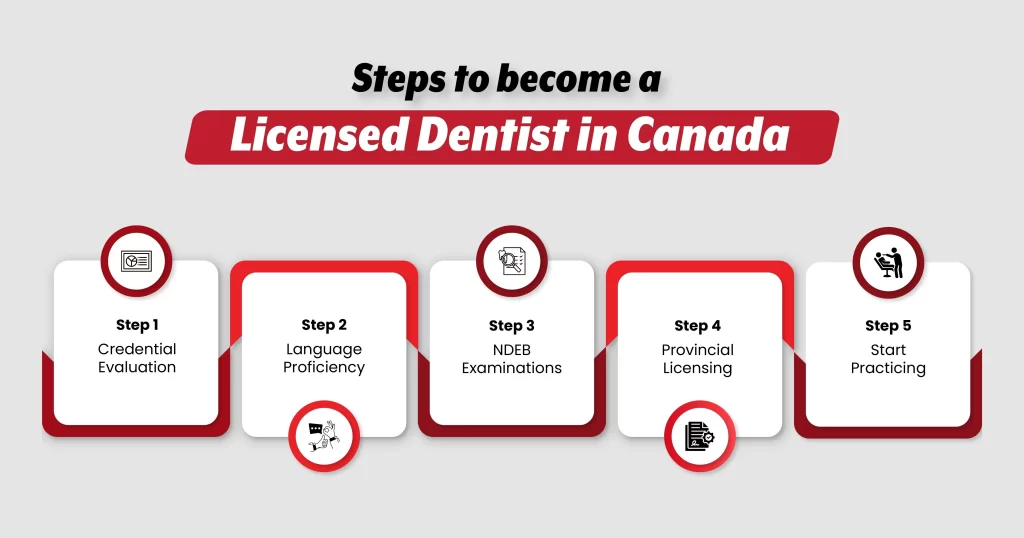
To practice dentistry in Canada, one must obtain a license from the provincial or territorial regulatory body. The process includes:
Credential Evaluation: International qualifications must be assessed to ensure they meet Canadian standards.
Examinations: Dentists must pass the National Dental Examining Board (NDEB) exams, which include a written examination and an Objective Structured Clinical Examination (OSCE).
Language Proficiency: Proof of proficiency in English or French is required.
Work Experience: Some provinces may require a period of supervised practice or additional training.
Immigration Pathways for Dentists to Canada
Canada offers multiple immigration pathways for qualified dentists, making it easier for skilled professionals to secure permanent residency and build a successful career. As dentists fall under NOC 31110 (TEER 1), they are eligible for several economic immigration programs designed to address healthcare labour shortages.
Express Entry – The Most Popular Route
The Express Entry system is the primary pathway for dentists to immigrate to Canada. It manages applications under programs like the Federal Skilled Worker Program (FSWP) and Canadian Experience Class (CEC). Candidates are ranked using the Comprehensive Ranking System (CRS), which considers factors such as age, education, work experience, and language proficiency.
With the introduction of category-based draws for healthcare professionals, dentists now have a higher chance of receiving an Invitation to Apply (ITA), even with a comparatively lower CRS score.
Category-Based Healthcare Draws
Dentists are included in Canada’s targeted healthcare and social services draws, which prioritize professionals in high-demand occupations. This pathway has become one of the fastest and most effective ways for dentists to obtain permanent residency, as it focuses specifically on filling gaps in the healthcare system.
Provincial Nominee Programs (PNPs)
Many provinces in Canada run Provincial Nominee Programs (PNPs) to attract healthcare professionals, including dentists. Provinces such as Ontario, British Columbia, and Alberta frequently invite candidates with dental experience.
A provincial nomination adds 600 CRS points to your Express Entry profile, significantly increasing your chances of receiving an ITA.
Employer-Sponsored Work Permit (LMIA)
Dentists can also move to Canada through a job offer from a Canadian employer. In this pathway, the employer obtains a Labour Market Impact Assessment (LMIA), allowing the candidate to apply for a work permit.
This route is ideal for those who want to enter Canada quickly and later transition to permanent residency through Express Entry or a PNP.
Study Pathway for Dentists
For candidates with lower CRS scores, the study pathway can be a strategic option. By enrolling in a dental or healthcare-related program in Canada, you can obtain a Post-Graduation Work Permit (PGWP), gain Canadian work experience, and eventually qualify for permanent residency under the Canadian Experience Class (CEC).
Important Note on Licensing
It is important to understand that immigrating to Canada as a dentist does not automatically allow you to practice. You must complete the certification process through the National Dental Examining Board of Canada (NDEB) and obtain a license from the relevant provincial authority.