



Canada is one of the top destinations for international students to build a career in law. It allows you to earn a globally recognized degree, get accustomed to a bilingual legal system, and more importantly offers strong post-study work pathways. As long as you understand the benefits of Canada Education, in-demand legal courses in Canada, useful scholarships to study in Canada, you are already halfway to a secure future. In light of this, let’s explore the crucial areas to know before applying for law courses in Canada.
Table Of Content
1What are the Benefits of Studying Law in Canada?2Law Courses in Canada3Best Law Schools in Canada4Requirements to Study Law in Canada for International Students5Law Courses in Canada Fees6Law Scholarships in Canada for International Students7Conclusion8Frequently Asked Questions
What are the Benefits of Studying Law in Canada?
The Benefits of Studying Law in Canada are:
Global Degrees : Canadian law qualifications are widely accepted, paving way for a global career.
Practical Education: Programs focus on real-world application of law.
Diverse Legal Systems: Students learn both Common Law and Civil Law, achieving a broader legal perspective.
Post-Study Work (PGWP): Graduates are welcomed to work in Canada .
Pathway to Permanent Residency (PR): Canadian education and work experience support immigration through programs like Express Entry.
Strong Career Opportunities: Graduates can explore roles in corporate law, international law, public policy.
Law Courses in Canada
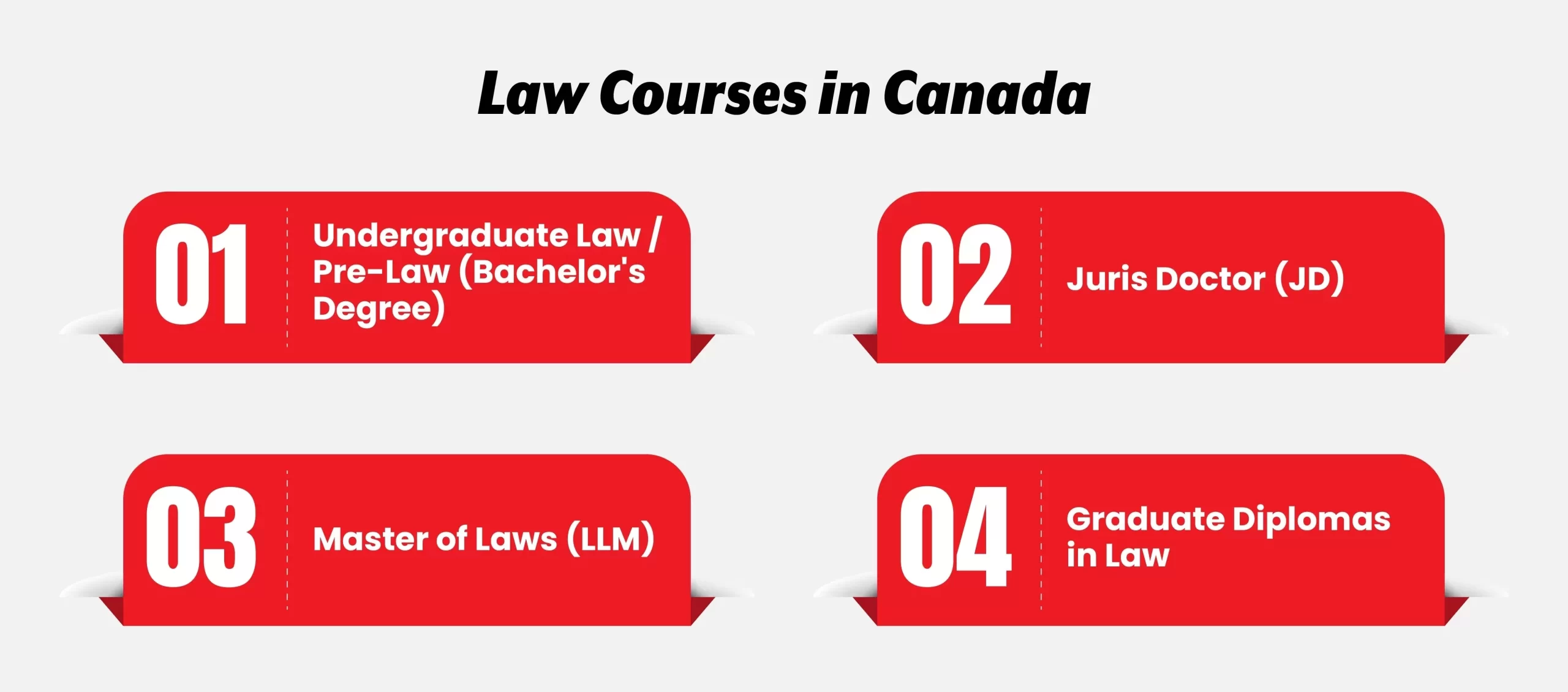
Here are the law courses in Canada for international students:
1. Undergraduate Law / Pre-Law (Bachelor’s Degree)
2. Juris Doctor (JD)
3. Master of Laws (LLM)
4. Graduate Diplomas in Law
1. Undergraduate Law / Pre-Law (Bachelor’s Degree)
Undergraduate Law / Pre-Law (Bachelor’s Degree) in Canada is a foundational program pursued before a Juris Doctor (JD).
- Covers legal theory, constitutional law, criminology, and social justice.
- Duration: 3–4 years
- Although, it prepares you for law school entry, not a professional law degree on its own.
2. Juris Doctor (JD)
- Covers contracts, torts, criminal law, property law, and procedural law.
- Duration: 3 years
- Required to become a licensed lawyer in Canada.
- Involves moot courts, internships, and real-world case training.
3. Master of Laws (LLM)
Master of Laws (LLM) in Canada is a postgraduate specialization for law graduates who want to gain deeper legal knowledge and expertise.
- Specializations include Corporate Law, International Law, Human Rights Law, and Tax Law.
- Duration: 1 year (full-time)
- Ideal if you already hold an LLB or JD and want academic or specialized practice expertise.
4. Graduate Diplomas in Law
- Topics include immigration law, environmental law, business law.
- Duration: 6–12 months
- Great for upskilling without committing to a full degree.
Having looked at the best law courses in Canada. Lets explore the best Universities with a special emphasis on the Public Universities in Canada.
Best Law Schools in Canada
The best law schools in Canada for international students are:
- University of Toronto Faculty of Law
- McGill University Faculty of Law
- Osgoode Hall Law School
- University of British Columbia Peter A. Allard School of Law
- University of Ottawa Faculty of Law
- Queen’s University Faculty of Law
- Dalhousie University Schulich School of Law
- University of Alberta Faculty of Law
- University of Calgary Faculty of Law
- Western Law
- Université de Montréal Faculty of Law
Requirements to Study Law in Canada for International Students
Here are the requirements to study law in Canada for international students:
1. Academic Qualifications
- JD Program: A completed bachelor’s degree in any field
- LLM Program: An LLB or JD is required
- Strong academic performance significantly improves your chances
2. Entrance Exam (LSAT)
- Most universities require the Law School Admission Test (LSAT) for JD admissions
- Tests reasoning, reading comprehension, and analytical thinking
- Generally not required for LLM programs
3. English Language Proficiency
- Required if English is not your first language
- Accepted tests: IELTS (6.5–7.5 overall) or TOEFL
4. Work Experience (for LLM – Optional)
- Not mandatory but strengthens your application, especially for specialized programs
5. Supporting Documents
- Academic transcripts
- Statement of Purpose (SOP)
- Letters of Recommendation (LOR)
- Resume/CV
6. Student Visa (Study Permit)
- Apply for a Canada Study Permit after receiving your admission letter
- Proof of financial funds is required alongside your admission documents
Law Courses in Canada Fees
Law course fees in Canada for international students generally range from CAD 15,000 to CAD 65,000 per year, depending on the program type and university.
| Program | Annual Fees (CAD) | Duration |
|---|---|---|
| Undergraduate / Pre-Law | $15,000 – $35,000 | 3–4 years |
| Juris Doctor (JD) | $25,000 – $65,000 | 3 years |
| Master of Laws (LLM) | $18,000 – $45,000 | 1 year |
| Graduate Diplomas in Law | $8,000 – $20,000 | 6–12 months |
In addition, students should plan for:
Living Expenses: CAD 10,000–20,000/year
Health Insurance: CAD 600–1,000/year
Books and Materials: CAD 500–1,500/year
Law Scholarships in Canada for International Students
The law scholarships in Canada for international students are:
Vanier Canada Graduate Scholarships – For doctoral-level research students
Lester B. Pearson International Scholarship – By University of Toronto, covers tuition and living costs.
Pierre Elliott Trudeau Foundation Scholarships – For PhD students in social sciences and humanities.
McGill Law Scholarships – Merit-based awards for incoming students.
University of Toronto Law Scholarships – Variety of entrance and in-program awards.
Osgoode Hall Law Scholarships – Need and merit-based options.
Canada Graduate Scholarships (CGS) – NSERC/SSHRC funded for master’s and doctoral students.
Ontario Graduate Scholarship (OGS) – For students studying in Ontario.
Shastri Indo-Canadian Institute Scholarships – For Indian students specifically.
Commonwealth Scholarships (Canada partner programs) – For students from Commonwealth nations.
These are the best scholarships to study in Canada.
Conclusion
Canada has numerous legal education programs that can be considered world-class. Many Canadian law schools showcase a variety of factors such as academic depth and global recognition. Their graduates enjoy hard to match post-graduate opportunities as well. In order to secure a great future, begin by shortlisting schools that match your legal interests, look into their LSAT requirements, and prepare your finances to include possible scholarships.
For authoritative information on studying in Canada, visit the official Government of Canada – Study Permit page.



I have a diploma in law from uganda pentacosto University.i want to upgrade..help me,I need scholarship please 🙏
Hi Ishimwe,
Thank you for your interest.
Please share your qualifications and experience, and we’ll assist you further. BOOK A FREE CONSULTATION NOW!