




Immigrating to Canada in 2026 depends on several personal factors such as your work experience, education, language ability, and which provinces need your skills. For many applicants, the easiest way to immigrate to Canada are Canada Express Entry, Provincial Nominee Programs (PNPs), study permits, or employer-supported work permits. If you have recognised qualifications, relevant skilled work experience, and strong language scores, your chances of success improve significantly.
Table Of Content
1Is it Easy to Immigrate to Canada?2Easiest Ways to Immigrate to Canada3Canada Immigration Pathways4Conclusion5Frequently Asked Questions
Is it Easy to Immigrate to Canada?
Yes, Canada is considered one of the easiest countries to immigrate to for skilled workers, particularly if you meet labour market and immigration requirements. That said, the process isn’t the same for everyone; how easy it is depends on your chosen pathway and personal profile.
The easiest way to immigrate to Canada depends mainly on your:
- Age
- Education
- Skilled work experience
- English or French language ability
- Job offer availability
- Provincial demand
- Family connections in Canada.
Canada continues to offer multiple routes such as Canada Express Entry, Provincial Nominee Program (PNP) Streams, Study Permits, Work Permits, and Employer-sponsored Pathways. Applicants with higher language scores, recognised qualifications, and relevant work experience generally have better prospects. If you meet the Canada PR requirements, you may be eligible for several long-term options depending on your profile.
Easiest Ways to Immigrate to Canada
Immigrating to Canada remains accessible through several skilled and family-based pathways. Which route is easiest for you will depend on your qualifications and goals.
Easiest way to immigrate to Canada include Express Entry, PNPs, Family Sponsorship, and Study-to-PR pathways.
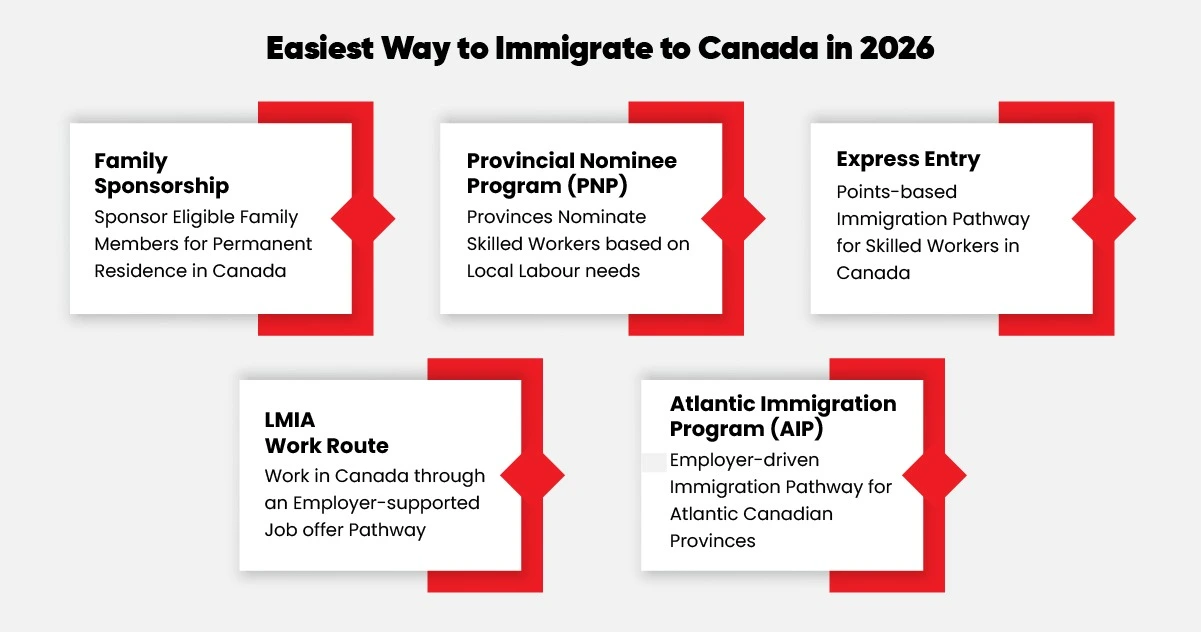
The list of the easiest ways to immigrate to Canada includes:
Family Sponsorship – A Canadian citizen or permanent resident sponsors a spouse, children, parents, or certain other relatives.
Provincial Nominee Programs (PNP) – Provinces and territories nominate workers; a provincial nomination often gives 600 extra CRS points for Express Entry.
Express Entry – One of the fastest skilled worker pathways; it manages Federal Skilled Worker (FSW), Federal Skilled Trades (FST), and Canadian Experience Class (CEC) programs.
LMIA Work Route – Secure a job offer and have the employer obtain an LMIA, then transition to PR via CEC or PNP routes.
Atlantic Immigration Program (AIP) – Requires a job offer from an employer in an Atlantic province; CRS pressure can be lower for eligible candidates.
Let’s look at each one in detail:
1. Express Entry – Fast and Popular
Express Entry is one of the fastest and most popular ways for skilled workers to get Canada PR. It’s a points-based system that ranks candidates using the Comprehensive Ranking System (CRS) and issues Invitations to Apply (ITA) during regular draws.
Your CRS score is Calculated Based on Factors such as:
- Age
- Education
- Work experience
- IELTS/CELPIP or other language test scores
- Job offers,
- Adaptability factors
- Spouse qualifications if applicable.
Applicants with higher CRS scores receive an ITA for Canada PR through regular Express Entry draws.
Express Entry is Best For:
Skilled professionals, IT professionals, healthcare workers, engineers, trade workers, international graduates, managers and supervisors.
Why Express Entry is Fast:
Express Entry offers faster PR processing compared to many other programs. It often does not require a job offer, is suitable for many skilled industries, and regular draws provide ongoing PR opportunities. Strong language scores and skilled work experience significantly improve your chances.
How to Improve Your Express Entry CRS Score:
To improve your Express Entry CRS score, focus on increasing your IELTS or PTE scores, gain more skilled work experience, complete higher education, obtain a PNP nomination for extra CRS points, include spouse qualifications if applicable, secure a valid Canadian job offer, and improve French language scores for additional points.
2. Provincial Nominee Program (PNP)
PNP is widely used by skilled workers because provinces nominate candidates who match local labour market needs and in demand jobs in Canada. Some PNP programs Canada streams are tied to Express Entry and add extra CRS points for eligible applicants.
PNP is Best For:
Skilled workers with lower CRS scores, applicants with experience in in-demand occupations, candidates targeting specific provinces, international graduates, and workers with provincial job offers.
How to Improve Your Immigration Chances Through PNP:
To improve your chances of getting nominated through a Provincial Nominee Program (PNP):
- Apply to provinces with in-demand occupations
- Improve your IELTS or PTE score
- Gain more skilled work experience
- Secure a provincial job offer if possible
- Keep your Express Entry profile updated
- Apply to streams matching your occupation and background
Why Applicants Choose PNP:
The reasons applicants choose PNP include lower CRS requirements in some streams, provinces selecting candidates based on labour shortages, certain streams targeting specific occupations, and additional CRS points that can boost Express Entry chances.
3. Family Sponsorship
Family Sponsorship lets Canadian citizens and permanent residents sponsor eligible family members for PR. It’s a common method for family immigration to Canada and doesn’t rely on CRS scoring like Express Entry.
Family Sponsorship is Best For:
Spouses and partners, dependent children, parents and grandparents, and certain eligible relatives.
How to Improve Your Immigration Chances Through Family Sponsorship:
To improve your chances through Family Sponsorship:
- Ensure the sponsor meets eligibility requirements
- Submit complete relationship documents
- Provide accurate financial and identity records
- Maintain valid immigration status if applying inland
- Include all required supporting documents
Why Applicants Choose Family Sponsorship:
Applicants prefer Family Sponsorship because it provides a direct pathway to PR for eligible relatives, is available for both inland and overseas applicants, and focuses on keeping families together.
4. LMIA Work Permit Route
Many foreign nationals first travel to Canada with a job offer supported by an LMIA, being one of the easiest way to immigrate to Canada. This pathway is commonly explored by applicants looking for Jobs in Canada with Visa Sponsorship, particularly in sectors facing labour shortages. Canadian work experience gained later may strengthen permanent residence applications.
LMIA Work Permit Route Is Best For:
Skilled workers with job offers, trades workers, healthcare workers, and applicants seeking Canadian work experience.
How to Improve Your Immiration Chances Through the LMIA Work Permit Route:
To improve your chances through the LMIA Work Permit Route:
- Apply for jobs in high-demand sectors
- Build a strong Canadian-style resume
- Search through Job Bank Canada and approved employers
- Improve English language ability
- Gain relevant skilled work experience
- Target provinces with labour shortages
Why Applicants Choose LMIA:
LMIA provides legal work authorization, Canadian work experience may improve PR eligibility, some employers support long-term immigration pathways, and it can lead to Express Entry or PNP opportunities.
5. Atlantic Immigration Program (AIP)
If you have a qualifying job offer in an Atlantic province like Nova Scotia, New Brunswick, Prince Edward Island, and Newfoundland and Labrador, then AIP is one of the easiest way to immigrate to Canada. It is an employer driven program that aims to address regional labour shortages and provide long term settlement support.
AIP is Best For:
Skilled workers, international graduates, applicants interested in Atlantic Canada, and candidates with qualifying job offers.
How to Improve Your Immigration Chances Through AIP:
To improve your chances through the Atlantic Immigration Program (AIP):
- Apply for jobs with designated Atlantic employers
- Target occupations facing labour shortages
- Improve language test scores
- Gain relevant work experience
- Research settlement opportunities in Atlantic provinces
- Keep educational and employment documents updated
Why Applicants Choose AIP:
The AIP is designed to fill local labour gaps, focuses on employer-supported immigration, may have lower CRS requirements, and supports long-term settlement in Atlantic Canada.
Canada Immigration Pathways
Below is a concise comparison to help applicants understand how eligibility, PR opportunities, and processing times vary across Canadian immigration pathways;
| Canada Immigration Pathway | Best For | Main Requirement | PR Opportunity | Processing Speed |
|---|---|---|---|---|
| Express Entry | Skilled workers | Age, education, work experience, language score | Direct Canada PR | Fast |
| Provincial Nominee Program (PNP) | Applicants with lower CRS scores | Province-specific eligibility | PR through provincial nomination | Moderate |
| Study Permit Pathway | International students | Admission from a Canadian institution | PR after study and work experience | Long-term pathway |
| Work Permit Pathway | Foreign workers with job offers | Valid Canadian job offer | Can lead to PR later | Moderate |
| Atlantic Immigration Program (AIP) | Workers targeting Atlantic Canada | Job offer from an Atlantic employer | Direct PR pathway | Faster than many programs |
| Rural and Community Immigration Pathways | Applicants willing to settle in smaller communities | Community recommendation or job demand | PR opportunity available | Moderate |
| Family Sponsorship | Family members of Canadian citizens or PR holders | Eligible sponsor in Canada | Direct PR | Moderate |
| Business and Investor Immigration | Entrepreneurs and investors | Business experience and investment funds | PR opportunity available | Varies |
Conclusion
If you plan to Migrate to Canada from India, Canada still offers multiple immigration options in 2026 for skilled workers, students, families, and employer-supported applicants. How easy it is for you depends on education, work experience, language ability, family ties, and provincial demand. Learning the details of each program will help you choose the best long-term pathway aligned with your goals.
For the most accurate, up-to-date details on Canada immigration programs, eligibility, processing updates, and official application instructions, consult Immigration, Refugees and Citizenship Canada (IRCC).