




How to get Nursing Jobs in Australia is a very important question for internationally qualified nurses looking to build a career in Australia. The country offers nursing opportunities across hospitals, aged care, community healthcare, and other clinical settings, but working as a nurse requires more than simply finding a job vacancy.
Knowing the Australian registration process, meeting the required professional standards, checking your work rights and preparing a strong job application can help you approach the process with greater clarity. This guide covers the key steps, from verifying your eligibility and completing the necessary assessment to identifying suitable nursing vacancies and applying for jobs in Australia.
Table Of Content
1What are the requirements to work as a nurse in Australia?2How to Get Nursing Jobs in Australia3Conclusion4FAQs About Getting Nursing Jobs in Australia
What are the requirements to work as a nurse in Australia?
To work as a nurse in Australia, internationally qualified nurses generally need a recognised nursing qualification, meet the Nursing and Midwifery Board of Australia (NMBA) registration standards, and obtain NMBA registration. Applicants may also need to meet requirements for English language proficiency, criminal history, health, professional indemnity insurance, and continuing professional development.
The main requirements for working as a nurse in Australia are:
1. Recognized Nursing Qualification
- Hold a relevant nursing qualification that meets the NMBA’s qualification requirements.
- Internationally qualified nurses are required to have their qualifications assessed through the NMBA’s internationally qualified nurse assessment process.
- Ahpra administers the assessment and registration process on behalf of the NMBA.
- Depending on the qualification and assessment outcome, an applicant may need to complete additional requirements, such as the Outcomes-Based Assessment (OBA), before becoming eligible for registration.
2. English Language Skills
- Applicants for nursing registration must meet the NMBA’s English language skills registration standard.
- There are various pathways for applicants to meet the standard depending on their education and circumstances.
- If an English language test is required, the NMBA accepts the following English Language Tests for Australia: Cambridge English, IELTS Academic, OET, TOEFL iBT and PTE Academic, provided applicants meet the required test conditions and scores.
- The revised English language skills standard took effect on 18 March 2025.
3. Nursing Registration with the NMBA
- To practise nursing in Australia, nurses must be registered with the NMBA.
- Internationally qualified nurses must complete the registration pathway that applies to their qualifications and circumstances.
- Ahpra manages the application and registration administration on behalf of the NMBA.
- Applicants must also meet the NMBA’s applicable core registration standards.
4. Criminal History Check
- Applicants must declare their criminal history in all countries, including Australia, when applying for registration.
- Ahpra conducts criminal history checks on behalf of the NMBA.
- The registration standard also requires applicants to notify NMBA of any relevant criminal charges or convictions.
- A criminal history does not automatically lead to a refusal to register; the NMBA considers the circumstances relevant to its criminal history standard.
6. Continuing Professional Development
- Registered nurses must complete continuing professional development (CPD) each year.
- CPD should be relevant to the nurse’s practice context and help to maintain, improve, and extend professional knowledge, skills, and competence.
- The NMBA’s CPD standard applies to registered nurses, enrolled nurses, and midwives, including those working full-time or part-time.
7. Recency of Practice
- Nurses must meet the NMBA’s recency of practice requirements.
- The NMBA generally requires evidence of recent nursing practice. Its current guidance states that 450 hours of practice within the previous five years is one way to demonstrate the required recency.
- Nurses who have had a significant break from practice may need supervised practice or an NMBA-approved re-entry program, depending on their circumstances.
8. Professional Indemnity Insurance
- Nurses must meet the NMBA’s professional indemnity insurance (PII) requirements.
- The PII arrangement must cover the nurse’s practice as required by the NMBA standard.
- Nurses are required to declare that they meet the relevant registration standards when renewing registration.
How to Get Nursing Jobs in Australia
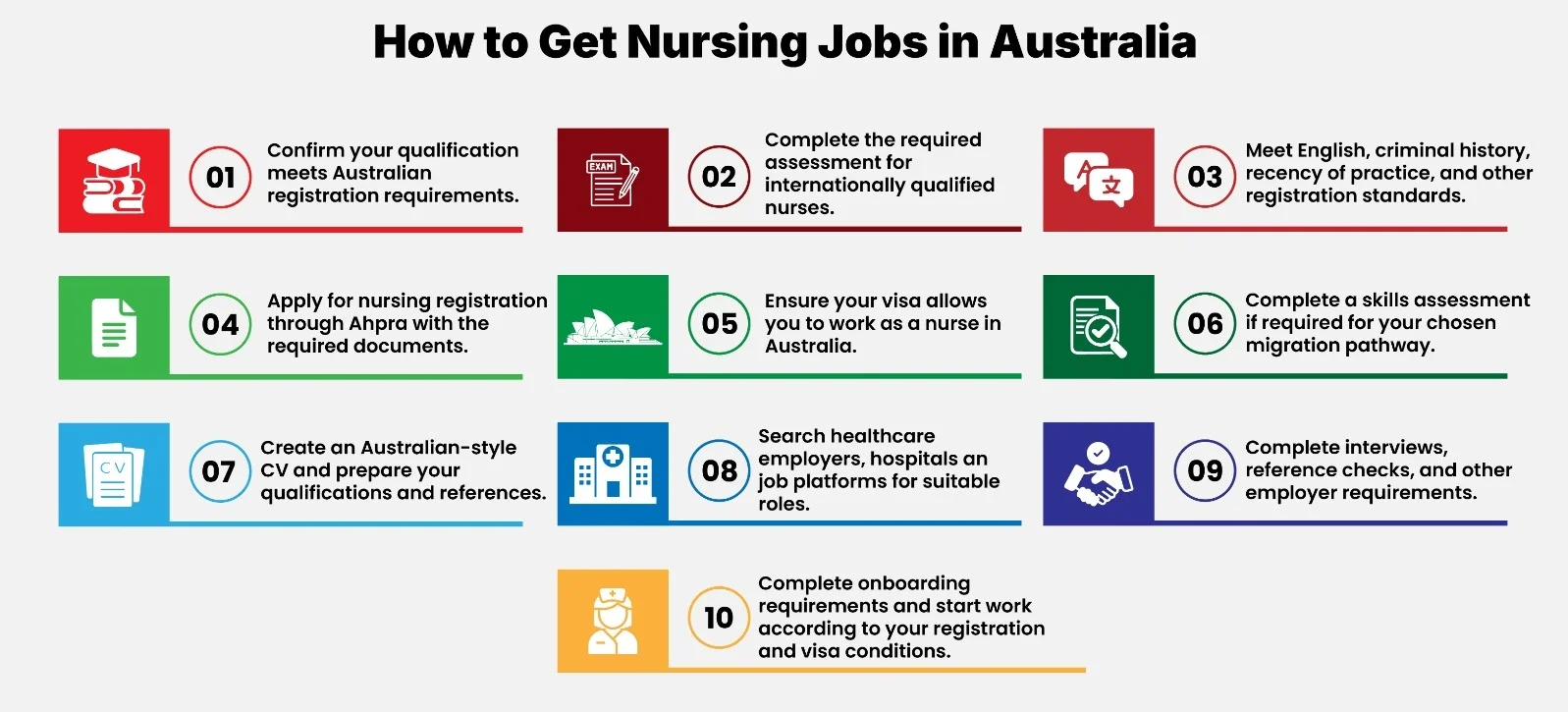
Here is a step-by-step process for getting nursing jobs in Australia:
Step 1: Check Your Nursing Qualification and Registration Eligibility
Before applying for nursing jobs, check whether your overseas nursing qualification can meet the Australian registration requirements. Internationally qualified nurses who want to register in Australia generally need to complete the IQNM self-check through Ahpra. The self-check assesses information about your qualification and places you into the applicable assessment stream or advises you if your qualification needs further assessment.
Steps to Follow:
- Compare your nursing qualification against the NMBA requirements.
- Complete the IQNM self-check through Ahpra.
- Follow the assessment pathway assigned to you.
- Complete any additional assessment requirements that apply to your stream.
Step 2: Complete the Required IQNM Assessment
The assessment you need depends on the stream assigned after the Self-check.
Stream A:
Applicants generally need to complete Orientation Part 1 before they can proceed to registration.
Stream B:
Applicants need to complete Orientation Part 1, the Portfolio, and the Outcomes-Based Assessment (OBA). The OBA consists of a multiple-choice question (MCQ) examination and an Objective Structured Clinical Examination (OSCE).
Stream C:
Applicants are advised that they need to upgrade their qualification before proceeding with the registration pathway.
Step 3: Meet the NMBA Registration Standards
You must meet the applicable NMBA registration standards before you can become registered. These can include requirements relating to:
- English language skills
- Criminal history
- Continuing professional development
- Recency of practice
- Professional indemnity insurance
- Other registration requirements applicable to your circumstances
The NMBA makes the registration decision, while Ahpra administers the registration process.
Step 4: Apply for Nursing Registration
Once you have successfully completed the required assessment stages, you can apply for registration with the NMBA through Ahpra. You need to provide the required application information and supporting documents. Completing the application does not automatically guarantee registration; the NMBA makes the final registration decision.
Step 5: Check Your Visa or Work Rights
Once you have completed the requirements for registration, review which Australian visa pathway is right for you. The Department of Home Affairs has a Skilled Occupation List, which displays the eligible occupations and the visa subclasses that can be used for skilled migration. The current list includes several registered nursing occupations. The assessing authority for the relevant nursing occupations is listed as ANMAC.
Depending on your circumstances, you may need a relevant skills assessment before applying for a particular skilled visa. The Department of Home Affairs states that the relevant assessing authority conducts skills assessments, which are mandatory for some visa subclasses or streams.
Step 6: Complete an ANMAC Skills Assessment If Your Visa Requires One
NMBA nursing registration is not the same as an Australian Skill Assessment for migration purposes. If your visa pathway requires an ANMAC skills assessment, you need to check which ANMAC assessment applies to you.
ANMAC states that nurses may require different assessment types depending on their Australian/New Zealand registration, overseas registration, qualification, and circumstances. For example, ANMAC’s Full Skills Assessment has specific eligibility requirements, including requirements relating to nursing qualifications, overseas registration, work experience, and evidence of English language.
Step 7: Prepare Your Australian Nursing Job Application
Once your registration and work-right requirements are in place, understanding How to Get Nursing Jobs in Australia also means preparing a strong job application that clearly presents your qualifications, registration and clinical experience.
Your application can include:
- Updated nursing CV/resume
- Nursing qualification details
- NMBA registration details
- Relevant clinical experience
- Professional references
- English language evidence, where relevant
- Skills and specialty information
- Other documents requested by the employer
Step 8: Search and Apply for Nursing Jobs
Once you have the required registration and work rights, you can search for nursing vacancies through Australian employers and Job Sites in Australia. You can also check vacancies directly on healthcare organizations’ career pages and apply for positions that match your registration, qualifications, and experience.
Look for positions such as:
- Registered Nurse
- Aged Care Registered Nurse
- Critical Care/Emergency Nurse
- Medical Nurse
- Paediatric Nurse
- Perioperative Nurse
- Other nursing roles that match your registration and experience
Step 9: Attend Interviews and Complete Employer Checks
If an employer selects your application, you may need to complete an interview and provide additional information. The employer may ask about:
- Your nursing experience
- Clinical skills
- Availability
- Registration status
- Work rights
- References
- Relevant qualifications and certifications
Step 10: Receive a Job Offer and Start Working
After successfully completing the employer’s recruitment process, you may receive a job offer. Before starting work as a nurse, make sure you hold the required NMBA registration and have the appropriate work rights in Australia. The NMBA specifically advises internationally qualified nurses to confirm registration eligibility before applying for employment.
Conclusion
Australia offers nurses opportunities to build their careers across different healthcare settings and nursing specialties. For internationally qualified nurses, understanding the registration process, preparing the right professional documents and exploring suitable employers can help make the job search more structured and manageable.
If you are researching How to get Nursing Jobs in Australia, taking the process step by step can help you move closer to your career goals. From meeting professional requirements to exploring suitable vacancies, being well prepared can help you approach the Australian nursing job market with greater confidence. For the latest registration requirements and guidance, applicants can refer to the official Nursing and Midwifery Board of Australia (NMBA) website before making their plans.