




Every community needs a doctor it can count on, and in Australia that doctor is often the GP. Becoming one is a long but rewarding journey, and this guide shows you how to become a general practitioner in Australia, from your first day at medical school to your final Fellowship exam. We’ll also cover the extra steps for international medical graduates and how many years it really takes.
Table Of Content
1What qualifications do you need to become a general practitioner in Australia?2How to Become a General Practitioner in Australia2How long does it take to become a GP Australia?3Conclusion4FAQs About How to Become a General Practitioner in Australia
What qualifications do you need to become a general practitioner in Australia?
The main qualifications and requirements to become a General Practitioner in Australia include:
Recognised Medical Degree: An MBBS, MD or equivalent accepted in Australia.
Approved Medical Internship: A supervised hospital year after graduation.
Overseas Qualification Assessment: International graduates complete an Australian skill assessment through the Australian Medical Council or an approved pathway.
English Language Proficiency: Accepted English language tests for Australia include IELTS Academic 7 in each band, OET grade B in each sub-test, or PTE Academic 65 in each skill.
Medical Registration with the Medical Board of Australia: Registration through Ahpra is required to practise.
Clinical Experience: Hospital experience after internship, usually needed before GP training.
General Practice Training: An RACGP or ACRRM program that ends in Fellowship.
Specialist Recognition as a General Practitioner: Granted on Fellowship, or through the Specialist or Expedited Specialist Pathway for overseas-trained GPs.
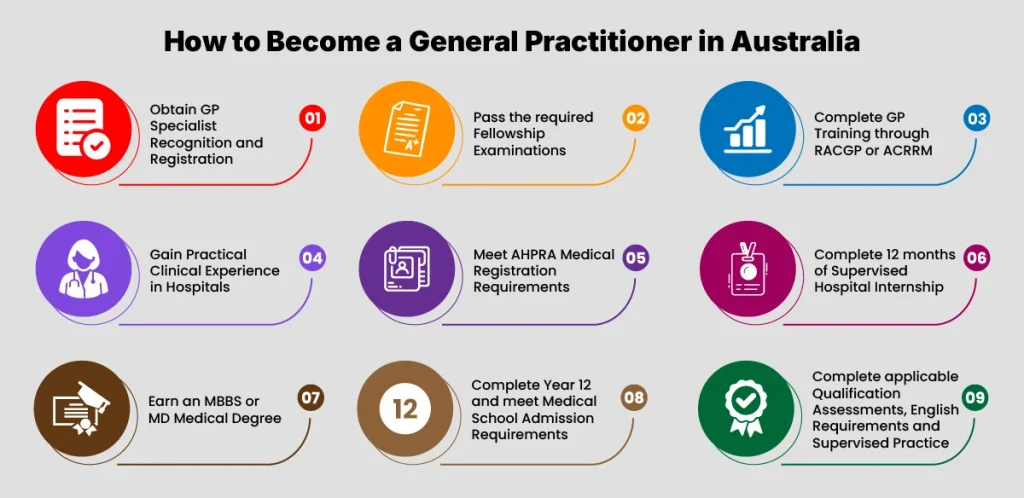
How to Become a General Practitioner in Australia
To become a general practitioner (GP) in Australia, students must complete a recognised medical degree, gain practical experience through supervised clinical training, obtain medical registration from the Medical Board of Australia, and complete an accredited general practice training program. After meeting the required training and assessment criteria, they can qualify as a GP and pursue medical careers in Australia.
For international medical graduates, the pathway may also include qualification assessments, examinations and supervised practice, depending on their medical qualifications and previous clinical experience. This guide explains how to become a general practitioner in Australia step by step, whether you study locally or overseas. A general practitioner in Australia is also a skilled migration occupation, so overseas doctors can often apply through employer-sponsored visas.
Here is the detailed process for becoming a general practitioner in Australia:
1. Complete Year 12 or an Equivalent Qualification
The first step to becoming a general practitioner in Australia is to complete Year 12 or an equivalent secondary school qualification. After that, students can choose one of two pathways to study medicine:
Undergraduate Entry: Apply directly to a medical program after Year 12, provided the university’s academic and admission requirements are met.
Graduate Entry: Complete a bachelor’s degree first, then apply for a graduate-entry medical program.
Students should focus on subjects such as biology and chemistry if required by their chosen university. International students must also check their academic qualifications, English language requirements and eligibility for admission.
Students should focus on subjects such as biology and chemistry if required by their chosen university. International students must also check their academic qualifications, English language requirements and eligibility for admission.
2. Complete a Medical Degree
Students must complete a recognised medical degree, such as a Bachelor of Medicine and Bachelor of Surgery (MBBS) or a Doctor of Medicine (MD).
Undergraduate Medical Degree: Usually takes around five to six years, depending on the university and course structure.
Graduate-Entry Medical Degree: Usually takes around four years after completing a bachelor’s degree.
After graduation, students must meet the requirements for supervised clinical training and medical registration before moving on to general practice training.
3. Complete a Medical Internship
The internship is a key stage in how to become a general practitioner in Australia. It is a supervised hospital year after graduation, in which new doctors apply what they learned at medical school under the guidance of senior doctors. Most interns rotate through core areas such as medicine, surgery and emergency care.
Duration: Usually 12 months, completed in an accredited hospital.
Where: Public and private hospitals across Australian states and territories. Placements are usually organised through a state or territory allocation process.
Registration during this Stage: Australian graduates hold provisional registration while they complete the internship.
Outcome: After a successful internship, you can apply for general registration.
4. Obtain Medical Registration
You cannot practise medicine in Australia without registration with the Medical Board of Australia, which is managed through Ahpra. Registration confirms that you are qualified, safe and fit to practise.
Provisional Registration: For new graduates completing their internship.
General Registration: Granted after the internship and other requirements are met. This is what allows you to work as a doctor and enter GP training.
Registration Standards: You must meet standards covering English language skills, criminal history, professional indemnity insurance, continuing professional development and recency of practice.
English Language Skills: Applicants must meet the Board’s English standard, for example through IELTS Academic, OET or PTE Academic, unless exempt. PTE Academic is also widely used for PTE for Australia immigration applications.
Renewal: Registration is renewed every year.
5. Gain Hospital Experience
Hospital experience is an important part of how to become a general practitioner in Australia, because many doctors work as resident medical officers (RMOs) after their internship. This builds the broad clinical skills you will use in general practice, where you will see patients of all ages with a wide range of conditions.
Typical Length: One to three years, depending on your plans.
Useful Areas: General medicine, emergency, paediatrics, obstetrics and gynaecology, and mental health.
Applying Early: You can apply for the Australian General Practice Training (AGPT) Program from your intern year onwards.
Recognition of Prior Experience: Hospital experience can count towards your training. The RACGP allows applicants to apply for up to 12 months of recognition of prior hospital experience.
Eligibility: AGPT places are generally for Australian and New Zealand citizens and permanent residents, so check the current requirements before applying.
6. Enrol in a General Practice Training Program
Specialist GP training prepares doctors for independent practice. The AGPT Program is the main pathway, delivered by the Royal Australian College of General Practitioners (RACGP) and the Australian College of Rural and Remote Medicine (ACRRM).
RACGP (FRACGP): Three years full-time, or the part-time equivalent.
Rural Generalist Training: Around four years full-time, with an extra year of rural skills training.
ACRRM: Usually around four years full-time, with a focus on rural and remote practice.
Training Content: Hospital terms, general practice placements and extended skills training, in city, regional, rural or remote locations.
Part-Time Training: Available if you need flexibility.
Alternative Route: The RACGP Fellowship Support Program is designed for doctors already working in general practice, including many international medical graduates.
7. Pass the Fellowship Exams
Passing the Fellowship exams is the final test of how to become a general practitioner in Australia. During training, registrars sit the college’s exams, which assess whether you are ready for unsupervised general practice anywhere in Australia. The RACGP exams are held twice a year and have three parts:
Applied Knowledge Test (AKT): A multiple-choice exam that tests your clinical knowledge.
Key Feature Problem (KFP): A written exam based on clinical cases and decision-making.
Clinical Competency Exam (CCE): An online practical assessment of your clinical skills, taken after you pass the AKT and KFP.
Start preparing early. Colleges offer exam support resources, practice questions and mock exams.
8. Gain Fellowship and Specialist GP Registration
After completing training and passing the exams, you can apply for Fellowship of the RACGP (FRACGP) or ACRRM (FACRRM). Fellowship is the qualification that recognises you as a specialist GP.
Fellowship: Confirms you can practise as a GP independently, anywhere in Australia.
Specialist Registration: Apply to Ahpra for specialist registration in general practice.
Medicare Access: Fellows have full access to Medicare rebates, which lets you work independently in general practice.
Ongoing Requirements: You must keep up your continuing professional development to maintain Fellowship and registration.
9. Extra Steps in the GP Pathway for IMG in Australia
Doctors who studied overseas must have their qualifications assessed before they can register. The route depends on your qualifications and where you trained.
Standard Pathway: Pass the Australian Medical Council (AMC) multiple-choice exam, then the AMC clinical exam or a workplace-based assessment. You receive the AMC Certificate. You can then work under supervision on limited registration before applying for general registration.
Competent Authority Pathway: For doctors who completed approved requirements in the UK, Ireland, Canada or the USA. It can exempt you from the AMC exams, though you still need supervised practice.
Specialist Pathways: Overseas-trained specialist GPs can be assessed for comparability to an Australian GP. Qualifications judged substantially equivalent may use the Expedited Specialist Pathway, introduced in October 2024.
Qualification Verification: The AMC uses ECFMG to verify your medical degree before you can proceed.
English Language Skills: All pathways require proof of English proficiency unless the Board grants an exemption.
Short-Term Training Pathway: This is for specialists doing up to 24 months of training in Australia. It does not lead to permanent registration.
How long does it take to become a GP Australia?
Becoming a general practitioner in Australia usually takes 9–12 years after secondary school. This covers medical school, a hospital internship, further hospital experience and specialist general practice training. The exact time depends on your degree, registration pathway and whether you train full-time or part-time.
Here is how long each stage of how to become a general practitioner in Australia typically takes:
| Stage | Typical duration |
|---|---|
| Medical degree (MBBS, MD or equivalent) | 5–6 years |
| Medical internship and hospital experience | 1–2 years |
| Accredited general practice training | 3–4 years |
| Total time | Approximately 9–12 years |
Several things can change this timeline:
Graduate-Entry Route: A bachelor’s degree (usually 3 years) followed by a 4-year medical degree can bring the total to around 12 years.
Training Program: RACGP training takes three years full-time, while Rural Generalist and ACRRM training usually take around four.
Part-Time Training: Training part-time lengthens the program, though it is available if you need flexibility.
Prior Experience: Hospital experience can count towards your training, so some doctors start GP training soon after their internship.
For international medical graduates (IMGs), the timeline is different. Doctors who have already completed a medical degree and internship overseas must still meet Australia’s registration requirements. This includes having their qualifications assessed, completing any required supervised practice and finishing GP training or recognition. The time depends on your registration pathway and whether your existing qualifications or specialist status are recognised. Specialist GPs from approved countries may be able to move faster through the Expedited Specialist Pathway.
For migration purposes, a GP falls under the Australia ANZSCO code 253111. GPs are on the Core Skills Occupation List, which includes many in demand jobs in Australia, and employers can sponsor them through visas such as the 482, 186 and 494, so these roles are also jobs in Australia with visa sponsorship.
Conclusion
Now you know how to become a general practitioner in Australia: it takes around 9-12 years. You complete a medical degree, finish an internship, register with the Medical Board of Australia, and train through an accredited general practice program that ends in Fellowship. International medical graduates follow the same path, with extra assessment steps depending on their qualifications. Requirements and pathways change, so check the latest visa information, including Australia visa processing time, on the Australian Department of Home Affairs website before you plan your next step.