




What are the best countries for chemical engineers in 2027?
If you’re planning to build an international career in chemical engineering, choosing the right country can make a significant difference to your salary, career growth, and future opportunities.
However, job demand, salary expectations, qualification requirements, and work visa options vary by destination.
In this guide, we’ll explore the best countries for chemical engineering jobs abroad in 2027, comparing career prospects, earning potential, and opportunities for skilled professionals and fresh graduates.
Table Of Content
1Why Chemical Engineering Jobs Abroad Are Growing in 20272Best Countries for Chemical Engineers — Quick Comparison3Which Country Has the Highest Demand for Chemical Engineers?4Highest-Paying Countries for Chemical Engineers5Chemical Engineering Salary Abroad in Indian Rupees6Best Countries for Chemical Engineering Jobs Abroad for Freshers7What Qualifications Do You Need to Work as a Chemical Engineer Abroad8Which Country Is Best for You?9How should Indian chemical engineers choose a destination?10FAQs
Why Chemical Engineering Jobs Abroad Are Growing in 2027
Demand is supported by five trends:
Pharmaceutical and biotechnology manufacturing: process development, scale-up, quality control and bioprocessing.
Energy transition: cleaner industrial processes, renewable fuels, hydrogen, carbon capture and energy efficiency.
Chemicals, petrochemicals and oil and gas: refining, plant operations, process optimisation and industrial safety.
Advanced materials and batteries: battery materials, polymers, speciality chemicals and semiconductor-related manufacturing.
Environmental compliance and process safety: emissions, industrial waste and workplace hazards.
Demand doesn’t mean a shortage in every country, so check current vacancies before choosing.
Best Countries for Chemical Engineers — Quick Comparison
The best countries for chemical engineers are Australia, Canada, Germany, the USA and Switzerland. The following table provides a starting point for comparing five destinations.
Salary ranges are indicative gross annual estimates for established professional roles, not guaranteed starting salaries or official national medians.
| Country | Relevant industries | Indicative annual salary | Potential advantage |
|---|---|---|---|
| Australia | Mining, resources, chemicals, energy and food processing | AUD 80,000–150,000 | Resources and process engineering opportunities |
| Canada | Energy, chemicals, mining, pharmaceuticals and manufacturing | CAD 60,000–120,000 | Opportunities across several industrial sectors |
| Germany | Chemicals, pharmaceuticals, materials and industrial manufacturing | €50,000–85,000 | Strong industrial and chemical manufacturing base |
| USA | Chemicals, energy, pharmaceuticals, biotechnology and materials | US$80,000–160,000+ | Broad range of industries and specialised roles |
| Switzerland | Pharmaceuticals, life sciences, speciality chemicals and advanced materials | CHF 90,000–140,000 | High earning potential in specialised industries |
Salary figures are approximate market-oriented planning ranges. They may differ significantly by location, seniority, employer and job title. The upper end generally reflects experienced or specialised professionals. Currency conversion is provided separately below.
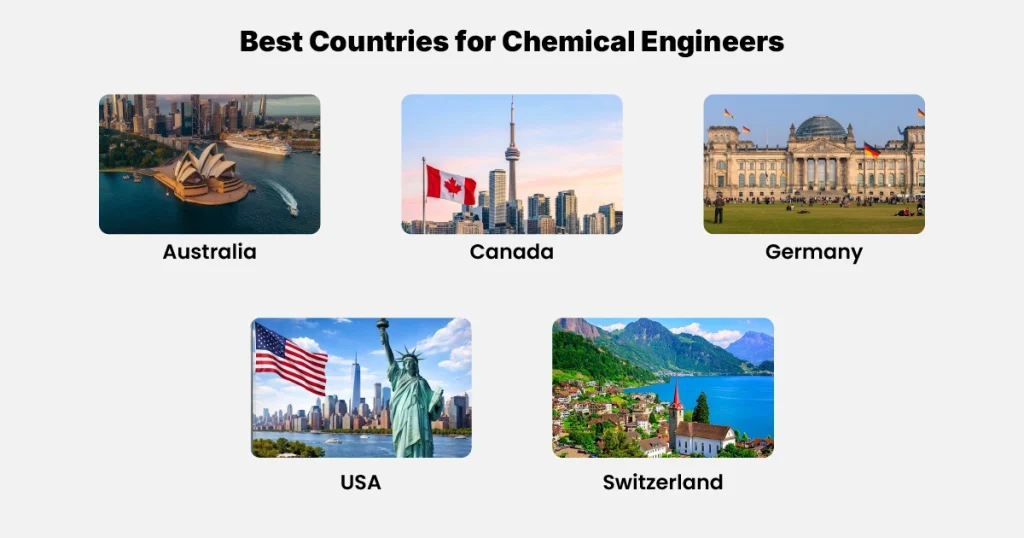
1. Australia
Best suited for: resources, mineral processing, energy and environmental work.
Salary: AUD 80,000–150,000, with senior roles higher. Remote-site resources jobs are paid differently from office-based manufacturing roles.
Good fit if: you have experience in process engineering, plant operations, environmental management or industrial safety. Freshers should look at graduate programmes and check employer visa eligibility.
2. Canada
Best suited for: energy, petrochemicals, manufacturing and pharma. Alberta is the hub for energy and petrochemical work. Ontario and Quebec lead in manufacturing and pharma.
Salary: CAD 60,000–120,000. Job Bank’s national estimate is a median of CAD 51.92 an hour, ranging from CAD 27.45 to CAD 76.92. This is a wage estimate, not what a new international applicant will necessarily earn.
Good fit if: you have industrial operations, process design or environmental experience. A job offer and PR are separate steps, and experience alone doesn’t guarantee either.
3. Germany
Best suited for: Chemical engineers interested in industrial manufacturing, pharmaceuticals, research and advanced materials.
Salary: €50,000–85,000. When comparing statistics, separate chemical engineering roles from chemistry or lab science jobs, because pay differs.
Language: Some international teams work in English. German improves access to production, plant and safety roles. Check that your degree meets the employer’s requirements.
4. United States of America (USA)
Best suited for: Engineers seeking specialised technical roles, research opportunities and potentially high earnings.
Salary: The BLS median is US$125,040, with the lowest 10% earning about US$79,420 and the highest 10% above US$182,880 (May 2025). These are US labour-market figures, not a guarantee for international candidates.
Watch out for: employer sponsorship, work authorisation, competition and cost of living. A high gross salary doesn’t always mean high savings.
5. Switzerland
Best suited for: Experienced engineers in pharmaceutical manufacturing, biotechnology, process validation and specialised chemical industries.
Salary: CHF 90,000–140,000. Housing, insurance and transport are expensive, so compare take-home savings rather than gross pay.
Watch out for: Candidates from outside the EU/EFTA may face additional admission requirements and restrictions. It is important to confirm eligibility before making relocation plans.
Which Country Has the Highest Demand for Chemical Engineers?
There is no single country that can be confidently described as having the highest demand for chemical engineers across every specialisation in 2027.
Demand depends on the number of vacancies, the type of industry, the experience employers require and the availability of suitably qualified local candidates.
For a practical comparison, consider the following:
USA: Worth researching for chemical manufacturing, pharmaceuticals, biotechnology, energy and research. Official projections indicate 5% employment growth for chemical engineers from 2025 to 2035.
Germany: Relevant for chemical production, industrial manufacturing, pharmaceuticals and materials research.
Canada: Worth exploring for energy, petrochemicals, mining, manufacturing and environmental process engineering.
Australia: Relevant for resources, mineral processing, industrial operations and energy.
Switzerland: A specialised market for pharmaceutical manufacturing, life sciences and advanced chemical applications.
The best way to identify a promising destination is to compare current job advertisements, the skills employers request, salary ranges and eligibility for international applicants.
Before choosing a country, search for both your exact job title and related positions, such as Process Engineer, Production Engineer, Process Development Engineer and Chemical Manufacturing Engineer. Employers may advertise suitable roles under different titles.
Chemical engineers considering Canada can explore their immigration options by using the Canada CRS Calculator to estimate their Comprehensive Ranking System (CRS) score.
Highest-Paying Countries for Chemical Engineers
The USA and Switzerland are worth investigating for high-paying chemical engineering careers. Australia, Canada and Germany can also offer competitive compensation in certain industries and at particular experience levels.
However, there is no universally reliable salary ranking that covers every chemical engineering occupation in every country using the same data and methodology.
A fair comparison should consider the following:
1. Gross annual salary.
2. Income tax and mandatory social contributions.
3. Housing, transport, insurance and everyday expenses.
4. Demand for your particular specialisation.
5. Career progression and opportunities to move into senior positions.
6. Visa eligibility and the cost of relocating.
For example, a pharmaceutical process engineer in Switzerland and a chemical engineer in an American manufacturing plant may have different pay structures, working conditions and living costs. Comparing only their gross salaries would not provide a complete picture.
For international job seekers, the most useful question is not simply which country pays the most, but which country offers the best combination of earnings, employability and long-term career growth for their profile.
Chemical Engineering Salary Abroad in Indian Rupees
For Indian candidates, converting foreign salaries into rupees makes international opportunities easier to understand.
The following estimates use illustrative exchange rates of US $1 = ₹88, C$1 = ₹64, A$1 = ₹58, €1 = ₹102 and CHF 1 = ₹110 ( as per October 2026). These are calculation assumptions, not live exchange rates.
| Country | Indicative gross annual salary | Approximate equivalent in INR |
|---|---|---|
| Australia | A$80,000–150,000 | ₹46.4 lakh–₹87 lakh |
| Canada | C$60,000–120,000 | ₹38.4 lakh–₹76.8 lakh |
| Germany | €50,000–85,000 | ₹51 lakh–₹86.7 lakh |
| USA | US$80,000–160,000 | ₹70.4 lakh–₹1.41 crore |
| Switzerland | CHF 90,000–140,000 | ₹99 lakh–₹1.54 crore |
These are approximate currency conversions of gross annual salaries, not take-home income. They are also not directly comparable to official national averages.
If you are planning to pursue chemical engineering opportunities in Australia, use the Australia PR Points Calculator to estimate your skilled migration points.
What do these salaries mean for Indian engineers?
A salary that converts to ₹80 lakh per year does not mean you can save ₹80 lakh or enjoy the same purchasing power as you would in India.
Before accepting an overseas offer, calculate:
- Expected monthly take-home salary.
- Rent and utility costs.
- Health insurance and other mandatory contributions.
- Food, transport and communication expenses.
- Relocation and visa-related expenses.
- Emergency savings and any financial commitments in India.
Tip: Compare estimated monthly savings rather than converting the entire salary into rupees and using that figure to judge the offer.
Best Countries for Chemical Engineering Jobs Abroad for Freshers
For fresh graduates, the realistic options are Germany (apply directly through opportunity card) and Canada, Australia or the USA (usually by studying there first). Employers rarely sponsor fresh graduates from overseas, so a Master’s degree abroad is the most common route into those three countries.
Countries to Consider as a Fresher :
Germany: Research graduate engineering roles, industrial internships and entry-level process engineering positions. German language proficiency may expand your options.
Australia: Look for graduate programmes, junior process engineering roles and opportunities connected with manufacturing, resources or environmental engineering. Check whether the employer accepts international applicants.
Canada: Explore graduate engineering programmes, manufacturing roles and junior positions in process development. Confirm whether you meet the employer’s work authorisation requirements.
How can freshers improve their chances of getting hired abroad?
1. Complete a relevant qualification. A bachelor’s degree in chemical engineering is a common entry requirement.
2. Gain practical experience. Internships, industrial training and final-year projects can demonstrate your ability to apply engineering principles.
3. Develop technical skills. Familiarity with process simulation, process control, mass and energy balances, equipment design and safety analysis can be valuable.
4. Build a focused CV. Highlight measurable project outcomes, technical tools, laboratory experience and relevant coursework.
5. Search using multiple job titles. Include graduate engineer, junior process engineer, production engineer and process development engineer.
6. Check work authorisation. Confirm whether the employer considers applicants who require sponsorship or another eligible work route.
7. Avoid guaranteed-job claims. Verify employers and recruitment agencies before paying fees or sharing sensitive documents.
Freshers should also distinguish between chemical engineering jobs and technician or laboratory assistant positions. Related roles may provide experience, but they do not always offer the same responsibilities or career progression as engineering positions.
What Qualifications Do You Need to Work as a Chemical Engineer Abroad?
Most professional chemical engineering positions require a relevant engineering degree, while specialised or research-focused roles may require postgraduate qualifications.
The exact requirements depend on the country, employer, job duties and industry.
1. A relevant engineering degree
A bachelor’s degree in chemical engineering or a closely related field is a common starting point. Employers may assess the institution, curriculum, academic results and relevance of your projects.
2. Relevant work experience
Fresh graduates can target graduate programmes and entry-level positions. Experienced candidates should demonstrate practical knowledge of process design, manufacturing, equipment, troubleshooting, safety or process optimisation.
3. Technical and digital skills
Useful skills may include process simulation tools such as Aspen Plus or Aspen HYSYS, where relevant; mass and energy balance calculations; process control and instrumentation fundamentals; equipment sizing and process design; process safety and hazard assessment; quality management and environmental compliance; and data analysis and technical reporting.
Employers will not necessarily require every tool or skill listed above. Prioritise those mentioned in your target job advertisements.
4. Language proficiency
English is important for many international engineering roles. German can be valuable in Germany, while local language skills may also be expected for certain positions in Switzerland and other destinations.
Always check the language requirements of the specific vacancy.
5. Professional recognition or registration
Some engineering roles or career paths may require professional registration, credential assessment or evidence of equivalent qualifications. Requirements vary between countries and may differ according to the responsibilities of the role.
For example, the US Bureau of Labor Statistics explains that a bachelor’s degree is the typical entry-level educational requirement for chemical engineers in the USA, while professional engineer licensure may be relevant for certain responsibilities and career paths.
Source: BLS — How to Become a Chemical Engineer.
6. Work visa or employment authorisation
A suitable degree does not automatically grant the right to work abroad. Candidates must qualify under the relevant immigration rules, which may involve an eligible job offer, employer sponsorship, occupation-specific criteria or other requirements.
Before applying, review official government immigration information for your chosen destination.
Chemical engineers interested in finding work in Germany can use the Germany Opportunity Card Points Calculator to explore their potential eligibility for this job-search pathway.
Which Country Is Best for You?
The best country for chemical engineers depends on your qualifications, experience, specialisation, budget and long-term goals.
Use this comparison as a starting point:
| Your career priority | Countries worth researching | Why |
|---|---|---|
| High earning potential | USA, Switzerland | Strong salaries in specialised and experienced roles |
| Resources and industrial processing | Australia, Canada | Mining, energy and process industries |
| Chemical manufacturing and industrial engineering | Germany, USA | Established chemical and manufacturing sectors |
| Pharmaceuticals and biotechnology | USA, Switzerland, Germany | Regulated manufacturing, process development and research |
| Entry-level or graduate roles | Australia, Germany, Canada, USA | Graduate programmes and junior roles, subject to eligibility |
How should Indian chemical engineers choose a destination?
Start by identifying the roles you can realistically qualify for. A candidate with three years of pharmaceutical manufacturing experience may have different opportunities from a fresher interested in environmental process engineering.
Next, shortlist two or three countries and compare current vacancies, qualifications, language requirements, work authorisation and likely savings.
If you plan to study abroad before entering the workforce, also consider tuition fees, living costs, course relevance and the post-study work rules that apply to your intended programme and destination.
Do not select a country based on salary alone. A suitable job in a growing specialisation, with realistic hiring prospects and manageable living costs, may be a better choice than a higher-paying role that is difficult to access.