



A spouse visa for Australia allows eligible individuals to join their spouse or de facto partner in Australia and build a life together. For Indians whose partners are Australian citizens, permanent residents or eligible New Zealand citizens, the Australian Partner visa program may provide a pathway to living together in Australia and eventually obtaining permanent residency.
If you are planning to apply in 2027, understanding the eligibility criteria, required documents, application fees and processing times can help you prepare. This guide explains the Australian spouse visa options for Indians, how to apply and what to consider before submitting your application.
Table Of Content
1What Is a Spouse Visa for Australia?2Who Can Apply for an Australian Spouse Visa?3What Are the Different Types of Spouse Visas in Australia?4What Are the Eligibility Requirements for a Spouse Visa Australia?5What Documents Are Required for an Australian Spouse Visa?6How to Apply for a Spouse Visa Australia from India7How Much Does a Spouse Visa Australia Cost in 2027?8How long does an Australian spouse visa take?9Can You Work in Australia on a Spouse Visa?10Which Australian Spouse Visa Is Right for You?11Frequently Asked Questions
What Is a Spouse Visa for Australia?
“Spouse visa,” “wife visa Australia” and “husband visa” are everyday search terms. Australia’s official name is the Partner visa, and it covers spouses and de facto partners. The pathway has two stages:
- Temporary stage: lets you live in Australia while the permanent stage is assessed (subclass 309 offshore, 820 onshore).
- Permanent stage: gives permanent residence (subclass 100 offshore, 801 onshore).
You apply for both stages in one combined application.
Who Can Apply for an Australian Spouse Visa?
You can apply for an Australian spouse visa (Partner visa) if you are married to, or in a de facto relationship with, an Australian citizen, Australian permanent resident or eligible New Zealand citizen, and your relationship is genuine and ongoing. If you are engaged and plan to marry, you may qualify for the Prospective Marriage visa (subclass 300) instead.
What Are the Different Types of Spouse Visas in Australia?
Australia has three main spouse visa pathways: the offshore Partner visa (subclasses 309/100), the onshore Partner visa (subclasses 820/801) and the Prospective Marriage visa (subclass 300). The right one depends on where you are when you apply and whether you are already married or in a de facto relationship.
Quick comparison
| Offshore Partner visa | Onshore Partner visa | Prospective Marriage visa | |
|---|---|---|---|
| Subclasses | 309 (temporary), 100 (permanent) | 820 (temporary), 801 (permanent) | 300 |
| Where you apply | Outside Australia | Inside Australia | Outside Australia |
| Relationship | Married or de facto | Married or de facto | Engaged, intending to marry |
| Main applicant fee | AUD 11,710 | AUD 11,710 | AUD 11,710 |
| Leads to PR? | Yes, via subclass 100 | Yes, via subclass 801 | Only after marriage, through the Partner visa |
| Best for | Applicants in India | Applicants already in Australia | Engaged couples planning to marry |
The 1 July 2026 charge for these visas is AUD 11,710 for the main applicant
1. Offshore Partner visa (subclasses 309 and 100)
This is the usual route for Indian applicants who are in India.
- Subclass 309 is the initial temporary stage and subclass 100 is the permanent stage. You lodge one combined application and pay one fee covering both.
- You must be outside Australia when you apply.
- The 309 lets you live in Australia while the permanent 100 stage is assessed.
2. Onshore Partner visa (subclasses 820 and 801)
This is for applicants who are already in Australia.
- Subclass 820 is the temporary stage and subclass 801 is the permanent stage, with one combined application and one fee.
- You must be in Australia when you apply.
- Check your current visa conditions first, because some visas restrict an onshore application.
3. Prospective Marriage visa (subclass 300, “visa 300 Australia”)
This is for couples who are engaged but not yet married.
- You apply from outside Australia, and the visa generally allows a stay of 9 to 15 months to marry your partner.
- It is temporary and doesn’t give permanent residence.
- After marrying, you can apply for the onshore Partner visa. Holders of a subclass 300 visa pay a significantly reduced charge for that 820 application.
What Are the Eligibility Requirements for a Spouse Visa Australia?
To qualify for an Australian spouse or partner visa, you must satisfy the requirements of the specific subclass. The following are important areas to consider.
1. Eligible Sponsor
Your spouse or partner must generally be an Australian citizen, Australian permanent resident or eligible New Zealand citizen. The sponsor must also meet the applicable sponsorship requirements.
A partner who holds only a temporary Australian student or work visa does not ordinarily qualify to sponsor someone under the standard Partner visa subclasses 309/100 or 820/801.
In that situation, you may need to explore another visa pathway that fits your circumstances.
2. Genuine Relationship
You must demonstrate that your relationship is genuine and continuing.
Depending on your circumstances, evidence may include:
- Marriage certificate or evidence of a qualifying de facto relationship
- Joint bank account statements
- Joint lease, mortgage or household bills
- Photographs together and evidence of shared activities
- Travel records and communication history
- Evidence of how you share financial and household responsibilities
- Statements from people who know about your relationship
No single document guarantees approval. The evidence should present a consistent and credible picture of your relationship.
3. De Facto Relationship Requirements
If you are not married, you may still qualify as a de facto partner if you meet the applicable legal criteria.
In many cases, applicants must demonstrate that their de facto relationship existed for at least 12 months before applying. Exceptions or alternative arrangements may apply in certain circumstances, such as a registered relationship where recognised by the relevant rules.
Check the specific requirements for your visa subclass before applying.
4. Health and Character Requirements
Applicants and relevant family members must satisfy the applicable health and character requirements. This may involve medical examinations, police certificates and additional information requested by the Department of Home Affairs.
5. Additional Requirements
You may also need to provide identity documents, information about previous relationships, details of dependent children and any other evidence requested during assessment.
Meeting the basic eligibility criteria does not guarantee a visa grant. Each application is assessed individually.
What Documents Are Required for an Australian Spouse Visa?
Preparing the right documents is an important part of an Australian Partner visa application. Your document checklist will depend on the visa subclass, your personal circumstances and the evidence needed to establish your relationship.
| Document category | Examples |
|---|---|
| Identity documents | Passport, birth certificate and other identity records |
| Marriage or relationship evidence | Marriage certificate, relationship registration where applicable, evidence of a de facto relationship |
| Sponsor documents | Evidence of the sponsor’s citizenship, permanent residency or eligible New Zealand citizenship |
| Financial evidence | Joint bank statements, shared loans or financial commitments |
| Household evidence | Joint lease, mortgage documents, household bills or evidence of shared living arrangements |
| Social evidence | Photographs, invitations, travel records and statements from people who know the couple |
| Commitment evidence | Communication records, evidence of time spent together and statements about future plans |
| Character documents | Police certificates and other documents requested by the department |
| Health documents | Medical examinations or other health information when required |
| Children and dependants | Birth certificates, adoption documents and evidence of dependency where applicable |
Tips for Preparing Your Documents
- Ensure names, dates and personal details are consistent across documents.
- Provide certified translations for documents that are not in English, following the department’s requirements.
- Organise relationship evidence into clear categories.
- Explain periods of separation or unusual circumstances where relevant.
- Follow the document instructions for your exact visa subclass.
Avoid submitting a large collection of unrelated documents. Clear, relevant and consistent evidence is more useful than unnecessary paperwork.
How to Apply for a Spouse Visa Australia from India
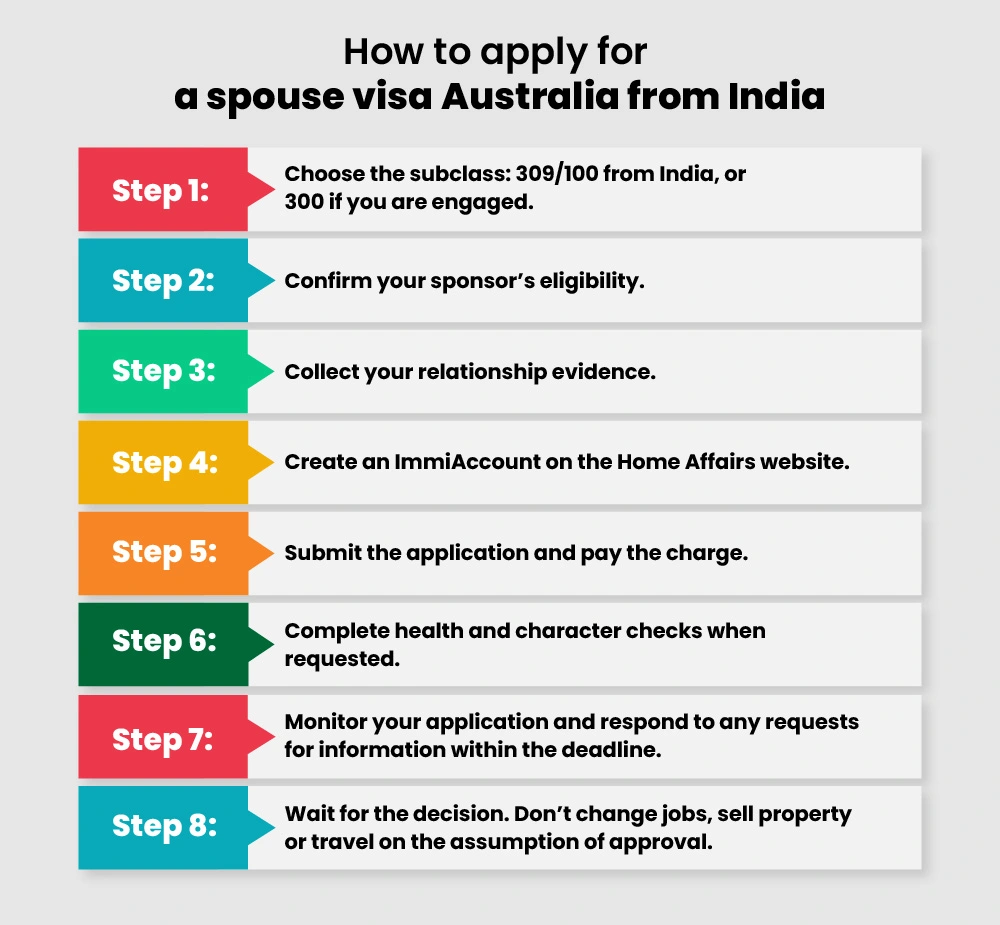
If you are applying from India, the process generally involves choosing the correct visa, preparing your evidence and submitting an online application.
Step 1: Identify the Correct Visa Subclass
Determine whether the offshore Partner visa (subclasses 309/100) or Prospective Marriage visa (subclass 300) is appropriate.
If you are already in Australia, check whether the onshore Partner visa (subclasses 820/801) is available to you.
Step 2: Check Your Sponsor’s Eligibility
Confirm that your spouse or prospective spouse meets the sponsorship requirements. Gather evidence of their citizenship, permanent residency or eligible New Zealand citizenship, as applicable.
Step 3: Collect Relationship Evidence
Prepare your marriage certificate or evidence of your qualifying de facto relationship. Gather supporting documents that demonstrate your shared finances, household arrangements, social recognition and commitment.
Step 4: Create or Access ImmiAccount
The Department of Home Affairs generally accepts these applications online through ImmiAccount. Select the appropriate visa application and complete the required information.
You can start from the official Department of Home Affairs visa listing.
Step 5: Submit the Application and Pay the Fee
Complete the application accurately, upload the supporting documents and pay the applicable visa application charge.
Follow the relevant sponsorship process and retain your application reference details.
Step 6: Complete Health and Character Checks
Complete medical examinations, provide police certificates or supply other information when required. Follow the department’s instructions on when and how to submit these documents.
Step 7: Monitor Your Application
Check ImmiAccount and your email regularly for updates or requests for additional information. Notify the department of relevant changes in your circumstances.
Step 8: Respond to Requests and Await the Decision
Provide any additional information within the specified timeframe. Processing times vary, and the department may request further evidence before making a decision.
A carefully prepared application can help reduce avoidable delays, but no applicant can guarantee a particular processing time or outcome.
How Much Does a Spouse Visa Australia Cost in 2027?
The main applicant pays AUD 11,710, based on the charge that took effect on 1 July 2026. Visa charges are reviewed every 1 July, so check the current partner visa Australia price on the Home Affairs pricing estimator before you apply in 2027.
| Applicant | Charge |
|---|---|
| Main applicant (309/100, 820/801 or 300) | AUD 11,710 |
| Additional applicant aged 18+ (Partner visa) | AUD 5,860 |
| Additional applicant under 18 (Partner visa) | AUD 2,935 |
These charges took effect on 1 July 2026, when the main charge rose from AUD 9,365, and the charge isn’t refunded once your application is validly lodged, whatever the outcome. The charge is the same whether you apply onshore or offshore.
Other costs to budget for: medical examinations, police certificates, certified translations, card payment surcharges and any professional help you choose.
How long does an Australian spouse visa take?
Expect more than a year. Home Affairs data published on 29 September 2026 showed 50% of offshore subclass 309 applications decided within 21 months and 90% within 32 months, measured from lodgement to decision. Published figures differ by month and by source, and every case depends on its evidence.
To check current times, use the Home Affairs processing-time tool for your visa type and watch your ImmiAccount for updates. Processing times are a guide, not a guarantee.
Can You Work in Australia on a Spouse Visa?
Eligible Partner visa holders can work in Australia, subject to the rights and conditions attached to their visa.
For example:
- Subclass 309: Eligible holders have work rights while living in Australia on the provisional Partner visa.
- Subclass 820: Eligible holders can live and work in Australia while the permanent Partner visa application is being processed.
- Subclass 300: Holders can work and study during the visa’s validity, subject to its conditions.
- Subclass 100 or 801: These are permanent visas that allow holders to live and work in Australia permanently.
If you are applying for a Partner visa while holding another Australian visa, your work rights may depend on your current visa and any bridging visa granted during processing.
Always check your visa grant notice and the Visa Entitlement Verification Online (VEVO) service before starting work or changing employment arrangements.
Which Australian Spouse Visa Is Right for You?
The most suitable pathway depends on your relationship status and location.
| Your situation | Pathway to investigate |
|---|---|
| You are in India and already married to an eligible Australian sponsor | Offshore Partner visa, subclasses 309/100 |
| You are in India and in a qualifying de facto relationship with an eligible sponsor | Offshore Partner visa, subclasses 309/100 |
| You are already in Australia and meet the onshore requirements | Partner visa, subclasses 820/801 |
| You intend to marry your eligible partner in Australia | Prospective Marriage visa, subclass 300 |
These are general indications rather than individual eligibility decisions. Your current visa conditions, relationship history and sponsor’s circumstances can affect which option is available.
Before applying, compare the official visa criteria and make sure you understand the application charge, documentary requirements and potential pathway to permanent residency.
If you or your partner are also considering permanent residency, you can check your eligibility with our Australia PR Points Calculator.