




Planning to move to Canada? Understanding the Cost of Living in Canada is an important part of preparing for your new life. From accommodation and groceries to transportation, healthcare and education, your monthly expenses will depend on where you live and your lifestyle. Whether you are moving alone, with your family or as an international student, this guide explores the average monthly expenses, affordable cities and essential costs to help you plan your budget and make informed decisions before moving.
Table Of Content
1Average Cost of Living in Canada Per Month?2Average Rent in Canada3Cost of Groceries and Food in Canada4Transportation Costs in Canada5Utility and Internet Costs in Canada6Healthcare Costs in Canada7Cost of Living in Canada for International Students8Cheapest Cities to Live in Canada9Factors Affecting the Cost of Living in Canada10Conclusion11FAQs About Cost of Living in Canada
Average Cost of Living in Canada Per Month?
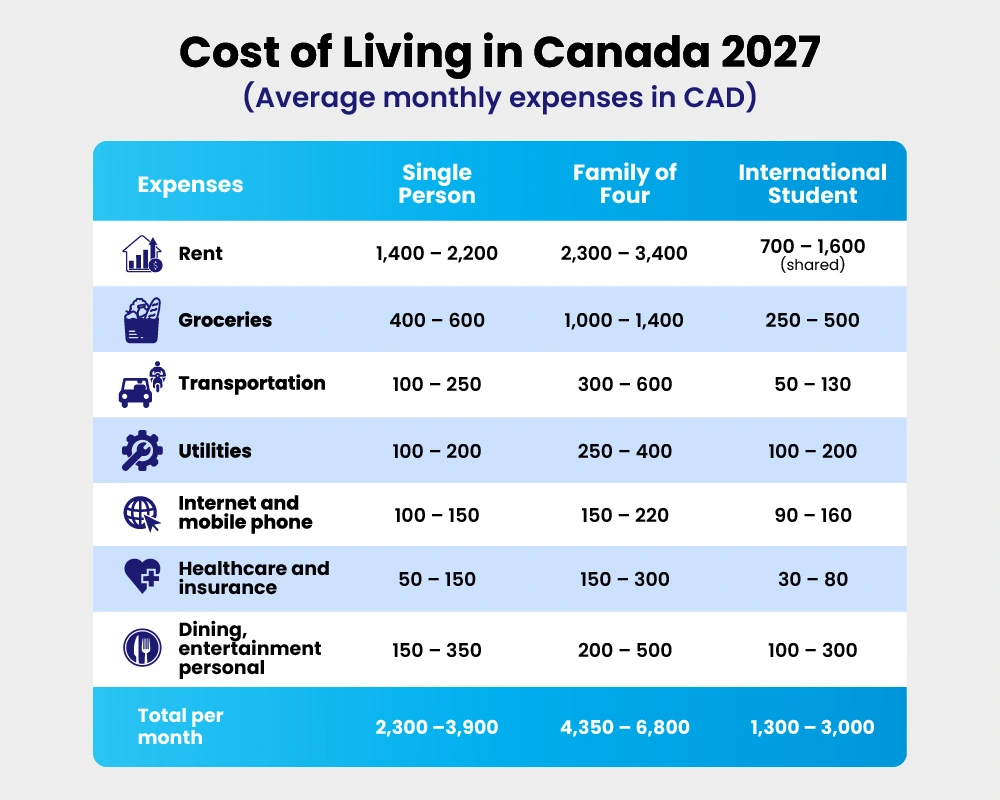
The average monthly cost of living in Canada ranges from CAD 2,300 to 3,900 for a single person and CAD 4,350 to 6,800 for a family of four. However, these expenses vary depending on the city, accommodation, household size and lifestyle. Rent usually accounts for the largest share of the monthly budget. The table below provides a breakdown of the estimated expenses
| Expenses | Single Person (CAD/month) | Family of Four (CAD/month) |
|---|---|---|
| Rent (1-bedroom / 2-bedroom) | 1,400 – 2,200 | 2,300 – 3,400 |
| Groceries | 400 – 600 | 1,000 – 1,400 |
| Transportation | 100 – 250 | 300 – 600 |
| Utilities (electricity, heating, water) | 100 – 200 | 250 – 400 |
| Internet & Mobile Phone | 100 – 150 | 150 – 220 |
| Healthcare & Insurance (dental, prescriptions) | 50 – 150 | 150 – 300 |
| Dining & Entertainment | 150 – 350 | 200 – 500 |
| Total Monthly Cost | 2,300 – 3,900 | 4,350 – 6,800 |
Average Rent in Canada
The average asking rent in Canada is approximately CAD 2,037 per month across all property types. However, the monthly rent for a one-bedroom apartment generally ranges from CAD 1,250 to 2,350 in major cities. Vancouver and Toronto are among the more expensive rental markets, while cities such as Winnipeg and Edmonton offer more affordable accommodation options.
Average Monthly Rent in Major Canadian Cities
The table below compares the average monthly rent for a one-bedroom apartment in major cities.
| City | Average Monthly Rent (1-Bedroom) |
|---|---|
| Vancouver | CAD 2,350 |
| Victoria | CAD 2,000 |
| Toronto | CAD 1,950 |
| Halifax | CAD 1,900 |
| Ottawa | CAD 1,800 |
| Montreal | CAD 1,800 |
| Kitchener | CAD 1,650 |
| Hamilton | CAD 1,600 |
| Calgary | CAD 1,450 |
| Winnipeg | CAD 1,300 |
| Edmonton | CAD 1,250 |
Cost of Groceries and Food in Canada
The average monthly grocery expense in Canada ranges from CAD 350 to 500 for a single person and CAD 1,100 to 1,500 for a family of four. Food costs have increased over the past few years, making groceries a significant part of household expenses. However, the total monthly expenses in Canada for single person depends on shopping habits, dietary preferences and household size. Here is an estimated monthly grocery budget by household size.
| Household Size | Monthly Grocery Cost (CAD) |
|---|---|
| Single person | 350 – 500 |
| Couple | 600 – 800 |
| Family of three | 800 – 1,000 |
| Family of four | 1,100 – 1,500 |
Some common grocery expenses include:
- Milk (2 litres): CAD 4.50 – 6.50
- Bread (one loaf): CAD 3 – 5
- Eggs (12): CAD 4 – 6
- Butter (454 g): CAD 5 – 7
- Rice (2 kg): CAD 8 – 12
- Chicken breasts (1 kg): CAD 12 – 16
- Ground beef (1 kg): CAD 14 – 18
- Apples (1 kg): CAD 5 – 7
- Bananas (1 kg): CAD 1.50 – 2.50
- Vegetable oil (3 litres): CAD 8 – 11
Prices vary by province, store and brand, so treat these as a guide rather than a fixed rate.
Monthly Food Expenses in Canada
A single person typically spends CAD 350 to 500 per month on groceries in Canada, while a family of four may spend CAD 1,100 to 1,500. Cooking at home, buying groceries in bulk and choosing affordable stores can help reduce these expenses. In comparison, dining out can add considerably to the monthly food budget.
Dining out costs far more than cooking at home. An inexpensive restaurant meal runs about CAD 15 to 30 per person, so a few meals out each week can easily add a few hundred dollars a month. As a result, 80% of Canadians say they now eat out less because of the cost of living. Therefore, most households cook on weekdays and save takeout and restaurants for occasional meals.
Transportation Costs in Canada
The average monthly transportation cost in Canada ranges from CAD 80 to 160 for a public transit pass, while owning and maintaining a car can cost several hundred dollars more. Expenses depend on the city, commuting distance and mode of transportation. Public transit is generally more affordable in major cities, although monthly pass prices vary across provinces. The table below lists the typical transportation costs.
| Transportation Type | Estimated Cost (CAD) |
|---|---|
| Monthly public transit pass | 80 – 160 per month |
| Single transit ride | 3 – 4 per ride |
| Gas | 150 – 250 per month |
| Car maintenance | 100 – 150 per month |
| Downtown parking | 100 – 300 per month |
| Car-sharing (occasional use) | 50 – 200 per month |
Utility and Internet Costs in Canada
The average monthly cost of utilities, internet and mobile services in Canada ranges from CAD 200 to 450 for a single person. These expenses include electricity, heating, water, home internet and mobile phone plans. However, the total varies depending on the size of the accommodation, location and whether certain utilities are included in the rent. The table below provides an estimated monthly breakdown.
| Utility Type | Estimated Cost (CAD) |
|---|---|
| Electricity | 50 – 100 per month |
| Heating (gas or electric) | 40 – 100 per month |
| Water and garbage | 30 – 70 per month |
| Home internet | 50 – 100 per month |
| Mobile phone plan | 30 – 85 per month |
Note: Many additional costs are not included in the table above, such as tenant insurance, cable or streaming subscriptions, and one-time connection or deposit fees. Moreover, larger homes and families will pay more, especially for winter heating.
Healthcare Costs in Canada
The average monthly cost of private health insurance in Canada ranges from CAD 75 to 150 for a single adult and CAD 180 to 450 for a family. Although eligible residents can access publicly funded basic healthcare, services such as dental care, prescription medicines and vision care often involve additional expenses. Newcomers may also need private insurance during provincial health coverage waiting periods. The table below outlines common healthcare expenses.
| Healthcare Service | Estimated Cost (CAD) | Covered by Public Healthcare? |
|---|---|---|
| Doctor visit / hospital stay | 0 | Yes |
| Ambulance (with provincial health card) | 50 – 450 | Partly (varies by province) |
| Ambulance (without health card) | 750 – 1,000+ | No |
| Dental cleaning and checkup | 150 – 300 | No |
| Dental filling | 150 – 400 per tooth | No |
| Root canal | 800 – 1,500 | No |
| Adult eye exam | 80 – 150 | No |
| Prescription glasses or contact lenses | 200 – 600 | No |
| Physiotherapy | 75 – 100 per session | No |
| Short-term private insurance (waiting period) | 50 – 150 per month | Not applicable |
| Private health insurance (single adult) | 75 – 150 per month | Not applicable |
| Private health insurance (family) | 180 – 450 per month | Not applicable |
Cost of Living in Canada for International Students
The average monthly living expenses for international students in Canada range from CAD 1,700 to 2,800, excluding tuition fees. Students who choose shared accommodation and affordable cities may be able to manage their expenses at a lower cost. In addition, IRCC requires a single study permit applicant outside Quebec to demonstrate CAD 23,448 in annual living expenses from September 1, 2026. The table below provides an estimated breakdown of student expenses.
| Expense | Estimated Cost (CAD) |
|---|---|
| Shared rent (room or shared apartment) | 700 – 1,600 per month |
| Groceries (cooking at home) | 250 – 500 per month |
| Utilities (if not included in rent) | 100 – 200 per month |
| Phone and internet | 90 – 160 per month |
| Student transit pass | 50 – 130 per month |
| Health insurance (if not in school fees) | 30 – 80 per month |
| Personal and other expenses | 100 – 300 per month |
| Total monthly living cost | 1,300 – 3,000 per month |
Other Expenses:
| Books and supplies | 1,000 – 2,000 per year |
| College diploma tuition | 16,000 – 25,000 per year |
| University tuition (graduate, average) | 24,693 per year |
| University tuition (undergraduate, average) | 42,062 per year |
| IRCC proof of funds (single applicant, outside Quebec) | 23,448 per year |
The table above does not include several one-time and extra costs, such as the study permit application fee, return flights, rent deposits, and first-year setup items like bedding and kitchenware. Moreover, tuition varies widely by province and program, so check your school’s official fee page before budgeting.
Those planning to Get a Job in Canada From India should research employment requirements, qualifications and available opportunities before making relocation plans.
Cheapest Cities to Live in Canada
The average monthly cost of living in some of Canada’s cheapest cities ranges from approximately CAD 2,238 to 3,255 for a single person, including rent. Cities such as Trois-Rivières, Sherbrooke and Quebec City offer relatively affordable living options compared with Toronto and Vancouver. Other budget-friendly choices include Saint John, Winnipeg, Saskatoon and Regina. Therefore, the table below compares rent and living costs in the best cities in Canada to live and work that are affordable.
| City | Average Rent (1-Bedroom) | Other Monthly Costs | Estimated Total Monthly Cost |
|---|---|---|---|
| Trois-Rivières, Quebec | CAD 938 | CAD 1,299 | CAD 2,238 |
| Sherbrooke, Quebec | CAD 1,211 | CAD 1,412 | CAD 2,623 |
| Quebec City, Quebec | CAD 1,362 | CAD 1,422 | CAD 2,784 |
| Saint John, New Brunswick | CAD 1,455 | CAD 1,469 | CAD 2,924 |
| Winnipeg, Manitoba | CAD 1,442 | CAD 1,534 | CAD 2,976 |
| Saskatoon, Saskatchewan | CAD 1,485 | CAD 1,613 | CAD 3,098 |
| Regina, Saskatchewan | CAD 1,552 | CAD 1,600 | CAD 3,152 |
| Edmonton, Alberta | CAD 1,622 | CAD 1,633 | CAD 3,255 |
Note: When choosing an affordable city, newcomers should also consider available Job Opportunities in Canada, average salaries and the demand for their skills.
Factors Affecting the Cost of Living in Canada
A variety of factors influence how much a person spends on living expenses in Canada:
City and Province: Rent and everyday prices differ widely, so the cost of living in Canada changes sharply between cities, such as Vancouver (about CAD 2,350 for rent) and Edmonton (about CAD 1,250).
Housing Type: Rent is the biggest expense, and sharing a home or living outside the city centre lowers it.
Taxes: Provincial income and sales taxes differ, and Alberta, for example, has no provincial sales tax.
Climate: Heating can make up 40 to 60% of winter utility bills in colder regions.
Transportation: A transit pass costs about CAD 80 to 160 a month, whereas driving adds gas, maintenance, parking, loan and insurance costs.
Food Prices: Food prices are forecast to rise 4 to 6% in 2026, so grocery bills keep climbing.
Household Size: Single people pay more per person on groceries, whereas families spend more overall.
Lifestyle: Cooking at home costs far less than dining out, so eating habits change your budget quickly.
Healthcare needs: Dental care, prescriptions and vision are not covered publicly, so private insurance adds to monthly costs.
Childcare: Costs vary by province, and Quebec’s subsidized system is among the cheapest in Canada.
Note: Newcomers planning their finances can also explore salary estimates and employment information through Job Bank Canada to understand how earnings compare with living expenses.
Conclusion
The cost of living in Canada per month depends mainly on where you live, with rent taking the largest share of most budgets. Moreover, groceries, transportation, utilities and healthcare add to the total, so it helps to plan for each category before you move. However, cities in Quebec and the Prairies, such as Trois-Rivières, Sherbrooke and Winnipeg, cost far less than Toronto or Vancouver. Therefore, compare cities carefully and build a realistic budget, especially if you are moving as an international student. Finally, check the IRCC official website for the latest immigration and study permit financial requirements before you apply.