




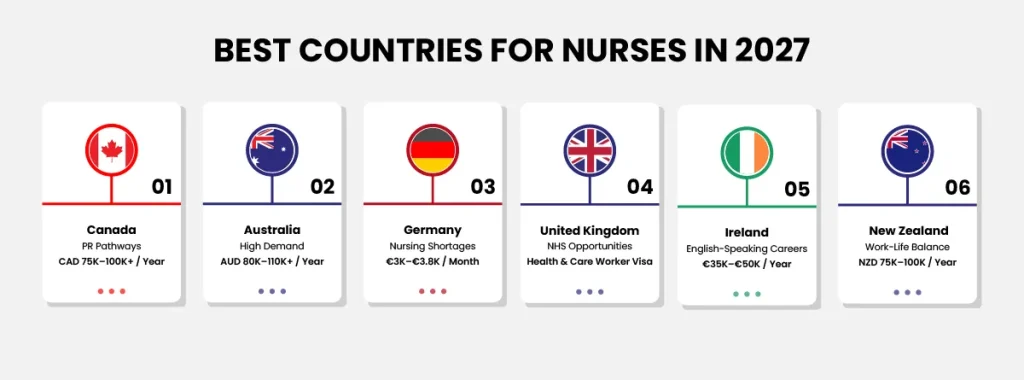
The best countries for nurses in 2027 are Canada, Australia, Germany, the UK, Ireland and New Zealand. All six combine strong demand for nurses, a clear licensing process and a realistic route to long-term settlement. The right one for you depends on your priorities: fastest permanent residency, highest salary, lowest upfront cost, or no English test.
This guide compares nursing jobs abroad country by country, with salaries, licensing steps, visa routes and PR pathways. It is written with Indian nurses in mind, but most of it applies to any internationally educated nurse.
Important: Immigration and licensing rules change often. Salary figures below are approximate ranges, and you should always confirm details on the official regulator and government websites before you spend money on exams or applications.
Table Of Content
1Best Countries for Nurses: Quick Comparison2Why Nursing Careers Abroad Are Growing in 20273Best Countries for Nurses in 20274Which Country Has the Highest Demand for Nurses in Europe?5Which Country Pays Nurses the Highest Salary?6Best Countries for Nurses to Work Abroad for Freshers8What Qualifications Do You Need to Work as a Nurse Abroad?9Which Country Is Best for You?10Frequently Asked Questions
Best Countries for Nurses: Quick Comparison
The Best Countries for Nurses to Work and Settle Abroad in 2027
1. Canada
2. Australia
3. Germany
4. United Kingdom
5. Ireland
6. New Zealand
| Country | Licensing body | Language requirement | Main route | Approx. gross pay | PR outlook |
|---|---|---|---|---|---|
| Canada | Provincial regulator (after NNAS assessment) | IELTS/CELPIP/OET (varies by province) | Express Entry, provincial nominee programs | CAD 75,000–100,000+ | Strong |
| Australia | AHPRA / NMBA (ANMAC for visa) | IELTS/OET at AHPRA standard | 482 Skills in Demand, then 186 or points-tested visas | AUD 80,000–110,000+ | Strong |
| Germany | State recognition authority (Anerkennung) | German B2 + nursing language exam | Recognition visa or job-based visa | €3,000–€3,800 per month (more for specialists) | Good |
| The UK | NMC | IELTS Academic/OET | Health and Care Worker visa | Band 5 NHS pay, plus London weighting | Good (five-year route for nurses) |
| Ireland | NMBI | IELTS/OET | Employment permit | Roughly €35,000–€50,000 | Good |
| New Zealand | NCNZ | IELTS/OET | Accredited Employer Work Visa, Green List | NZD 75,000–100,000 | Strong |
Why Nursing Careers Abroad Are Growing in 2027
Three forces are driving demand for nursing careers abroad. Populations in Europe, North America and Australasia are ageing, which means more patients with complex, long-term needs. Many health systems also lost experienced staff after the pandemic and have struggled to train enough domestic nurses to replace them. Finally, governments now treat healthcare as a priority in migration policy.
Canada, for example, runs dedicated Express Entry draws for healthcare occupations. Germany has estimated a shortfall of tens of thousands of nurses and actively recruits from India. Australia lists nursing among its most in-demand occupations.
The flip side: demand does not mean the process is easy. Every country on this list requires you to be licensed first, and licensing is usually the slowest, most expensive step. Nurses who plan the sequence properly get working sooner.
Best Countries for Nurses in 2027
Canada
Canada is one of the best countries for nurses to migrate to if permanent residency is your main goal. Registered nurses and licensed practical nurses fall under the healthcare category in Express Entry, and these category draws have often invited candidates at lower cut-off scores than general draws. Many provinces also run their own nominee programs for nurses.
Licensing: Most internationally educated nurses start with an assessment through the National Nursing Assessment Service (NNAS), then apply to the provincial regulator. Expect extra steps such as exams or a bridging program.
Salary: Pay varies by province and union contract. Registered nurses commonly earn in the range of CAD 75,000–100,000 or more, with overtime and specialty roles adding to that.
Watch out for: Getting PR is not the same as getting licensed. Some nurses land in Canada and still wait many months before they can work as a nurse, so start the licensing process early and run it in parallel with your immigration application.
Australia
Australia offers high pay, strong demand across hospitals and aged care, and several routes to permanent residency, which makes it a top pick for nurses who want to work and live abroad long-term.
Licensing: You need registration with AHPRA through the Nursing and Midwifery Board of Australia, usually via the Outcomes-Based Assessment pathway for overseas nurses. A separate ANMAC skills assessment is generally needed for skilled visas.
Visa: Most nurses with an employer arrive on the Subclass 482 Skills in Demand visa (Core Skills stream), which has a minimum salary threshold set annually. Permanent residency can follow through employer-sponsored or points-tested visas.
Salary: Registered nurses commonly earn roughly AUD 80,000–110,000 or more, depending on state, sector and experience.
Watch out for: AHPRA registration can take many months, so budget for time as well as fees.
Germany
Germany is the standout choice for nurses who would rather learn a new language than sit an English test. Hospitals and care homes face persistent shortages, and India is already one of the largest source countries for foreign nurses there.
Licensing: Your nursing qualification must be recognised (Anerkennung). Full recognition generally needs German at B2 level and, in most states, a nursing-specific language exam.
Visa: Some recognition-partnership routes let you enter with a lower German level (around A2) and finish language and recognition steps in Germany.
Salary: Qualified nurses typically earn about €3,000–€3,800 per month gross, with specialist and ICU nurses earning more. German salaries look lower than Australia’s on paper, but healthcare, pension and social security are built into the system.
Watch out for: Reaching B2 takes most learners many months of serious study. Start before you do anything else.
The UK
The UK remains a popular destination, especially for nurses who want employer-sponsored routes with reduced visa costs. Registered nurses use the Health and Care Worker visa, which carries lower application fees and no Immigration Health Surcharge.
Licensing: Register with the Nursing and Midwifery Council (NMC) by passing the computer-based test (CBT) and then the in-person OSCE. The NMC sets its own English standard, typically IELTS Academic or OET at set levels.
Visa rules: The visa itself has its own English requirement, which was raised to B2 for new applications in January 2026. Registered nurses have been kept on a five-year route to settlement.
Salary: NHS nurses are paid on the Agenda for Change scale, with Band 5 as the usual starting point and extra London weighting in the capital.
Watch out for: UK policy is changing quickly, and international recruitment of nurses has recently dropped. Check current job availability and the latest Home Office rules before you commit.
Ireland
Ireland suits nurses who want an English-speaking country close to Europe, with a smaller, friendlier healthcare system and a clear registration process.
Licensing: Register with the Nursing and Midwifery Board of Ireland (NMBI). Overseas nurses may need to complete an aptitude test or adaptation period.
Visa: Non-EEA nurses need an employment permit. Depending on the role and current permit lists, this may be the Critical Skills or General Employment Permit, so confirm with the Department of Enterprise before accepting an offer.
Salary: Staff nurse pay is commonly in the €35,000–€50,000 range, and living costs in Dublin are high. Cork, Galway and Limerick can be cheaper.
Watch out for: Registration and permit timelines must line up. An approved permit does not let you work as a nurse without NMBI registration.
New Zealand
New Zealand offers a good work-life balance, competitive pay and one of the more direct routes from a job offer to residency.
Licensing: Register with the Nursing Council of New Zealand (NCNZ). Depending on your background, you may need a theory exam and a Competence Assessment Programme.
Visa: Most nurses come on an Accredited Employer Work Visa. Registered nurses are on the Green List, and holders of registration plus a qualifying job offer from an accredited employer may be eligible to apply for residence.
Salary: Public-sector registered nurses commonly earn roughly NZD 75,000–100,000 depending on experience.
Watch out for: The country is small, so opportunities concentrate in a few regions. Check job availability in your specialty.
Which Country Has the Highest Demand for Nurses in Europe?
Germany has the most visible demand in Europe, with a shortage in the tens of thousands and active recruitment of Indian nurses. The UK and Ireland also hire internationally, but the UK’s policy environment is shifting, so Germany is currently the most stable demand story for nurses willing to learn German.
Germany is facing a significant nursing workforce shortage, driven by an ageing population, rising demand for long-term care and the retirement of experienced healthcare professionals. According to Germany’s Federal Statistical Office (Destatis), the country could face a shortfall of between 280,000 and 690,000 nursing and care professionals by 2049, depending on future workforce trends. As domestic recruitment alone may not meet growing demand, international healthcare professionals are becoming increasingly important in supporting Germany’s healthcare system and maintaining patient care standards.
Which Country Pays Nurses the Highest Salary?
In nominal terms, Australia, New Zealand and Canada generally offer the highest nurse pay among the six countries above. But the highest paid countries for nurses are not always the best value. Compare take-home pay after tax, rent, healthcare costs and exam fees, not just the headline number. A modest salary in a lower-cost city can leave you better off than a large one in Sydney or Dublin.
Best Countries for Nurses to Work Abroad for Freshers
If you are a newly qualified nurse with a Bachelor’s degree in Nursing and around six months of work experience, Australian PR may be possible, but your options are relatively limited.
Australia offers skilled migration pathways for nurses such as the Subclass 189 (Skilled Independent), Subclass 190 (Skilled Nominated) and Subclass 491 (Skilled Work Regional) visas. However, eligibility depends on your nursing occupation, skills assessment, registration requirements, English proficiency and points score. Six months of experience alone does not guarantee eligibility.
Canada’s Express Entry programs generally require at least one year of nursing qualifying skilled work experience under the Federal Skilled Worker Program. Australian and New Zealand employers may also prefer nurses with clinical experience.
Germany and the UK may be more accessible options for newly qualified nurses, as their nursing recognition and registration processes focus on qualifications, language proficiency and competency assessments rather than a universal minimum number of years of work experience.
Our recommendation: Gaining one to two years of relevant clinical experience in a recognised Indian hospital can significantly widen your international nursing opportunities, including Australia, Canada and New Zealand. It can also strengthen your professional profile when pursuing overseas registration and migration pathways.
What Qualifications Do You Need to Work as a Nurse Abroad?
The core requirements to work as a nurse are similar everywhere:
1. A recognised nursing degree or diploma: BSc Nursing or GNM for most Indian nurses.
2. Active registration in India: Through your state nursing council, with documents ready for verification.
3. Proof of language skill: IELTS Academic or OET for English-speaking countries, or German B2 for Germany.
4. Licensing in the destination country: Through exams, assessments or bridging programs.
5. Clinical experience: Often a year or more, depending on the visa route.
6. Clean police and health checks: Plus verified identity and education documents.
Which Country Is Best for You?
Fastest route to permanent residency: Canada, Australia or New Zealand.
No English test: Germany (you will need German instead).
Lowest visa cost for an employer-sponsored move: The UK.
High pay and a warm climate: Australia.
English-speaking, close to Europe: Ireland.
Rank what matters most to you, whether that is PR, savings, family settlement or career growth, and then match it to a country. Nurses who pick based on a single viral salary figure often end up frustrated.