



DAMA Visa Australia is one of the most searched pathways for overseas workers, but it is not a single visa you can apply for directly. A Designated Area Migration Agreement is a regional labour agreement between the Australian Government and a regional authority. It gives employers in that region access to the Skills in Demand (482), Skilled Employer Sponsored Regional (494) and Employer Nomination Scheme (186) visas on more flexible terms. For foreigners looking for DAMA visa sponsorship jobs in Australia, this means the pathway always starts with an endorsed employer. Each region sets its own occupations and concessions on age, English language and salary. This guide covers the occupation list, eligibility, requirements, fees, processing time and application steps.
Table Of Content
1What is DAMA Visa in Australia?2DAMA Visa Occupation List3DAMA Visa Australia Eligibility4DAMA Visa Australia Requirements5How to apply for DAMA Visa in Australia6DAMA Visa Australia Fees7Australia DAMA Visa Processing Time8Conclusion9FAQs About the DAMA Visa in Australia
What is DAMA Visa in Australia?
A Designated Area Migration Agreement (DAMA) is a regional labour agreement framework, not a standalone visa. It lets employers in designated regions sponsor skilled and semi-skilled overseas workers when they cannot find suitable Australian workers. Workers are sponsored through the 482, 494 or 186 visa, using the labour agreement stream, so the rules, occupation list and concessions depend on where the employer operates.
Compared with standard skilled visas, a DAMA can offer access to more occupations and concessions on age, English language and salary. Eligible workers can also move to permanent residency through the 186 visa, or from the 494 to the 191 visa after three years in a regional area.
DAMA Visa Occupation List
No single national DAMA occupation list exists, because each region’s head agreement sets its own list, usually built on ANZSCO occupation codes and tailored to local labour shortages. This is why employers and applicants have to check the list for the specific region rather than rely on one general source.
That regional tailoring is what sets a DAMA apart from standard employer sponsorship. Many DAMA lists include roles that are missing from the Australian Skilled Occupation List, now known as the Core Skills Occupation List, which is used for regular 482 and 186 nominations. These include cooks, chefs, hotel and restaurant managers, aged and disability carers, meat processing workers and several trades. Some regions also add occupations in construction, engineering and ICT, depending on where local demand is strongest.
Common occupation groups seen across DAMAs include:
Hospitality and Tourism: cooks, chefs, café and restaurant managers, accommodation managers
Trades and Technical: carpenters, electricians, plumbers, welders, motor mechanics
Healthcare and Community Services: aged and disability carers, nurses, childcare workers
Agriculture and Meat Processing: farm managers, butchers, meat process workers
Before assuming an occupation is covered, check three things against the region’s current list:
- Whether the occupation and its exact ANZSCO code appear on that region’s DAMA list
- Whether the role falls under a general concession or is a named occupation with a capped number of places
- Whether a skills assessment is still required, since DAMA concessions do not automatically waive the assessing authority’s requirements
DAMA Visa Australia Eligibility
Eligibility for DAMA visa sponsorship jobs in Australia for foreigners is split between the employer and the applicant, and both must qualify.
Employer Eligibility
1. Operate in a DAMA Region: The business must be located in a designated area covered by a DAMA, and the job must be based in that region.
2. Endorsement by the Regional Authority: The employer must be endorsed by the regional authority to access the agreement, and must show that the position has been tested against the local labour market.
3. Genuine Position: The role must be a genuine, full-time vacancy in an occupation listed on that region’s DAMA occupation list.
4. Meet Salary Requirements: The salary offered must meet the Annual Market Salary Rate, subject to any salary concession the agreement allows.
5. Meet Sponsorship Obligations: The employer must be an approved sponsor and comply with obligations such as paying the agreed salary, providing fair working conditions and meeting training requirements.
Applicant Eligibility
1. Job Offer in an Eligible Occupation: The applicant must have a genuine job offer from an endorsed employer for an occupation on the regional list.
2. Relevant Skills and Work Experience: The applicant must have the skills for the role, usually backed by at least two years of relevant full-time work experience. A skills assessment may be required for some occupations.
3. Meet English Language Requirements: The applicant must show the required English level through one of the approved English language tests for Australia, such as IELTS, with concessions available under some DAMAs.
4. Age Requirement: The age limit for DAMA visa Australia is generally under 45 for the 494 and 186 visas, though many DAMAs raise it to 50 or 55 for certain occupations. The 482 visa has no age limit.
5. Health and Character Requirements: The applicant must meet Australia’s health and character standards, including police clearance certificates.
DAMA Visa Australia Requirements
The requirements for DAMA visa Australia are split between the employer and the applicant, so both need to prepare the following documents.
Documents Required from the Applicant
- Valid passport and other identity documents
- Employment contract or formal job offer from a DAMA-endorsed employer
- Updated resume or CV
- Educational qualifications, including certificates and transcripts
- Skills assessment outcome, where required for the occupation
- Evidence of relevant work experience, such as reference letters, payslips and tax records
- English language test results from an approved provider
- Police clearance certificates from each country lived in for the required period
- Health examination results, where requested
- Professional registration or licence, where the occupation requires one
- Marriage certificate, birth certificates and passports of family members included in the application
Documents Required from the Employer
- DAMA endorsement approval from the regional authority
- Approved sponsor status or sponsorship application details
- Business registration details, including ABN
- Job description and position details for the nominated role
- Evidence of labour market testing, such as job advertisements
- Employment contract showing the salary and conditions offered
- Proof that the salary meets the Annual Market Salary Rate or the agreed concession
- Evidence of the business’s financial position and ongoing operations
- Details of training commitments for Australian workers, where applicable
How to apply for DAMA Visa in Australia
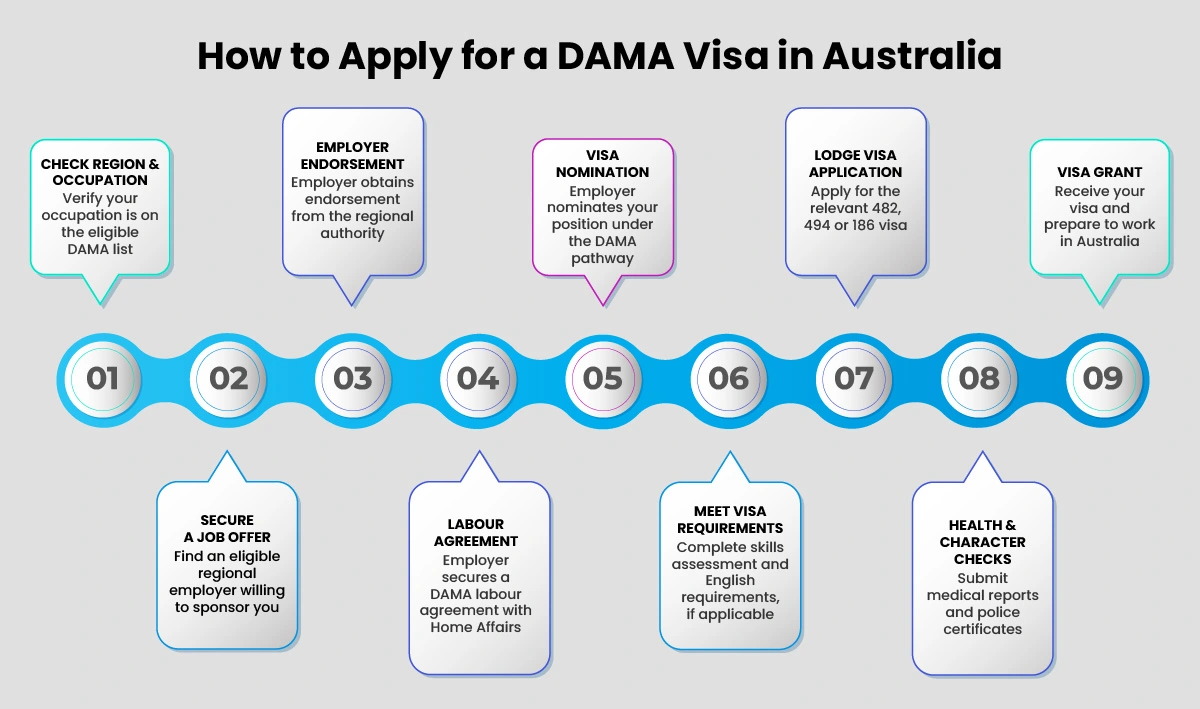
The DAMA visa application is a three-stage process: the employer gets endorsed, then nominates the position, and finally the applicant lodges the visa.
Here are the steps to apply for an Australian DAMA visa:
Step 1: Check the Regional DAMA and Occupation List
Identify the DAMA covering the region where you plan to work and confirm that your occupation, along with its ANZSCO code, appears on that region’s occupation list.
Step 2: Secure a Job Offer from an Eligible Employer
Find an employer in the DAMA region who is willing to sponsor you. Searching for jobs in Australia with visa sponsorship, and checking that the employer holds or is seeking DAMA endorsement, is the usual starting point.
Step 3: Employer Seeks Endorsement from the Regional Authority
The employer applies to the designated area representative for endorsement, showing that the position is genuine and that they could not fill it locally. The regional authority then issues an endorsement letter.
Step 4: Employer Becomes an Approved Sponsor
If not already approved, the employer applies to the Department of Home Affairs to become a standard business sponsor.
Step 5: Employer Lodges the Nomination
The employer submits a nomination for the position through the Department of Home Affairs, along with the DAMA endorsement.
Step 6: Complete Skills and English Assessments
Obtain a skills assessment if required for your occupation, and take an approved English language test.
Step 7: Lodge the Visa Application
Submit your visa application online through ImmiAccount, either as a Skills in Demand visa (subclass 482) DAMA or an Employer Nomination Scheme (subclass 186) DAMA, with all supporting documents attached.
Step 8: Complete Health and Character Checks
Undergo the required health examinations and provide police clearance certificates when requested.
Step 9: Wait for the Decision and Receive the Grant
Once approved, you will receive a visa grant notice with your visa conditions. You can then travel to Australia and begin work with your sponsoring employer.
DAMA Visa Australia Fees
The cost of a DAMA Visa Australia application includes two main components: government visa application charges and regional endorsement fees. There is no separate DAMA visa fee charged by the Department of Home Affairs, as applicants under a Designated Area Migration Agreement (DAMA) pay the standard visa application charges for their respective visa subclass.
From 1 July 2026, the Australia DAMA visa cost for a Skills in Demand (subclass 482) visa is AUD 4,015. The visa application charges for subclasses 186 and 494 have increased from AUD 4,910 to AUD 6,140.
For a subclass 482 DAMA visa application, each additional adult applicant pays AUD 4,015, while each dependent child under 18 pays AUD 1,005.
In addition to the visa application fee, the sponsoring employer must cover other DAMA sponsorship costs, including the AUD 420 sponsorship application fee, a nomination charge and the Skilling Australians Fund (SAF) levy.
Many regional authorities also charge a Designated Area Representative (DAR) endorsement fee as part of the DAMA application process. This fee varies by region and may be nil in some areas.
Applicants planning to work in Australia through the DAMA visa from India should budget for all these expenses together. Visa application charges are generally non-refundable if the application is refused or withdrawn.
Australia DAMA Visa Processing Time
Australia Visa Processing Time for a DAMA depends on four stages: endorsement by the regional authority, approval of the employer’s labour agreement, nomination and the worker’s visa decision. The Department of Home Affairs publishes processing times only for the visa stage and does not publish a processing time for labour agreement requests.
The Australia DAMA visa processing time varies depending on the labour agreement stream. For the visa itself, the processing timelines are:
Subclass 482 Labour Agreement Stream: 50% of applications are decided within 6 months and 90% within 10 months.
Subclass 494 Labour Agreement Stream: 50% of applications are decided within 86 days and 90% within 13 months.
Subclass 186 Agreement Pathway: 50% of applications are decided within 44 days and 90% within 13 months.
Regional endorsement is usually the quickest step, and one migration agency estimates it takes about 2 to 4 weeks, depending on the region.
Because labour agreement approval and nomination come before the visa decision, most applicants should plan for an overall Australia DAMA visa processing time of about 6 to 12 months, although some cases take longer. Complete documents, accurate employer details and quick replies to Home Affairs requests are the best ways to keep the processing time on the shorter side.
Conclusion
DAMA Visa Australia is not a single visa. It is a regional labour agreement pathway, and it gives skilled and semi-skilled workers a route into Australia when their occupation, age, English level or salary may not fit standard skilled visas. Success depends on the details: the region’s occupation list, the employer’s endorsement and labour agreement, and the visa subclass used (482, 494 or 186), along with the fees, processing time and PR pathway involved. Rules and concessions differ from one region to the next and are reviewed regularly, so always check the current terms on the Department of Home Affairs DAMA page before you apply.
If you are planning a DAMA Visa Australia application, CanApprove can review your occupation, target region and employer eligibility, and guide you through each stage with confidence.