




Australia remains a top choice for Indian skilled workers, students, professionals, and families seeking improved career prospects, quality education, higher living standards, and pathways to permanent residency; if you’re wondering how to migrate to Australia from India, the process requires careful planning: choose the right visa, verify eligibility, prepare documentation, meet English language requirements, and complete skills assessments where needed. This guide explains the essential requirements, a step-by-step process, and key considerations Indian applicants should know before starting their migration journey.
Table Of Content
1Is it worth moving to Australia from India?2Australia Visa Requirements for Indian Citizens3How to Migrate to Australia from India4Conclusion5Frequently Asked Questions
Is it Worth moving to Australia from India?
Yes, Australia is worth moving to for many Indians, especially skilled professionals, students, and families seeking better career growth, higher living standards, and long-term settlement opportunities.
Some of the main benefits of migrating to Australia include:
- Strong job opportunities in sectors such as healthcare, IT, engineering, construction, education, and trades.
- Higher salary potential compared to many job markets in India.
- Permanent Residency pathways for eligible skilled workers and their families.
- Good quality of life with access to healthcare, education, safety, and public services.
- Multicultural environment with a large Indian community across major Australian cities.
- Career growth opportunities in a stable and well-developed economy.
However, before planning your move, it is important to check your visa eligibility, occupation demand, skill assessment requirements, English language score, and financial readiness.
Australia Visa Requirements for Indian Citizens
When planning how to migrate to Australia from India, understanding the visa requirements is one of the first steps.
Australian visa requirements for Indian citizens vary by visa type, purpose of travel, and applicant profile, but most categories require common documents and eligibility checks before applying.
1. Valid Passport
A valid Indian passport is required to apply for an Australian visa. Make sure your passport is active, has enough validity, and is in good condition before submitting your application.
2. Age Requirement
For skilled migration visas, applicants are generally required to be under 45 years of age at the time of invitation. Age rules may differ based on the visa subclass.
3. English Language Proficiency
Many Australian visa pathways require proof of English language ability. Applicants may need to take accepted English Language Tests for Australia such as IELTS, PTE Academic, TOEFL iBT, or other approved tests.
4. Skills Assessment
For skilled migration, applicants usually need a positive Australian Skill Assessment from the relevant assessing authority. This confirms that their education, skills, and work experience meet Australian standards.
5. Health Requirements
Most applicants must meet Australia’s health requirements. This may include completing a medical examination through an approved panel physician.
6. Character Requirements
Applicants may need to provide police clearance certificates or other documents to prove they meet Australia’s character requirements.
7. Financial Requirements
Some visa categories require proof of sufficient funds to support yourself and your family members during your stay in Australia.
8. Supporting Documents
Applicants must submit required documents such as identity proof, educational certificates, employment records, English test results, and other documents based on the visa subclass.
9. Visa-Specific Eligibility
Each Australian visa has its own eligibility criteria. These may include occupation demand, Australia ANZSCO Code, work experience, sponsorship, study plans, or points requirements depending on the visa type.
How to Migrate to Australia from India
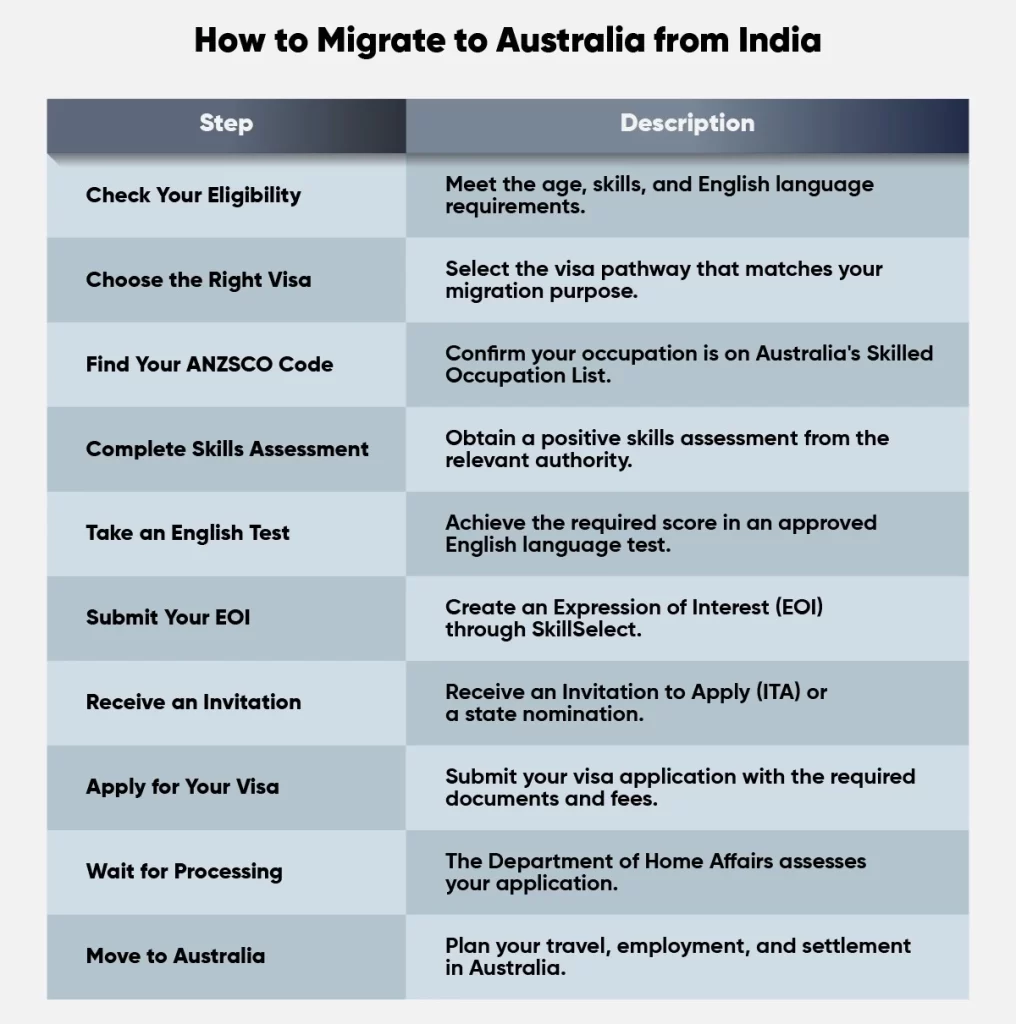
Here is a step-by-step process to migrate to Australia from India:
Step 1: Check Your Eligibility
The first step is to understand whether you qualify for an Australian visa. Your eligibility may depend on factors such as:
- Age
- Education
- Work experience
- English language ability
- Occupation
- Health and character requirements
- Visa subclass requirements
For skilled migration, your occupation should usually be listed under Australia’s relevant skilled occupation list.
Step 2: Choose the Right Australia Visa
Select a visa pathway based on your reason for moving to Australia. Skilled workers, students, family members, business owners, and sponsored employees may need different visa subclasses.
| Visa Type | Who It Is For |
|---|---|
| Skilled Migration Visa | Skilled professionals with eligible occupations and points-based profiles |
| Employer-Sponsored Visa | Applicants with sponsorship or a job offer from an Australian employer |
| Student Visa | Students planning to study in Australia |
| Family Visa | Applicants joining eligible family members in Australia |
| Business or Investor Visa | Entrepreneurs or investors planning business activity in Australia |
Step 3: Check Your Occupation and ANZSCO Code
If you are applying through a skilled migration pathway, check whether your occupation is eligible and identify the correct Australia ANZSCO Code. This helps determine:
- Which visa options may be available
- Which assessing authority will review your profile
- Whether your occupation matches current Australian labour needs
This step is especially important for applicants exploring In Demand Jobs in Australia or planning to Get a Job in Australia from India.
Step 4: Complete Your Skills Assessment
When planning How to Migrate to Australia from India, most skilled migration visas require a positive Australian Skill Assessment from the relevant assessing authority. The assessment checks whether your qualifications, work experience, and skills meet Australian standards for your nominated occupation.
The assessing authority may ask for:
- Educational certificates
- Employment documents
- Role descriptions
- Professional licences, if required
- Identity documents
Step 5: Take an English Language Test
Many applicants must prove their English language ability through an accepted test. Common options include IELTS, PTE Academic, TOEFL iBT, and other approved tests.
Applicants often choose PTE for Australia Immigration because it is widely accepted for many visa subclasses. However, the required score may vary depending on the visa type and points requirement.
Step 6: Submit an Expression of Interest
For points-tested skilled visas, you are to submit an Expression of Interest through SkillSelect. This allows Australian authorities and state or territory governments to review your profile for possible invitation or nomination.
Your EOI should include accurate details about your:
- Age
- Qualifications
- Work experience
- English score
- Skills assessment
- Nominated occupation
Step 7: Receive an Invitation or Nomination
After submitting your EOI, you may receive an invitation to apply if your profile meets the required criteria. Some visa pathways may also require nomination from an Australian state or territory.
The invitation depends on factors such as your points score, occupation demand, visa subclass, and available places.
Step 8: Apply for the Visa
Once invited, submit your visa application with all required documents. Make sure the information in your application matches your EOI, skills assessment, English test result, and supporting documents.
You may also need to complete health checks, provide police clearance certificates, and pay the visa application fee.
Step 9: Wait for the Visa Decision
After submission, the Department of Home Affairs will assess your application. Processing times can vary depending on the visa subclass, document accuracy, background checks, and application volume.
If approved, you can plan your travel, settlement, job search, and long-term pathway toward Australian Citizenship, where eligible.
Step 10: Move to Australia
Once your visa is approved, you can begin planning your move to Australia by arranging travel, accommodation, and key documents. After arrival, you can settle in, start your job search, and work toward long-term goals such as permanent residency or Australian citizenship.
Conclusion
Understanding How to Migrate to Australia from India is important before starting your visa journey. From checking your eligibility and choosing the right visa to completing skills assessment, English language testing, document preparation, and final visa submission, every step must be planned carefully.
Australia continues to attract Indian skilled workers, students, professionals, and families because of its career opportunities, quality of life, and long-term settlement options. To avoid mistakes, always check the latest visa rules, eligibility criteria, processing details, and official updates before applying.
For accurate and updated information, visit the official website of the Australian Department of Home Affairs.