




Australia’s healthcare system is globally respected for its advanced cardiac care facilities and perfusionists in Australia play a crucial role in this ecosystem.. With rising cases of cardiovascular disease and an aging population, Australia continues to invest heavily in cardiac surgery and critical care services. This has created strong long-term demand for skilled perfusionists, especially in major hospitals across metropolitan regions.
In this guide, we explain about the demand, how to become a perfusionist in Australia, registration and recognition requirements, salary expectations, top hiring locations, and PR prospects clearly and step by step.
Table Of Content
1Who Is a Perfusionist?2Are perfusionists in high demand in Australia?3Roles and Responsibilities of Perfusionists4Eligibility Requirements to Work as a Perfusionist in Australia5Registration and Professional Recognition in Australia6How to Become a Perfusionist in Australia (Step-by-Step)7Salary of Perfusionists in Australia8Top Cities and States Hiring Perfusionists9Conclusion10Frequently Asked Questions
Who Is a Perfusionist?
A perfusionist is a specialized healthcare professional who operates heart-lung bypass machines and other extracorporeal equipment during cardiac surgery and critical care procedures. They play a critical role in maintaining a patient’s circulation and oxygenation while the heart is stopped for surgery.
Are perfusionists in high demand in Australia?
Yes, perfusionists are in demand in Australia, but it’s important to understand the nature of this demand.
Specialised but essential role
Perfusionists are critical to cardiac surgery and ECMO services. Hospitals performing open-heart surgeries cannot operate without them.
Steady demand in major hospitals
Demand exists mainly in large tertiary and teaching hospitals across Australia, where advanced cardiac and critical care services are available.
Limited workforce, fewer trained professionals
The number of qualified perfusionists in Australia is small, and training positions are limited, which increases the value of experienced professionals.
Growing need due to an aging population
Rising cardiovascular diseases and increased cardiac procedures continue to support long-term demand for perfusionists.
Favourable for experienced and certified professionals
Hospitals actively seek perfusionists with recognised certification and hands-on experience.
Trainee positions are highly competitive, but once qualified, perfusionists enjoy strong job stability and retention.
Not a mass-recruitment occupation
Demand is focused and specialised, unlike nursing or general allied health roles.
However, this is not a mass-recruitment occupation like nursing. Competition is high at the entry level, especially for trainee positions. Once certified and experienced, perfusionists generally enjoy strong job stability, attractive salaries, and long-term career security.
Roles and Responsibilities of Perfusionists
Perfusionists are highly specialised healthcare professionals who support cardiac surgery and critical care teams. Their role requires technical expertise, clinical judgement, and constant vigilance during life-support procedures.
Key roles and responsibilities include:
Operating the heart-lung machine
Manage cardiopulmonary bypass during open-heart surgeries by controlling blood circulation, oxygenation, and body temperature.
Maintaining patient physiology
Monitor and regulate blood pressure, blood gases, electrolytes, anticoagulation levels, and flow rates throughout surgery.
ECMO and life-support management
Set up, operate, and monitor Extracorporeal Membrane Oxygenation (ECMO) systems for critically ill patients in ICU and emergency settings.
Preparing and maintaining perfusion equipment
Assemble, test, and troubleshoot heart-lung machines, circuits, oxygenators, and related equipment before and during procedures.
Medication and blood product management
Administer anticoagulants and other medications, manage blood products, and ensure safe transfusion practices during bypass.
Supporting surgical and anaesthetic teams
Work closely with surgeons, anaesthetists, and nurses to ensure smooth coordination during complex cardiac procedures.
Ensuring patient safety and infection control
Follow strict clinical protocols, safety checks, and sterile techniques to minimise risk and complications.
Emergency response and critical decision-making
Act quickly during surgical emergencies, equipment failure, or sudden changes in patient condition.
Documentation and reporting
Accurately record perfusion data, procedures performed, and patient responses for legal, clinical, and audit purposes.
Continuing professional development
Maintain skills and certification through ongoing training, research involvement, and adherence to professional standards.
Curious about other opportunities in Australian healthcare? Check out our comprehensive list of in-demand healthcare jobs in Australia to plan your career path.
Eligibility Requirements to Work as a Perfusionist in Australia
Becoming a perfusionist in Australia requires a mix of formal education, clinical training, certification, and (for international professionals) skills assessment. Here’s a clear breakdown of the eligibility criteria:
1. Educational Qualifications
Bachelor’s Degree (Minimum): A relevant undergraduate degree in:
- Biomedical Science
- Medical/Health Science
- Life Sciences
- Allied Health
Other science degrees with strong anatomy, physiology, and clinical components may also be considered.
2. Specialty Clinical Training
Trainee Perfusionist Position: Entry into the profession typically requires securing a clinical trainee role in a recognised hospital or perfusion training program.
These positions provide practical, supervised experience with cardiac bypass and extracorporeal support systems.
3. Professional Certification
Australasian Board of Cardiovascular Perfusion (ANZBP): After completing formal training and clinical case requirements, candidates must obtain ANZBP certification:
- Certificate of Clinical Perfusion
- This certification is widely recognised by employers and is considered the standard professional credential for perfusionists in Australia and New Zealand.
4. Clinical Experience Requirements
Supervised Case Log Book: Trainee perfusionists must complete and document a prescribed number of supervised clinical cases, including:
- Cardiopulmonary bypass procedures
- ECMO (Extracorporeal Membrane Oxygenation)
- Other related perfusion procedures
These cases must be logged under accredited supervision as part of the certification process.
5. Skills Assessment (for International Candidates)
If you completed your training outside Australia or New Zealand, a formal skills assessment is required from the relevant Australian assessing authority (commonly VETASSESS or another recognised allied health body):
- Qualification equivalence assessment
- Clinical competence evaluation
- English language proficiency (if required)
6. English Language Proficiency
Most employers and assessing authorities require proof of English proficiency to ensure safe and effective communication in high-risk clinical environments:
- IELTS (International English Language Testing System)
- OET (Occupational English Test)
- PTE (Pearson Test of English)
This requirement helps confirm a candidate’s ability to communicate clearly with multidisciplinary healthcare teams and patients.
7. Continued Professional Development
Certified perfusionists must engage in ongoing learning and professional development to maintain certification and stay up to date with clinical best practice.
Registration and Professional Recognition in Australia
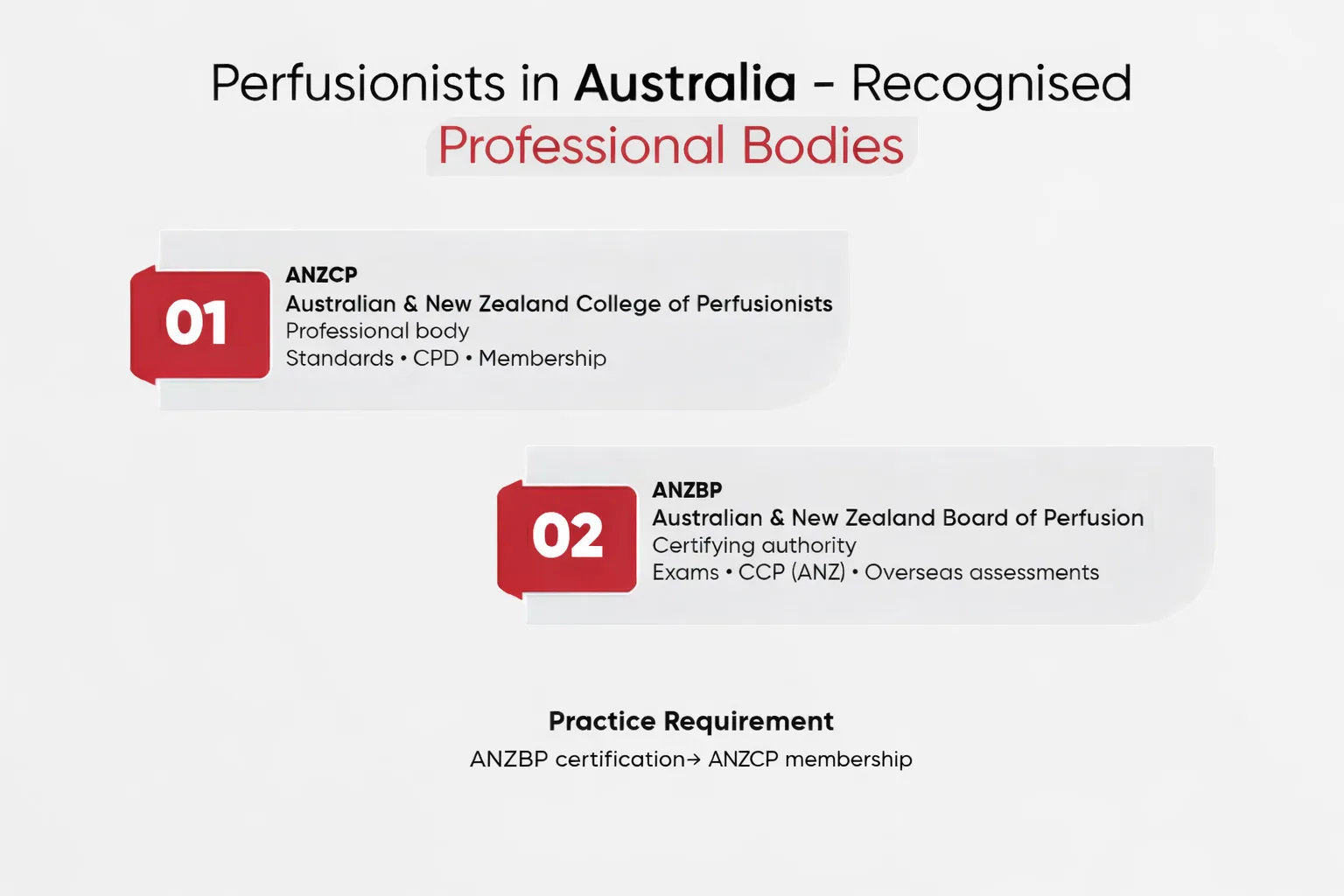
Unlike doctors or nurses, perfusionists are not regulated by AHPRA in Australia. However, professional recognition is still essential.
Key Regulatory & Professional Bodies
- Australian and New Zealand College of Perfusionists (ANZCP)
- Australian and New Zealand Board of Perfusion (ANZBP)
Is Registration Mandatory?
- Government registration is not mandatory
- ANZCP / ANZBP certification is essential for employment in Australian hospitals
Why Certification Matters
Most public and private hospitals require:
- Recognised perfusion education
- Supervised clinical experience
- Board certification (Certificate of Clinical Perfusion)
- Ongoing Continuing Professional Development (CPD)
Without ANZCP/ANZBP recognition, employment opportunities are extremely limited.
How to Become a Perfusionist in Australia (Step-by-Step)
Step 1: Complete a Relevant Bachelor’s Degree
You must hold a degree in:
- Biomedical Science
- Medical Science
- Health Science
- Life Sciences (with anatomy & physiology)
Step 2: Secure a Trainee Perfusionist Position
This is a critical step in becoming a perfusionist in Australia:
- Training is hospital-based
- Positions are limited and highly competitive
- Usually offered by major cardiac hospitals
Step 3: Enrol in an Accredited Perfusion Training Program
Once selected as a trainee, you must enrol in an accredited perfusion training pathway:
- Often delivered as a postgraduate qualification
- Combines academic coursework with supervised clinical practice
- Typical training duration: 2–3 years
Step 4: Complete Clinical Case Requirements
You must successfully document and complete supervised clinical cases, including:
- A required number of cardiopulmonary bypass cases
- ECMO and advanced perfusion procedures
- Formal supervised assessments
Step 5: Pass ANZBP Board Examinations
After meeting training and clinical requirements:
- Successful candidates are awarded the Certificate of Clinical Perfusion
- Professional recognition as a qualified perfusionist
Important for International Candidates:
Direct entry into Australian training programs is difficult without PR or citizenship. Overseas-trained perfusionists may be required to undergo additional supervised training and assessment.
Salary of Perfusionists in Australia
Perfusionists are among the highest-paid allied health professionals in Australia.
Average Salary Range
- AUD 110,000 – AUD 160,000 per year
- Average national salary: ~AUD 130,000 annually
Salary Depends On:
- Years of experience
- Type of hospital (public vs private)
- Advanced skills (ECMO, pediatric perfusion)
- Location and state health awards
Senior perfusionists and team leaders can earn significantly higher packages, especially in metropolitan hospitals.
Top Cities and States Hiring Perfusionists
Perfusionist jobs are concentrated in hospitals offering cardiac surgery services.
Major Hiring Locations
| State | Major Hiring City |
| New South Wales | Sydney |
| Victoria | Melbourne |
| Queensland | Brisbane |
| Western Australia | Perth |
| South Australia | Adelaide |
Most opportunities exist in:
- Large public tertiary hospitals
- Private cardiac specialty hospitals
- Teaching and research hospitals
Regional demand is limited due to the specialised nature of cardiac surgery.
Conclusion
Perfusionists in Australia occupy a highly specialised, well-respected, and well-paid healthcare role. While the pathway is demanding, the career rewards include strong job stability, excellent salaries, and opportunities to work with cutting-edge cardiac technology.
For international perfusionists, Australia offers long-term career potential but professional recognition, certification, and visa planning are critical. With the right guidance and credentials, this profession can open doors to both employment and permanent residency.



I need a perfusionist job in australia
I am a fresher but iam quick learn.
Hi Srinivas,
Thank you for reaching out and for your interest.
We are an immigration consultancy and do not offer direct job opportunities.
We can guide you through the right immigration pathways and help you explore opportunities in your field.
Please share your qualifications and experience, and we’ll assist you further. BOOK A FREE CONSULTATION NOW!
I want to know when is the intake in the college (planning for msc) and are they providing scholarship??