




Canada’s immigration strategy is changing and French language skills are now one of the biggest advantages in the Express Entry system. With targeted Canada French Draws, candidates with French proficiency are receiving invitations at much lower CRS scores than general Express Entry draws.
Table Of Content
1What Are Canada Express Entry French Draws?2French Draws in Canada 20253Why French Draws Matter for Express Entry Candidates4Will French Draws Continue in 2026?5French Language Proficiency Draw Requirements for Express Entry6How French Skills Boost Your CRS Score7Pros and Limitations of French Draws8How to Prepare for a French Draw9Conclusion10Frequently Asked Questions
So, is learning French really worth it in 2026? Let’s break it down.
What Are Canada Express Entry French Draws?
Canada Express Entry French Draws are category-based invitation rounds introduced by IRCC to attract French-speaking skilled workers outside Quebec.
Under these targeted draws:
- Candidates must demonstrate strong French language proficiency
- Invitations are issued separately from general Express Entry draws
- CRS cut-off scores are usually much lower than regular draws
These draws aim to strengthen Francophone communities across Canada, especially in provinces like Ontario, New Brunswick, Manitoba, and Alberta.
French Draws in Canada 2025
In 2025, Express Entry French draws became one of the most consistent and favourable categories. Immigration, Refugees and Citizenship Canada (IRCC) conducted 9 French-language proficiency draws, inviting thousands of candidates from the Express Entry pool.
Here’s a summary of the French draws held in 2025:
| # | Draw Date | Invitations Issued | CRS of Lowest-Ranked |
|---|---|---|---|
| 337 | Feb 19, 2025 | 6,500 | 428 |
| 339 | Mar 6, 2025 | 4,500 | 410 |
| 341 | Mar 21, 2025 | 7,500 | 379 |
| 360 | Aug 8, 2025 | 2,500 | 481 |
| 365 | Sep 4, 2025 | 4,500 | 446 |
| 371 | Oct 6, 2025 | 4,500 | 432 |
| 376 | Oct 29, 2025 | 6,000 | 416 |
| 382 | Nov 28, 2025 | 6,000 | 408 |
| 388 | Dec 17, 2025 | 6,000 | 399 |
One of the biggest highlights of French draws in Canada 2025 is the consistently lower CRS requirement.
- The lowest CRS score recorded was 379, which is far below typical general Express Entry cut-offs.
- Even when CRS temporarily increased mid-year, it stabilised again below 420 towards the end of 2025.
This trend clearly shows that French language proficiency can significantly improve your chances of receiving an Invitation to Apply (ITA), even if your CRS score is not competitive in general draws.
Most French draws in 2025 issued 4,500 to 7,500 invitations, indicating Canada’s continued commitment to attracting French-speaking immigrants outside Quebec. Compared to other category-based draws, French proficiency rounds consistently offered higher invitation volumes, making them one of the most accessible Express Entry pathways.
For many applicants, French proficiency Canada PR pathways proved faster and more realistic than waiting for general draws.
Why French Draws Matter for Express Entry Candidates
French-language proficiency draws are especially beneficial for candidates who:
- Have CRS scores below 450
- Do not have a job offer or provincial nomination
- Are strong in French or bilingual (French + English)
Additionally, candidates with NCLC 7+ in French and CLB 5+ in English can earn up to 50 additional CRS points, further strengthening their Express Entry profile.
Will French Draws Continue in 2026?
Yes!! All signs strongly point to French draws continuing in 2026. Do you need to know why?
It is because:
- Canada has officially committed to increasing Francophone immigration outside Quebec
- Labour shortages in bilingual regions are growing
- French draws help Canada meet regional immigration targets
If anything, French draws are expected to become more frequent and more strategic in 2026.
French Language Proficiency Draw Requirements for Express Entry
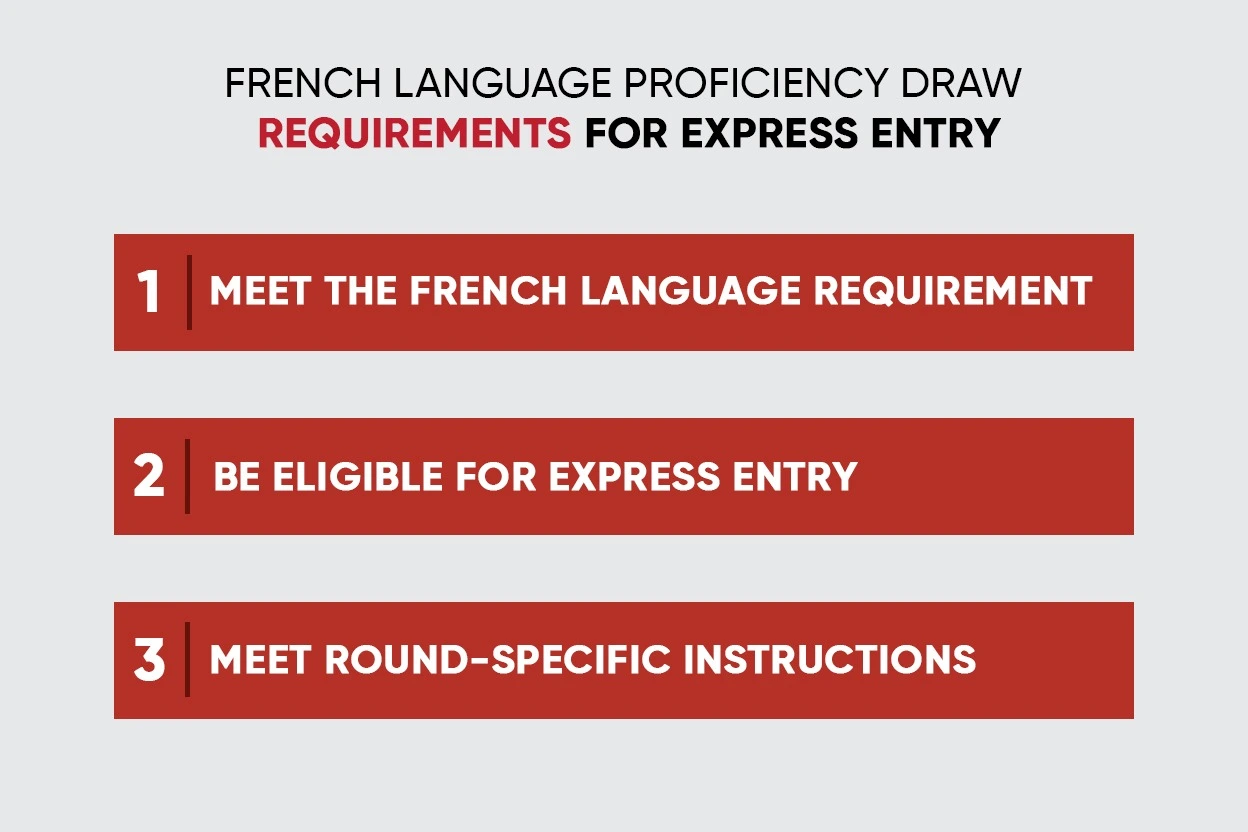
To qualify for Express Entry French draws, candidates must:
1. Meet the French language requirement
- Prove French as their first official language
- Score at least NCLC 7 in all four abilities:
- Reading
- Writing
- Listening
- Speaking
Accepted French Tests are:
- TEF Canada
- TCF Canada
2. Be eligible for Express Entry
You must already qualify for one of these programs:
- Federal Skilled Worker (FSW)
- Canadian Experience Class (CEC)
- Federal Skilled Trades (FST)
French alone is not enough. Express Entry eligibility is mandatory.
3. Meet round-specific instructions
Each French draw may have additional conditions (cut-off CRS score, date of profile creation, etc.). These are announced with every draw.
For 2026 applicants, TEF Canada 2026 preparation is especially important, as scoring well can dramatically change CRS outcomes.
How French Skills Boost Your CRS Score
French language proficiency can significantly increase your Comprehensive Ranking System (CRS) score under Canada’s Express Entry system. In fact, strong French skills can add up to 50 additional CRS points, making French one of the most powerful factors for improving your Express Entry ranking, especially for candidates with otherwise moderate scores.
If French is your strongest language, you can claim it as your first official language in Express Entry. Higher scores in French can earn substantial core human capital points across all four language abilities:
- Listening
- Speaking
- Reading
- Writing
Candidates who score NCLC 7 or higher in all four skills can gain a strong base CRS score, which directly improves their overall ranking in the Express Entry pool.
Even if English is your primary language, adding French as a second official language can still boost your CRS score. Candidates who achieve at least NCLC 5 in all four French abilities can earn additional CRS points under the second-language category.
This makes French a valuable option for applicants who already meet English language requirements but are looking for ways to improve their CRS without relying on a job offer or provincial nomination.
Additional CRS Points for Bilingual Candidates
One of the biggest CRS advantages comes from Canada’s French–English bilingualism bonus. Candidates can earn:
- Up to 50 extra CRS points if they score NCLC 7 or higher in French and
- CLB 5 or higher in English
These bonus points are separate from core language points and often make the difference between remaining in the pool and receiving an Invitation to Apply (ITA).
Pros and Limitations of French Draws
French-language proficiency draws under Canada’s Express Entry system have opened new opportunities for skilled workers aiming for Canadian permanent residence. While these draws offer significant advantages, it is equally important to understand their limitations before planning your immigration strategy.
Pros
- Lower CRS cut-offs
- Less competition compared to general draws
- No job offer required
- Works well with PNPs and spousal points
- Strong future relevance (2026 and beyond)
Limitations
- Requires genuine French proficiency
- Preparation time for TEF/TCF
- Not applicable to Quebec PR
- Test scores must be well-balanced across all abilities
French draws are not “easy”, but they are strategic.
How to Prepare for a French Draw
If you’re planning Canada PR in 2026, here’s a smart approach:
1. Start French early (A1 → B2 progression)
2. Focus on NCLC 7+ across all modules
3. Choose the right test: TEF Canada or TCF Canada
4. Combine French with:
- Express Entry profile optimisation
- PNP strategies
- Spousal CRS points (if applicable)
5. Avoid refusals with proper documentation and profile review.
Conclusion
Even if your English score is not very high, strong French language proficiency alone can make you competitive in French-language Express Entry draws. With consistently lower CRS cut-offs and high invitation numbers, French continues to be a powerful advantage for Canada PR aspirants.
At CanApprove, we help you turn this opportunity into reality through our dedicated French language classes, specially designed for immigration applicants. Our expert-led program focuses on TEF Canada and TCF Canada preparation, improving all four language skills, and strategically boosting your CRS score to enhance your Express Entry profile.
As 2026 is expected to remain a strong year for French-proficient candidates, now is the right time to invest in your future. Whether you’re starting from scratch or aiming to improve your scores, CanApprove is here to guide you at every step of your Canada PR journey. Learning French could be the key to faster Canadian permanent residence, don’t miss this opportunity to get ahead.