




Canada is witnessing a significant surge in mental health needs, making psychiatry one of the most in-demand medical professions today. From rising awareness of mental health issues to an aging population and post-pandemic challenges, the demand for psychiatrists in Canada has never been higher. As a result, psychiatry has emerged as a stable, well-paid, and future-proof career, especially for internationally trained medical professionals.
This blog explores why psychiatrists are in high demand, where opportunities are strongest, eligibility requirements, salary expectations, and immigration pathways to Canada.
Table Of Content
1Are Psychiatrists in High Demand in Canada?2Reasons Behind the High Demand for Psychiatrists in Canada3Provinces with the Highest Demand for Psychiatrists4Eligibility Requirements to Work as a Psychiatrist in Canada5How to Become a Psychiatrist in Canada?6Salary of Psychiatrists in Canada7New Express Entry Category for Physicians with Canadian Work Experience (2026 Update)8Medical Occupations Included in the New Category9Frequently Asked Questions
Are Psychiatrists in High Demand in Canada?
Yes, psychiatrists are highly sought after across Canada. Multiple reports from Canadian health authorities confirm a psychiatrist shortage in Canada, particularly in rural regions and smaller provinces. Long waiting times for mental health consultations often stretching from months to over a year clearly reflect the supply-demand gap.
With mental health now a national healthcare priority, psychiatrist jobs in Canada are consistently listed under high-demand healthcare occupations.
Reasons Behind the High Demand for Psychiatrists in Canada
Several factors contribute to the growing demand for mental health professionals in Canada:
1. Rising Mental Health Awareness
Canadians are increasingly seeking professional help for conditions such as depression, anxiety, bipolar disorder, PTSD, and schizophrenia. This has sharply increased the demand for psychiatrists and psychologists.
2. Post-Pandemic Mental Health Crisis
The COVID-19 pandemic triggered widespread mental health challenges, accelerating the need for mental health jobs in Canada, especially psychiatry.
3. Aging Population
Canada’s aging population requires specialized psychiatric care for dementia, Alzheimer’s, and age-related mental health conditions.
4. Retirement of Existing Psychiatrists
A large portion of Canada’s psychiatrist workforce is nearing retirement, worsening the psychiatrist shortage in Canada.
5. Limited Local Graduates
Despite high demand, the number of psychiatry graduates each year is not sufficient—creating strong opportunities for internationally trained doctors.
Provinces with the Highest Demand for Psychiatrists
The provinces with the highest demand for psychiatrists in Canada over the next three years are New Brunswick, Newfoundland and Labrador, Nova Scotia, Prince Edward Island, and Saskatchewan, all rated with very good job prospects. Provinces such as Ontario, Alberta, British Columbia, Manitoba, and Quebec show good demand. Demand is driven by psychiatrist shortages and expansion of mental health services.
Job Prospects for Psychiatrists by Province (Next 3 Years as per Job Bank)
| Province / Territory | Job Prospect Rating | Demand Level |
| New Brunswick | ⭐⭐⭐⭐⭐ | Very Good |
| Newfoundland and Labrador | ⭐⭐⭐⭐⭐ | Very Good |
| Nova Scotia | ⭐⭐⭐⭐⭐ | Very Good |
| Prince Edward Island | ⭐⭐⭐⭐⭐ | Very Good |
| Saskatchewan | ⭐⭐⭐⭐⭐ | Very Good |
| Alberta | ⭐⭐⭐⭐ | Good |
| British Columbia | ⭐⭐⭐⭐ | Good |
| Manitoba | ⭐⭐⭐⭐ | Good |
| Ontario | ⭐⭐⭐⭐ | Good |
| Quebec | ⭐⭐⭐⭐ | Good |
| Northwest Territories | — | Undetermined |
| Nunavut | — | Undetermined |
| Yukon | — | Undetermined |
Many provinces actively recruit internationally educated psychiatrists through targeted programs.
Eligibility Requirements to Work as a Psychiatrist in Canada
According to Canada’s National Occupational Classification (NOC), psychiatrists fall under NOC 31101 – Specialist Physicians, a key reference point for assessing eligibility under Canadian immigration programs. To work as a psychiatrist in Canada, candidates must meet the standard employment requirements applicable to Specialist Physicians (NOC 31100). These requirements cover education, medical training, certification, and licensing.
Here’s what you typically need:
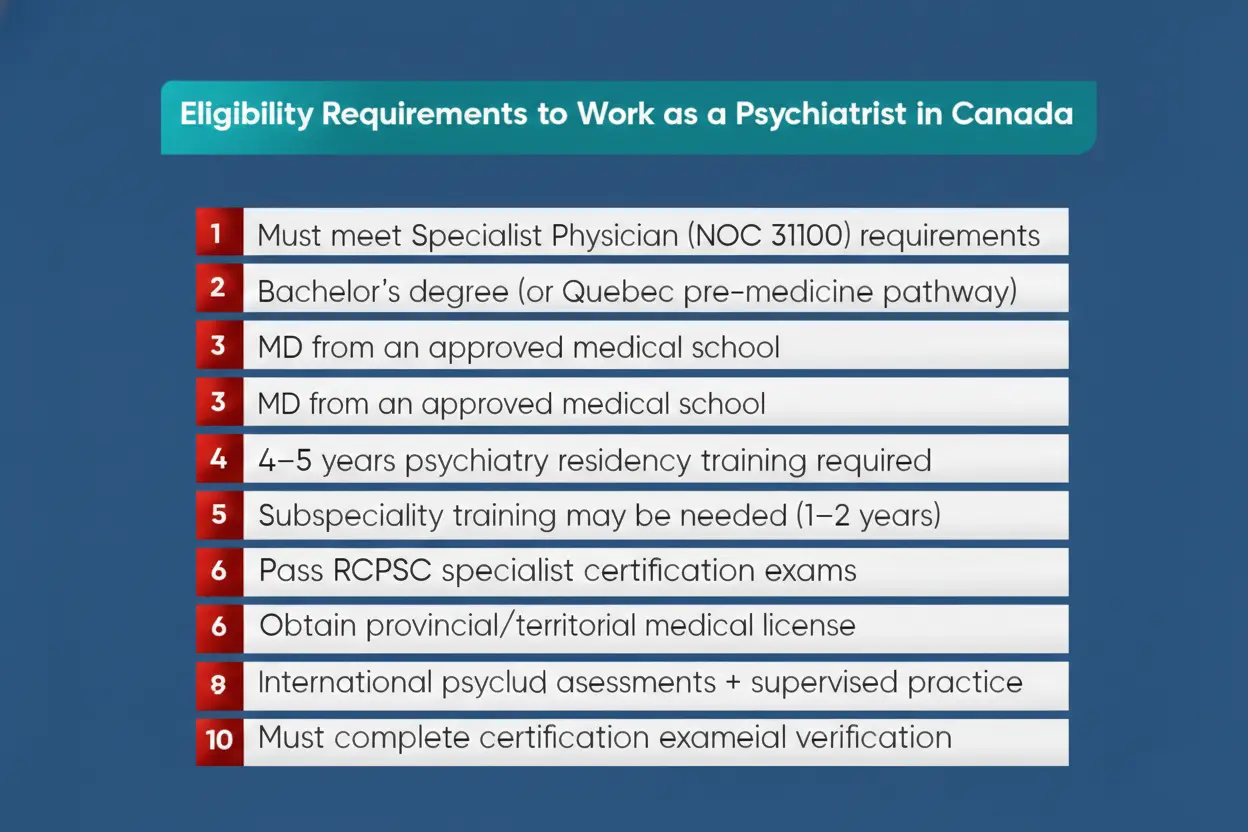
Educational Background
- A bachelor’s degree is generally required before entering medical school
- In Quebec, candidates may complete a college program followed by one year of pre-medicine university studies instead of a standard bachelor’s degree pathway
- You must graduate from an approved medical school
Medical and Specialty Training
- Completion of specialty training in psychiatry is mandatory
- For clinical medicine specialties such as psychiatry, four to five years of specialty residency training is required
- In some cases, an additional two years of subspecialty training may be required depending on the role and practice area
Certification Requirements
- You must complete the certifying examinations conducted by the Royal College of Physicians and Surgeons of Canada (RCPSC)
- This certification is essential to be recognized as a specialist physician in Canada
Licensing Requirements
- You must obtain a license from the provincial or territorial medical regulatory authority where you intend to practice
- Licensing is mandatory in all provinces and territories and may include additional assessments or supervised practice periods
Each province has its own regulatory authority, such as the College of Physicians and Surgeons of Ontario, British Columbia, or Alberta. These bodies evaluate qualifications, conduct assessments, and issue licenses to eligible candidates.
Internationally trained psychiatrists must usually complete credential verification, certification exams, and sometimes supervised practice before receiving full licensure.
How to Become a Psychiatrist in Canada?
To become a psychiatrist in Canada, you must complete medical education, specialty training in psychiatry, national certification, and provincial licensing. Here are the exact steps:
1. Complete a bachelor’s degree (pre-medical education).
2. Graduate from an approved medical school with an MD degree.
3. Finish 4–5 years of psychiatry residency training.
4. Pass required medical licensing exams (such as MCCQE).
5. Obtain certification from the Royal College of Physicians and Surgeons of Canada (RCPSC).
6. Get licensed by the provincial or territorial medical regulatory authority.
7. Meet language proficiency requirements (English or French).
Internationally trained psychiatrists must also complete credential verification and specialist assessment before receiving a license to practice.
Salary of Psychiatrists in Canada
The average salary of psychiatrists in Canada ranges widely by province and experience level. Nationally, annual wages typically range from CAD 126,000 to over CAD 600,000, with a median salary of about CAD 311,000 per year. Provinces such as Manitoba, Quebec, and British Columbia report some of the highest median earnings for psychiatrists.
Psychiatrist Salaries in Canada by Province (Annual)
| Province / Area | Low ($/year) | Median ($/year) | High ($/year) |
| Canada (Overall) | 126,465 | 311,297 | 607,184 |
| Alberta | 129,664 | 272,306 | 728,244 |
| British Columbia | 127,985 | 317,845 | 587,478 |
| Manitoba | 118,433 | 343,507 | 699,304 |
| New Brunswick | 149,979 | 335,358 | 518,119 |
| Newfoundland and Labrador | 114,972 | 303,112 | 535,328 |
| Nova Scotia | 182,271 | 207,046 | 476,596 |
| Ontario | 110,998 | 295,785 | 599,836 |
| Prince Edward Island | 103,834 | 318,714 | 473,486 |
| Quebec | 144,640 | 343,031 | 556,888 |
| Yukon Territory | 34,935 | 247,242 | 300,271 |
Additional benefits may include incentives, relocation bonuses, and flexible work schedules.
New Express Entry Category for Physicians with Canadian Work Experience (2026 Update)
Canada has introduced a new Express Entry category specifically for physicians with Canadian work experience, creating a faster and more competitive permanent residence (PR) pathway for eligible doctors, including psychiatrists in Canada.
Announced by IRCC in December 2025, this new category-based selection stream is designed to address physician shortages and strengthen Canada’s healthcare system. The first draws under this category are expected to begin in early 2026.
Because category-based Express Entry draws often have lower CRS cut-off scores, this pathway can significantly improve PR chances for qualified physicians.
Medical Occupations Included in the New Category
The new category covers selected physician occupations under the National Occupation Classification (NOC), including:
- Psychiatrists
- Pediatricians
- Dermatologists
- Other specialist physicians
- Certain general practitioners and medical specialists
This creates a direct Canada PR advantage for those already working in psychiatry jobs in Canada on valid authorization.



I am Dr Sunny Mathew p, aged 61 years, a senior consultant Psychiatrist from India, Kerala, Kasargod DT, with 12 years of experience in treating mentally ill patients,-
i was the Nodal officer of the District Mental program for nearly 10 years, worked in both Rural and Urban areas,
Now willing to work in the AREA OF NEED of CANADA, Nova Scotia, for a period of one year
Hi Dr. Sunny Mathew,
Thank you for sharing your profile. With your strong experience as a senior consultant psychiatrist and leadership in district mental health programs, you have excellent opportunities to apply for psychiatry roles in Canada, especially in Area of Need regions like Nova Scotia.
Your profile is highly relevant for recruitment consideration, subject to meeting the licensing requirements in Canada.
To understand your best pathway and current opportunities, you can connect with our immigration experts for a free consultation.