




Imagine a career where your nursing skills open doors to Canada’s stunning landscapes and world-class hospitals, where snow-dusted Rockies meet advanced ICUs. In 2026, over 60,000 nursing roles await due to an aging population and growing healthcare investments. Skilled professionals from India can access visa sponsorship, six-figure salaries, and a path to permanent residency. If you’re looking for nursing jobs in Canada for Indian nurses, whether as a Registered Nurse, LPN, or NP, your passion can turn into a maple-leaf future. Let’s dive in to the blog and explore how.
Table Of Content
1Types of Nursing Jobs in Canada2Nursing Jobs in Canada3Nursing Jobs in Canada with Visa Sponsorship4Nursing Salary in Canada5Nursing job in Canada Requirements6How to apply for Nursing Jobs in Canada8Conclusion9Frequently Asked Questions
Types of Nursing Jobs in Canada
Nursing Jobs in Canada include a wide range of roles from entry-level support to advanced practice, meeting diverse healthcare needs across hospitals, clinics, and communities.
Types of Nursing Jobs in Canada include:
- Registered Nurse (RN)
- Licensed Practical Nurse (LPN)/Registered Practical Nurse (RPN)
- Nurse Practitioner (NP)
- Registered Psychiatric Nurse (RPN)
- Nurse Aide/Health Care Assistant
- Personal Support Worker (PSW)
- Home Support Worker
- Critical Care/ICU Nurse
- Community Health Nurse
- Geriatric Nurse
Nursing Jobs in Canada
Nursing jobs in Canada offer diverse opportunities for skilled professionals, with high demand driven by an aging population, healthcare expansions, and persistent staffing shortages projected through 2026, making them some of the most In Demand Jobs in Canada.
1. Registered Nurse (RN)
Registered Nurses (RNs) are essential pillars of Canada’s healthcare system, providing direct patient care, coordinating treatments, and ensuring patient safety across various settings. High demand stems from an aging population, healthcare expansions, and chronic staffing shortages expected to persist through 2026. They work in hospitals, clinics, long-term care facilities, and community health centers.
Registered Nurse Job Description
- Perform patient assessments and develop individualized care plans.
- Administer medications, IVs, and assist in procedures.
- Collaborate with multidisciplinary teams for holistic care.
- Educate patients and families on disease management.
- Document care and adhere to provincial regulations.
How to Become a Registered Nurse in Canada
1. Complete a BScN or equivalent (4 years).
2. Pass the NCLEX-RN exam.
3. Register with provincial college (e.g., CNO, BCCNM).
For International Applicants: Use NNAS for credential assessment, prove language proficiency (IELTS 7+), complete bridging if needed, and pursue Express Entry visa.
2. Licensed Practical Nurse (LPN)/Registered Practical Nurse (RPN)
LPNs/RPNs support RNs in delivering basic nursing care, crucial for addressing shortages in long-term and community care amid Canada’s growing elderly demographic. Demand is strong in provinces like Ontario and Alberta through 2026. Common workplaces include nursing homes, clinics, and home health agencies.
Licensed Practical Nurse Job Description
- Monitor vital signs and assist with daily living activities.
- Administer basic medications and wound care.
- Support patient hygiene and mobility.
- Report changes to RNs or physicians.
- Participate in care planning.
How to Become a Licensed Practical Nurse in Canada
1. Complete a 1-2 year practical nursing diploma.
2. Pass the CPNRE exam.
3. Register with provincial regulatory body.
For International Applicants: NNAS assessment, language tests (IELTS 7+), possible competency exams or bridging, and PNPs for sponsorship.
3. Nurse Practitioner (NP)
Nurse Practitioners (NPs) provide advanced primary care, diagnosing illnesses and prescribing treatments, filling gaps in underserved areas due to physician shortages and healthcare reforms in 2026. They operate in clinics, hospitals, and rural community health centers.
Nurse Practitioner Job Description
- Conduct advanced assessments and diagnostics.
- Prescribe medications and order tests.
- Manage chronic conditions independently.
- Develop treatment plans and refer as needed.
- Promote preventive health education.
How to Become a Nurse Practitioner in Canada
1. Earn BScN and gain RN experience (2+ years).
2. Complete NP master’s program (2 years).
3. Pass provincial NP exams and register.
For International Applicants: NNAS plus advanced credential review, IELTS/CELBAN, supervised practice hours, Express Entry eligibility.
4. Nurse Aide/Health Care Assistant
Nurse Aides offer vital hands-on support in daily care, highly sought after in long-term facilities due to aging boomers and post-pandemic burnout in 2026. They serve in hospitals, nursing homes, and assisted living.
Nurse Aide Job Description
- Assist with bathing, feeding, and mobility.
- Monitor basic health indicators.
- Maintain clean environments.
- Support emotional well-being.
- Follow infection control protocols.
How to Become a Nurse Aide in Canada
1. Complete a 6–12 month certificate program.
2. Obtain provincial certification (e.g., HCA in BC).
3. Secure employer training if needed.
For International Applicants: Credential equivalency via provincial bodies, basic language proof, direct job applications with LMIA sponsorship.
5. Critical Care/ICU Nurse
Critical Care Nurses manage life-threatening conditions in high-pressure environments, in peak demand from rising ICU admissions and hospital expansions through 2026. Primarily in hospital ICUs, ERs, and trauma centers.
Critical Care Nurse Job Description
- Monitor critically ill patients with advanced equipment.
- Administer life-support interventions.
- Respond to emergencies and code situations.
- Coordinate with intensivists.
- Provide family support during crises.
How to Become a Critical Care Nurse in Canada
1. Qualify as RN and gain experience.
2. Complete Critical Care Certificate (1 year).
3. Obtain specialty certification (e.g., CNCC).
For International Applicants: RN pathway via NNAS, language requirements, critical care bridging programs, targeted Express Entry or PNP.
Nursing Jobs in Canada with Visa Sponsorship
Canada actively sponsors visas for nurses due to critical shortages, primarily via LMIA-approved job offers, Express Entry , and Provincial Nominee Programs (PNPs) in high-demand provinces like Ontario, BC, and Alberta.
Below are some of the nursing Jobs in Canada with Visa Sponsorship:
Registered Nurse (RN): High sponsorship availability for hospitals/clinics; requires NNAS approval and job offer.
Licensed Practical Nurse (LPN)/RPN: Common in long-term care; employers often provide LMIA for foreign-trained.
Personal Support Worker (PSW): Entry-level with high sponsorship potential in Ontario/BC; minimal certification needed.
Health Care Aide (HCA): Sought in Alberta; LMIA common for home care roles.
Nurse Practitioner (NP): Specialized sponsorship in primary care; Express Entry fast-track eligible
Nursing Salary in Canada
On average, nurses in Canada earn approximately $85,000–$105,000 CAD per year across roles in 2026, depending on experience, province, and specialization, with higher earnings in high-demand areas such as critical care.
1. Registered Nurse Salary in Canada
On average, a Registered Nurse in Canada earns around $103,000 CAD annually and is among the highest-paying nursing roles in Canada, with salaries varying based on experience, urban vs. rural settings, and specializations such as ICU.
- Entry-Level Registered Nurse (0–2 years): $70,000–$85,000 CAD.
- Experienced / Mid-Career Registered Nurse (3–7 years): $90,000–$110,000 CAD.
- Senior Registered Nurse (8+ years): $115,000–$130,000+ CAD.
2. Licensed Practical Nurse (LPN)/Registered Practical Nurse (RPN) Salary in Canada
On average, a Licensed Practical Nurse (LPN) / Registered Practical Nurse (RPN) in Canada earns around $65,000 CAD per year and plays an essential role in long-term care, with steady demand across provinces.
- Entry-Level LPN/RPN (0–2 years): $50,000–$60,000 CAD.
- Mid-Career LPN/RPN (3–7 years): $62,000–$72,000 CAD.
- Senior LPN/RPN (8+ years): $75,000–$85,000 CAD.
3. Nurse Practitioner Salary in Canada
On average, a Nurse Practitioner in Canada earns around $125,000 CAD per year, with higher salaries supported by independent practice authority in underserved areas.
- Entry-Level Nurse Practitioner (0–2 years): $105,000–$115,000 CAD.
- Mid-Career Nurse Practitioner (3–7 years): $120,000–$135,000 CAD.
- Senior Nurse Practitioner (8+ years): $140,000–$160,000+ CAD.
4. Nurse Aide/Health Care Assistant Salary in Canada
On average, Nurse Aides in Canada earn around $45,000 CAD per year and are critical for entry-level sponsorship opportunities in long-term care facilities.
- Entry-Level Nurse Aide (0–2 years): $38,000–$43,000 CAD.
- Mid-Career Nurse Aide (3–7 years): $44,000–$50,000 CAD.
- Senior Nurse Aide (8+ years): $52,000–$58,000 CAD.
5. Critical Care/ICU Nurse Salary in Canada
On average, Critical Care Nurses in Canada earn around $110,000 CAD per year, driven by high-stakes hospital roles and workforce shortages.
- Entry-Level Critical Care Nurse (0–2 years): $80,000–$95,000 CAD.
- Mid-Career Critical Care Nurse (3–7 years): $100,000–$120,000 CAD.
- Senior Critical Care Nurse (8+ years): $125,000–$145,000+ CAD.
Nursing job in Canada Requirements
Nursing jobs in Canada demand specific qualifications, licensing, and skills to meet provincial standards and high healthcare needs.
Requirements for Nursing job in Canada are:
- Valid nursing credentials assessed via NNAS (National Nursing Assessment Service) for internationally trained nurses.
- Language proficiency: IELTS 7.0+ overall (no band below 7.0) or CELBAN equivalent.
- Pass provincial/territorial licensing exams (e.g., NCLEX-RN for RNs, CPNRE for LPNs).
- Relevant education: BScN for RNs/NPs; diplomas for LPNs/PSWs.
- 1–2 years of post-registration experience preferred for sponsorship roles.
- Clean criminal record and health checks for visa applications.
- Provincial registration with bodies like CNO (Ontario) or BCCNM (BC).
How to apply for Nursing Jobs in Canada
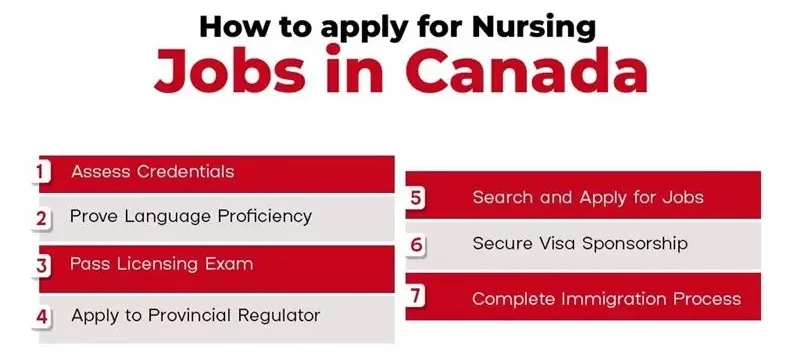
Follow these step-by-step guidelines to apply for nursing jobs in Canada as an international applicant, focusing on credential recognition, licensing, and immigration pathways.
1. Assess Credentials: Submit education, licenses, and experience to NNAS (nnas.ca) for advisory report; takes 12-16 weeks.
2. Prove Language Proficiency: Achieve IELTS Academic 7.0+ (no band <7.0), CELBAN, or equivalent for English/French.
3. Pass Licensing Exam: Register for NCLEX-RN (RNs), CPNRE (LPNs), or equivalent via provincial regulators.
4. Apply to Provincial Regulator: Use NNAS report to register with bodies like CNO (Ontario), BCCNM (BC); complete bridging if required.
5. Search and Apply for Jobs: Use Job Bank, Indeed, LinkedIn; target employers offering LMIA sponsorship in high-demand provinces.
6. Secure Visa Sponsorship: Obtain job offer for Express Entry (CRS score boost), PNP, or LMIA work permit; submit to IRCC.
7. Complete Immigration Process: Gather police clearance, medicals; aim for PR via Express Entry or temporary work permit first.
Conclusion
In conclusion, nursing jobs in Canada in 2026 offer immense potential for Indian professionals, with strong demand, attractive salaries, visa sponsorship options, and structured pathways via Express Entry and PNPs. For those exploring Job Opportunities in Canada, start by assessing your credentials through the official Job Bank website at www.jobbank.gc.ca, where you can find real-time nursing openings and labour market insights to kickstart your career.



Hello I am a Nigerian health care worker presently based in SA. I am interested in working as a social worker in Canada please advise.
Kind regards.
Hi Joan,
Thank you for reaching out to CanApprove!
We’re glad you took the first step toward your abroad journey.
If you’re looking for clear, personalized guidance based on your profile, goals, and eligible pathways, our expert consultants are here to help you every step of the way.
Book your FREE consultation now!
Nursing assistant in Canada
Hi Mailal,
Thank you for reaching out and for your interest.
We are an immigration consultancy and do not offer direct job opportunities.
We can guide you through the right immigration pathways and help you explore opportunities in your field.
Please share your qualifications and experience, and we’ll assist you further. BOOK A FREE CONSULTATION NOW!
Steff nusre
Hi Vijay Laxmi,
Thank you for reaching out and for your interest.
We are an immigration consultancy and do not offer direct job opportunities.
We can guide you through the right immigration pathways and help you explore opportunities in your field.
Please share your qualifications and experience, and we’ll assist you further. BOOK A FREE CONSULTATION NOW!
I am an Indian RN. I want to know how can I get a job offer from a Canadian employer without any work permit or PR in Canada? Also how your agency can help and how much charges can I expect? I am trying to explore jobs on various portals but not getting any positive response. I already passed my NCLEX- RN exam and got registered in Alberta as RN.
Hi Kaur,
Thank you for reaching out and for your interest.
We are an immigration consultancy and do not offer direct job opportunities.
We can guide you through the right immigration pathways and help you explore opportunities in your field.
Please share your qualifications and experience, and we’ll assist you further. BOOK A FREE CONSULTATION NOW!
Need job as nurse in canada
Hi Manisha,
Thank you for reaching out and for your interest.
We are an immigration consultancy and do not offer direct job opportunities.
We can guide you through the right immigration pathways and help you explore opportunities in your field.
Please share your qualifications and experience, and we’ll assist you further. BOOK A FREE CONSULTATION NOW!
I am a bilingual nurse Who passed the nclex looking to work in canada
Hi Victor,
Thank you for reaching out and for your interest.
We are an immigration consultancy and do not offer direct job opportunities.
We can guide you through the right immigration pathways and help you explore opportunities in your field.
Please share your qualifications and experience, and we’ll assist you further. BOOK A FREE CONSULTATION NOW!
Am much interested
Hi Silver,
Thank you for reaching out and for your interest.
We are an immigration consultancy and do not offer direct job opportunities.
We can guide you through the right immigration pathways and help you explore opportunities in your field.
Please share your qualifications and experience, and we’ll assist you further. BOOK A FREE CONSULTATION NOW!
Want to know more about the Canada nursing opportunity.
Hi Sruthy,
Thank you for reaching out and for your interest.
We can guide you through the right immigration pathways and help you explore opportunities in your field.
Please share your qualifications and experience, and we’ll assist you further. BOOK A FREE CONSULTATION NOW!
I want to work in Canada as a licensed practical Nurse, I will be happy if my request is granted
Hi Chidinma,
Thank you for reaching out and for your interest.
We can guide you through the right immigration pathways and help you explore opportunities in your field.
Please share your qualifications and experience, and we’ll assist you further. BOOK A FREE CONSULTATION NOW
Can I have the details for Canada process,to work as an RN
Hi,how can I get sponsorship
Hi Agnes,
Thank you for reaching out and for your interest.
We can guide you through the right immigration pathways and help you explore opportunities in your field.
Please share your qualifications and experience, and we’ll assist you further. BOOK A FREE CONSULTATION NOW
Me gustaría tender experiencia en otro país
Hola Glenda,
Gracias por comunicarte con CanApprove.
I need a Rn job
Hi Suhailat,
Thank you for reaching out.
We can guide you through the right immigration pathways and help you explore opportunities in your field.
Please share your qualifications and experience, and we’ll assist you further. BOOK A FREE CONSULTATION NOW!
Hello l would like to work as a nurse for you as a full time employee
Hi Annamuhammet,
Thank you for your interest.
CanApprove can assist you. Please note that we are not a job consultancy, so we do not provide overseas job placements or recruitment services.
Our immigration experts can assess your profile and guide you on the most suitable work visa or employer-sponsored visa options based on your qualifications, work experience, and the country you wish to migrate to.
Please share your qualifications and experience, and we’ll assist you further. BOOK A FREE CONSULTATION NOW!