



Australia has emerged as a premier destination for engineering students worldwide, and it is anticipated that this trend will continue in 2026. The selection of the appropriate engineering courses in Australia can establish the groundwork for a fulfilling global career, as the country boasts globally recognized degrees, state-of-the-art research facilities, and robust industry connections. This guide offers an in-depth look at the information that international students must be aware of, including the entry requirements, fees, career outcomes, and top specializations and universities.
Table Of Content
1Is Australia Good for Engineering?2Best Engineering Courses in Australia4Conclusion5Frequently Asked Questions
Is Australia Good for Engineering?
Yes, Australia is one of the best countries for engineering students, as it provides exceptional career prospects and the highest quality of education.
The primary reasons for selecting engineering in Australia are as follows:
- Engineering degrees that are internationally acknowledged
- Universities that are highly regarded and have state-of-the-
- Internship opportunities and strong industry connections
- Skilled engineers are in high demand in various sectors.
- Eligible graduates may pursue post-study employment opportunities.
- Potential pathways for skilled migration for eligible engineers
- Excellent career advancement and graduate salaries
- An environment that is both student-friendly and multicultural for international students
Best Engineering Courses in Australia
International students enjoy exceptional career prospects, practical learning opportunities, and a diverse array of specializations when they study engineering in Australia.
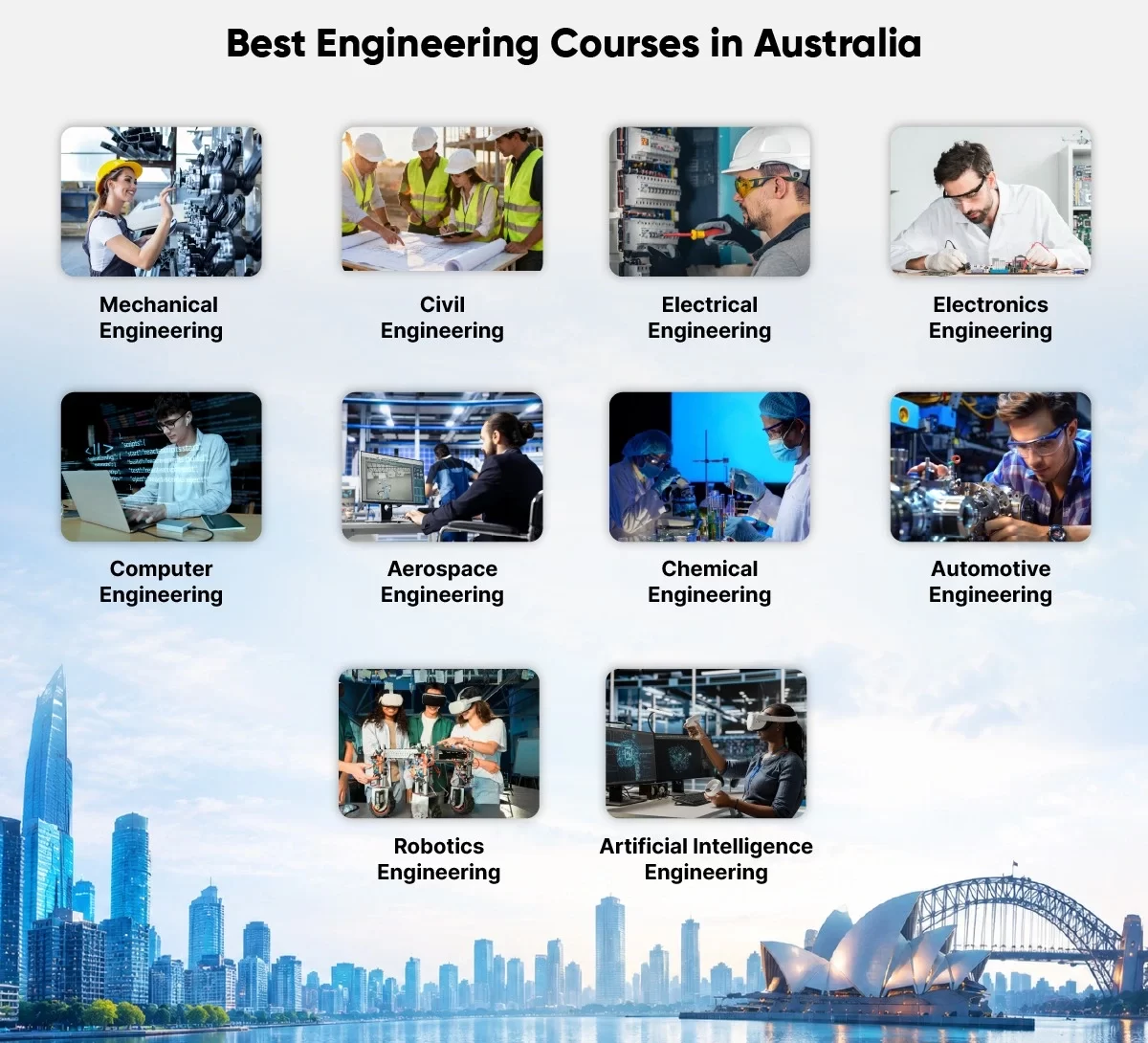
The best engineering courses in Australia include:
- Mechanical Engineering
- Civil Engineering
- Electrical Engineering
- Electronics Engineering
- Computer Engineering
- Aerospace Engineering
- Chemical Engineering
- Automotive Engineering
- Robotics Engineering
- Artificial Intelligence Engineering
Below is a detailed breakdown of demanding courses in Australia, including the degrees on offer, top universities, entry requirements, and fees.
1. Mechanical Engineering in Australia
Mechanical engineering is a program that is highly sought after by international students in Australia. Australian universities combine theoretical knowledge with practical training, research, and real-world industry experience to provide graduates with the basic skills required for global careers.
The high demand for mechanical engineering skills in industries such as manufacturing, mining, renewable energy, automotive, and aerospace provides mechanical engineering graduates in Australia with the opportunity to pursue excellent career paths.
Mechanical Engineering Courses in Australia
- Bachelor of Engineering (Honours) – Mechanical Engineering
- Bachelor of Mechanical Engineering
- Master of Engineering (Mechanical)
- Master of Mechanical Engineering
- Master of Professional Engineering (Mechanical)
Best Universities for Mechanical Engineering in Australia
- The University of Melbourne
- The University of Sydney
- The University of New South Wales (UNSW Sydney)
- Monash University
- The University of Queensland
- RMIT University
- Queensland University of Technology (QUT)
Mechanical Engineering in Australia Requirements
- Completion of the 12th grade in Mathematics and Physics (undergraduate)
- Postgraduate admission requires a pertinent bachelor’s degree
- Minimum 60%–75% academic average, depending on the university
- The IELTS overall band should be 6.5, with no individual band falling below 6.0 (or the equivalent PTE/TOEFL score)
- Statement of Purpose (SOP)
- Academic transcripts and letters of recommendation (for certain postgraduate programs)
Mechanical Engineering in Australia Fees
The average cost of studying Mechanical Engineering in Australia ranges from AUD 35,000 to AUD 60,000 per year, depending on the university and course level.
- Fees for undergraduate studies range from AUD 35,000 to AUD 55,000 annually
- Postgraduate fees: AUD 40,000 – AUD 60,000 per year
2. Civil Engineering in Australia
Civil engineering is a highly stable and in-demand engineering discipline in Australia, fueled by the continuous development of infrastructure, urban expansion, and government-sponsored construction projects in major cities.
Opportunities in the fields of water management, urban planning, construction, transportation, and government infrastructure bodies are available to graduates.
Civil Engineering Courses in Australia
- Bachelor of Engineering (Honours) – Civil Engineering
- Bachelor of Civil Engineering
- Master of Engineering (Civil)
- Master of Professional Engineering (Civil)
- Master of Construction Management (with Civil specialisation)
Best Universities for Civil Engineering in Australia
- The University of Melbourne
- Monash University
- The University of New South Wales (UNSW Sydney)
- The University of Sydney
- The University of Queensland
- RMIT University
- University of Technology Sydney (UTS)
Civil Engineering in Australia Requirements
- Completion of the 12th grade in Mathematics and Physics (undergraduate)
- Postgraduate admission requires a pertinent bachelor’s degree
- Minimum 60%–75% academic average, depending on the university
- The IELTS overall band should be 6.5, with no individual band falling below 6.0 (or the equivalent PTE/TOEFL score)
- Statement of Purpose (SOP)
- Academic transcripts and letters of recommendation (for certain postgraduate programs)
Civil Engineering in Australia Fees
The average cost of studying Civil Engineering in Australia ranges from AUD 34,000 to AUD 58,000 per year, depending on the university and course level.
- Undergraduate fees: AUD 34,000 – AUD 52,000 per year
- Postgraduate fees: AUD 38,000 – AUD 58,000 per year
3. Electrical Engineering in Australia
Electrical engineering continues to be in high demand in Australia, with graduates employed in various sectors, including renewable energy, telecommunications, and smart infrastructure projects.
Australia’s efforts to modernize its grid and promote renewable energy have substantially elevated the demand for skilled electrical engineers.
Electrical Engineering Courses in Australia
- Bachelor of Engineering (Honours) – Electrical Engineering
- Bachelor of Electrical Engineering
- Master of Engineering (Electrical)
- Master of Professional Engineering (Electrical)
Best Universities for Electrical Engineering in Australia
- The University of New South Wales (UNSW Sydney)
- The University of Melbourne
- Monash University
- The University of Sydney
- The University of Queensland
- University of Adelaide
Electrical Engineering in Australia Requirements
- Completion of the 12th grade in Mathematics and Physics (undergraduate)
- Postgraduate admission requires a bachelor’s pertinent degree
- A minimum academic score of 65%–75%, contingent upon the university
- IELTS 6.5 overall (no band below 6.0), or equivalent PTE/TOEFL score
- Statement of Purpose (SOP)
- Transcripts of academic work
Electrical Engineering in Australia Fees
The average cost of studying Electrical Engineering in Australia ranges from AUD 36,000 to AUD 60,000 per year, depending on the university and course level.
- Undergraduate fees: AUD 36,000 – AUD 54,000 per year
- Postgraduate fees: AUD 40,000 – AUD 60,000 per year
4. Electronics Engineering in Australia
The field of electronics engineering is closely associated with the expanding technology and defense sectors in Australia, and it concentrates on circuit design, embedded systems, telecommunications, and signal processing.
This course is an excellent option for students who are interested in semiconductor technologies, IoT, and hardware design.
Electronics Engineering Courses in Australia
- Bachelor of Engineering (Honours) – Electronics Engineering
- Bachelor of Engineering (Electronics and Communications)
- Master of Engineering (Electronics)
- Master of Professional Engineering (Electronics)
Best Universities for Electronics Engineering in Australia
- The University of New South Wales (UNSW Sydney)
- RMIT University
- The University of Melbourne
- Macquarie University
- The University of Adelaide
Electronics Engineering in Australia Requirements
- Completion of the 12th grade in Mathematics and Physics (undergraduate)
- Postgraduate admission requires a bachelor’s pertinent degree
- A minimum academic average of 60% to 75%
- IELTS 6.5 overall (no band below 6.0), or an equivalent PTE/TOEFL score
- Statement of Purpose (SOP)
- Transcripts of academic work
Electronics Engineering in Australia Fees
The average cost of studying Electronics Engineering in Australia ranges from AUD 34,000 to AUD 58,000 per year, depending on the university and course level.
- Fees for undergraduate studies range from AUD 34,000 to AUD 52,000 annually
- Postgraduate fees: AUD 38,000 – AUD 58,000 per year
5. Computer Engineering in Australia
Computer engineering is a field that prepares graduates for careers in the high-demand sectors of systems design, embedded computing, networking, and IT infrastructure in Australia by combining hardware and software expertise.
Computer Engineering Courses in Australia
- Bachelor of Engineering (Honours) – Computer Engineering
- Bachelor of Computer Science / Engineering (combined degrees)
- Master of Engineering (Computer)
- Master of Professional Engineering (Computer/Software)
Best Universities for Computer Engineering in Australia
- The University of Sydney
- The University of Melbourne
- The University of New South Wales (UNSW Sydney)
- Monash University
- RMIT University
Computer Engineering in Australia Requirements
- Completed 12th with Mathematics (Physics recommended) for undergraduate entry
- Relevant bachelor’s degree for postgraduate entry
- Minimum 65%–80% academic average
- IELTS 6.5 overall (no band below 6.0), or an equivalent PTE/TOEFL score
- Statement of Purpose (SOP)
- Transcripts of academic work
Computer Engineering in Australia Fees
The average cost of studying Computer Engineering in Australia ranges from AUD 38,000 to AUD 62,000 per year, depending on the university and course level.
- Fees for undergraduate studies range from AUD 38,000 to AUD 56,000 annually
- Postgraduate fees: AUD 42,000 – AUD 62,000 per year
6. Aerospace Engineering in Australia
Aerospace engineering is among the most demanding courses in Australia and a specialized field that is well-suited for students who are interested in space technology, aviation systems, and aircraft design. In this sector, Australia’s aerospace and defense industries provide robust employment and research opportunities.
Aerospace Engineering Courses in Australia
- Bachelor of Engineering (Honours) – Aerospace Engineering
- Bachelor of Aerospace Engineering / Aviation
- Master of Engineering (Aerospace)
- Master of Professional Engineering (Aerospace)
Best Universities for Aerospace Engineering in Australia
- The University of Sydney
- RMIT University
- The University of New South Wales (UNSW Sydney)
- Monash University
- The University of Queensland
Aerospace Engineering in Australia Requirements
- Completion of the 12th grade in Mathematics and Physics (undergraduate)
- Postgraduate admission requires a pertinent bachelor’s degree
- A competitive intake requires a minimum academic average of 70%–80%
- IELTS 6.5 overall (no band below 6.0), or an equivalent PTE/TOEFL score
- Statement of Purpose (SOP)
- Transcripts of academic work
Aerospace Engineering in Australia Fees
The average cost of studying Aerospace Engineering in Australia ranges from AUD 40,000 to AUD 65,000 per year, depending on the university and course level.
- Fees for undergraduate studies range from AUD 40,000 to AUD 58,000 annually
- Postgraduate fees: AUD 44,000 – AUD 65,000 per year
7. Chemical Engineering in Australia
Chemical engineering in Australia is in high demand due to the resources and manufacturing sectors that underpin the Australian economy. This field encompasses the energy, mining, materials, and process design industries.
Chemical Engineering Courses in Australia
- Bachelor of Engineering (Honours) – Chemical Engineering
- Bachelor of Chemical Engineering
- Master of Engineering (Chemical)
- Master of Professional Engineering (Chemical)
Best Universities for Chemical Engineering in Australia
- The University of Melbourne
- The University of Sydney
- The University of Queensland
- Monash University
- The University of New South Wales (UNSW Sydney)
Chemical Engineering in Australia Requirements
- Completion of the 12th grade in Mathematics, Physics, and Chemistry (undergraduate)
- Postgraduate admission requires a bachelor’s degree that is pertinent
- A minimum academic average of 65%–75%
- IELTS 6.5 overall (no band below 6.0), or an equivalent PTE/TOEFL score
- Statement of Purpose (SOP)
- Transcripts of academic work
Chemical Engineering in Australia Fees
The average cost of studying Chemical Engineering in Australia ranges from AUD 36,000 to AUD 60,000 per year, depending on the university and course level.
- Undergraduate fees: AUD 36,000 – AUD 54,000 per year
- Postgraduate fees: AUD 40,000 – AUD 60,000 per year
8. Automotive Engineering in Australia
Automotive engineering emphasizes the development of electric vehicle (EV) technologies, as well as the design and production of vehicles. International students are regaining interest in this niche field as a result of Australia’s increasing emphasis on sustainable transport and electric vehicle infrastructure.
Automotive Engineering Courses in Australia
- Bachelor of Engineering (Honours) – Mechanical Engineering (Automotive specialisation)
- Bachelor of Automotive Engineering
- Master of Engineering (Automotive/Mechanical)
- Master of Professional Engineering (Automotive)
Best Universities for Automotive Engineering in Australia
- RMIT University
- Deakin University
- The University of Melbourne (via Mechanical Engineering)
- Swinburne University of Technology
Automotive Engineering in Australia Requirements
- Completion of the 12th grade in Mathematics and Physics (undergraduate)
- Postgraduate admission requires a bachelor’s pertinent degree
- A minimum academic average of 60% to 70%
- IELTS 6.5 overall (no band below 6.0), or an equivalent PTE/TOEFL score
- Statement of Purpose (SOP)
- Transcripts of academic work
Automotive Engineering in Australia Fees
The average cost of studying Automotive Engineering in Australia ranges from AUD 33,000 to AUD 55,000 per year, depending on the university and course level.
- Fees for undergraduate studies range from AUD 33,000 to AUD 50,000 annually
- Postgraduate fees: AUD 36,000 – AUD 55,000 per year
9. Robotics Engineering in Australia
One of the most rapidly expanding sectors in Australia. And several engineering companies in Australia are keen on it. This course integrates mechanical design, electronics, and programming to create automated systems for manufacturing, healthcare, mining, and agriculture.
Robotics Engineering Courses in Australia
- Bachelor of Engineering (Honours) – Mechatronics/Robotics Engineering
- Bachelor of Robotics Engineering
- Master of Engineering (Robotics/Mechatronics)
- Master of Professional Engineering (Robotics)
Best Universities for Robotics Engineering in Australia
- The University of Sydney
- The University of New South Wales (UNSW Sydney)
- Queensland University of Technology (QUT)
- The University of Technology Sydney (UTS)
- RMIT University
Robotics Engineering in Australia Requirements
- Completed 12th with Mathematics and Physics (undergraduate)
- Relevant bachelor’s degree for postgraduate entry
- Minimum 65%–75% academic average
- IELTS 6.5 overall (no band below 6.0), or equivalent PTE/TOEFL score
- Statement of Purpose (SOP)
- Academic transcripts
Robotics Engineering in Australia Fees
The average cost of studying Robotics Engineering in Australia ranges from AUD 38,000 to AUD 62,000 per year, depending on the university and course level.
- Undergraduate fees: AUD 38,000 – AUD 56,000 per year
- Postgraduate fees: AUD 42,000 – AUD 62,000 per year
10. Artificial Intelligence Engineering in Australia
Currently, Australian universities offer specialized AI and machine learning specializations that are in high demand among international students. These specializations are backed by robust research output and industry partnerships. In addition, there are a huge number of scholarships to study in Australia.
Artificial Intelligence Engineering Courses in Australia
- Bachelor of Engineering (Honours) – Software Engineering (AI specialisation)
- Bachelor of Advanced Computing (AI major)
- Master of Engineering (Artificial Intelligence)
- Master of Data Science / AI
Best Universities for Artificial Intelligence Engineering in Australia
- The University of Melbourne
- The University of New South Wales (UNSW Sydney)
- Monash University
- The University of Sydney
- The Australian National University (ANU)
Artificial Intelligence Engineering in Australia Requirements
- Completed the 12th grade with a major in mathematics (undergraduate)
- A bachelor’s degree in engineering, computer science, or a related field (postgraduate)
- A minimum academic average of 65%–80%
- IELTS 6.5 overall (no band below 6.0), or an equivalent PTE/TOEFL score
- Statement of Purpose (SOP)
- Academic transcripts; portfolios or coding assessments may be necessary for certain programs
Artificial Intelligence Engineering in Australia Fees
The average tuition fee for AI Engineering in Australia ranges from AUD 40,000 to AUD 68,000 per year, depending on the university and course level, making it one of the most expensive engineering programs in Australia.
- Fees for undergraduate studies range from AUD 40,000 to AUD 58,000 annually
- Postgraduate fees: AUD 45,000 – AUD 68,000 per year
Conclusion
The globally recognized universities, diverse specializations, and robust career pathways of Australia continue to make it a top choice for international students who are pursuing engineering. Regardless of whether you are attracted to traditional fields such as civil and mechanical engineering or emerging areas like robotics and artificial intelligence, selecting the appropriate course and university and preparing for entry requirements in advance will enable you to maximize your time studying in Australia.
For official information on studying in Australia, visit the Australian Government’s dedicated student portal: Study Australia