




Planning to move to Germany through the Opportunity Card? This pathway offers skilled professionals an opportunity to explore employment options, but applicants must meet specific eligibility, financial and documentation requirements. A Germany Opportunity Card Rejection can disrupt these plans if important requirements are overlooked. Understanding the common rejection reasons, how to avoid them and the reapplication process can help you prepare a stronger application and move closer to your career goals in Germany.
Why Do Germany Opportunity Card Applications Get Rejected?
A Germany Opportunity Card application may be rejected if the applicant fails to meet the eligibility requirements or cannot provide sufficient evidence to support their application. Errors in documentation, inadequate financial resources and discrepancies in the information submitted can also affect the visa decision.
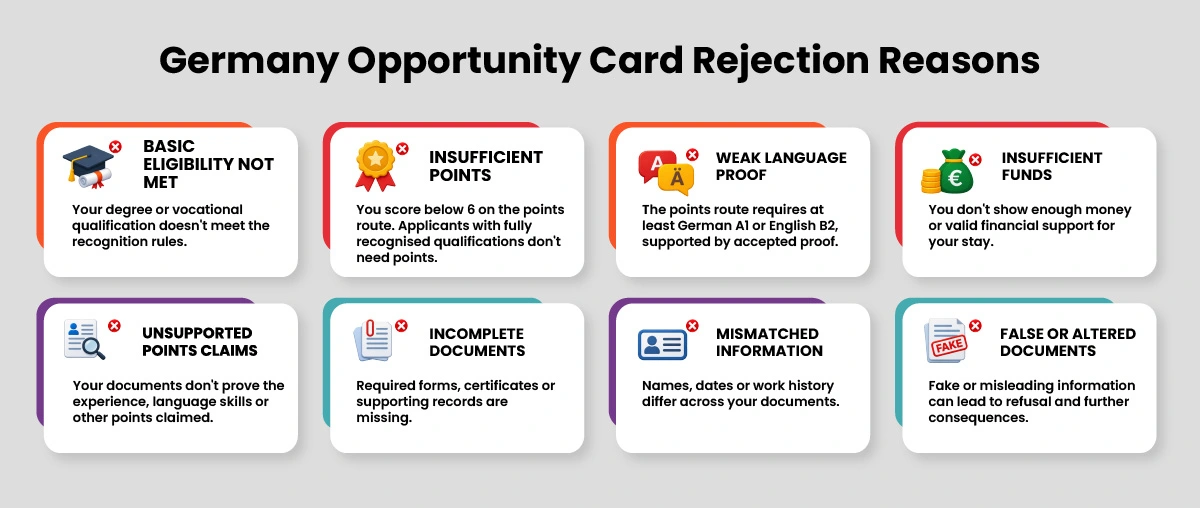
The Common reasons for Germany Opportunity Card Rejection include:
Failure to Meet Qualification Requirements: Qualifications that do not meet the required standards.
Insufficient Points: Failure to secure the minimum six points under the points-based route.
Language Proficiency Issues: Failure to meet the required German or English language levels.
Insufficient Financial Resources: Inability to prove sufficient funds to cover living expenses in Germany.
Incomplete Documentation: Missing certificates, employment records or other mandatory documents.
Unrecognised Qualifications: Failure to provide the required proof of academic or vocational qualifications.
Incorrect Information: Inconsistencies in personal details, educational records or employment history.
Invalid Supporting Documents: Expired certificates, invalid passports or improperly submitted documents.
Inadequate Health Insurance: Failure to provide suitable health insurance coverage for the stay in Germany.
Germany Opportunity Card Rejection Reasons
1. Failure to Meet Basic Eligibility Requirements
One of the most common reasons for Germany Opportunity Card rejection is failing to meet the basic eligibility requirements set by the German government.
Germany offers two pathways to obtain an Opportunity Card:
Skilled Worker Option: Applicants with a foreign academic degree or vocational qualification fully recognised in Germany, or a relevant German qualification, can apply without using the points-based system.
Points-Based Option: Applicants who do not qualify as recognised skilled workers must meet the formal qualification requirements, demonstrate the required language proficiency and score at least six points under the Germany Opportunity Card points system.
Applicants who do not satisfy the requirements of either pathway may face rejection.
How to Avoid This Rejection:
- Check whether your academic degree or vocational qualification meets the eligibility criteria.
- Verify your university’s recognition status through the Anabin database.
- Obtain a Statement of Comparability from ZAB, where applicable.
- Confirm that your vocational training meets the minimum duration and recognition requirements.
- Determine whether you qualify under the Skilled Worker Option or Points-Based Option before preparing your application.
- Review the latest eligibility guidelines published by the German government.
2. Insufficient Points Under the Points-Based System
Applicants who do not qualify under the Skilled Worker Option must score at least six points under the Germany Opportunity Card points system. Points are awarded based on factors such as professional experience, age, language proficiency, qualification recognition and previous stays in Germany.
The following table explains the eligibility factors and the points applicants can earn:
| Eligibility Factor | Points Available |
|---|---|
| Partial recognition of foreign qualifications | 4 |
| German language proficiency – B2 or above | 3 |
| German language proficiency – B1 | 2 |
| German language proficiency – A2 | 1 |
| English language proficiency – C1 or above | 1 additional |
| Professional experience – 5 years within the last 7 years | 3 |
| Professional experience – 2 years within the last 5 years | 2 |
| Qualification in a shortage occupation | 1 |
| Age below 35 years | 2 |
| Age from 35 to below 40 years | 1 |
| Previous legal stay in Germany for at least 6 continuous months within the last 5 years | 1 |
| Spouse or partner also qualifies for and applies for the Opportunity Card | 1 |
Applicants must secure at least six points to qualify through this pathway. The points claimed must also be supported by relevant certificates and documents.
How to Avoid This Rejection:
- Calculate your points using the official Germany Opportunity Card points calculator.
- Check whether your professional experience qualifies for additional points.
- Explore opportunities to improve your German language proficiency.
- Verify whether your qualification falls under an eligible shortage occupation.
- Check whether your previous stay in Germany or your partner’s eligibility can contribute additional points.
- Submit supporting documents for every point you claim.
3. Inadequate Language Proficiency
Language proficiency is an important eligibility requirement for applicants using the points-based pathway. Applicants must demonstrate a minimum level of German or English through an accepted language certificate. Failure to meet the required level, submitting an unaccepted certificate or providing outdated test results can affect the application.
Minimum Language Requirements
| Language | Minimum Proficiency | Points Available |
|---|---|---|
| German | A1 | 0 points (Basic eligibility) |
| German | A2 | 1 point |
| German | B1 | 2 points |
| German | B2 or above | 3 points |
| English | B2 | Basic eligibility requirement |
| English | C1 or above | 1 additional point |
The table shows the language-related eligibility and points criteria. German A2 and A1 are not cumulative; the highest applicable German level determines the points.
What Can Cause Language-Related Application Issues?
- Submitting a certificate that does not meet the minimum proficiency level.
- Using a test provider that is not recognised or accepted.
- Providing a certificate that is too old. Language certificates are generally accepted only when the examination took place within the previous 12 months.
- Claiming additional points without providing the required evidence.
How to Avoid This Rejection:
- Check the language requirements for your chosen application pathway.
- Take an accepted German or English language examination.
- Ensure your certificate meets the required CEFR level.
- Verify the examination provider’s acceptance with the German mission handling your application.
- Check the examination date before submitting your certificate.
- Consider improving your German proficiency to gain additional points.
Note: Applicants qualifying directly as skilled workers through fully recognised qualifications do not need to submit language proof for the Opportunity Card. However, German language skills can improve their employment prospects.
4. Insufficient Financial Resources
Applicants must demonstrate that they can support themselves financially throughout their stay in Germany. Since the Opportunity Card is primarily intended for job hunting, applicants must show that they can manage their living expenses without relying on securing immediate full-time employment. Insufficient funds or unacceptable financial proof can affect the visa decision.
For 2026, the standard financial requirement is €1,091 per month. The following are the accepted ways to demonstrate financial resources.
Ways to Prove Financial Resources
| Financial Proof | What Applicants Need to Provide |
|---|---|
| Blocked Account | Confirmation showing the required deposit and permitted monthly withdrawal amount. |
| Declaration of Commitment | A formal undertaking from an eligible person residing in Germany to cover the applicant’s living expenses. |
What Can Lead to Financial Proof Issues?
- Depositing less than the required amount in a blocked account.
- Providing a blocked account confirmation without the necessary financial details.
- Submitting an informal sponsorship letter instead of an eligible Declaration of Commitment.
- Failing to provide sufficient proof of access to the declared funds.
How to Avoid This Rejection:
- Calculate the financial requirement according to your intended period of stay.
- Ensure your blocked account covers the required monthly amount.
- Check that your account confirmation includes the permitted withdrawal details.
- If relying on a sponsor, obtain the formal Declaration of Commitment through the competent German authority.
Note: The €1,091 monthly requirement is the 2026 figure and should be updated if the blog is published for a later year.
5. Incomplete Documentation
Submitting an incomplete application can prevent German authorities from properly assessing an applicant’s eligibility. The required documents vary depending on whether the applicant qualifies through the Skilled Worker Option or the Points-Based Option. Missing academic records, qualification assessments, employment evidence or financial documents may leave important eligibility claims unverified.
Important Documents to Prepare
| Document Category | Supporting Documents |
|---|---|
| Identity | Valid passport and required personal details |
| Educational Qualifications | Degree certificates, academic transcripts and vocational training certificates |
| Qualification Recognition | Anabin results, ZAB assessment or relevant recognition documents, depending on the pathway |
| Work Experience | Employment certificates and supporting records of professional experience |
| Language Proficiency | Accepted German or English language certificates, where required |
| Financial Resources | Blocked account confirmation, Declaration of Commitment |
| Health Insurance | Proof of suitable health insurance coverage |
| Application Documents | Completed application form, CV and other documents requested by the German mission |
Common Documentation Mistakes
- Uploading degree certificates without the required semester-wise mark sheets.
- Failing to provide employment records to support claimed work experience.
- Missing qualification recognition evidence.
- Submitting unclear or incomplete scanned copies.
- Leaving out mandatory translations or supporting documents.
- Overlooking additional documents requested by the German mission.
How to Avoid This Rejection:
- Prepare a document checklist based on your application pathway.
- Compare your documents against the latest German mission checklist for India.
- Check that all educational and professional records are complete.
- Arrange translations in the required language and format.
- Ensure that uploaded copies are clear and readable.
- Carry the original documents for verification when instructed.
6. Issues With Qualification Recognition
Qualification recognition is an important part of the Germany Opportunity Card eligibility process. Applicants must establish that their academic or vocational qualifications meet the requirements of their chosen application pathway. Problems can arise when qualifications are not recognised in the country where they were obtained, the required assessment is missing or the submitted documents do not establish the qualification’s validity.
It is important to understand that recognition in the country of origin and recognition in Germany are two different requirements.
Qualification Recognition Requirements
| Application Route | Qualification Requirement |
|---|---|
| Skilled Worker Option | Foreign academic or vocational qualifications must be fully recognised in Germany. |
| Points-Based Option | Foreign academic or vocational qualification must be recognised by the state in which it was obtained. |
| Points for Partial Recognition | Applicants must provide an official notice showing partial recognition of their qualification in Germany. |
How Can Applicants Verify Their Qualifications?
- Anabin Database: Applicants with foreign university degrees can check whether their university is listed with H+ status and whether their degree is assessed as comparable.
- ZAB Statement of Comparability: Applicants can obtain an assessment from the Central Office for Foreign Education (ZAB) if their academic qualification requires further verification.
- Digital Statement on a Foreign Vocational Qualification (DAB): Applicants using the points-based route with foreign vocational qualifications may need this document to establish that their training lasted at least two years and is recognised in the country of training.
- Partial Recognition Notice: Applicants claiming points for partial recognition must provide the official decision issued by the relevant German recognition authority.
How to Avoid This Rejection:
- Check your university and degree details through the Anabin database.
- Obtain the relevant ZAB assessment or DAB, depending on your qualification.
- Verify that your vocational training meets the minimum two-year duration requirement.
- Ensure your qualification is officially recognised in the country where you obtained it.
- Obtain the official partial recognition notice if claiming the corresponding points.
- Submit the appropriate recognition documents along with your application.
7. Incorrect or Inconsistent Information
The information provided in a visa application must be accurate and consistent with the supporting documents. Discrepancies in personal details, educational qualifications, employment history or previous visa records may raise questions during the assessment process. Similarly, unsupported claims about work experience, language proficiency or qualification recognition can affect the assessment of eligibility. Applicants with a previous German visa rejection should also disclose their immigration history accurately and address any relevant concerns in their new application.
Common Information Errors to Watch Out For
| Application Details | Possible Inconsistencies |
|---|---|
| Personal Information | Differences in name, date of birth or passport details. |
| Educational History | Incorrect qualification details or graduation dates. |
| Employment History | Mismatched employment dates, job titles or experience duration. |
| Language Proficiency | Claiming a higher language level than the submitted certificate demonstrates. |
| Points Calculation | Claiming points without meeting the relevant criteria. |
| Immigration History | Providing inaccurate or incomplete information about previous visa applications when requested. |
How to Avoid This Rejection:
- Cross-check all personal details against your passport and official records.
- Ensure your CV and employment certificates contain consistent information.
- Verify your qualification details and academic dates before submission.
- Calculate your professional experience accurately, using eligible periods of employment.
- Ensure that every point claimed is supported by relevant evidence.
- Disclose previous visa refusals and immigration history truthfully wherever requested.
Important: Avoid submitting altered certificates, false employment records or misleading information. Providing false statements or documents can result in visa refusal and potentially affect future immigration applications.
8. Invalid or Outdated Supporting Documents
Apart from submitting all the required documents, applicants must ensure that each document meets the prescribed validity, format and verification requirements. Expired passports, outdated language certificates, unaccepted examination results or documents that cannot be properly verified may affect the application.
Documents That Require Special Attention
| Document | What Applicants Should Check |
|---|---|
| Passport | Must meet the German mission’s validity and blank-page requirements. |
| Language Certificate | Should be issued by an accepted examination provider and generally be no more than one year old. |
| Academic Certificates | Must be official and supported by the required transcripts or mark sheets. |
| Qualification Assessments | Must contain the relevant recognition or comparability information. |
| Employment Records | Must clearly establish the applicant’s professional experience. |
| Translated Documents | Must follow the translation requirements specified by the German mission. |
How to Avoid This Rejection:
- Check your passport’s validity and ensure it meets the current visa requirements.
- Verify the acceptance period of your language examination results.
- Obtain official copies of academic and professional certificates.
- Arrange translations through the required authorised or certified channels.
- Check that all uploaded documents are clear, complete and legible.
- Keep the original documents ready for verification during your visa appointment.
9. Inadequate Health Insurance Coverage
Health insurance is an essential requirement for applicants planning to stay in Germany under the Opportunity Card. Applicants must provide proof of suitable health insurance coverage that meets the requirements for their intended stay. Missing insurance certificates, policies that are not valid from the date of entry or coverage that does not satisfy the applicable requirements may affect the visa decision.
What Should Your Health Insurance Cover?
Before submitting your application, check the following details:
- Coverage Period: The insurance should be valid from your intended date of entry into Germany and cover the period for which the visa is issued.
- Insurance Type: The policy must meet the applicable requirements for incoming health insurance or suitable statutory or private health insurance.
- Policy Validity: The insurance certificate should clearly establish that the coverage is active for the intended stay.
- Coverage Conditions: Review the policy to ensure that it provides the required medical coverage and is accepted by the German mission.
How to Avoid This Rejection:
- Arrange suitable health insurance before submitting your visa application.
- Choose an insurance provider offering coverage that meets German visa requirements.
- Ensure that the policy begins on or before your intended date of entry.
- Check that the coverage period matches your intended stay.
- Obtain an official insurance certificate containing your policy details and coverage dates.
- Verify the insurance requirements with the German mission before finalising your application.
Germany Opportunity Card Rejection Rate
The Germany Opportunity Card rejection rate is not officially published, as German authorities do not statistically record rejection figures for this visa category.
This means applicants cannot rely on a fixed rejection rate to estimate their chances of approval. Instead, they should focus on meeting the eligibility requirements, submitting accurate and complete documentation, and demonstrating sufficient financial resources. A well-prepared application that addresses all the prescribed requirements can help applicants avoid common reasons for rejection.
How to Reapply for the Germany Opportunity Card After Rejection?
You can reapply for the Germany Opportunity Card at any time after rejection. However, address the reasons for the previous refusal before submitting a fresh application to improve your chances of approval.
Follow these steps to apply for the Germany Opportunity Card again after rejection:
Step 1: Review the Previous Rejection
Read the refusal letter and identify the specific reasons for rejection. Use the information provided to determine which eligibility requirements or supporting documents need attention.
Step 2: Correct the Issues in Your Previous Application
Address the shortcomings identified in the refusal letter before submitting a fresh application.
- Obtain missing educational or professional certificates.
- Correct errors or inconsistencies in the application.
- Arrange the necessary qualification recognition.
- Update your financial proof or language certificates, where required
Step 3: Reassess Your Eligibility
Check whether you still meet the Germany Opportunity Card requirements.
- Confirm that your qualifications meet the applicable criteria.
- Recalculate your points if applying through the points-based pathway.
- Verify your language proficiency.
- Ensure you meet the financial requirements for your intended stay.
Step 4: Prepare and Submit a Fresh Application
Once the issues have been addressed, prepare a fresh application with updated information and supporting documents.
- Use the German Consular Services Portal to start a new application.
- Complete the application form with accurate and updated details.
- Upload the documents required for your selected eligibility pathway.
- Ensure that all information is consistent with your certificates and other supporting records.
The portal provides a personalised document checklist based on your eligibility route. Applicants in India should also refer to the latest requirements published by the German Missions in India.
Step 5: Attend the Visa Appointment
After submitting your application, the German mission will conduct a preliminary review of the information and documents. If the application is complete, you will receive instructions to schedule an in-person appointment.
During the appointment, you may need to:
- Submit your biometric information, including fingerprints and a photograph.
- Present the original documents requested by the visa authorities.
- Pay the applicable visa fee.
- Provide any additional information requested during the appointment.
Make sure you attend the appointment with all the required documents, as incomplete submissions or failure to attend may affect the application.
Step 6: Track Your Application Status
After completing the appointment, you can monitor your application through the Consular Services Portal. The German mission may contact you if additional documents or clarification are required. Respond to such requests within the specified timeframe to avoid unnecessary delays.
Important: A previous rejection does not prevent you from reapplying. However, address the reasons for refusal before submitting a fresh application to avoid a similar outcome
Conclusion
A Germany Opportunity Card rejection does not necessarily mean the end of your plans to work in Germany. Understanding the reasons behind the refusal, correcting application errors and ensuring you meet the eligibility requirements can help you prepare a stronger application. From qualification recognition and language proficiency to financial proof and documentation, every requirement deserves careful attention.
Before applying, review the latest guidelines on the official Make it in Germany website, and ensure your application is complete and accurate. With proper preparation and the right guidance, you can take a more informed step towards your career opportunities in Germany.