



If you are a qualified teacher planning to migrate to Australia through a skilled migration pathway, the AITSL Skill Assessment is an important step to understand. AITSL, or the Australian Institute for Teaching and School Leadership, assesses whether your qualifications and English language proficiency meet the requirements for your nominated teaching occupation.
For teachers applying for skilled migration, the assessment is mainly qualification-based. This means your teaching qualification, initial teacher education, supervised teaching practice and English proficiency are key parts of the assessment. Work experience is not used to meet the core qualification criterion for the AITSL assessment.
This guide explains the AITSL assessment requirements, eligible teacher occupations, English requirements, documents, fees, processing time and what you need to do after receiving a successful assessment.
Table Of Content
1What Is an AITSL Skills Assessment?2Who Needs an AITSL Skills Assessment?3AITSL Teacher Occupations and ANZSCO Codes4AITSL Skills Assessment Requirements5AITSL English Language Requirement6Documents Required for AITSL Assessment7AITSL Skills Assessment Process: Step-by-Step8AITSL Skills Assessment Processing Time9AITSL Skills Assessment Fees10AITSL Assessment vs Teacher Registration in Australia11AITSL Skills Assessment for Indian Teachers12What Happens After a Successful AITSL Assessment?13Frequently Asked Questions About AITSL Skill Assessment
What Is an AITSL Skills Assessment?
An AITSL Skills Assessment is an assessment of a teacher’s qualifications and English language proficiency for skilled migration purposes in Australia.
AITSL checks whether your education and teacher training meet the requirements for your nominated occupation. You must meet both the qualification criteria and English language criteria to receive a suitable assessment outcome.
Generally, applicants must have completed at least four years of full-time equivalent university-level study, including a relevant initial teacher education (ITE) qualification. The ITE qualification must also be relevant to the teaching occupation you nominate.
It is important to understand that an AITSL assessment is for migration, not a licence to teach in Australia. A successful assessment does not automatically give you the right to work as a teacher.
Who Needs an AITSL Skills Assessment?
Teachers who want to migrate to Australia through a skilled migration pathway may need an AITSL assessment if their nominated occupation is assessed by AITSL.
Before applying, you should check the requirements of the specific Australian visa you intend to apply for because not every visa requires a skills assessment.
AITSL currently assesses several school teacher occupations, including:
- Primary School Teacher
- Middle School Teacher
- Secondary School Teacher
- Special Needs Teacher
- Teacher of the Hearing Impaired
- Teacher of the Sight Impaired
- Special Education Teachers (nec)
One important update for applicants is that Early Childhood Teacher (ANZSCO 241111) is no longer assessed by AITSL. Since 7 December 2024, ACECQA has been the assessing authority for this occupation.
Therefore, identifying the correct occupation before starting your application is essential.
AITSL Teacher Occupations and ANZSCO Codes
Your nominated occupation determines which AITSL occupation checklist you need to follow.
| Teacher Occupation | ANZSCO Code |
|---|---|
| Primary School Teacher | 241213 |
| Middle School Teacher | 241311 |
| Secondary School Teacher | 241411 |
| Special Needs Teacher | 241511 |
| Teacher of the Hearing Impaired | 241512 |
| Teacher of the Sight Impaired | 241513 |
| Special Education Teachers (nec) | 241599 |
AITSL assesses each occupation against specific requirements. For example, if you nominate a Secondary School Teacher, your initial teacher education and supervised teaching practice must be relevant to secondary school students. AITS’s occupation-specific checklists should therefore be reviewed before submitting an application.
AITSL Skills Assessment Requirements
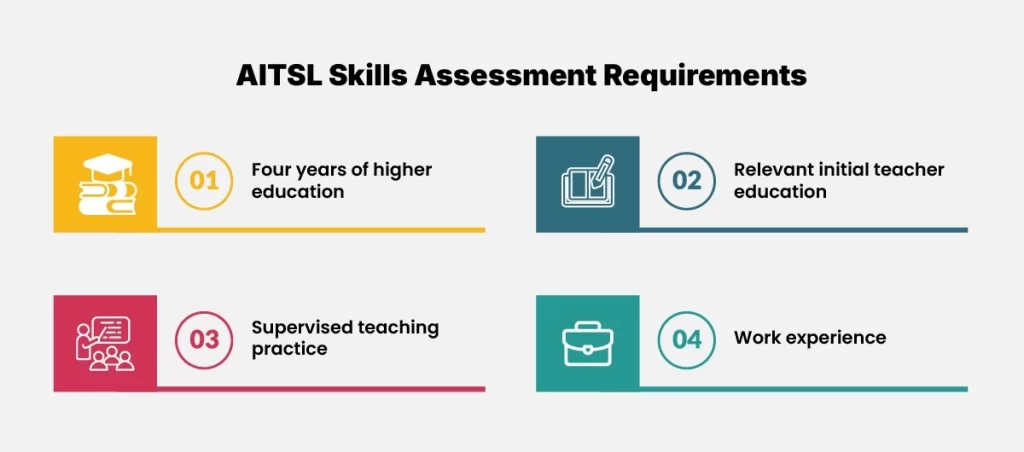
The main AITSL requirements relate to your qualifications, initial teacher education, supervised teaching practice and English proficiency.
Four years of higher education
You generally need a minimum of four years of full-time equivalent university-level study resulting in recognised qualifications. Your study must include a relevant initial teacher education qualification.
Simply holding a degree does not necessarily mean you will meet the AITSL criteria. The qualification needs to contain appropriate teacher education studies relevant to your nominated occupation.
Relevant initial teacher education
Your initial teacher education qualification must be relevant to the occupation you nominate.
For example, a teacher applying under the Secondary School Teacher occupation must have an appropriate secondary teacher education qualification.
AITSL also states that at least one year of initial teacher education study must be relevant to the nominated occupation.
Supervised teaching practice
Your teacher education program should include supervised teaching practice relevant to your nominated occupation.
For example, AITSL’s guidance indicates that a Secondary School Teacher applicant must have completed at least 45 days of supervised teaching practice with secondary-school-aged students in a secondary setting.
The exact evidence required can vary according to the occupation, so applicants should follow the relevant AITSL checklist.
Work experience
One common misunderstanding is that teaching experience automatically helps you pass the AITSL assessment.
AITSL states that its skills assessment is qualifications-based, and work experience before or after completing the initial teacher education qualification is not considered for meeting the core skills assessment qualification criterion.
However, relevant skilled employment can be important later for migration points. After receiving a suitable AITSL skill assessment, eligible applicants can request an optional Skilled Employment Statement (SES).
AITSL English Language Requirement
English proficiency is one of the most important parts of an AITSL Skill Assessment.
AITSL requires applicants to meet its English language criteria in addition to the qualification requirements. The English requirement can be met through an eligible study pathway or an acceptable Academic IELTS result.
For applicants using IELTS Academic, the commonly applicable AITSL requirement is:
- Listening: 8.0
- Speaking: 8.0
- Reading: 7.0
- Writing: 7.0
In other words, getting an overall 7.5 is not enough if you do not meet the required individual bands.
Can the English requirement be met without IELTS?
Potentially, yes. AITSL skill assessment states that its English requirement can be met through an eligible study option as well as a suitable Academic IELTS Test Report Form.
Applicants should check the current AITSL English proficiency requirements before relying on a study-based exemption.
Documents Required for AITSL Assessment
The exact documents depend on your nominated occupation and personal circumstances. AITSL provides occupation-specific checklists, so applicants should use the checklist relevant to their occupation rather than relying on a generic document list.
Documents may include:
- Passport or acceptable identity documents
- Degree or qualification certificates
- Academic transcripts
- Initial teacher education qualification evidence
- Evidence of supervised teaching practice
- Documents showing the setting and age range of students during teaching practice
- English language test evidence, where applicable
- Evidence relating to the institution and qualification
- Certified translations for documents that are not in English, where required
- Other documents requested under the relevant occupation checklist
Your documents should be consistent and accurate. Incorrect, incomplete or inconsistent documentation can delay the assessment. AITSL also warns that false or misleading information can result in an unsuccessful assessment and other consequences.
A Useful Tip For Indian Teachers
If you completed your teacher education in India, make sure your university documents clearly demonstrate the qualification structure, subjects studied and supervised teaching practice. If your university can provide an official teaching-practice statement, keep it ready.
This can help AITSL understand whether your training matches the requirements of your nominated occupation.
AITSL Skills Assessment Process: Step-by-Step
The AITSL assessment process can be broken down into several stages.
Step 1: Choose your occupation
First, identify the correct teaching occupation and corresponding ANZSCO code.
Your qualification and teaching specialisation should match the occupation you nominate.
Step 2: Check the AITSL requirements
Review AITSL’s current requirements and the occupation-specific checklist.
Pay particular attention to:
- Four years of higher education
- Initial teacher education
- Relevant teaching specialisation
- Supervised teaching practice
- English proficiency
- Identity and qualification documents
Step 3: Prepare your documents
Collect your certificates, transcripts, teaching-practice evidence, identity documents and English test evidence.
Make sure names, dates and other details are consistent across your documents.
Step 4: Create an application through the AITSL Applicant Portal
AITSL uses its Applicant Portal for skills assessment applications. Applicants complete and submit their application online through the portal.
Step 5: Pay the assessment fee
Once your application is completed, payment is made through the Applicant Portal.
Step 6: Submit the application
Upload the required evidence and submit the application for assessment.
AITSL does not provide a general pre-assessment service, so applicants should carefully check the criteria before lodging their application.
Step 7: Receive the outcome
If your application meets the requirements, AITSL will issue a suitable skills assessment outcome.
If further information is required, processing may take longer.
AITSL Skills Assessment Processing Time
According to AITSL, the majority of assessment-ready applications are completed within four weeks, while some applications can take up to six weeks.
However, this is not a guaranteed timeframe.
Processing can take longer if:
- Documents are missing
- Incorrect documents are uploaded
- Information is inconsistent
- The application is complex
- Application volumes increase during peak periods
AITSL does not offer a general fast-track or priority processing service.
For this reason, it is better to prepare your documents carefully rather than submitting an incomplete application simply to start the process.
AITSL Skills Assessment Fees
As of 1 July 2025, the current AITSL fee for a skills assessment application is:
| Service | Fee |
|---|---|
| Skills Assessment | AUD 1,154 |
| Appeal of Assessment Outcome | AUD 904 |
| Skilled Employment Statement | AUD 255 |
AITSL states that these fees do not include GST because no GST is charged on its Assessment for Migration fees.
AITSL has announced a change to its skilled migration fees from 7 September 2026.
The new fees will apply to applications submitted through the AITSL online Applicant Portal from 7 September 2026 onwards. Applications submitted on or before 6 September 2026 will be charged at the current rates.
| AITSL Service | Fee from 7 September 2026 |
|---|---|
| Assessment of Application | AUD 1,198 |
| Appeal of Assessment Outcome | AUD 938 |
| Skilled Employment Statement (SES) | AUD 265 |
| Partial Refund Amount | AUD 982 |
If you are planning to apply for an AITSL Skill Assessment before the fee increase, the date you submit your application matters.
- Submitted by 6 September 2026: Current fees apply.
- Submitted from 7 September 2026: New fees apply.
- Applications submitted through the online Applicant Portal: The applicable fee will be based on the submission date.
AITSL Assessment vs Teacher Registration in Australia
An AITSL assessment and Australian teacher registration are not the same thing.
AITSL Skills Assessment
The AITSL assessment is primarily for skilled migration purposes. It determines whether your qualifications and English proficiency meet the requirements for your nominated teaching occupation.
Teacher Registration
Teacher registration is required if you want to work as a teacher in Australia. Registration is managed by the relevant teacher regulatory authority in the state or territory where you intend to teach.
For example, a teacher planning to work in Australia may need to separately apply to the relevant state or territory registration authority after or alongside their migration process.
Therefore: AITSL assessment is not equal to teacher registration.
Receiving a positive AITSL assessment does not automatically make you a registered teacher in Australia.
Why the distinction matters
A teacher planning to migrate should think about two separate questions:
1. Do I meet the skills assessment requirements for migration?
2. Can I obtain teacher registration in the Australian state or territory where I want to teach?
Both can be important, but they serve different purposes.
AITSL Skills Assessment for Indian Teachers
Indian teachers can apply for an AITSL Skill Assessment if they meet the requirements for an eligible teaching occupation.
However, having a B.Ed., M.Ed. or teaching experience alone does not guarantee a successful assessment.
AITSL looks at the overall qualification structure, including the length of higher education, relevant initial teacher education and supervised teaching practice. English language requirements must also be satisfied.
For Indian teachers, it is therefore useful to check eligibility before paying the assessment fee, particularly if your qualification involved distance learning, unusual study arrangements or limited supervised teaching practice.
Once you understand your AITSL Skill Assessment eligibility, you can also calculate your Australia PR points using our points calculator and get an idea of where you stand for skilled migration.
What Happens After a Successful AITSL Assessment?
A successful AITSL assessment is an important step, but it is not a guarantee of Australian PR.
Depending on your circumstances, you may then explore an appropriate skilled migration pathway and submit an Expression of Interest (EOI) if required.
Your final migration pathway can depend on factors such as:
- Age
- English ability
- Qualifications
- Skilled employment
- Points
- State or territory nomination
- Visa eligibility
- Current occupation lists and migration rules
If you are applying for a points-tested skilled visa, your AITSL assessment is one part of the overall migration process.
Eligible applicants may also request an AITSL Skilled Employment Statement (SES) after receiving a suitable skills assessment. This statement can be used as evidence of relevant skilled employment for the Points Test, subject to the applicable migration rules.