




French is one of Canada’s two official languages and can play an important role in your immigration and settlement journey. French speaking cities in Canada offer opportunities for skilled workers, students, and newcomers, with access to Francophone communities, employment, and immigration pathways. In this guide, we explore the top 10 cities to consider in 2026.
Table Of Content
1Does learning French help in Canada PR?2Top 10 French-Speaking Cities in Canada3Conclusion4Frequently Asked Questions
Does learning French help in Canada PR?
Yes, learning French can improve your chances of getting Canadian PR. French is one of Canada’s two official languages, and the immigration system rewards French-speaking candidates with additional points and dedicated category-based draws under Express Entry.
Developing strong French language skills is especially valuable if you are targeting Express Entry because it can both raise your CRS score and make you eligible for French-language draws, which often have lower cut-off scores than regular rounds of invitations. As a result, French can be a strategic skill for applicants who want to strengthen their overall Canada PR profile.
Learning French has several advantages for Canada PR, including:
French-language Express Entry Draws: Candidates with NCLC 7 or higher in French may qualify for dedicated French-language category draws.
Extra CRS Points: Strong French skills can add up to 50 additional CRS points, helping improve your Express Entry profile.
Better Chance of an ITA: French can improve your chances of receiving an Invitation to Apply for PR through higher CRS points and Canada French draws.
More Job Opportunities: French can support access to bilingual roles, Francophone employers, and jobs in French-speaking communities.
Provincial Nomination Opportunities: Some provinces have Francophone-focused streams or may prioritise French-speaking candidates through their Provincial Nominee Programs.
Easier Settlement and Integration: Learning French can make it easier for newcomers to access professional networks outside of Quebec, community assistance, and French-language settlement services.
Top 10 French-Speaking Cities in Canada
French is spoken across Canada, but it is most widely used in Quebec, New Brunswick, and several bilingual communities in Ontario. Quebec is home to the majority of Canada’s Francophone population, while French-speaking communities outside Quebec also offer strong employment, education, and settlement opportunities. French is one of Canada’s two official languages, and more than 7.8 million Canadians reported French as their first official language in the 2021 Census.
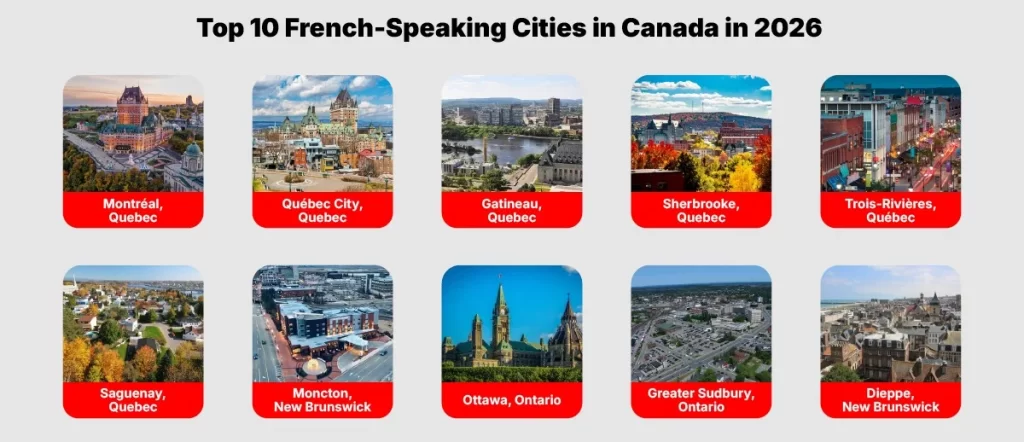
Here is the list of french speaking cities in Canada:
1. Montréal, Quebec
2. Québec City, Quebec
3. Gatineau, Quebec
4. Sherbrooke, Quebec
5. Trois-Rivières, Québec
6. Saguenay, Quebec
7. Moncton, New Brunswick
8. Ottawa, Ontario
9. Greater Sudbury, Ontario
10. Dieppe, New Brunswick
1. Montréal, Quebec
Montréal is Canada’s largest French-speaking city and the cultural and economic heart of Francophone Canada, though it’s also the most bilingual city in Quebec, with a large English-speaking and immigrant population. However, Quebec’s language laws, notably Bill 96, require French for most workplace, business, and public interactions, so functional French is close to essential here even in “international” sectors.
Quebec operates its own immigration selection system (Arrima/QSC), separate from federal Express Entry. As a result, PR pathways into Montréal often run through Quebec-specific programs rather than IRCC draws.
Why Choose Montréal for Immigration?
- Large French-speaking and multicultural community
- Strong tech, AI, aerospace, and gaming sector clusters
- Access to Quebec-specific immigration streams (QSWP, PEQ)
- Lower cost of living compared to Toronto/Vancouver
- Genuinely bilingual, cosmopolitan urban lifestyle
- Established immigrant and newcomer communities
Best for: Skilled tech and aerospace workers, candidates targeting Quebec’s own immigration streams, and those wanting an affordable, bilingual big-city lifestyle.
2. Québec City, Quebec
As the provincial capital, Québec City is far more monolingually French than Montréal, with a much smaller Anglophone presence, making it ideal for candidates who want full French immersion. In addition, it has a stable, government-driven economy and a strong sense of Francophone cultural identity rooted in its 400+ year history.
Because English is less commonly used day-to-day, strong French proficiency is more of a practical necessity than a bonus here.
Why Choose Québec City for Immigration?
- Deep French immersion with minimal English dependence
- Strong government and public-sector job base
- Growing finance, insurance, and tech industries
- Safe, family-friendly, low-crime environment
- Rich historical and cultural heritage
- Stable, low cost-of-living economy
Best for: Candidates seeking immersive French living, government-sector careers, and a safe, family-oriented city.
3. Gatineau, Quebec
Gatineau sits directly across the river from Ottawa, forming a unique bilingual twin-city zone where federal bureaucracy and Quebec’s French-first policies intersect. As one of the standout French Speaking Cities in Canada, many residents work in Ottawa’s federal public service while living under Quebec’s French-language regulations, creating unusual flexibility for bilingual candidates.
Its status as a Quebec municipality within the National Capital Region makes it a distinctive entry point for both federal and provincial pathways.
Why Choose Gatineau for Immigration?
- Access to federal government jobs with bilingual advantage
- Quebec residency with easy access to Ottawa’s job market
- Lower housing costs than Ottawa, with easy commuting
- Strong public administration and policy career opportunities
- Blend of Quebec culture and federal institutional stability
- Growing tech and services sector
Best for: Bilingual professionals targeting federal public service jobs while living under Quebec’s residency and language framework.
4. Sherbrooke, Quebec
Sherbrooke is a mid-sized university city in the Eastern Townships, known for its strong academic and research base and predominantly French-speaking population. Moreover, it has actively positioned itself as an immigration-friendly city, with regional programs designed to attract and retain newcomers to counter rural population decline.
The city’s focus is on regional economic development and talent retention, with several immigration pilots aimed specifically at newcomers.
Why Choose Sherbrooke for Immigration?
- Strong university and research presence
- Active regional immigration pilot programs
- Affordable housing relative to Montréal
- Growing manufacturing, biotech, and clean energy sectors
- Predominantly French-speaking environment for immersion
- Welcoming, mid-sized community feel
Best for: Students, researchers, and skilled workers seeking regional immigration pathways and affordable living.
5. Trois-Rivières, Québec
One of the oldest cities in Canada, Trois-Rivières is deeply Francophone with minimal English usage, situated between Montréal and Québec City along the St. Lawrence. Over time, its economy has transitioned from traditional industries like pulp and paper toward diversified manufacturing and services.
The city actively courts immigrants to offset an aging population, making newcomers a priority for local economic planning.
Why Choose Trois-Rivières for Immigration?
- Full French-language immersion environment
- Growing manufacturing and industrial trades sector
- Affordable cost of living compared to major cities
- Family-friendly, slower-paced lifestyle
- Rich historical character along the St. Lawrence
- Active local efforts to attract and retain newcomers
Best for: Families and industrial/manufacturing workers seeking an affordable, French-immersive mid-sized city.
6. Saguenay, Quebec
Located in a more remote northern region of Quebec, Saguenay is almost entirely French-speaking and historically tied to aluminum production and natural resource industries. Because of its geographic isolation, the region has fostered a strong regional identity and lower exposure to English-language influence compared to southern Quebec cities.
As a result, the region offers specific labour-shortage-driven immigration initiatives to attract skilled workers into resource industries.
Why Choose Saguenay for Immigration?
- Strong natural resources, metallurgy, and heavy industry job market
- Regional/rural immigration streams with lower CRS competition
- Very low cost of living
- Close-knit, community-oriented lifestyle
- Almost entirely French-speaking environment
- Targeted labour-shortage immigration initiatives
Best for: Skilled workers in resource and industrial sectors seeking lower competition and cost of living.
7. Moncton, New Brunswick
Moncton is the commercial hub of officially bilingual New Brunswick, Canada’s only province with both English and French as official languages by law. Unlike Quebec, it has a large Acadian Francophone population and a genuinely dual-language public life, distinct from Quebec’s French-first environment.
This legal bilingualism creates strong demand for candidates fluent in both English and French across government and private sectors.
Why Choose Moncton for Immigration?
- Genuine bilingual environment without Quebec’s language laws
- Strong demand in customer service, call centre, and admin roles
- Access to New Brunswick’s Provincial Nominee Program streams
- Affordable East Coast living
- Growing Acadian Francophone cultural community
- Stable, diversified commercial economy
Best for: Bilingual candidates seeking PNP pathways and affordable East Coast city life.
8. Ottawa, Ontario
As Canada’s capital, Ottawa is officially bilingual at the federal government level, even though Ontario itself is not. Consequently, there is strong demand for French-English bilingual professionals in public service roles. Its proximity to Gatineau also reinforces a cross-river Francophone community and daily bilingual interaction, making it one of the notable French Speaking Cities in Canada.
Ottawa offers a stable, low-volatility economy tied closely to federal institutional employment.
Why Choose Ottawa for Immigration?
- Federal public service careers where bilingualism is often required
- Strong opportunities in policy, government relations, and diplomacy
- Growing tech sector alongside government-driven stability
- Ontario PR pathways with added value from French skills
- High quality of life and public services
- Close cultural and economic ties with Gatineau’s Francophone community
Best for: Bilingual professionals targeting federal government careers and Ontario-based PR pathways.
9. Greater Sudbury, Ontario
Sudbury has one of Ontario’s largest Francophone minority communities outside the Ottawa region, with French-language schools, media, and services well established despite English being dominant provincially. At the same time, its economy centers on mining and resource industries.
The city has been proactive in regional immigration efforts to address labour shortages, positioning it as a growing option for skilled newcomers.
Why Choose Sudbury for Immigration?
- Strong mining, engineering, and resource-sector job market
- Access to Northern Ontario immigration pilot programs
- Established Francophone community services outside Quebec
- Lower competition and cost compared to Toronto
- French-language schools and media support
- Growing focus on newcomer retention
Best for: Skilled workers in mining and engineering seeking Northern Ontario immigration pathways.
10. Dieppe, New Brunswick
Dieppe, adjacent to Moncton, is one of the most Francophone-majority municipalities in Canada outside Quebec, with a strong Acadian cultural identity. As part of officially bilingual New Brunswick, it benefits from the same dual-language legal framework as Moncton.
The city is often seen as a quieter, family-oriented alternative within the same bilingual metro region.
Why Choose Dieppe for Immigration?
- Strong Francophone community life outside Quebec
- Quiet, family-friendly suburban setting
- Opportunities in retail, healthcare, and service sectors
- Priority processing under New Brunswick’s PNP for French speakers
- Distinct Acadian cultural identity
- Close proximity to Moncton’s commercial hub
Best for: Young families and French-speaking newcomers seeking a quieter alternative within one of New Brunswick’s French Speaking Cities in Canada.
Conclusion
French proficiency has become one of the smartest strategies for Canada PR success. From Montréal’s bilingual job market to Saguenay’s low-competition draws, each city offers unique advantages such as extra CRS points, dedicated French-language rounds, and Provincial Nominee priority for French speakers. Cities like Moncton, Dieppe, and Sudbury add genuine bilingual and Francophone community support outside Quebec, making settlement easier for newcomers.
For candidates weighing their options, strengthening French skills alongside the right city choice is fast becoming the Easiest Way to Immigrate to Canada.
Before finalizing your destination, check current job openings and demand trends on Job Bank Canada to align your skills with the right opportunities.