




An investment in education pays the best interest. But the return depends entirely on where you invest. In that regard Austria Education System makes a compelling case. Moreover, it pairs world-class universities with centuries of intellectual tradition. And tuition fees won’t drain your savings either.
Table Of Content
1Is Education Free in Austria for International Students?2Austria Education System Ranking3Austria Education System4Grading System in Austria5Cost of Living in Austria for International Students6Conclusion7Frequently Asked Questions
Whether you’re planning to study abroad for an undergraduate degree, a master’s, or a doctorate, the Austria education system is one you should seriously consider.
Is Education Free in Austria for International Students?
No, universities in Austria are not completely free for international students. However, tuition fees in Austria for international students are relatively low compared to many other study destinations.
At public universities in Austria, non-EU/EEA students usually pay around €726 per semester. In comparison, EU/EEA students generally pay only a small nominal contribution fee.
Private universities in Austria set their own tuition fees, which vary depending on the program and level of study.
Austria Education System Ranking
The Austria education system ranking is strong globally due to its high academic standards, strong research expertise, and the consistent presence of its universities in leading global rankings.
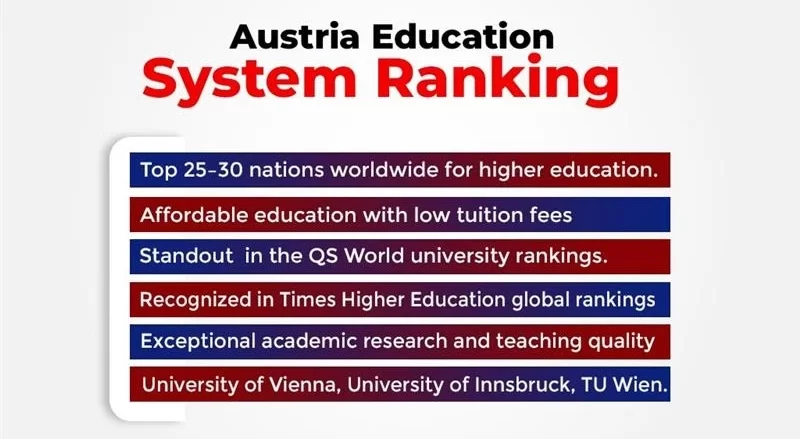
This strong Austria education system ranking is supported by the following key highlights:
- Ranks among the top 25–30 nations worldwide for higher education quality.
- Consistently top in the QS World university rankings.
- Recognized in Times Higher Education global rankings.
- Known for its exceptional academic research, teaching quality and global outlook.
- Prestigious Universities like University of Vienna, University of Innsbruck, TU Wien.
Austria Education System
The Austria education system is known for its well-structured organization, strong public funding, and balanced focus on both academic and vocational pathways.
Education in Austria is compulsory for nine years, starting at age six and continuing until around age fifteen.
Key Characteristics of the Austrian Education System:
- Most high schools in Austria and their universities are publicly funded, making education affordable.
- A student in the Austrian education system can opt for academic or vocational routes, thus allowing great flexibility.
- Strong academic quality and aligns with broader European educational frameworks.
- The dual training is a vital part of higher education in Austria and considered one of the most effective in Europe for employment
Structure of Austria Education System
The Austrian education system is divided into the following levels:
1. Early Childhood Education
2. Primary Education
3. Lower Secondary Education
4. Upper Secondary Education
5. Higher Education
Austria School System by Age
The Austria School System age structure is given below:
Ages 6–10
Primary School – Students learn basic literacy and numeracy
Ages 10–14
Lower Secondary School – Students can opt for academic (AHS) or the vocational route (NMS).
Ages 14–18
Upper Secondary School – Academic students work toward the Matura while BHS students receive vocational qualifications.
Ages 18+
Higher Education – Now it’s time for Public Universities and private institutions to welcome you.
Types of Higher Education Institutions in Austria
1. Public Universities – Research powerhouses that offer Bachelor’s, Master’s, and PhD programs
2. Universities of Applied Sciences – Practice-focused with strong industry connections and real-world readiness.
3. Private Universities: Specialised programmes with tuition fee on higher side, so is the expertise.
4. University Colleges of Teacher Education: Dedicated to shaping Austria’s next generation of educators
Grading System in Austria
Austria uses a 5-point numerical scale that is used consistently across schools and universities.
| Grade | German Term | Meaning | Result |
|---|---|---|---|
| 1 | Sehr gut | Very Good | Excellent performance |
| 2 | Gut | Good | Above average |
| 3 | Befriedigend | Satisfactory | Average performance |
| 4 | Genügend | Sufficient | Pass |
| 5 | Nicht genügend | Insufficient | Fail |
Universities in Austria use the European Credit Transfer and Accumulation System (ECTS) for grading and credit recognition. This system converts grades into the widely recognised A–F scale, making it easier for international students and institutions to understand academic results.
The ECTS system is applied consistently across major institutions, including the University of Vienna
Cost of Living in Austria for International Students
The cost of living for international students in Austria is around €800–€1,200 per month on average. This typically covers accommodation, food, transport, and personal expenses.
The exact cost also depends on the city you live in. Vienna is generally the most expensive, while cities like Graz and Innsbruck offer more affordable living options.
Moreover, student housing, university canteens, and Austria’s efficient public transport help students manage daily expenses more easily. These factors make the Austria education system attractive for study abroad aspirants.
Conclusion
The Austria education system has absolutely everything a smart student requires. From Academic excellence and Genuine affordability to Cultural richness that enriches life inside and outside the classroom.
The Austrian school system builds a rock-solid foundation where strong values carry students through to world-class higher education. Firstly, Low tuition caught your eye. While Global rankings sealed the deal. Student life in Vienna or Graz was the cherry on the top.
In conclusion, whichever reason resonates , choosing Austria for higher education rewards you academically, financially, and personally.
For official information about studying and the education system in Austria, you can visit the Austrian government education portal: https://studyinaustria.at/