



If you’re planning to study engineering abroad in 2026, Germany is a great option. Offering some of the best Engineering Courses in Germany, the country is known for strong education, advanced technology, and top engineering industries, giving students real skills and global career opportunities.
For international and Indian students, engineering in Germany offers quality education, hands-on learning, and affordable fees at leading universities. From mechanical and computer engineering to new-age tech fields, Germany prepares students for the future.
In this blog, we’ll explain why Germany is good for engineering, top universities, entry requirements, and fees for Indian students, to help you decide if Germany is right for you.
Table Of Content
1Is Germany good for Engineering?2Best Engineering Courses in Germany3Top 10 Engineering Universities in Germany4Engineering Courses in Germany Requirements5Engineering in Germany for Indian Students Fees6Conclusion7Frequently Asked Questions
Is Germany good for Engineering?
Yes, Germany is good for engineering. It offers low or no tuition fees, strong practical learning, and close industry connections.
German universities such as TUM, RWTH Aachen, and KIT are known for quality education and excellent career outcomes.
Engineering graduates enjoy high job demand, good starting salaries, and an 18-month post-study work visa. While admissions can be competitive and living costs exist, part-time jobs in Germany and scholarships help ease the financial burden.
Overall, Germany offers excellent education with strong career prospects.
Best Engineering Courses in Germany
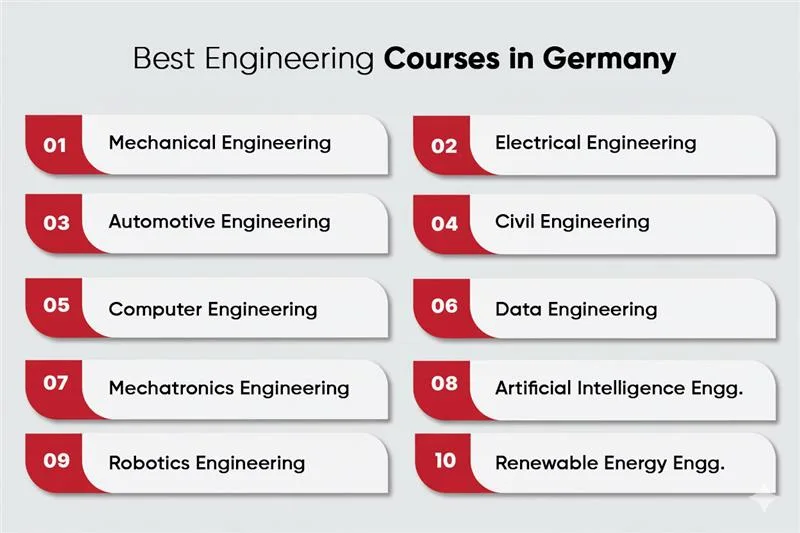
The best engineering courses in Germany include Mechanical Engineering, Electrical Engineering, Automotive Engineering, Civil Engineering, Computer Engineering, Data Engineering, Mechatronics, Artificial Intelligence, Robotics, and Renewable Energy Engineering.
Lets see each course in detail:
1. Mechanical Engineering in Germany
Germany leads in mechanical engineering education, offering some of the best mechanical engineering courses in Germany at TU9 universities, with a focus on innovation in automotive, energy, and robotics sectors.
- Covers core topics like thermodynamics, materials science, fluid dynamics, CAD/CAM, and manufacturing processes.
- Emphasizes hands-on projects, internships with companies like BMW and Siemens, and research in sustainable technologies.
- Typically 3–4 years for bachelor’s (180 ECTS), 2 years for master’s; many English-taught options for internationals.
- Prepares for high-demand careers with average starting salary €50,000–€60,000.
Best Universities for Mechanical Engineering in Germany
1. Technical University of Munich (TUM)
2. RWTH Aachen University
3. Karlsruhe Institute of Technology (KIT)
4. University of Stuttgart
5. Technical University of Berlin
2. Electrical Engineering in Germany
Germany is a global leader in electrical engineering, offering some of the best courses at top technical universities, with a focus on power systems, electronics, automation, and renewable energy.
- Covers circuits, control systems, power electronics, signal processing, and emerging areas like EV technology and smart grids.
- Emphasizes lab work, industry simulations, and thesis projects with companies like Siemens.
- Typically 3–4 years for bachelor’s, 2 years for master’s; many English-taught options for international students.
- Prepares for high-demand careers with starting salaries around €55,000.
Best Universities for Electrical Engineering in Germany
1. RWTH Aachen University
2. Technical University of Munich (TUM)
3. Karlsruhe Institute of Technology (KIT)
4. TU Berlin
5. University of Stuttgart
3. Automotive Engineering in Germany
Germany is the hub of the automotive industry, offering top programs in vehicle design, powertrains, and autonomous systems.
- Covers vehicle dynamics, engine technology, electric mobility, ADAS, and aerodynamics.
- Strong industry ties with Porsche, Audi; includes Formula Student competitions.
- Mostly master’s level, English-taught; typically 2 years duration.
- Leads to jobs at OEMs with starting salaries around €55,000.
Best Universities for Automotive Engineering in Germany
1. Technical University of Munich (TUM)
2. RWTH Aachen University
3. Karlsruhe Institute of Technology (KIT)
4. University of Stuttgart
5. TU Berlin
4. Civil Engineering in Germany
Civil engineering in Germany focuses on sustainable infrastructure, urban planning, and earthquake-resistant design.
- Covers structural analysis, geotechnics, hydrology, BIM, and green building.
- Projects with Deutsche Bahn; strong emphasis on Eurocodes.
- Bachelor’s and master’s programs available; many bilingual options.
- Careers in construction firms with starting salaries €48,000–€55,000.
Best Universities for Civil Engineering in Germany
1. Technical University of Munich (TUM)
2. RWTH Aachen University
3. TU Berlin
4. University of Stuttgart
5. Karlsruhe Institute of Technology (KIT)
5. Computer Science Engineering in Germany
Germany offers high-quality computer science engineering programs with a practical, tech-focused approach.
- Covers algorithms, software engineering, networks, machine learning, and AI.
- Hands-on learning through hackathons, tech fairs, and industry collaborations.
- Typically 3–4 years for bachelor’s, 2 years for master’s; many English programs.
- Graduates enjoy strong job prospects with salaries €60,000+.
Best Universities for Computer Science Engineering in Germany
1. Technical University of Munich (TUM)
2. RWTH Aachen University
3. Karlsruhe Institute of Technology (KIT)
4. TU Darmstadt
5. Saarland University
6. Data Engineering in Germany
Data engineering is a rapidly growing field in Germany with strong career opportunities.
- Covers Hadoop, Spark, SQL/NoSQL, and data warehousing.
- Industry projects with companies like SAP.
- Mostly master’s level, 2-year programs.
- High-demand jobs with starting salaries around €65,000.
Best Universities for Data Engineering in Germany
1. Technical University of Munich (TUM)
2. University of Mannheim
3. TU Berlin
4. RWTH Aachen University
5. University of Freiburg
7. Mechatronics Engineering in Germany
Mechatronics combines mechanical, electrical, and computer engineering, offering hands-on learning in automation and robotics.
- Covers mechanics, electronics, and control systems.
- Lab work includes KUKA robots and industrial automation projects.
- Bachelor’s and master’s programs available; practice-heavy.
- Graduates secure industry roles with starting salaries €52,000+.
Best Universities for Mechatronics Engineering in Germany
1. RWTH Aachen University
2. Karlsruhe Institute of Technology (KIT)
3. University of Stuttgart
4. TU Ilmenau
5. Technical University of Munich (TUM)
8. AI Engineering in Germany
Germany is ideal for studying AI, with strong universities, advanced research, and good career opportunities.
- Covers neural networks, deep learning, and AI ethics.
- Research collaborations with institutes like Max Planck Society.
- Mostly master’s level; English-taught programs.
- Graduates enjoy high-paying jobs with salaries €70,000+.
Best Universities for AI Engineering in Germany
1. Technical University of Munich (TUM)
2. University of Freiburg
3. TU Darmstadt
4. RWTH Aachen University
5. Saarland University
9. Robotics Engineering in Germany
Germany leads in robotics and automation, offering advanced education and hands-on industry experience.
- Covers sensors, motion planning, and human-robot interaction.
- Opportunities to participate in competitions like RoboCup.
- Specialized master’s programs.
- Strong job market with starting salaries €60,000+.
Best Universities for Robotics Engineering in Germany
1. Technical University of Munich (TUM)
2. University of Stuttgart
3. RWTH Aachen University
4. Karlsruhe Institute of Technology (KIT)
5. Bielefeld University
10. Renewable Energy Engineering in Germany
Germany is a global leader in renewable energy, making it ideal for students interested in clean technologies.
- Covers energy systems, photovoltaics, wind energy, and grid integration.
- Projects with companies like RWE.
- Mostly master’s programs; practical-focused.
- Green jobs with starting salaries €55,000+.
Best Universities for Renewable Energy Engineering in Germany
1. University of Stuttgart
2. TU Berlin
3. RWTH Aachen University
4. Karlsruhe Institute of Technology (KIT)
5. Technical University of Munich (TUM)
Top 10 Engineering Universities in Germany
The Top 10 Engineering Universities in Germany are:
1. Technical University of Munich (TUM)
2. RWTH Aachen University
3. Karlsruhe Institute of Technology (KIT)
4. Technical University of Berlin (TU Berlin)
5. TU Dresden
6. University of Stuttgart
7. Technical University of Darmstadt
8. Leibniz University Hannover
9. TU Braunschweig
10. Hamburg University of Technology (TUHH)
Engineering Courses in Germany Requirements
To study engineering in Germany, you need to meet academic and language requirements and submit key documents, with bachelor’s applicants requiring 13 years of schooling and a Science and Math background, master’s applicants needing a relevant bachelor’s degree, English programs requiring IELTS/TOEFL and German programs B1/B2 proficiency, essential documents including a Statement of Purpose, recommendation letters, and APS for Indian students, and students who don’t meet direct entry can join Studienkolleg to qualify.
Here’s a detailed guide:
1. Academic Eligibility
Bachelor’s Programs: Completion of 13 years of schooling with a strong background in Science and Mathematics.
Master’s Programs: A relevant bachelor’s degree in engineering or a related field with good academic performance.
2. Language Requirements
English-taught programs usually require IELTS 6.5 or above (or equivalent tests like TOEFL).
For German-taught programs, B1 or B2 level German proficiency is required.
3. Documents Needed
A clear Statement of Purpose (SOP) explaining your study goals.
Letters of Recommendation (mainly for master’s programs).
APS certificate, which is mandatory for Indian students.
4. Preparatory Options
Students who do not meet direct entry requirements can join Studienkolleg, a preparatory course that helps them qualify before starting their studies.
Engineering in Germany for Indian Students Fees
One of the biggest reasons Indian students choose Germany for engineering is the affordable cost of education. Compared to countries like the USA, UK, or Australia, studying engineering in Germany is much more budget-friendly. Most public universities charge very low fees, making high-quality education accessible to students from different financial backgrounds. Understanding the fee structure in advance helps Indian students plan their studies and living expenses with confidence.
Bachelor’s Programs
Semester fees for Bachelor’s programs are typically €250–€350, covering student services and public transport. Private universities are costlier, around €9,000–€13,000 per year.
Master’s Programs
Semester fees for master’s programs are typically €250–€400, with most programs tuition-free. Other costs, like study materials, are minimal compared to the USA, UK, or Australia.
Living Expenses
Indian students in Germany usually spend around €850–€1,200 per month on rent, food, transport, and insurance, depending on the city. For a student visa, you need to show proof of about €992 per month.
Conclusion
Germany is a great choice for engineering studies in 2026. With top universities, practical learning, and affordable education, students get real skills and good career opportunities, including excellent engineering jobs in Germany after graduation.
Whether it’s mechanical, electrical, or computer engineering, studying in Germany prepares you for the future while giving a rich student experience.