



Ever wondered why “Made in Germany” still means something on a global scale? Behind every precision-engineered BMW, every wind turbine spinning across the North Sea, and every automated production line in Stuttgart, there is a mechanical engineer making it happen. Mechanical engineering jobs in Germany are booming as the country races to electrify its automotive industry, automate its factories, and green its energy grid, and it simply doesn’t have enough engineers to keep up.
For skilled professionals looking for a move abroad, 2026 offers aspiring engineers strong demand, competitive pay, and clear visa routes like the EU Blue Card and Opportunity Card. Here’s a closer look at the roles, salaries, and how to get in.
Table Of Content
1Are Mechanical Engineers in demand in Germany?2Mechanical Engineering Jobs in Germany3Mechanical Engineering Jobs in Germany with Visa Sponsorship4Mechanical Engineering Salary in Germany5Job Opportunities for Mechanical Engineers in Germany6Mechanical Engineering Companies in Germany7Conclusion8Frequently Asked Questions
Are Mechanical Engineers in demand in Germany?
Yes, Mechanical Engineering Jobs in Germany are in high demand due to the country’s strong manufacturing sector, the ongoing shortage of skilled labour, and the rapid shift towards automation and renewable energy across industries.
Why Are Mechanical Engineers in Demand in Germany?
- Steady Demand for Mechanical Engineers: Germany’s strong manufacturing base in automotive, machinery, aerospace and industrial manufacturing makes it a world leader in this field.
- Skilled Labour Shortage: German companies are looking for skilled mechanical engineers to relieve the engineering talent shortage in the country.
- Industry 4.0 evolution: With the rise of automation, robotics, AI-led manufacturing and intelligent factories, the demand for mechanical engineering skills is growing.
- Renewable Energy Growth: Germany’s commitment to clean energy and sustainability is generating new jobs in wind, solar, hydrogen, and energy-efficient technology.
- Competitive Salaries and Career Progression: Mechanical engineers are offered good employee benefits, good career growth and competitive salaries.
- Visa Sponsorship Opportunities: The EU Blue Card and Germany Opportunity Card are two common ways that employers sponsor international engineers.
- High Demand Across Major Cities: Mechanical engineering jobs are widely available in Munich, Stuttgart, Berlin, Hamburg, Frankfurt, and other industrial hubs.
Mechanical Engineering Jobs in Germany
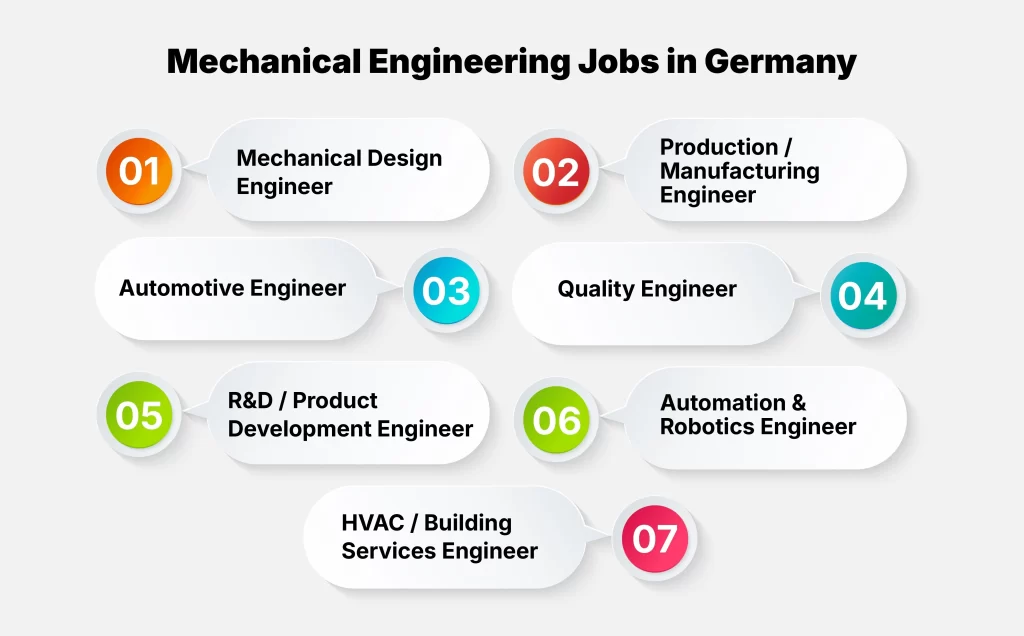
Here are the seven mechanical engineering jobs in Germany roles with the strongest hiring activity and clearest paths for international applicants right now:
1. Mechanical Design Engineer
2. Production / Manufacturing Engineer
3. Automotive Engineer
4. Quality Engineer
5. R&D / Product Development Engineer
6. Automation & Robotics Engineer
7. HVAC / Building Services Engineer
1. Mechanical Design Engineer
Mechanical Design Engineers in Germany design, develop, and improve machines, mechanical components, and industrial equipment using CAD software. They work closely with manufacturing and production teams to create safe, efficient, and high-quality products. With Germany’s strong automotive, aerospace, robotics, and manufacturing industries, this role stays consistently in demand across the country.
Mechanical Design Engineer Job Description
Mechanical Design Engineer Job Description
- Design mechanical components, products, and machinery using CAD software
- Create detailed 2D drawings and 3D models for manufacturing
- Perform engineering calculations, simulations, and product testing
- Improve existing designs to enhance performance, quality, and cost efficiency
- Collaborate with production, quality assurance, and R&D teams
- Ensure designs comply with German and international engineering standards
- Troubleshoot design issues and provide effective engineering solutions
- Prepare technical documentation, bills of materials (BOM), and design reports
How to Become a Mechanical Design Engineer in Germany
1. Complete a Bachelor’s or Master’s degree in Mechanical Engineering
2. Gain proficiency in CAD software such as SolidWorks, CATIA, Siemens NX, or AutoCAD
3. Build practical experience through internships or engineering projects
4. Improve German language skills (B1/B2 is preferred by many employers)
5. Apply for Mechanical Design Engineer jobs and obtain a German work visa or EU Blue Card (if eligible)
Mechanical Design Engineer Salary in Germany
The average salary of a Mechanical Design Engineer in Germany ranges from €55,000 to €65,000 per year, depending on experience, qualifications, industry, and location.
- Entry-Level (0–2 years): €45,000–€55,000 per year
- Mid-Level (3–7 years): €55,000–€70,000 per year
- Senior-Level (8+ years): €70,000–€90,000+ per year
2. Production / Manufacturing Engineer
Production and Manufacturing Engineers are among the In Demand Jobs in Germany, overseeing how products are built by improving process efficiency, tooling, and factory layouts. They work on the shop floor as much as they do at a desk, bridging the gap between a finished design and a fully operational production line. Germany’s automotive and industrial machinery sectors rely heavily on these professionals to maximize productivity and minimize defects.
Production / Manufacturing Engineer Job Description
- Plan and optimize manufacturing processes and production lines
- Select and coordinate tooling, machinery, and factory layout
- Monitor production efficiency and reduce waste or downtime
- Work with design and quality teams to resolve manufacturability issues
- Implement lean manufacturing and Industry 4.0 practices
- Conduct root-cause analysis on production defects
- Prepare cost estimates and process documentation
How to Become a Production / Manufacturing Engineer in Germany
1. Complete a Bachelor’s or Master’s degree in Mechanical or Manufacturing Engineering
2. Build hands-on experience with production planning tools and lean manufacturing methods
3. Learn PLC basics and factory automation systems, since many roles now overlap with Industry
4. Strengthen German language skills, as shop-floor coordination often requires it
5. Apply through German job portals and secure a visa via the EU Blue Card or Opportunity Card
Production / Manufacturing Engineer Salary in Germany
The average salary of a Production/Manufacturing Engineer in Germany ranges from €60,000 to €70,000 per year, depending on experience, industry, and location.
- Entry-Level (0–2 years): €48,000–€55,000 per year
- Mid-Level (3–7 years): €55,000–€72,000 per year
- Senior-Level (8+ years): €72,000–€90,000+ per year
3. Automotive Engineer
With BMW, Mercedes-Benz, Volkswagen, Audi, and Porsche all headquartered in Germany, automotive engineering is one of the highest paying jobs in Germany and most competitive mechanical engineering specializations. Automotive Engineers work on vehicle components, powertrains, and increasingly on electric drivetrains and battery systems as the industry shifts away from combustion engines.
Automotive Engineer Job Description
- Design and develop vehicle components, systems, and powertrains
- Run simulations and physical testing on engines, chassis, or EV drivetrains
- Collaborate with suppliers on parts specification and quality
- Support crash safety, NVH (noise, vibration, harshness), and durability testing
- Contribute to electric vehicle and battery system development
- Ensure compliance with German and EU automotive regulations
- Document technical specifications for production handoff
How to Become an Automotive Engineer in Germany
1. Complete a Bachelor’s or Master’s degree in Mechanical or Automotive Engineering
2. Specialize in areas like powertrain, EV systems, or vehicle dynamics through coursework or projects
3. Gain internship experience with an automotive OEM or supplier, ideally in Germany
4. Learn German, since automotive engineering teams frequently work in mixed German/English environments
5. Apply for roles at major automakers and secure sponsorship through the EU Blue Card
Automotive Engineer Salary in Germany
The average salary of an Automotive Engineer in Germany ranges from €65,000 to €85,000 per year, making it one of the better-paid mechanical engineering specializations.
- Entry-Level (0–2 years): €50,000–€60,000 per year
- Mid-Level (3–7 years): €60,000–€78,000 per year
- Senior-Level (8+ years): €78,000–€100,000+ per year
4. Quality Engineer
Quality Engineers make sure that what gets manufactured actually meets spec, both for the customer and for German and international regulatory standards. It’s a role that blends technical engineering knowledge with process auditing, and it’s in steady demand across automotive, machinery, and industrial equipment manufacturers.
Quality Engineer Job Description
- Develop and monitor quality control processes and inspection standards
- Conduct root-cause analysis on defects and non-conformances
- Run FMEA (Failure Mode and Effects Analysis) and other risk assessments
- Coordinate with suppliers on incoming part quality
- Support ISO and industry-specific certification audits
- Use Six Sigma and Lean methodologies to reduce defect rates
- Prepare quality reports for management and clients
How to Become a Quality Engineer in Germany
1. Complete a Bachelor’s degree in Mechanical Engineering or a related field
2. Get trained in quality tools such as Six Sigma, FMEA, and SPC (Statistical Process Control)
3. Build experience in a manufacturing or automotive quality role
4. Pursue relevant certifications (Six Sigma Green/Black Belt is widely recognized)
5. Start Job Hunting in Germany by applying for quality engineering roles and pursue a work visa through Germany’s skilled worker pathway.
Quality Engineer Salary in Germany
The average salary of a Quality Engineer in Germany ranges from €55,000 to €70,000 per year, depending on industry and specialization.
- Entry-Level (0–2 years): €45,000–€55,000 per year
- Mid-Level (3–7 years): €55,000–€70,000 per year
- Senior-Level (8+ years): €70,000–€85,000+ per year
5. R&D / Product Development Engineer
R&D and Product Development Engineers work on what comes next, developing new products, materials, and mechanical systems before they ever reach a production line. This role suits engineers who enjoy prototyping and problem-solving over routine production work, and it’s especially active in Germany’s push toward electromobility and renewable energy technology.
R&D / Product Development Engineer Job Description
- Research and develop new mechanical products, components, or materials
- Build and test prototypes using CAD and simulation tools
- Collaborate with cross-functional teams on feasibility and cost analysis
- Patent and document new mechanical innovations
- Stay current with emerging technologies (EVs, hydrogen systems, advanced materials)
- Present findings and design proposals to stakeholders
- Support the transition from prototype to manufacturable design
How to Become an R&D / Product Development Engineer in Germany
1. Complete a Master’s degree in Mechanical Engineering (preferred for R&D-heavy roles)
2. Build a strong project or thesis portfolio focused on innovation or product design
3. Gain proficiency in CAD, simulation software, and rapid prototyping tools
4. Pursue internships or research assistant roles with German universities or companies
5. Apply for R&D positions and secure sponsorship through the EU Blue Card
R&D / Product Development Engineer Salary in Germany
The average salary of an R&D/Product Development Engineer in Germany ranges from €60,000 to €80,000 per year, depending on the industry and specialization.
- Entry-Level (0–2 years): €48,000–€58,000 per year
- Mid-Level (3–7 years): €58,000–€75,000 per year
- Senior-Level (8+ years): €75,000–€95,000+ per year
6. Automation & Robotics Engineer
As German factories invest heavily in Industry 4.0, Automation and Robotics Engineers have become some of the most sought-after (and best-paid) mechanical engineering specialists. They design and maintain the robotic systems and automated production lines that keep German manufacturing competitive on a global scale.
Automation & Robotics Engineer Job Description
- Design, program, and maintain robotic and automated production systems
- Integrate PLCs, sensors, and control systems into manufacturing lines
- Troubleshoot automation faults and minimize production downtime
- Collaborate with mechanical, electrical, and software teams on system upgrades
- Implement predictive maintenance and Industry 4.0 solutions
- Test and validate new automation equipment before rollout
- Document system architecture and maintenance procedures
How to Become an Automation & Robotics Engineer in Germany
1. Complete a Bachelor’s or Master’s degree in Mechanical, Mechatronics, or Automation Engineering
2. Learn PLC programming (Siemens TIA Portal is widely used in Germany) and robotics control systems
3. Build hands-on experience through internships in automotive or industrial automation
4. Strengthen German language skills, since automation teams often work closely with shop-floor staff
5. Apply for automation roles and pursue sponsorship through the German EU Blue Card
Automation & Robotics Engineer Salary in Germany
The average salary of an Automation/Robotics Engineer in Germany ranges from €65,000 to €90,000 per year, among the highest-paying mechanical engineering specializations.
- Entry-Level (0–2 years): €50,000–€62,000 per year
- Mid-Level (3–7 years): €62,000–€80,000 per year
- Senior-Level (8+ years): €80,000–€105,000+ per year
7. HVAC / Building Services Engineer
HVAC Engineers design and maintain heating, ventilation, air conditioning, and building climate systems for residential, commercial, and industrial buildings. With Germany’s strong focus on energy efficiency and sustainable construction, this role has grown steadily, especially in retrofitting older buildings to meet new energy standards.
HVAC / Building Services Engineer Job Description
- Design HVAC systems for residential, commercial, or industrial buildings
- Perform load calculations and energy efficiency assessments
- Select equipment and oversee installation and commissioning
- Ensure systems comply with German energy efficiency regulations
- Troubleshoot and optimize existing HVAC systems
- Coordinate with architects, contractors, and building services teams
- Prepare technical specifications and maintenance schedules
How to Become an HVAC Engineer in Germany
1. Complete a Bachelor’s degree in Mechanical Engineering or Building Services Engineering
2. Gain knowledge of German building codes and energy efficiency standards
3. Build experience with HVAC design software and building simulation tools
4. Learn German, since building services work usually involves close coordination with local contractors
5. Apply for HVAC engineering roles and pursue a work visa through the standard or shortage occupation route
HVAC / Building Services Engineer Salary in Germany
The average salary of an HVAC Engineer in Germany ranges from €50,000 to €65,000 per year, depending on experience and project complexity.
- Entry-Level (0–2 years): €42,000–€50,000 per year
- Mid-Level (3–7 years): €50,000–€65,000 per year
- Senior-Level (8+ years): €65,000–€80,000+ per year
Mechanical Engineering Jobs in Germany with Visa Sponsorship
List of engineering companies in Germany with visa sponsorship includes:
1. Mechanical Design Engineer
2. Manufacturing Engineer
3. Production Engineer
4. Quality Engineer
5. Maintenance Engineer
6. Automotive Engineer
7. HVAC Engineer
8. Project Engineer
Mechanical engineering jobs in Germany with visa sponsorship are available for international professionals in automotive companies, manufacturing plants, aerospace industries, renewable energy firms, industrial machinery companies, and engineering consulting firms.
Due to the shortage of skilled engineers, many German employers offer work visa sponsorship, relocation assistance, accommodation support, competitive salaries, and career growth opportunities for qualified international candidates.
International mechanical engineers can apply for various engineering roles based on their qualifications, technical skills, specialization, and work experience.
To apply for mechanical engineering jobs in Germany with visa sponsorship, candidates typically need a recognized mechanical engineering degree, relevant work experience, and German language proficiency at the A2 or B1/B2 level. Some multinational companies also offer English-speaking engineering roles.
Visa Routes for Mechanical Engineers
EU Blue Card – The EU Blue Card is one of the most popular pathways to migrate to Germany from India as a mechanical engineer. Once you secure a job offer from a German employer, you can apply for an EU Blue Card, which offers the right to live and work in Germany along with a faster pathway to permanent residency.
German Opportunity Card (Chancenkarte) – Designed for candidates without a job offer yet. Eligibility is based on a points system covering degree, work experience, language skills, and age. Approved applicants get up to 12 months to job-hunt in Germany while working part-time.
Mechanical Engineering Salary in Germany
The average Mechanical Engineering salary in Germany is €55,000–€75,000 per year, depending on your experience, qualifications, job role, industry, and location. Engineers with specialized skills and experience in high-demand sectors often earn higher salaries, with top earners in automotive and robotics roles clearing €95,000–€100,000+.
Factors Influencing Mechanical Engineering Salary in Germany
Work Experience – Senior engineers typically earn significantly more than entry-level professionals.
Education & Certifications – Higher qualifications and specialized certifications can increase your earning potential.
Job Role & Specialization – Roles in automotive, robotics, design, and project engineering often offer higher salaries.
Industry – Salaries vary across automotive, aerospace, manufacturing, renewable energy, and industrial engineering sectors.
Location – Major cities such as Munich, Stuttgart, and Frankfurt generally offer higher pay.
Company Size – Large multinational companies often provide better salary packages and benefits.
Technical & Language Skills – German language proficiency and in-demand technical skills can improve salary prospects.
Relevant Work Experience – Previous industry or international experience can help you secure higher-paying roles.
Job Opportunities for Mechanical Engineers in Germany
Mechanical engineering jobs in Germany have growing job opportunities across several fast-moving sectors:
Electromobility & Battery Systems – As German automakers shift production toward EVs, engineers with battery pack design, thermal management, or eDrive experience are in short supply.
Automation & Industry 4.0 – Factories across the country are investing heavily in smart manufacturing, keeping demand steady for engineers who bridge mechanical design with controls.
Renewable Energy – Wind turbine manufacturing and hydrogen infrastructure are growing fast, particularly in northern Germany.
Testing & Validation – End-of-line testing, NVH engineering, and quality validation roles stay consistently open at automotive suppliers.
If you’re planning your move and researching how to get a job in Germany from India, the practical steps are: get your degree recognized (or check whether it already qualifies you directly), build a German-style CV and cover letter, start applying through platforms like LinkedIn, StepStone, and Indeed Germany while still in India, and lean on the Opportunity Card if you’d rather job hunt in person. Completing a German engineering course or language classes before you apply signals genuine commitment to relocating, which recruiters notice.
Mechanical Engineering Companies in Germany
Here is a list of top Mechanical Engineering Companies in Germany
- Siemens
- Bosch
- BMW
- Mercedes-Benz
- Volkswagen
- Audi
- Porsche
- ThyssenKrupp
- Continental
- Dürr
- Enercon
- Infineon Technologies
- Hochtief
Conclusion
Germany isn’t a shortcut, and job hunting there from abroad takes real effort, patience with the visa process, and ideally some German language skills. But the fundamentals hold up: the country genuinely needs mechanical engineers, pays fairly across the board, and offers two workable visa routes depending on whether you already have an offer in hand. Whether you’re aiming for design, production, automotive, or automation, mechanical engineering jobs in Germany are one of the more realistic paths for skilled professionals looking to relocate in 2026.
For official, up-to-date guidance on visas, qualification recognition, and job hunting as a skilled professional, the German Federal Government’s Make it in Germany portal is the most reliable starting point.