


Germany is one of the most popular study destinations for international students, and a big reason for that is the sheer number of programs that are now offered in English. English Taught Masters in Germany give international students the opportunity to earn a globally recognized degree without being fluent in German. You only need the right program, the right university, and a clear plan to apply. This guide walks you through just that.
Table Of Content
1Are Masters Programs in Germany Taught in English?2English Taught Masters Programs in Germany3Public Universities in Germany that Teach in English4What are the Requirements for English Taught Masters in Germany?5How to Apply for an English Taught Masters in Germany6Tuition Fees for English Taught Masters in Germany7Conclusion8Frequently Asked Questions
Are Master’s Programs in Germany Taught in English?
Yes, many master’s programs in Germany are taught in English.
Key facts about English-taught Master’s programs in Germany:
- Thousands of master’s programs are available in English at public and private universities.
- The most popular fields of study are engineering, computer science, business, data science, artificial intelligence, and management.
- Most of the English-taught master’s programs do not require knowledge of the German language for admission.
- Generally, for master’s courses in Germany, universities accept English language test scores like IELTS, TOEFL, or PTE.
- However, it is still recommended to learn basic German—it makes daily life easier, it opens up opportunities for part-time jobs, and it improves your long-term career prospects in Germany.
English Taught Masters Programs in Germany
The most in-demand English-taught master’s degrees in Germany fall into six broad categories and are available in the best public universities in Germany.
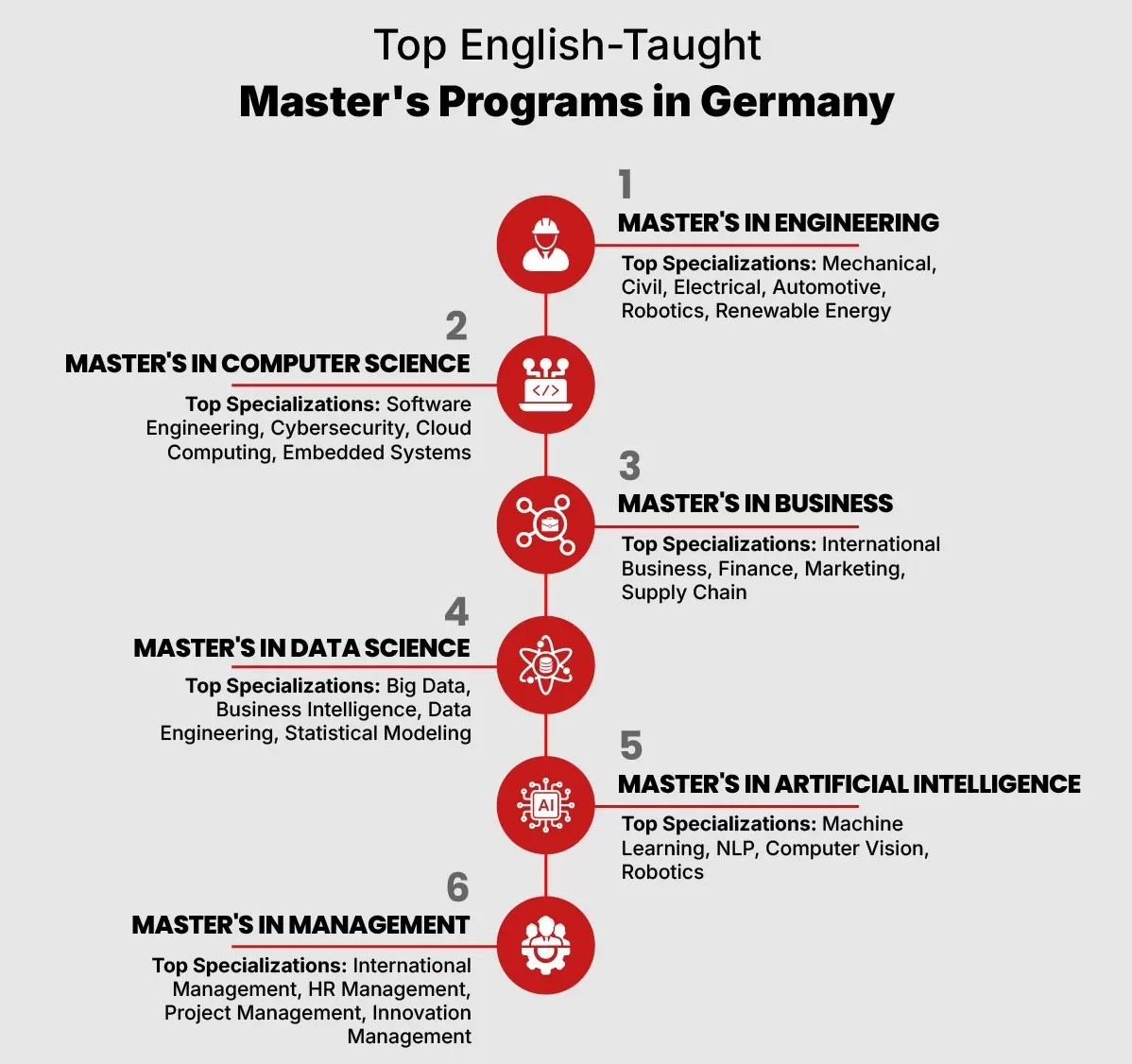
The top English-taught master’s programs in Germany are:
1. Master’s in Engineering
2. Master’s in Computer Science
3. Master’s in Business
4. Master’s in Data Science
5. Master’s in Artificial Intelligence
6. Master’s in Management
Here’s a detailed overview of each program:
1. Master’s in Engineering
A master’s in engineering taught in English in Germany prepares students for careers in automotive, manufacturing, robotics, construction, and industrial engineering. The project combines advanced technical knowledge, practical laboratory training, research, and industry collaboration to equip graduates with the skills demanded by global projectors.
Popular Engineering Master’s Specializations
- Mechanical Engineering
- Automotive Engineering
- Civil Engineering
- Electrical Engineering
- Industrial Engineering
- Robotics and Automation
- Renewable Energy Engineering
What Will You Study in an Engineering Master’s Program?
- Engineering Design
- Manufacturing Systems
- Materials Science
- Computer-Aided Design (CAD) and Simulation
- Automation Technologies
- Project Management
- Research Methodology
- Sustainable Engineering
Career Opportunities After a Master’s in Engineering
- Mechanical Engineer
- Automotive Engineer
- Design Engineer
- Project Engineer
- Manufacturing Engineer
- Robotics Engineer
- Production Engineer
- Research and Development (R&D) Engineer
2. Master’s in Computer Science
Studying a computer science MSc in English in Germany gives you a solid foundation in software systems, algorithms, and computing infrastructure. This is an especially useful qualification, given the strength of Germany’s tech and IT sector.
Popular Computer Science Master’s Specializations
- Software Engineering
- Cybersecurity
- Cloud Computing
- Distributed Systems
- Human-Computer Interaction
- Embedded Systems
What Will You Study in a Computer Science Master’s Program?
- Algorithms and Data Structures
- Software Architecture
- Database Systems
- Machine Learning Fundamentals
- Network Security
- Cloud Infrastructure
- Systems Programming
Career Opportunities After a Master’s in Computer Science
- Software Developer
- Systems Architect
- Cybersecurity Analyst
- Cloud Engineer
- Backend Developer
- IT Consultant
3. Master’s in Business
The Business Master’s in Germany is designed for students who want to work in management, consulting, or corporate strategy, often in Germany’s large multinationals.
Popular Business Master’s Specializations
- International Business
- Finance
- Marketing
- Supply Chain Management
- Entrepreneurship
What Will You Study in a Business Master’s Program?
- Corporate Strategy
- Financial Management
- Marketing Analytics
- International Trade
- Operations Management
- Business Ethics
Career Opportunities After a Master’s in Business
- Business Analyst
- Marketing Manager
- Financial Consultant
- Supply Chain Manager
- Product Manager
4. Master’s in Data Science
Data science has become one of the most sought-after English-taught master’s programs in Germany, especially with the country’s manufacturing and automotive data needs and Germany’s push into digital industry.
Popular Data Science Master’s Specializations
- Big Data Analytics
- Business Intelligence
- Statistical Modeling
- Data Engineering
What Will You Study in a Data Science Master’s Program?
- Statistics and Probability
- Data Mining
- Big Data Technologies (Spark, Hadoop)
- Data Visualization
- Predictive Modeling
Career Opportunities After a Master’s in Data Science
- Data Scientist
- Data Analyst
- Business Intelligence Developer
- Data Engineer
5. Master’s in Artificial Intelligence
Germany has poured a lot of money into AI research, and there are now a number of universities offering dedicated, English-taught AI master’s degrees.
Popular AI Master’s Specializations
- Machine Learning
- Natural Language Processing
- Computer Vision
- Robotics and Autonomous Systems
What Will You Study in an Artificial Intelligence Master’s Program?
- Neural Networks and Deep Learning
- Reinforcement Learning
- AI Ethics
- Computer Vision Techniques
- Applied Robotics
Career Opportunities After a Master’s in Artificial Intelligence
- AI Engineer
- Machine Learning Engineer
- Research Scientist
- Computer Vision Engineer
6. Master’s in Management
Typically, students with an undergraduate technical or business degree wanting to move into management pursue a management master’s.
Popular Management Master’s Specializations
- International Management
- Innovation Management
- Human Resource Management
- Project Management
What Will You Study in a Management Master’s Program?
- Organizational Behavior
- Leadership and Strategy
- Change Management
- Cross-Cultural Management
Career Opportunities After a Master’s in Management
- Management Consultant
- Operations Manager
- HR Manager
- Project Lead
Public Universities in Germany that Teach in English
- Technical University of Munich (TUM)
- Ludwig Maximilian University of Munich (LMU Munich)
- RWTH Aachen University
- Karlsruhe Institute of Technology (KIT)
- Technical University of Berlin (TU Berlin)
- University of Stuttgart
- University of Freiburg
- University of Mannheim
- University of Bonn
- University of Hamburg
- Technical University of Dresden (TU Dresden)
- University of Cologne
- FAU Erlangen-Nuremberg
- University of Bremen
- Otto von Guericke University Magdeburg
Among them are TUM, RWTH Aachen, KIT, TU Berlin, and TU Dresden, which belong to the TU9 Universities in Germany, an alliance of the country’s leading technical universities, especially renowned for engineering and technical degree programs.
These public universities offer master’s programs in English in engineering, computer science, business, data science, artificial intelligence, natural sciences, and more. They are known for academic excellence, world-class research, and strong industry connections. The reason Germany is such an affordable and popular destination for international students is that most public universities charge low or no tuition fees.
What are the Requirements for English Taught Masters in Germany?
To enroll in a master’s degree program taught in English in Germany, you have to meet the admission requirements of the university you have chosen. Most universities ask for the following, although exact requirements can vary by institution and course:
Bachelor’s Degree: An accredited bachelor’s degree in a discipline related to the master’s program to which you are applying.
English Language Requirement: The program is available in English, so you will need to prove your language ability via IELTS, TOEFL, PTE, or other approved testing. Some universities also accept a Medium of Instruction (MOI) certificate.
Academic Transcripts: Submit official transcripts from your undergraduate university to show your academic performance.
Statement of Purpose (SOP): A well-written SOP explaining your academic background, career goals, and reasons for applying to the program and university.
Letters of Recommendation (LORs): Most universities demand one or two recommendation letters from professors or employers.
Updated CV/Resume: This should contain your education, internships, work experience, technical skills and certifications.
Valid Passport: Required to complete your university application process and later to apply for a German student visa.
Additional Requirements (if applicable): Depending on the university and course, you may also need to submit GRE/GMAT scores, a portfolio, relevant work experience, or an admission interview.
How to Apply for an English Taught Masters in Germany
Here’s a simple step-by-step process to apply for an English-taught master’s program in Germany:
1. Shortlist Your Programs
Research English-taught master’s programs in Germany that match your academic background and career goals.
2. Check Eligibility and Requirements
Confirm each university’s specific admission criteria, deadlines, and required documents.
3. Take Your English Proficiency Test
Book IELTS, TOEFL, or PTE early, since scheduling and results can take a few weeks.
4. Prepare Your Application Documents
This includes your SOP, LORs, CV, and academic transcripts.
5. Submit Applications
directly to the university or through uni-assist, the centralized application portal many German universities use.
6. Wait for the Admission Offer
Processing times vary, so apply well ahead of intake deadlines.
7. Apply for Your German Study Visa
Once admitted, gather your financial proof (blocked account), health insurance, and admission letter to apply for your visa.
8. Arrange Accommodation and Travel
After receiving your visa, arrange your accommodation and travel, then complete your enrollment (Immatrikulation) once you arrive in Germany.
Tuition Fees for English Taught Master’s in Germany
The average tuition fee for English-taught master’s programs in Germany is about €0–€10,000 per year, depending on the type of university.
Public Universities: Most of the English-taught master’s programs are tuition-free, and students only pay a semester contribution of around €150–€350.
Private Universities: Tuition costs range from €5,000 to €20,000 per year. On average, tuition is around €10,000-€15,000 per year, varying with the university and course.
Besides tuition, don’t forget to budget for the cost of living in Germany, which is usually €850–€1,200 per month, depending on the city, which includes rent, health insurance, food, and transport.
Conclusion
Choosing to study a masters degree in English in Germany means access to some of Europe’s leading academic institutions, the low or zero tuition fees of public universities and a direct pathway into Germany’s job market after graduation, all without having to speak German to get started.” Start by narrowing down programs that match your background, check requirements early, and plan enough runway for the visa process.
For official, up-to-date information on programs, funding, and requirements, always cross-check with DAAD (German Academic Exchange Service): https://www.daad.de/en/